- The paper demonstrates that a Gaussian structured jet model reproduces the multi-band afterglow of GRB 221009A by fitting VHE gamma-ray data and constraining neutrino emissions.
- It employs MCMC sampling to derive precise jet parameters, highlighting a mildly off-axis configuration and a dominant synchrotron self-Compton contribution at VHE.
- The analysis implies that only GRBs with extreme energetics, high baryon loading, and favorable microphysics can overcome current neutrino detection thresholds.
Multi-Messenger Constraints on GRB 221009A: VHE Gamma-Ray and Neutrino Afterglow from a Gaussian Structured Jet
Introduction and Scientific Motivation
The detection and interpretation of broadband afterglows in gamma-ray bursts (GRBs) have critical implications for understanding the extreme particle acceleration environments within relativistic jets and their relevance for multi-messenger astrophysics. The unprecedented brightness and proximity of GRB 221009A, combined with its detection in the very-high-energy (VHE; E≳100 GeV) regime by LHAASO, provides a unique data set to constrain both leptonic and hadronic emission processes. The absence of coincident neutrinos from IceCube, KM3NeT, and GRAND200k raises fundamental questions about particle acceleration and jet microphysics in luminous GRBs. This paper presents a quantitative multi-messenger analysis of the afterglow properties of GRB 221009A, utilizing a Gaussian structured jet framework to interpret VHE gamma-ray production and compute associated neutrino yields.
The analysis adopts a Gaussian structured jet configuration, abandoning the standard top-hat jet paradigm and thereby alleviating energy-budget inconsistencies for extreme VHE emission observed off-axis. The energy per solid angle and Lorentz factor are parameterized with a Gaussian profile as functions of polar angle θ:
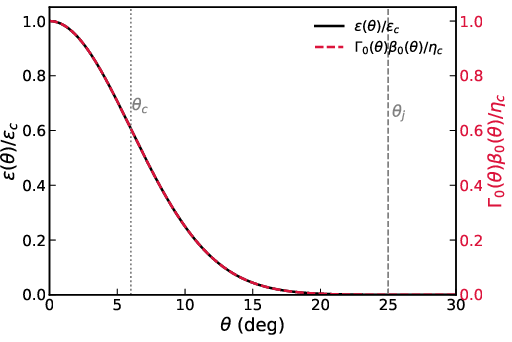
Figure 1: Normalized angular energy (black) and velocity (red, dashed) profiles for a Gaussian structured jet with θc=6∘, θj=25∘, ηc=300, and Ek=1×1053 erg.
The Gaussian structure naturally leads to a gradual steepening of the afterglow light curve, eschewing the sharp spectral breaks characteristic of top-hat jets. The model incorporates adiabatic blast wave evolution in a uniform-density ISM, with detailed accounting for angular-dependent Doppler boosting and relativistic beaming effects, crucial for accurate off-axis signal predictions.
Spectral and Temporal Fitting: Afterglow Modeling and Parameter Inference
Markov Chain Monte Carlo (MCMC) sampling was employed to infer posterior distributions for the afterglow model's key parameters, utilizing GeV and TeV data from AGILE–GRID and LHAASO during intervals T∗+[22,100] s, T∗+[100,674] s, and T∗+[674,1774] s. The best-fit scenario favors a mildly off-axis jet configuration (θv≈2.5∘, θc≈4.4∘), total kinetic energy logEk(erg)≈52.7, bulk Lorentz factor ηc≈460, and microphysical fractions logϵe≈−0.8, logϵB≈−3.7.
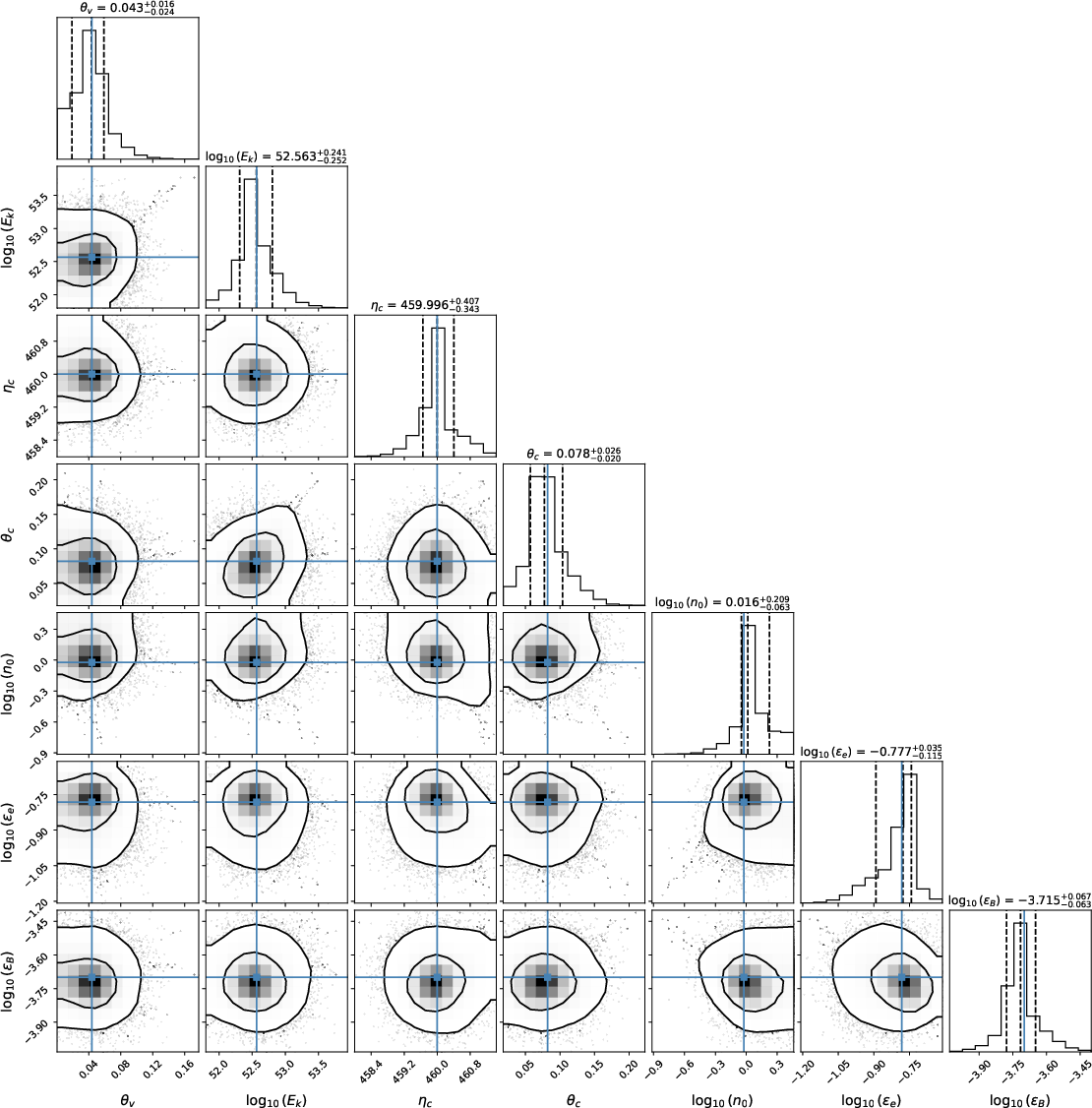
Figure 2: Posterior distributions for the Gaussian structured-jet afterglow parameters of GRB 221009A.
Synthetic SEDs across three temporal bins display the expected double-humped architecture where electron synchrotron dominates below ∼1 GeV and Synchrotron Self-Compton (SSC) dominates above, with significant EBL attenuation above ∼10 TeV.
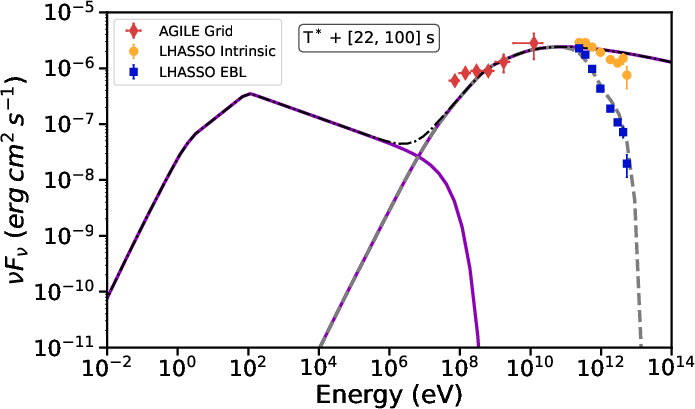
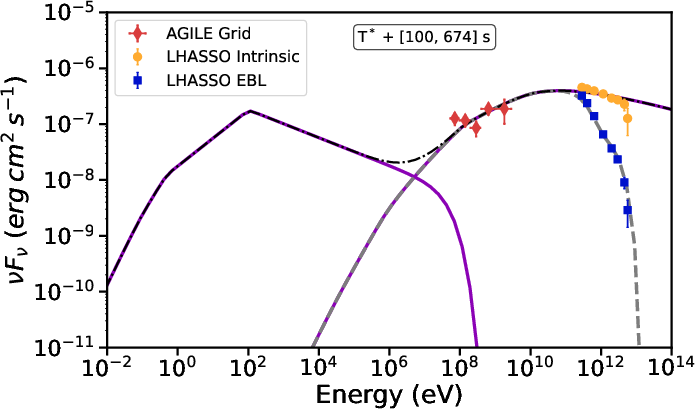
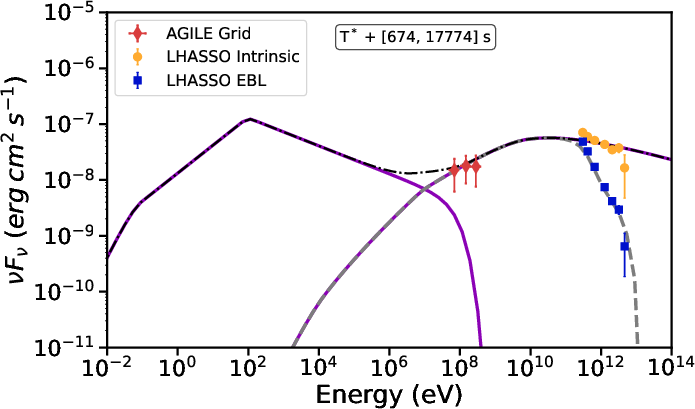
Figure 3: Modeled SEDs at three post-burst intervals, exhibiting the synchrotron and SSC components and the impact of EBL attenuation at the highest energies.
The jet model reproduces the light curves in both GeV and TeV bands, accurately fitting both the rising and rapid decay phases.
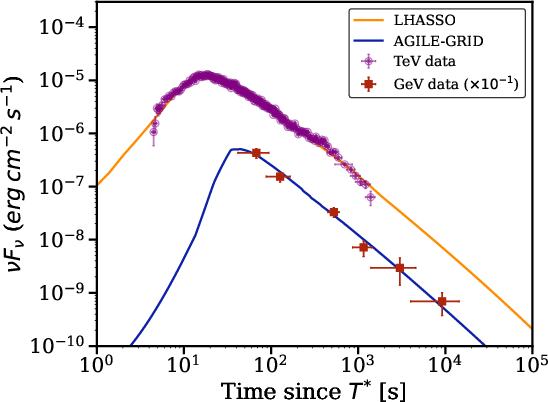
Figure 4: Fitted GeV and TeV afterglow light curves for GRB 221009A, showing consistency with AGILE–GRID and LHAASO data.
The results strongly favor ϵe≫ϵB, resulting in efficient SSC production dominating the VHE component.
Neutrino Production in the Afterglow: Hadronic Channel Calculations
The hadronic scenario considers pγ interactions in the forward shock region, evaluating the time/energy-dependent neutrino flux for each flavor post-oscillation. Isotropic-equivalent kinetic energy along the observer's line of sight is calculated from the Gaussian angular structure, with explicit dependence on both viewing geometry and microphysical parameters.
The predicted neutrino signal is presented for both on-axis (θv<θc) and off-axis (θv>θc) geometries, showing that Doppler de-boosting in off-axis cases leads to suppression of the observed flux by approximately an order of magnitude.
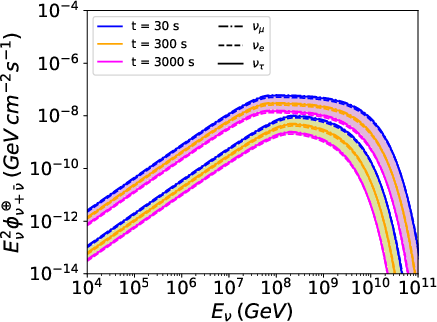
Figure 5: Predicted flavor-resolved neutrino fluxes for a source at z=0.151 in both on-axis (upper) and off-axis (lower) viewing geometries.
Furthermore, the model calculates the time-integrated 90% CL upper-limit sensitivity curves for next-generation detectors (IceCube-Gen2 and GRAND200k) for muon neutrino detection.
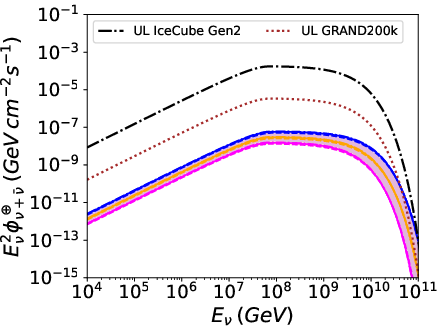
Figure 6: 90% CL upper-limit sensitivity for νμ events in future neutrino observatories, compared to on-axis model fluxes.
Predicted neutrino fluxes from GRB 221009A, based on afterglow-inferred parameters, are consistently below these limits for all flavors and across all relevant intervals, quantitatively explaining the null detection in current facilities.
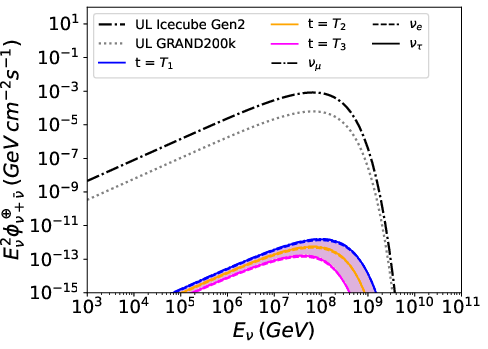
Figure 7: Time-resolved neutrino flux predictions for GRB 221009A at three epochs; all values remain below instrumental upper limits.
Parameter Correlates and Event Rate Constraints
Parameter space explorations detail how increased Ek,iso, n0, ϵe, ϵB, and baryonic loading (ϵp) enhance pγ neutrino emissivity and expected event yields. GRB 221009A, even under optimistic hadronic scenarios, remains below detection thresholds (Nμ≪1 per event) for GRAND200k.
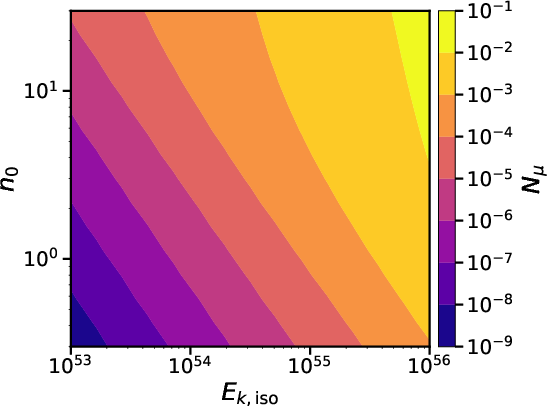
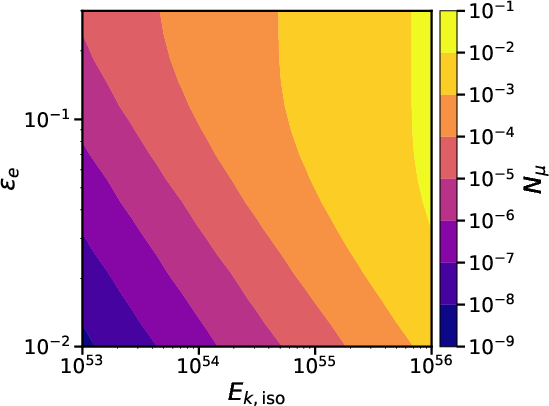
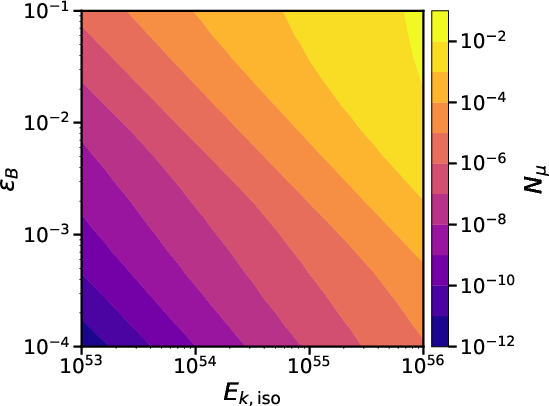
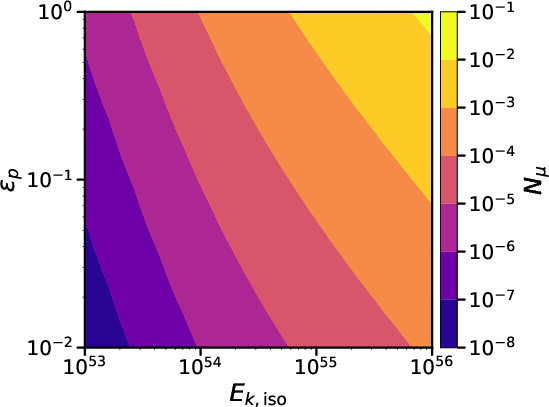
Figure 8: Muon neutrino event yield Nμ as a function of Ek,iso and key hadronic parameters for GRAND200k.
The correlation maps confirm that only extremely energetic (high Ek,iso), baryon-loaded, and dense-medium GRBs may yield detectable afterglow neutrinos.
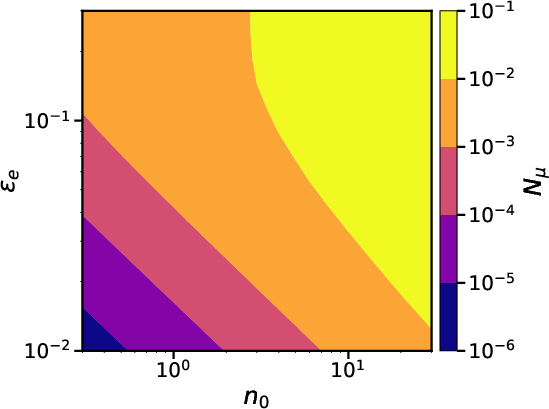
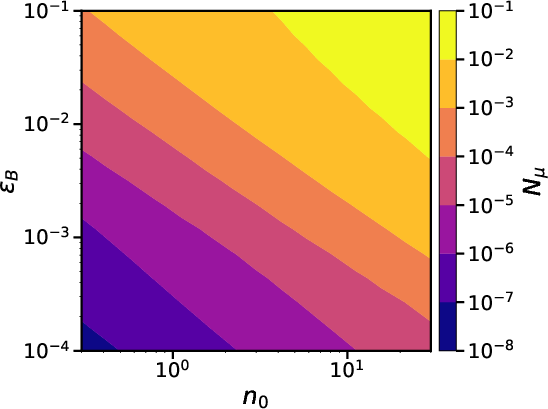
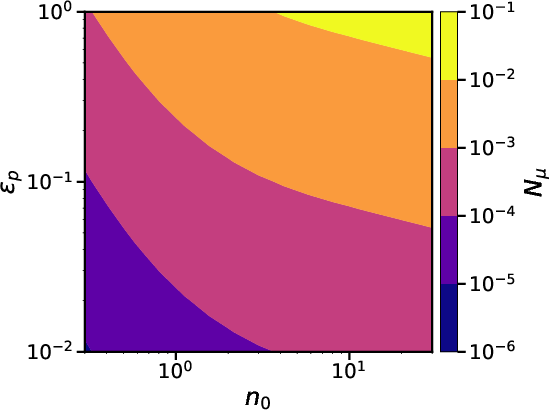
Figure 9: Two-dimensional contour maps of Nμ event yield as a function of n0 and microphysical parameters, illustrating parameter regimes driving detectability.
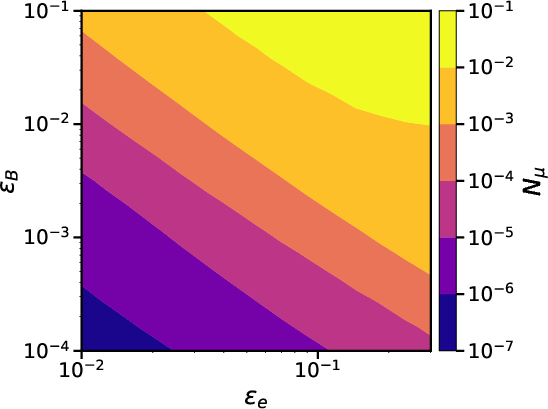
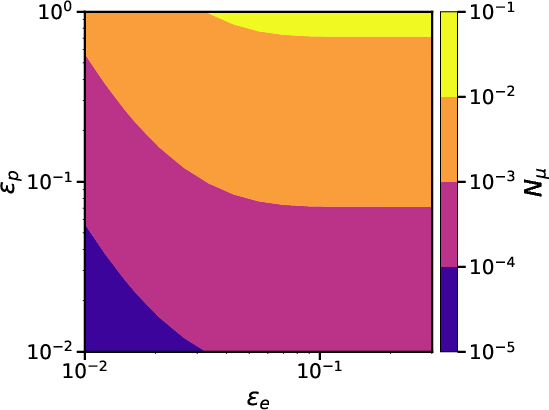
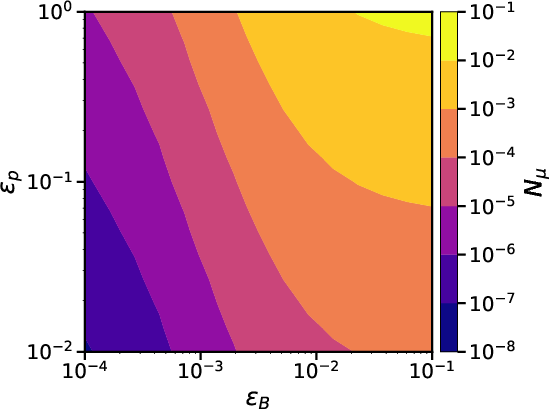
Figure 10: Event yield contours in microphysical-parameter planes relevant to GRAND200k, highlighting the primary sensitivity to ϵe and ϵp enhancement.
Implications for Multi-Messenger GRB Astrophysics
Key quantitative finding: Even for a "brightest of all time" (BOAT) GRB at z∼0.15 and with aggressive microphysics, the afterglow neutrino flux remains below the detection sensitivity of IceCube Gen2 and GRAND200k, and the yield is O(0.1) events per source (contradicting some theoretical extrapolations favoring high single-event rates).
The analysis demonstrates that structured jet geometry and observer orientation fundamentally control both the electromagnetic and neutrino afterglow observables. The parameter study refines the astrophysical conditions required for GRBs to be efficient neutrino sources: particularly high Ek,iso, ambient density, and baryon loading are necessary but not sufficient unless the burst occurs even closer than GRB 221009A or with substantially more favorable microphysics.
Practically, this argues that regular detection of GRB afterglow neutrinos in future facilities will be rare and may require stacking analyses or the occurrence of even more energetic, nearer events. The constraints also add weight to the argument that only a limited subset of GRBs can contribute meaningfully to the observed astrophysical neutrino flux. The results suggest that VHE afterglow detections (via LHAASO, CTA) will be critical not only for EM model constraints but also for bounding the hadronic component and, by extension, UHECR acceleration scenarios.
Conclusion
This study rigorously constrains the VHE gamma-ray and high-energy neutrino afterglow production of GRB 221009A within a physically motivated, parameter-rich Gaussian structured jet model. The simultaneous fit to multiwavelength afterglow observations and null neutrino detection allows for the quantification of the interplay between jet structure, microphysical regime, and observer orientation. The predicted neutrino flux, under the best-fit and most optimistic parameters, remains undetectable by current and planned neutrino observatories.
These results indicate that detectable multi-messenger (gamma-ray + neutrino) signatures in the afterglow phase are reserved for even more extreme GRBs or demand a fundamentally different particle acceleration regime. The forthcoming data from CTA and next-generation neutrino instruments, combined with statistical population studies, will provide further insight into the fundamental microphysics, baryon loading, and environmental properties of relativistic GRB jets, thus continuing to refine our understanding of their role as cosmic ray and neutrino factories.
Reference: "Multi Messenger Study of GRB 221009A with VHE Gamma-ray and Neutrino Afterglow from a Gaussian Structured Jet" (2511.13633)