- The paper establishes a spectral-theoretic framework, showing how eigenvalue bifurcations signal phase transitions in random graph models.
- It employs graphon limits and nonlinear fixed-point equations to extend traditional mean-field theory to heterogeneous, nonlocal networks.
- Numerical simulations corroborate the analysis by demonstrating metastability and multiple steady-state solutions in both FM and AFM regimes.
Rigorous Characterization of Phase Transitions in the Ising Model on Random Graphs
Introduction
This paper establishes a comprehensive framework for analyzing phase transitions in the Ising model applied to random graph ensembles. Utilizing methodologies from graphon theory and dynamical systems, the authors extend conventional mean-field results to a setting that incorporates heterogeneous, nonlocal interactions. Critical phenomena—including bifurcation behavior and metastability—are elucidated via the spectral properties of graph limit operators, with detailed results for Erdős–Rényi, power-law, and small-world network architectures.
Theoretical Framework: Graphons and Continuum Limits
The analysis starts from a generalized Ising Hamiltonian defined on graphs Γn with adjacency matrix A=(aij). By averaging local spins, the authors derive a fixed-point equation for node magnetizations:
mi=tanh(βn−1j=1∑naijmj).
To study the thermodynamic limit as n→∞, the graph sequence is required to converge in the sense defined by graphon theory. A graphon W:[0,1]2→[0,1] encodes large-graph connectivity, and the Ising model admits a continuum limit described by the nonlinear integral equation
m(x)=tanh(β∫QW(x,y)m(y)dy),x∈Q.
Phase transitions correspond to bifurcations of the trivial (paramagnetic) solution m(x)≡0, and their existence and nature are linked to the eigenvalues of the integral kernel W.
Spectral Criteria for Phase Transitions
The kernel operator W acts self-adjointly on L2([0,1]), with spectrum σ(W). Phase transitions are characterized by the condition
βc−1=λk,
where λk is a nonzero eigenvalue of W. The bifurcation at β=βc is typically of pitchfork type, enforced by the ±m symmetry of the Ising free energy.
When W admits multiple nonzero eigenvalues, sequential phase transitions and the coexistence of multiple nontrivial solutions is possible—leading to a mathematically precise description of metastable phases.
Detailed Analysis Across Topologies
Erdős–Rényi and Power-law Graphs
For Erdős–Rényi graphs (W≡p), the kernel has a single nonzero eigenvalue λ1=p, resulting in a single critical temperature and a conventional pitchfork bifurcation.
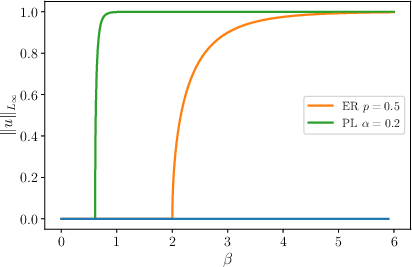
Figure 1: Bifurcations for Erdős–Rényi (ER, p=0.5) and power-law (PL, α=0.2) graphons, showing the birth of nonzero homogeneous solutions at respective critical temperatures.
For power-law graphons W(x,y)=(xy)−α, the spectrum also contains a unique nonzero eigenvalue λ=(1−2α)−1, leading to similar bifurcation structure and explicit prediction of critical temperature.
The main focus is the small-world graphon
K(x)={1−p,∣x∣≤r, p,r<∣x∣≤1/2,
periodically extended and analyzed on the torus. The spectrum is analytically tractable via Fourier transform, yielding eigenvalues μk associated to harmonic modes. Notably, both ferromagnetic (FM, J>0) and antiferromagnetic (AFM, J<0) regimes are captured.
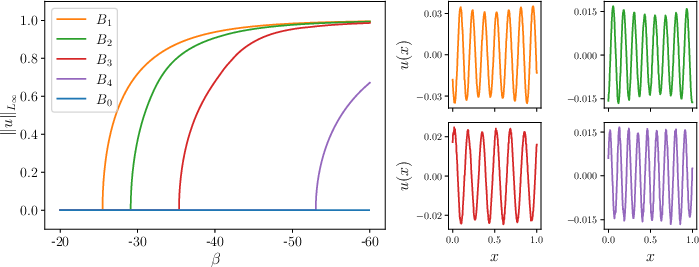
Figure 2: Bifurcation diagrams for the continuum Ising model on small-world networks (p=0.05, r=0.1), highlighting the emergence and progression of steady-state solutions as inverse temperature β varies.
The spectral structure ensures that multiple harmonics can sequentially bifurcate at decreasing temperatures, each associated with an eigenvalue μk. When J<0 (AFM), bifurcating solutions correspond to high-frequency spatial patterns. Translation invariance and kernel symmetries induce SO(2) symmetry in the solution space, directly impacting metastable state structure.
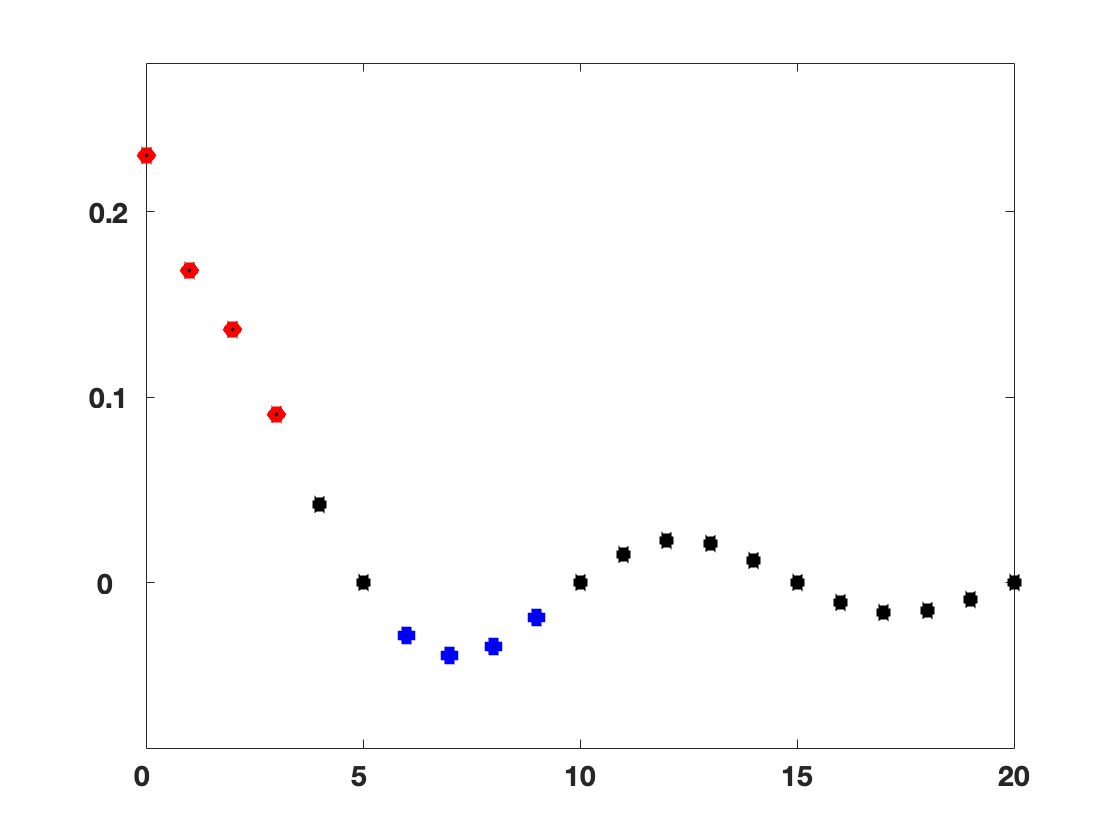
Figure 3: Eigenvalue spectra of K for a small-world graph (p=0.05, r=0.1), with the largest and smallest eigenvalues highlighted, governing the critical temperatures for distinct bifurcations.
Extensive Monte Carlo simulations (Metropolis–Hastings algorithm, N=5000 spins) validate the analytical predictions, confirming that the system dynamically relaxes to ground states associated with principal bifurcating branches (μ0 in FM, μ8 in AFM). By initializing with different eigenmode patterns, metastable states corresponding to subdominant eigenvalues persist for extended time intervals before relaxation, substantiating the predicted coexistence and metastability at low temperatures.
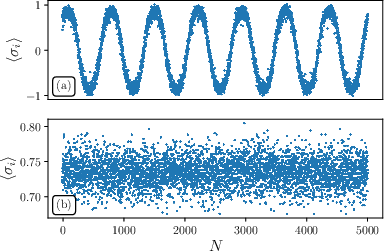
Figure 4: Spin configurations for AFM (J=−1) and FM (J=+1) regimes just below their respective critical temperatures, demonstrating ground state magnetization patterns linked to the principal eigenvalues.
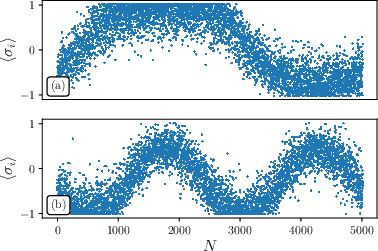
Figure 5: Transient spin configurations in FM regime slightly below T=Jμ1 and T=Jμ2, capturing metastable modes before relaxation to the uniform FM ground state.
Implications and Outlook
The rigorous identification of phase transitions through kernel spectra provides a unified description for Ising models on arbitrary dense or sparse random graphs, including those with strongly inhomogeneous and nonlocal couplings. Practically, this enables prediction and control of metastable phenomena in engineered networks, neural circuit models, and complex systems. Theoretically, the graphon framework extends the reach of mean-field theory, connecting dynamical systems, statistical mechanics, and non-equilibrium phenomena.
Future research directions include characterization of dynamical relaxation in high-dimensional metastable landscapes, generalization to graphs with directed or weighted edges, and applications to inference problems in machine learning where spin-glass-like transitions are relevant.
Conclusion
This work provides a spectral-theoretic foundation for the analysis of phase transitions and metastability in the Ising model on random graphs. By leveraging graphon limits and bifurcation theory, the results elucidate how network topology and operator spectra control the emergence, multiplicity, and stability of ordered phases. The integration of analytical predictions and numerical simulations substantiates the claim that metastability in such systems is a direct consequence of the underlying spectral structure, offering a pathway for precise control of collective phenomena across complex networks.

