- The paper presents a novel mechanism where dissipative monopole-axion interactions generate both the baryon asymmetry and the correct dark matter relic abundance.
- It employs a detailed framework utilizing dyon level crossings, dark fermion pair production, and explicit PQ symmetry breaking to regulate axion dynamics.
- The model constrains the axion decay constant below 10^9 GeV, linking experimental searches to a mixed dark matter scenario with observable astrophysical signatures.
Monopole-Axion Interactions as the Origin of Dark Matter and Baryon Asymmetry
Model Overview and Motivation
This paper constructs a comprehensive model in which the observed baryon asymmetry and the relic abundance of dark matter both arise from dynamical interactions between the QCD axion and magnetic monopoles residing in a dark SU(2)D gauge sector. In this framework, the spontaneous breaking of SU(2)D→U(1)D produces ’t Hooft–Polyakov monopoles, which can take on dyonic character through the Witten effect in the presence of a dynamical axion field. These monopoles, together with light U(1)D-charged dark fermions, serve as the dark matter constituents.
The QCD axion’s rotation, induced by explicit PQ symmetry breaking and governed by axiogenesis, both generates the baryon asymmetry (YB) and provides a kinetic-energy reservoir that would otherwise lead to axion overproduction via kinetic misalignment. The central mechanism of the paper is that dissipative monopole-axion interactions can efficiently deplete this excess axion abundance, yielding a correct relic density and resolving the longstanding tension between baryogenesis and axion dark matter in minimal axiogenesis implementations.
Dissipative Dynamics: Axion-Monopole Interactions
In the presence of an axion background θ≡a/fa coupled to the dark U(1)D sector, monopoles acquire electric charges and become dyons. Their quantized dyonic levels vary with θ, and transitions between neighboring levels can occur when energy gaps exceed twice the dark fermion mass 2mf. Each crossing emits a fermion-antifermion pair, converting axion kinetic energy into dark fermions and thus dissipating the rotation.
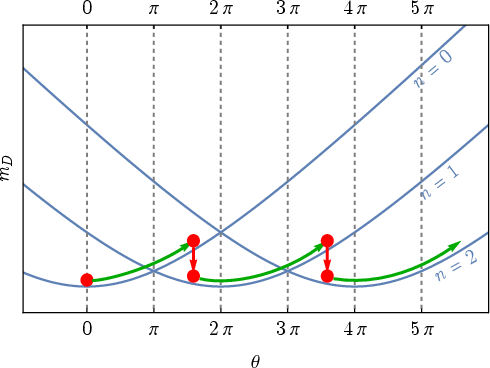
Figure 1: Cartoon depiction of axion kinetic energy dissipation via monopole-dyon level crossings and dark fermion pair production.
The dissipation rate is proportional to the number of monopoles, the dark fermion mass, and the velocity of the axion rotation:
Γθ≡ρθρ˙θ=π2αDmWmfYθfMξDM
where mW is the dark vector boson mass, fM is the fraction of DM in monopoles, ξDM the observed DM abundance, and Yθ the axion PQ charge yield. Dissipation becomes efficient at a temperature Tdi, after which the axion’s kinetic energy is rapidly reduced until the rotation is either trapped by the QCD or axion-dyon potential, or destroyed by parametric resonance.
The model predicts a preference for fa (the axion decay constant) below 109 GeV to avoid axion DM overproduction, synchronizing the phenomenological constraints from baryogenesis and DM relic density.
Dark Matter Composition and Relic Abundance Calculations
Dark matter in this setup consists of three coexisting components: the dark monopoles, axions, and the dark fermions produced in the dissipation events. The relic abundances for these species are calculated from first principles, with particular attention to the following constraints:
- Axion dark matter: Determined at the time the rotation is trapped by the QCD or dyon-axion potentials. The paper provides closed-form approximations for ρa/s in terms of fa, cB, ϵ, and other model parameters. Axion fragmentation via parametric resonance is shown to be subleading in the viable region, as trapping precedes significant backreaction.
- Dark monopoles: Relic abundance set by the Kibble-Zurek and freeze-out mechanisms at the phase transition, with mM∼100−500 TeV and fM∼0.5 providing consistency with the observed DM energy density.
- Dark fermion abundance: Fermions annihilate after production with a cross-section subject to Sommerfeld enhancement. Their freeze-out relic density constrains mf and mW, with mf restricted to be several hundred GeV for successful depletion of axion kinetic energy without excessive DM density.
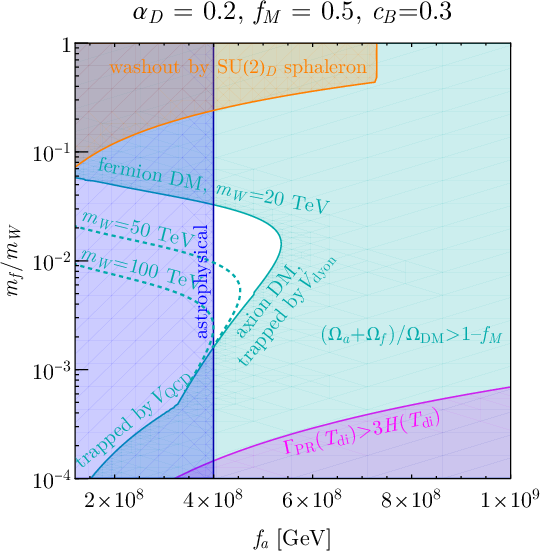
Figure 2: Model parameter space for successful baryogenesis and dark matter; exclusions from overproduction, parametric resonance, sphaleron washout, and astrophysical limits illustrated for fixed αD, cB, fM.
Overproduction constraints (cyan, blue, green areas in Fig. 2) carve out a narrow viable space in the fa vs mf/mW plane. Notably, direct axion searches in the sub-109 GeV range and detection of self-interacting DM in galaxies could empirically probe the model’s predictions.
Theoretical Implications and Phenomenological Signatures
The mechanism presented not only solves the axion overproduction problem endemic to minimal axiogenesis scenarios, but also links the baryon asymmetry, axion dynamics, and DM relic density in a unified manner tied to monopole-axion interactions. The theoretical requirement for a relatively low fa significantly impacts current and planned axion detection experiments, justifying an experimental focus below the canonical “axion window.”
The self-interacting nature of the DM components—monopoles and dark fermions—due to the long-range dark photon interactions opens a channel for potentially observable astrophysical effects, especially in galactic structure and substructure. The presence of dissipative dark matter could have measurable consequences in cluster mergers and halo profiles.
Additionally, the model naturally accommodates a mixed DM scenario with comparable energy densities in monopoles, axions, and dark fermions, possibly leading to rich dark-sector cosmology.
Future Directions in Axion and Dark Sector Physics
The work raises several avenues for further investigation. These include:
- Detailed modeling of DM self-interactions and catalysis of dissipative processes in halos.
- Extended study of sphaleron-induced washout and its interplay with cosmic phase transitions.
- Experimental searches for axions with fa<109 GeV, possibly via axion helioscopes or microwave cavity experiments.
- Collider and astrophysical signatures of heavy dark monopoles or millicharged fermions.
- Examination of the acoustic misalignment mechanism in scenarios with minimal backreaction and explicit PQ sector interactions.
Conclusion
This paper establishes a model in which the observed baryon asymmetry and dark matter relic abundance are realized via dissipative interactions between the QCD axion and dark sector monopoles, mediated by axion-driven dyon level crossings and dark fermion emission. The scenario resolves the axion overproduction problem in axiogenesis, predicts a tightly constrained axion decay constant, and exposes a unique landscape for dark matter phenomenology rooted in gauge theory topology and axion dynamics. The interweaving of baryogenesis, axion cosmology, and topological dark matter presents a technically robust framework with imminent experimental relevance and theoretical depth.

