- The paper demonstrates how near-Earth experiments impose constraints on screened dark energy models using post-Newtonian corrections.
- It employs Earth-orbit measurements from GP-B, LAGEOS-2, and Sagnac experiments to test deviations from General Relativity.
- The analysis tightens parameter space for chameleon, symmetron, and dilaton screening, informing future dark energy research.
Earth-orbit Bounds on Screened Dark Energy
This paper investigates the effects of dark-energy-motivated screening mechanisms using near-Earth space-based measurements. The authors compute leading corrections to observables within a post-Newtonian framework and map these corrections to constraints on specific screening models such as chameleon, symmetron, and dilaton.
Introduction
The late-time acceleration of the universe remains a mystery of fundamental physics. The cosmological constant Λ has served as the dominant explanation for dark energy; however, this standard model presents a naturalness problem related to the vacuum energy. To explore alternatives, the paper investigates models involving light scalar fields that interact with ordinary matter, potentially producing extra long-range forces absent in laboratory settings due to a screening effect. This effect allows gravitational interactions to remain hidden locally while acting on large cosmological scales.
Screened Scalar-Tensor Theories
The paper models the behavior of scalar-tensor theories using Jordan and Einstein frames. The modified gravitational strength and PPN parameters are assessed under varying environmental densities, illustrating how screened models deviate from General Relativity values.
The scalar-tensor theories are considered using Brans-Dicke form actions to evaluate screened-gravity corrections and PPN parameters like G, γ, and β. These parameters are particularly significant as they provide a clean link between model choices, such as potential and coupling functions, and observable effects.
Solar-System Tests
Three distinct Earth-based experiments are proposed for testing these models: GP-B, LAGEOS-2, and a hypothetical space-based Sagnac experiment.
Gravity Probe B
Gravity Probe B (GP-B) was launched to test Einstein’s General Relativity through measuring the geodetic effect and frame-dragging. The geodetic precession observed by GP-B was used to estimate corrections induced by screened scalar fields.
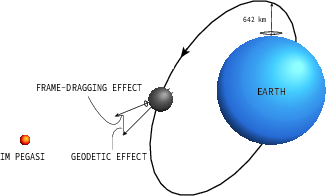
Figure 1: GP-B schematic and geometry of the geodetic and frame-dragging effects.
LAGEOS-2
LAGEOS-2 assesses the secular precession of an orbit's pericenter, primarily influenced by Earth’s mass (Einstein precession). It provides a direct test of PPN parameters.
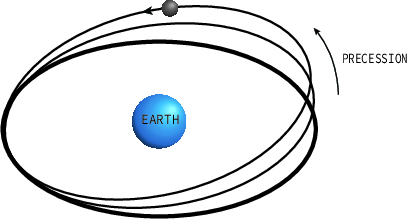
Figure 2: Secular pericenter precession of an Earth-orbiting satellite.
Sagnac Experiment
The space-based Sagnac experiment explores orbital setups utilizing Sagnac time delay measurements. Projected constraints are based on the precision of state-of-the-art atomic clocks.
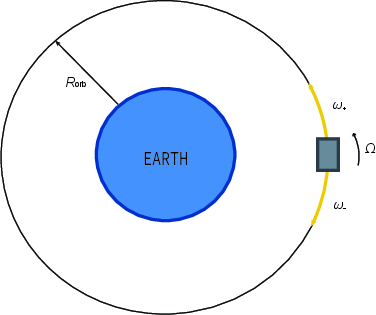
Figure 3: Schematic of a Sagnac experiment around Earth.
Results
Chameleon Screening
For the chameleon model, the paper proposes bounds on the parameter space (n,βm), with the Sagnac experiment providing the tightest constraints, limiting previously allowed regions effectively.
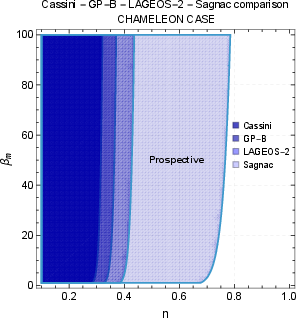
Figure 4: Constraints on the chameleon parameter space in the plane (n,βm) for Λ=ΛDE.
Symmetron Screening
In symmetron models, constraints are provided on (Msym,λ) parameter space for fixed values of μ. LAGEOS-2 results showed significant influence due to strong pericenter-advance testing capabilities.
Dilaton Screening
The dilaton scenario presented constraints in $(\lambda_{\text{dil}, A_2)$, at fixed G0. These models demonstrated similar behavior to the symmetron models, having LAGEOS-2 bounds strongly influencing due to G1-sensitivity.
Conclusion
This paper emphasizes the sensitivity of near-Earth experiments to deviations in General Relativity due to screening mechanisms. The proposed methodology facilitates the exclusion of parameter space regions otherwise allowed by Solar System tests.
Earth-orbit tests provide critical boundaries on these modified gravity theories and, with advancements in atomic-clock technology, hold the potential to probe minor deviations, offering insight into cosmological scalar fields and their impact.
Analyzing future experiments with precision timing could further tighten constraints on screened modified gravity models, contributing to resolving the dark energy conundrum.