- The paper presents a novel framework integrating causal discovery with representation learning to reveal latent biomedical factors.
- Methodologies such as PC, GAS, and GSP algorithms are utilized for efficient causal structure identification in high-dimensional data.
- Applications in Perturb-seq data and adaptive experimental design illustrate the framework's potential to transform therapeutic strategies.
Causal Structure and Representation Learning with Biomedical Applications
This essay provides a comprehensive analysis of the paper "Causal Structure and Representation Learning with Biomedical Applications" (2511.04790). The paper outlines the integration of causality and representation learning, focusing on applications in biomedicine. It presents a statistical framework for causal discovery using multi-modal data, addressing challenges in identifying causal variables and designing interventions.
Introduction to Causality
Causality is fundamentally about discerning the mechanisms that underpin systems. The paper emphasizes moving beyond correlations to understand causal mechanisms, which is crucial for effective interventions. It uses illustrations like the correlation between ice cream sales and sunburn to demonstrate the importance of causal understanding. Causal Directed Acyclic Graphs (DAGs) are employed to model causal systems, where nodes represent variables, and directed edges denote causal relationships.
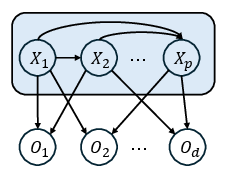
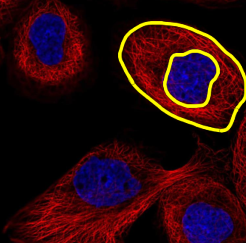
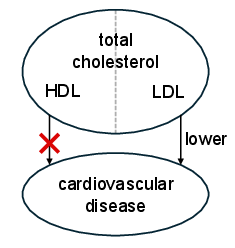
Figure 1: Graphical model representing causal representation learning.
Causal Discovery Methods
PC Algorithm
The PC algorithm is a two-step constraint-based causal discovery method. It iteratively eliminates edges that indicate conditional independence and orients edges using CI relations. The algorithm effectively uncovers adjacencies and orient v-structures while employing Meek's rules for further orientation.
GAS Algorithm
GAS reduces the CI testing burden by focusing on ancestral relations, integrating adjacency search with edge orientation. This approach uses fewer CI tests, accommodating larger causal graphs with reduced faithfulness constraints. The algorithm achieves matching lower bounds in CI testing, particularly beneficial for high-dimensional settings.
GSP Algorithm
GSP is a score-based algorithm leveraging permutation search to identify the sparsest I-MAP equivalent DAG, ensuring consistency under the faithfulness assumption. It navigates the space of permutations efficiently, offering a solid balance between computational feasibility and robust causal discovery.
Interventional Data
Interventional data, perturbation-induced modulations, enhance causal discovery by offering additional orientations between nodes not deducible from observational data alone. The paper extends permutation-based approaches to leverage interventional insights for more precise causal inference.
Causal Representation Learning
Observational Data
The papers explore identifiability of latent causal variables $\bX$ from observed data $\bO = \bbf(\bX)$. Under certain assumptions about the mixing function $\bbf$ and noise terms, the paper proposes mechanisms to recover $\bX$ and its structure, extending disentanglement processes to causal domains like gene networks.
Interventional and Multi-modal Data
Interventional CRL employs distinct shifts in distributions to further disentangle causal variables, while multi-modal data incorporate diverse observational datasets to enrich causal variable identification, tapping into data variability across modalities.
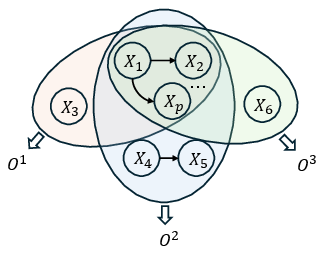
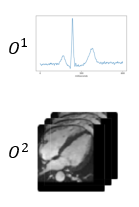
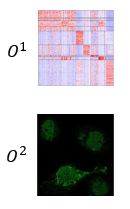
Figure 2: Graphical model representing multi-modal causal representation learning.
Applications in Biomedicine
The framework's application to Perturb-seq data elucidates how integration of sequential and imaging data can unearth latent causal patterns governing gene expression. This integrative approach aligns with therapeutic discovery aims, such as decoupling disease causal factors.
Causal Experimental Design
The paper discusses adaptive strategies for causal experimental design, iteratively refining causal models with new interventional data to optimize learning about causal structures. This section highlights the interplay between causal inference and experiment modalities, shaping efficient, data-driven biomedical discoveries.
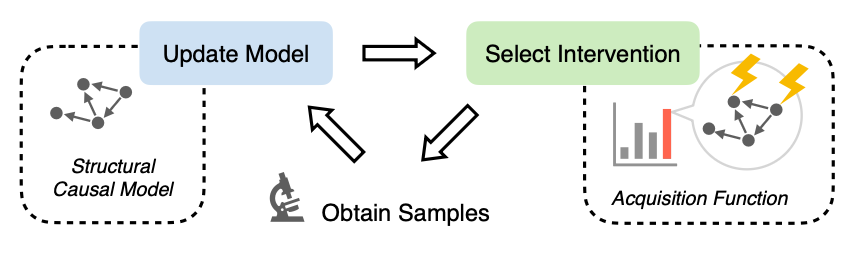
Figure 3: Illustration of iterative intervention design.
Conclusion
The discussed framework robustly integrates causal inference with representation learning, enhancing insights into complex biomedical systems. By leveraging multi-modal and interventional data, this approach addresses latent variable identification, promising transformative impacts on therapeutic strategies and mechanistic understanding in biomedicine. The methodologies pave the way for future research into scalable, reliable causal modeling for complex, high-dimensional data environments.

