- The paper presents a comprehensive synthesis of psychological and neuroscientific theories of cognitive control using network control theory as a formal framework.
- It employs network control theory to quantify control energy and map distributed neural signals, linking regional connectivity to individual differences in behavior.
- The review identifies measurement challenges and conceptual tensions, proposing future directions for more integrated, ecologically valid models.
Neural Dynamics of Cognitive Control: Current Tensions and Future Promise
Conceptual Foundations and Historical Context
Cognitive control encompasses a suite of processes enabling goal-directed behavior in the face of competing impulses, distractions, and uncertainty. The paper provides a comprehensive review of the psychological and neuroscientific constructs underlying cognitive control, tracing its historical roots from dual-process models (e.g., Plato’s charioteer analogy) to contemporary frameworks emphasizing dynamic feedback loops of perception, valuation, and action. The authors highlight the persistent ambiguity and fragmentation in definitions, with terms such as executive function, self-regulation, and willpower often used interchangeably, complicating theoretical cohesion and empirical measurement.

Figure 1: Conceptual network illustrating the plurality and overlap of self-regulation constructs in psychological science.
The review underscores the limitations of componential approaches that map individual control processes (e.g., inhibition, working memory, task switching) onto discrete neural substrates. Such approaches struggle to reconcile with advances in computational and network neuroscience, which emphasize distributed, parallel, and dynamic representations.
Measurement and Ontological Challenges
Empirical assessment of cognitive control is hampered by weak coherence between task-based and survey-based measures, as revealed by data-driven ontology discovery. The paper demonstrates that current measurement modalities capture only fragmented aspects of self-regulation, with limited cross-modal and cross-domain validity.
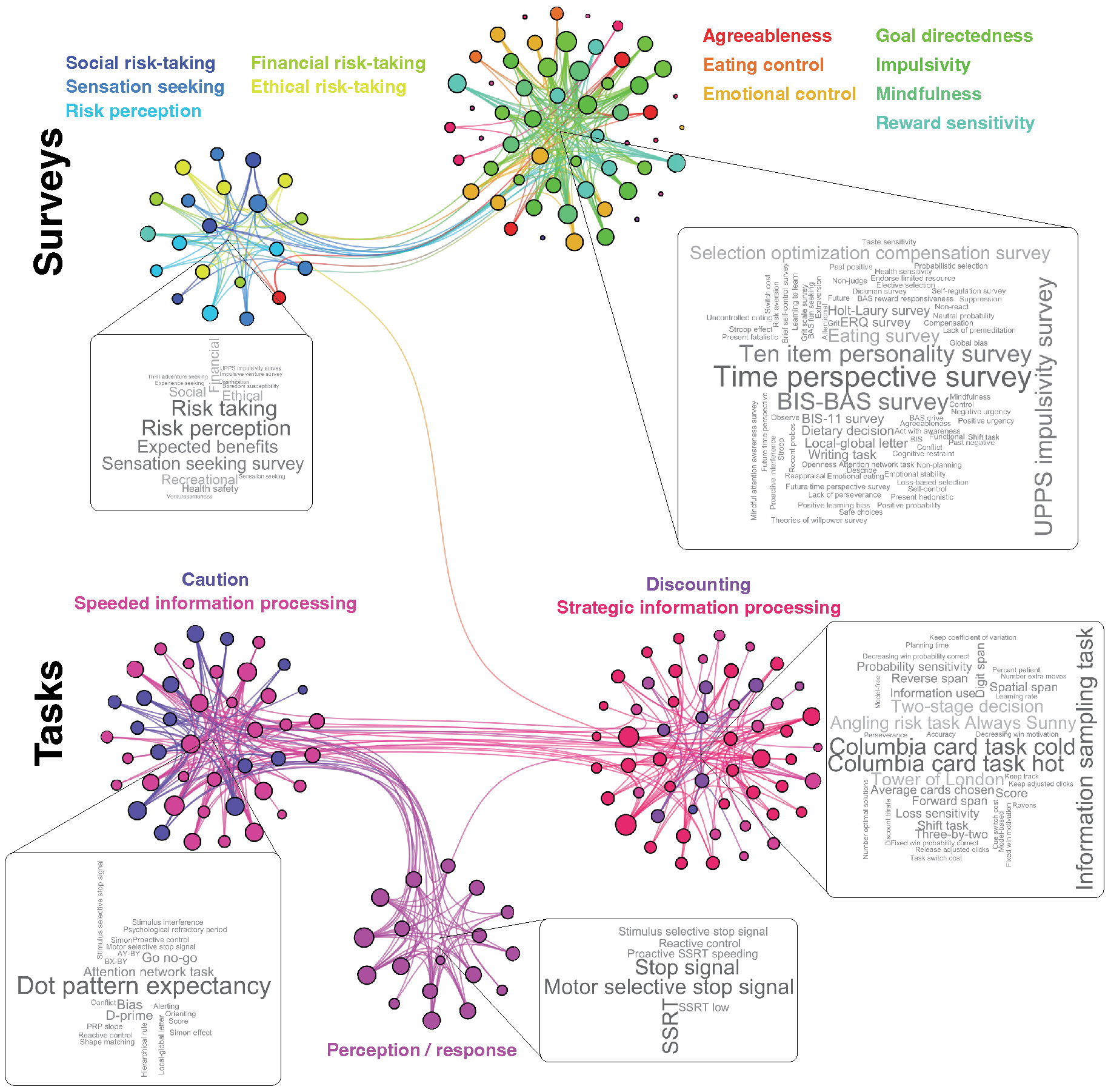
Figure 2: Network visualization of self-regulation measurements from tasks and surveys, highlighting sparse interconnections and conceptual fragmentation.
This ontological fragmentation reflects deeper theoretical tensions regarding the domain specificity versus generality of control processes, the context-dependence of “good” control, and the influence of cultural and normative assumptions on the selection of goals and behaviors deemed worthy of study.
Computational and Neural Substrates
The neural implementation of cognitive control is traditionally conceptualized as a set of top-down signals originating from prefrontal and cingulate regions, biasing activity in task-relevant areas. The review details the roles of dorsolateral, ventrolateral, and ventromedial prefrontal cortex, dorsal anterior cingulate, insula, thalamus, and striatum in conflict monitoring, behavioral inhibition, valuation, and flexible adaptation.
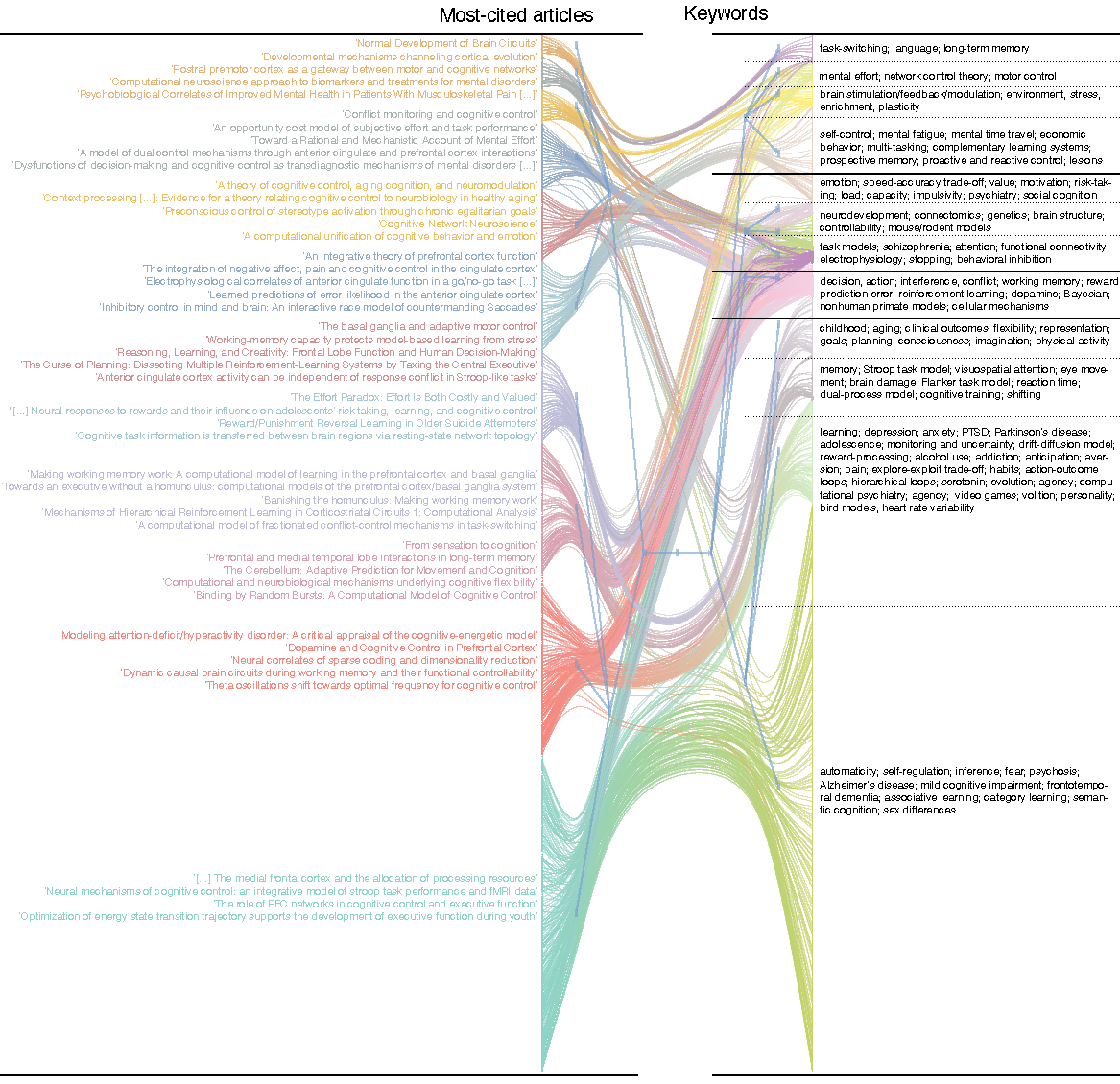
Figure 3: Hierarchical and distributed conceptual structure of cognitive control computations derived from highly cited literature.
The authors discuss the limitations of centralized models, noting evidence for both local and distributed control signaling. Theories diverge on the relative importance of centralized (modular) versus decentralized (heterarchical) architectures, with recent work favoring models that accommodate parallel, recurrent, and context-sensitive signaling.
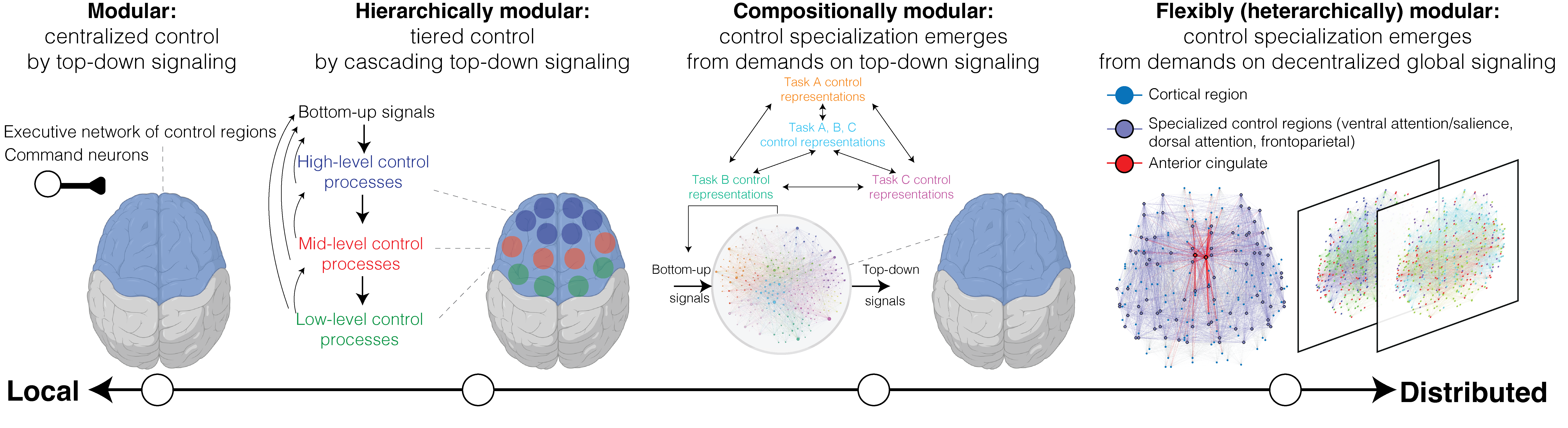
Figure 4: Schematic of local and distributed control signaling, contrasting modular, hierarchical, compositional, and flexibly modular architectures.
A central contribution of the paper is the exposition of network control theory as a formal framework for understanding cognitive control. Network control theory models the brain as a dynamical system of interconnected nodes (regions) and edges (anatomical pathways), enabling precise quantification of the kind, amount, location, and timing of control signals required to transition global activity patterns toward task-specific targets.
(Figure 5)
Figure 5: Guided activation and activity flow in network control theory, illustrating the propagation of neural signals across anatomical connectivity.
The theory operationalizes control energy as the minimal input required to steer spontaneous dynamics toward desired states, accounting for the cost and efficiency of control. Regions with strongly nested and recurrent connectivity (hubs) are predicted to be optimal controllers, efficiently distributing control inputs across the network.
(Figure 6)
Figure 6: Mathematical intuition for network control: combinatorial solutions for reaching target activity patterns using available connection strengths.
Empirical evidence supports the association of network control metrics with individual differences in executive function, working memory, impulsivity, and neurodevelopment. Network control theory also explains the spatial distribution of neurotransmitter receptor expression and metabolic signaling, linking biophysical constraints to behavioral and clinical variability.
Limitations and Theoretical Tensions
The paper critically evaluates the limitations of both psychological and network control approaches. Psychological models are underconstrained at the neural level and often confounded by cultural and normative biases. Network control theory, while mathematically rigorous, is currently reductive, relying on linear dynamics and often abstracting away from the richness of psychological constructs and everyday behavior.
The authors advocate for future integration, suggesting that psychological theory can inform the selection of control targets, cost functions, and feedback signals in network models, while network control theory can provide mechanistic explanations for the dynamic allocation of control across biopsychosocial levels.
Future Directions and Implications
The review identifies several promising avenues for advancing the science of cognitive control:
- Taxonomy of Goals: Expanding the representation of goals beyond static templates to dynamic, vectorial, and hierarchical structures, incorporating semantic, emotional, social, and motivational dimensions.
- Social and Ecological Validity: Modeling collective and relational aspects of control, leveraging multilayer network approaches to capture interactions among individuals, goals, and psychological states.
- Dynamic Computational Models: Integrating recurrent neural networks and biologically constrained models to study the emergence and adaptation of control strategies under energetic and temporal constraints.
- Clinical and Translational Applications: Applying network control theory to predict and modulate behavioral and clinical outcomes, informing interventions in psychiatry, neurology, and neuroengineering.
Conclusion
This paper provides a rigorous synthesis of psychological and neuroscientific theories of cognitive control, highlighting persistent conceptual, measurement, and implementation challenges. By formalizing control as a dynamic, distributed process within the framework of network control theory, the authors offer new mathematical tools and empirical predictions that converge with, and expand upon, established findings. The integration of psychological constructs and network models holds promise for developing multi-level, biopsychosocial accounts of cognitive control, with implications for theory, measurement, intervention, and the design of artificial intelligence systems. The field stands to benefit from embracing plurality, ecological validity, and formal rigor in the ongoing effort to understand and leverage the neural dynamics of cognitive control.