- The paper introduces a novel synthesis method for bulk moiré metals, highlighting tunable higher-dimensional Fermi surfaces via engineered interlayer mismatches.
- The study employs advanced techniques like X-ray diffraction, HAADF-STEM imaging, and high-field quantum oscillation measurements to characterize structural and electronic properties.
- The findings utilize a superspace crystal framework to explain the emergence of over 40 distinct Fermi surface cross-sections, offering insights into higher-dimensional quantum phenomena.
Introduction
This work introduces a new class of bulk moiré metals synthesized in thermodynamic equilibrium, distinct from previously studied van der Waals heterostructures assembled far from equilibrium. The authors report a family of exfoliatable van der Waals crystals with atomically incommensurate lattices, where lattice mismatches between alternating layers generate coherent, tunable moiré superlattices throughout the bulk. High-field quantum oscillation measurements reveal a complex and tunable Fermiology, with the structurally simplest member exhibiting over 40 distinct cross-sectional Fermi surface areas—an unprecedented observation. Theoretical analysis demonstrates that these bulk moiré metals encode electronic properties of higher-dimensional superspace crystals, paralleling established crystallographic methods for incommensurate lattices. This work establishes a scalable synthesis route for large-area moiré materials and provides a platform for exploring higher-dimensional quantum phenomena.
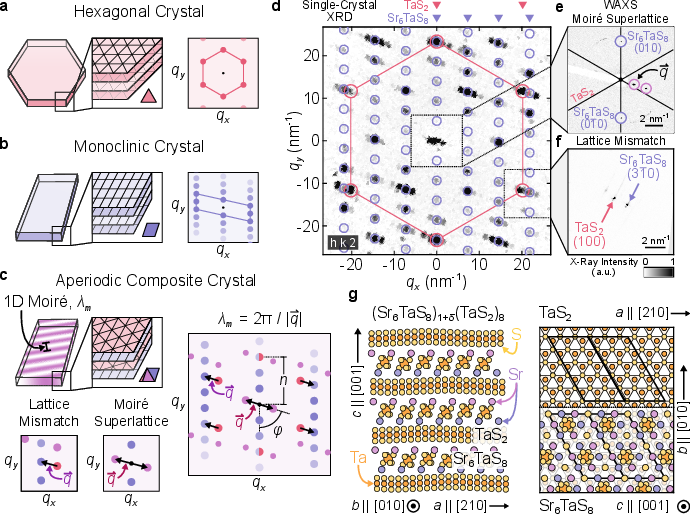
Figure 1: Structural characterization and diffraction signatures of bulk moiré materials, illustrating the formation of aperiodic composite crystals via intergrowth of lattice-mismatched monolayers.
Synthesis and Structural Characterization
The synthesis strategy leverages salt-catalyzed reactions to promote the intergrowth of hexagonal TaS2 and monoclinic Sr6TaS8 layers, yielding aperiodic composite crystals with tunable moiré superlattices. X-ray diffraction (SCXRD, WAXS) and HAADF-STEM imaging confirm the formation of atomically incommensurate structures, with sharp diffraction peaks and minimal disorder across millimeter-scale crystals. The reproducibility and scalability of this approach contrast favorably with the twist-angle and strain variations typical in mechanically assembled 2D moiré materials.
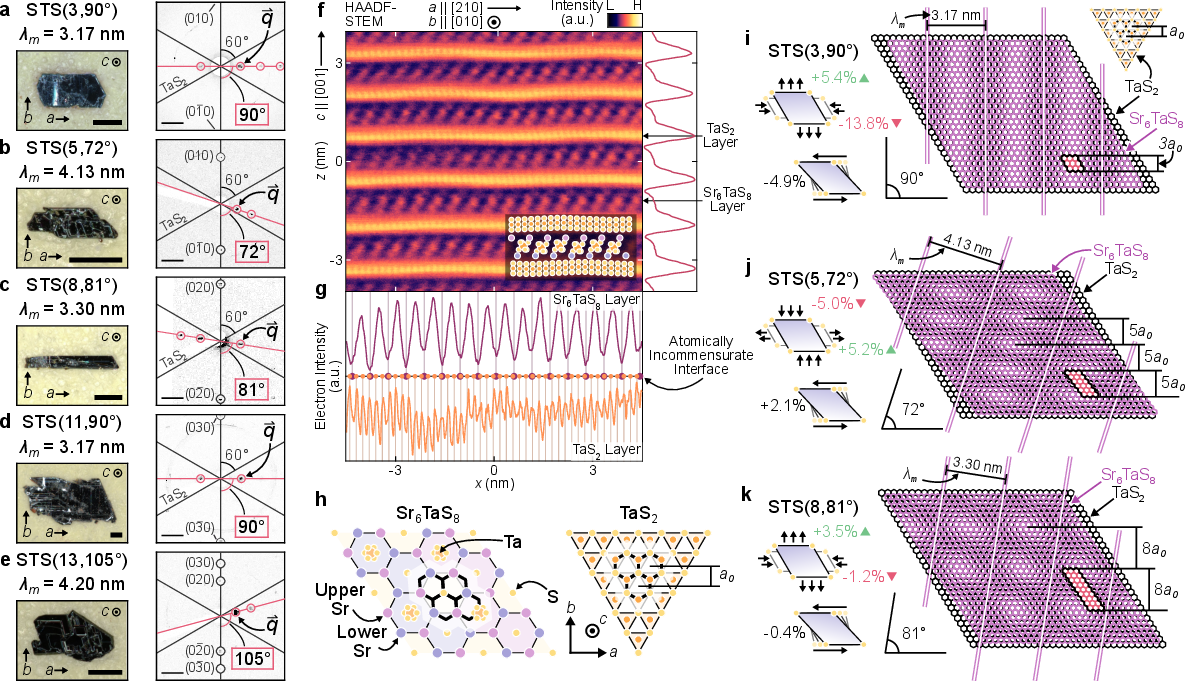
Figure 2: Optical, diffraction, and STEM characterization of five families of bulk moiré materials, demonstrating tunable superlattice wavelengths and orientation angles via synthesis parameters.
Systematic variation of precursor stoichiometry, temperature sequence, and salt catalyst enables control over the commensurate Bragg plane order (n), moiré wavelength (λm), and orientation angle (ϕ) of the superlattice. WDS measurements confirm that all structural families are chemically similar, composed of TaS2 and Sr6TaS8 layers, with tunability arising from interlayer heterostrain and heteroshear. The latter acts as a continuously tunable analogue to twist angle in 2D moiré systems.
Quantum Oscillation Measurements and Fermiology
Torque magnetometry and magnetotransport measurements in high magnetic fields reveal a dense cascade of quantum oscillations, mapping the Fermiology of these bulk moiré metals. Comparative studies of structurally cognate compounds with different superlattice q-vector orientations show that the direction and magnitude of the moiré modulation directly reshape and resize Fermi pockets, as evidenced by merging and splitting of FFT peaks in the quantum oscillation spectra.
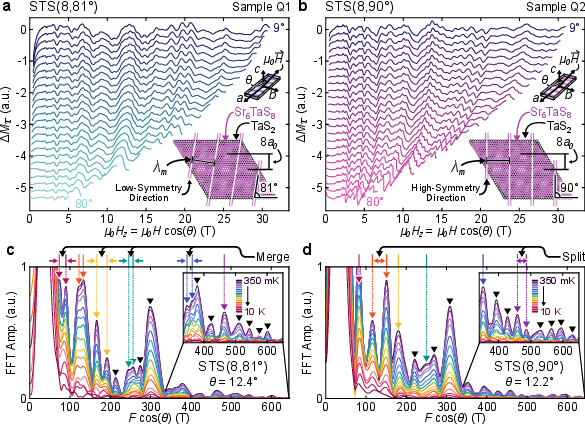
Figure 3: Quantum oscillation data and FFT analysis for cognate bulk moiré crystals, highlighting tunable Fermi surface topology via superlattice orientation.
The simplest member, STS(3,90), exhibits a purely 1D moiré superlattice and a remarkable spectrum of over 40 linearly spaced de Haas-van Alphen frequencies, with total extremal areas far exceeding the Brillouin zone size. The sharpness and regularity of these oscillations, as well as their temperature dependence, cannot be explained by conventional non-Onsager mechanisms such as magnetic breakdown or Weiss oscillations.
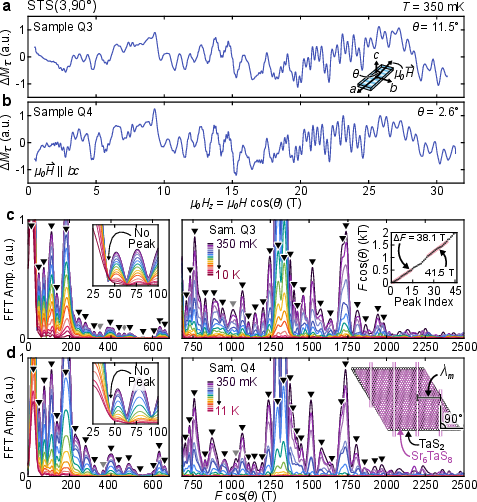
Figure 4: High-field torque magnetization and FFT spectra for STS(3,90), revealing a dense, linearly spaced frequency comb indicative of higher-dimensional Fermiology.
Superspace Crystal Framework and Synthetic Dimensions
To rationalize these observations, the authors invoke the superspace crystal formalism, wherein incommensurate lattices are described as projections of higher-dimensional periodic structures. This approach restores translation symmetry in an emergent synthetic dimension, enabling a Bloch band description of electronic states. The momentum-space network model derived from Lifshitz-Kosevich theory predicts that quasi-2D Fermi pockets are linked along a discrete synthetic dimension kζ, generating a sequence of fictitious Fermi pockets with cross-sectional areas incremented by Aq.
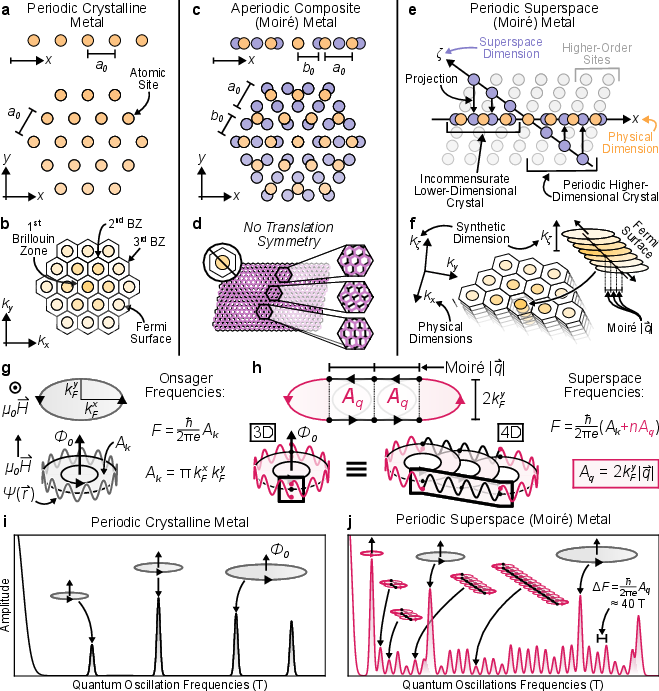
Figure 5: Schematic representation of the superspace crystal model, showing the elevation of aperiodic composite lattices into higher-dimensional periodicity and the resulting ($3+1$)D Fermi surface topology.
This framework naturally explains the observed linear frequency spacing and abundance of quantum oscillation peaks, as cyclotron orbits propagate coherently into the synthetic dimension. The bulk moiré metals thus realize ($3+1$)D Fermi surfaces, with three continuous spatial dimensions and one discrete synthetic dimension, providing an ideal platform for higher-dimensional Fermiology.
Implications and Future Directions
The demonstration of tunable, high-mobility bulk moiré metals with emergent superspace dimensions has significant implications for both fundamental and applied research. The ability to program aperiodic lattice structures via synthesis conditions enables experimental access to a broad range of theoretical proposals in higher dimensions, including topological phases with exotic bulk-boundary correspondences and unconventional superconductivity breaking higher-dimensional symmetries. The reproducibility and scalability of the synthesis method position these materials as promising candidates for next-generation electronic devices and quantum simulation platforms.
The superspace crystal approach bridges the gap between abstract higher-dimensional models and experimentally accessible material systems, offering a quantitative fingerprint for incommensurate lattice structures via quantum oscillation spectroscopy. Future work may explore the realization of higher-dimensional topological phenomena, holographic dualities, and fault-tolerant quantum error correction in these and related systems.
Conclusion
This study establishes a new paradigm for the synthesis and characterization of bulk moiré metals, demonstrating tunable higher-dimensional Fermiology via emergent superspace crystal structures. The combination of scalable synthesis, robust structural characterization, and high-resolution quantum oscillation measurements provides a comprehensive platform for exploring and engineering quantum phases of matter in higher dimensions. The superspace formalism offers a powerful theoretical tool for understanding dynamic electronic phenomena in aperiodic composite materials, with broad implications for condensed matter physics and quantum materials research.