- The paper details an analytical and numerical study showing that atomic transverse motion coupled with laser wavefront curvature introduces systematic phase noise in large-momentum-transfer atom interferometers.
- It demonstrates that beam focusing at the Rayleigh range minimizes curvature noise while balancing pulse efficiency, setting stringent requirements for atomic cloud stability.
- The proposed position-resolved phase-shift readout technique offers a robust, regression-based method to mitigate phase bias and enhance interferometric sensitivity.
Wavefront Curvature and Transverse Atomic Motion in Time-Resolved Atom Interferometry: Impact and Mitigation
Introduction and Motivation
Time-resolved atom interferometry is central to next-generation precision measurements, including gravitational wave detection and searches for ultra-light dark matter. The sensitivity of these experiments is fundamentally limited by systematic effects, among which phase noise induced by the coupling of atomic transverse motion to laser wavefront curvature is particularly significant. This paper presents a comprehensive analytical and numerical study of curvature-induced phase noise in long-baseline, large-momentum-transfer (LMT) atom interferometers, quantifies the requirements for atomic cloud stability, and proposes a practical mitigation strategy based on position-resolved phase-shift readout.
Semi-Classical Modelling of Curvature-Induced Phase Shifts
The authors employ a semi-classical framework to model the phase evolution in symmetric LMT Mach-Zehnder atom interferometers, focusing on single-photon transitions relevant for time-resolved applications. The total interferometric phase for an atom with initial coordinates (x0,v0) is decomposed into a nominal phase and a perturbation due to wavefront curvature. For Gaussian beams, the transverse phase profile is quadratic in position, and the curvature term R(z) introduces a systematic dependence on the atom's transverse coordinates.
The analytical model for the phase perturbation δφ(x0,v0) is validated against Monte Carlo simulations, demonstrating excellent agreement when accounting for the effective interrogation time in LMT sequences.
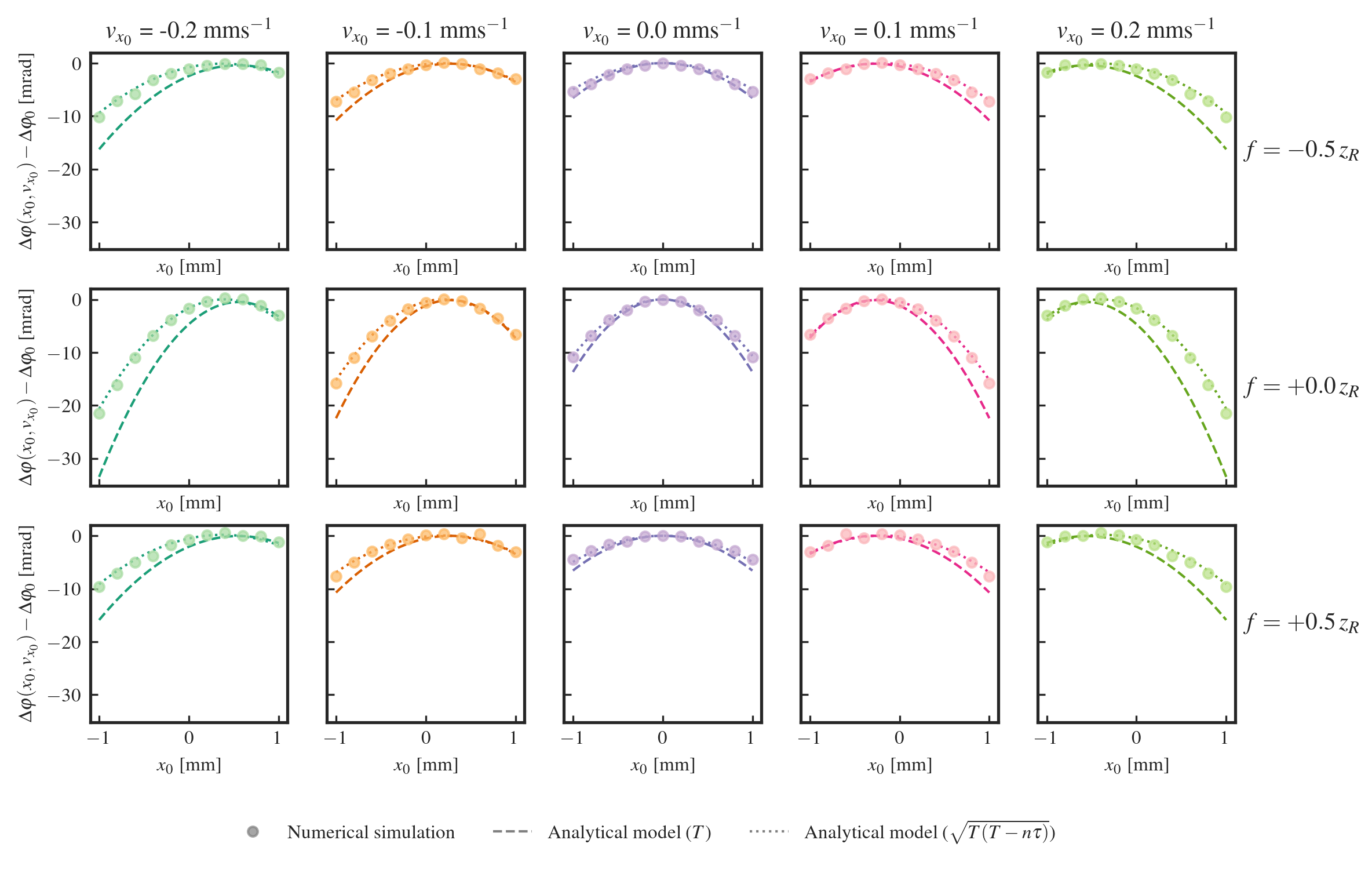
Figure 1: Phase shift for a single atom in a Gaussian beam at different focus positions f, comparing numerical simulations and the analytical model.
Ensemble Effects and Position-Averaged Readout
In practical interferometry, the measured phase is averaged over an ensemble of atoms with a Gaussian-distributed initial phase-space. The position-averaged phase shift is shown to be systematically biased by the mean and variance of the initial transverse center-of-mass (COM) position and velocity. The analytical expressions for the effective phase perturbation are corroborated by large-scale Monte Carlo simulations.
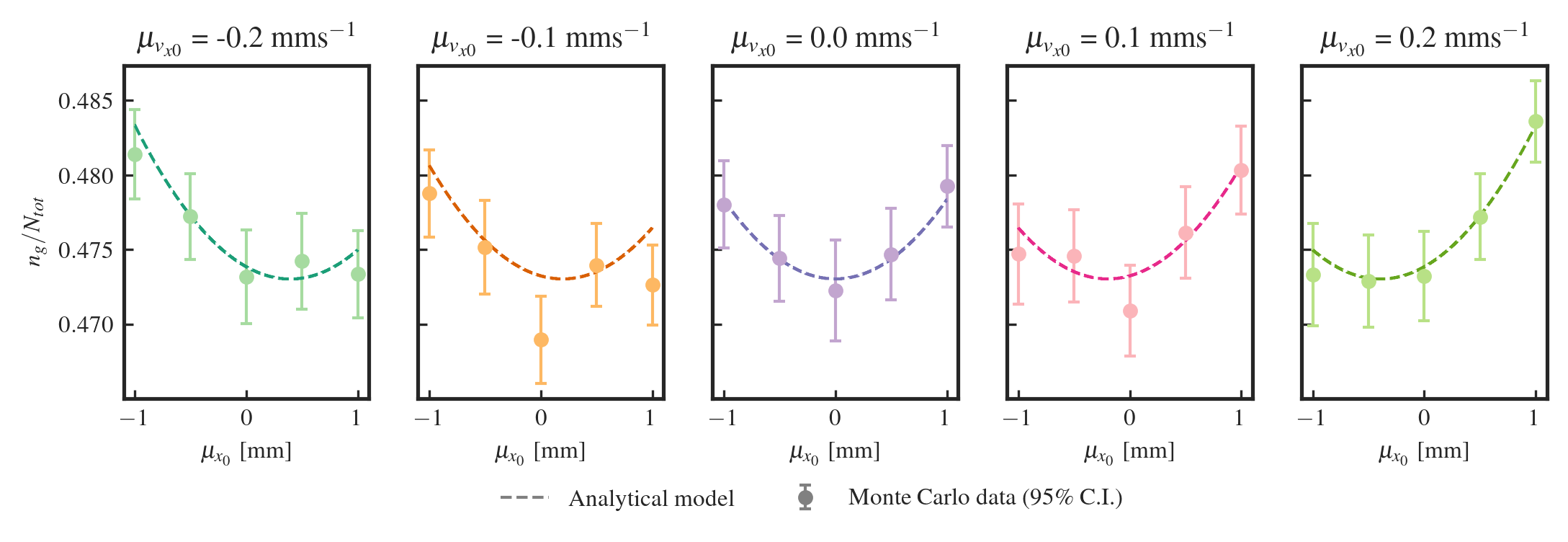
Figure 2: Normalised ground-state population as a function of initial transverse COM position and velocity, comparing Monte Carlo simulations and the analytical model.
Curvature Noise in Long-Baseline Gradiometers: Trade-offs and Requirements
The study extends to atom gradiometers, which suppress common-mode noise by differential measurement between two vertically separated interferometers. The curvature-induced phase noise is shown to depend critically on the laser beam's focus position f and Rayleigh range zR. Placing the focus at ∣f∣=zR minimizes curvature variation and suppresses noise by up to two orders of magnitude, but at the cost of reduced π-pulse efficiency due to Rabi frequency non-uniformity.
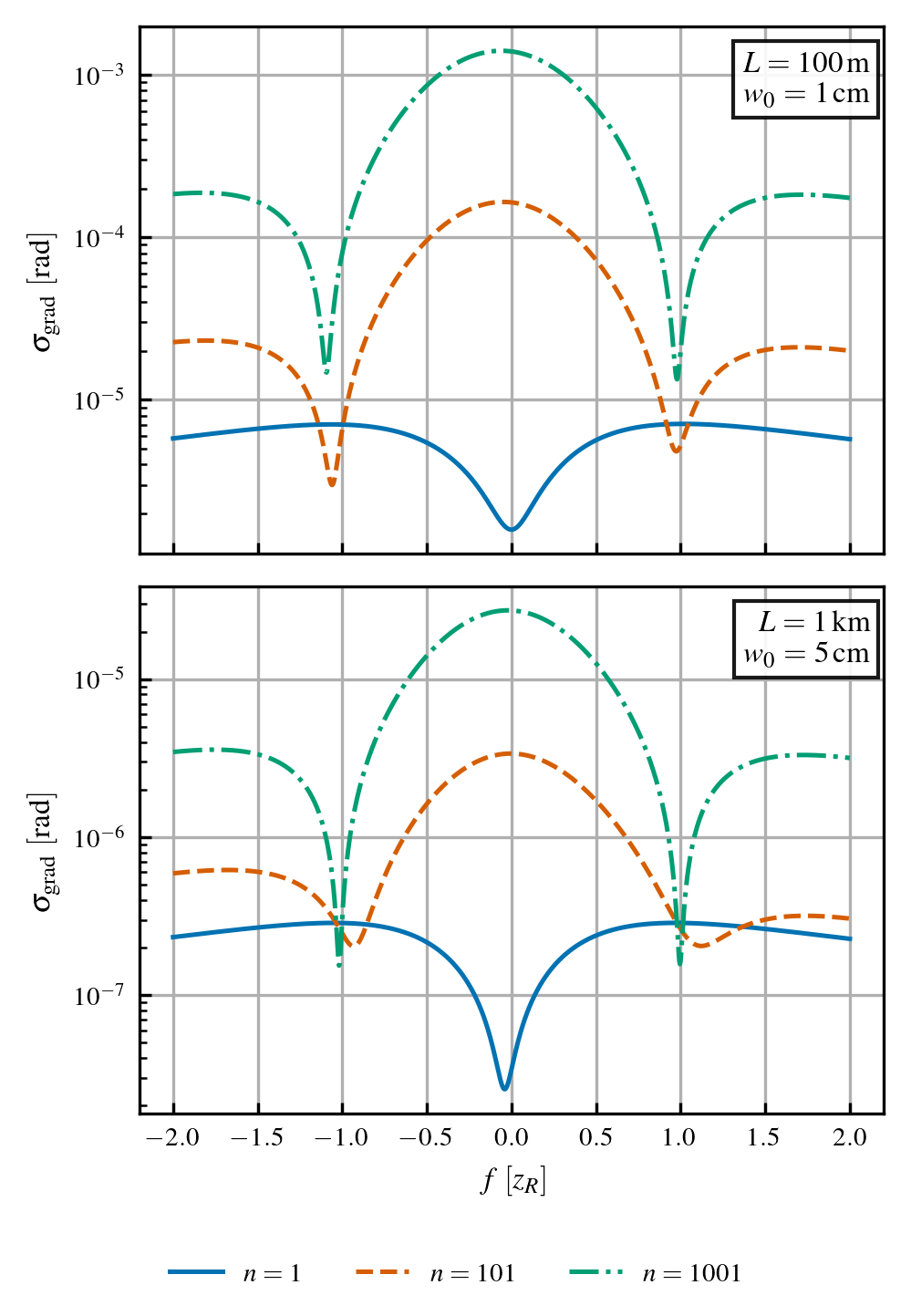
Figure 3: Curvature-induced differential phase noise in position-averaged readout versus focus position f for fixed COM fluctuations.
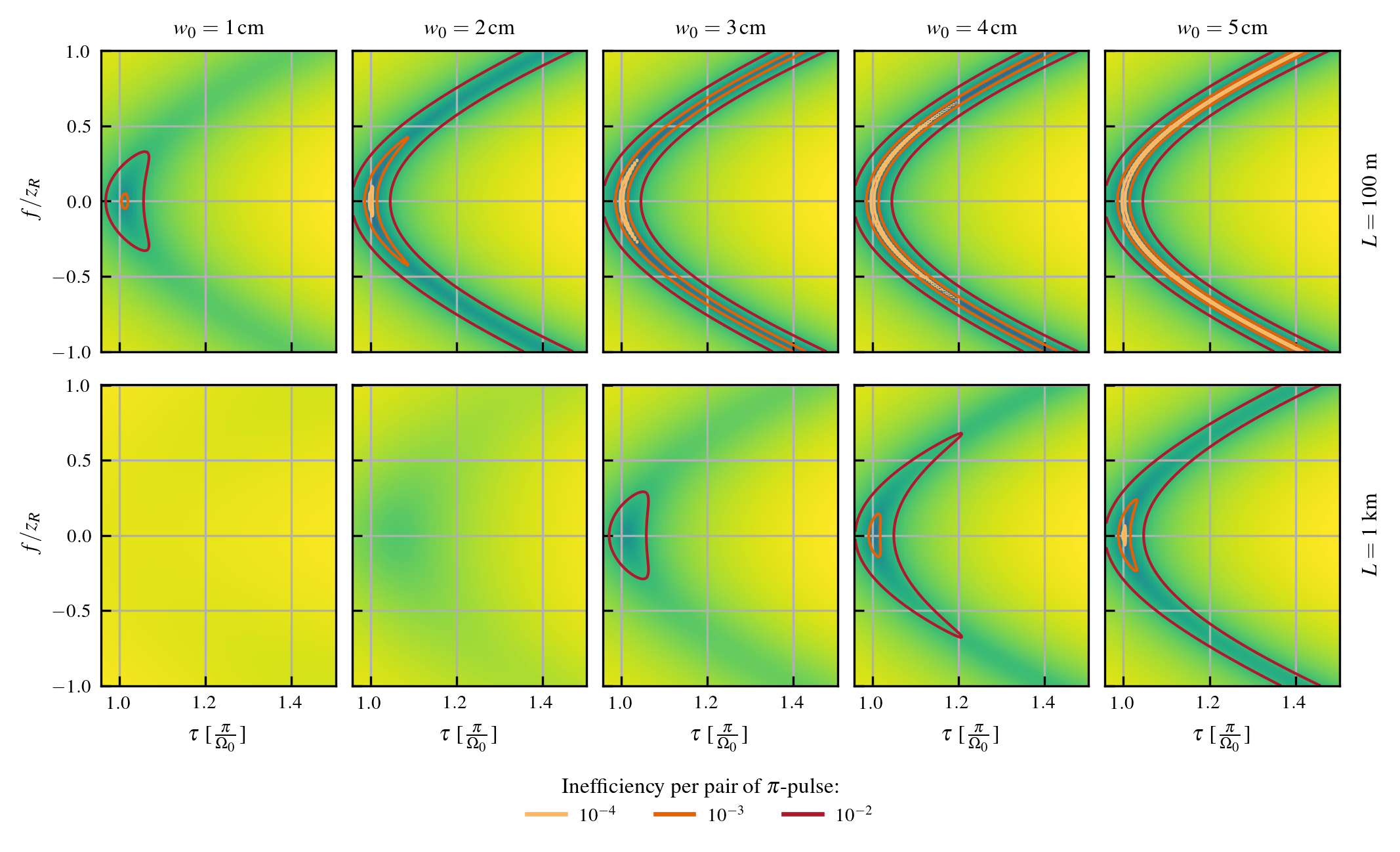
Figure 4: Gradiometer inefficiency 1−εgrad as a function of focus position, beam waist, and pulse duration for 100-m and 1-km setups.
The analysis quantifies the stringent requirements for atomic cloud stability: for a 100-m baseline in the high-efficiency/high-noise (HEHN, f=0) configuration, sub-micron control of COM position and velocity is required to achieve sub-10−5 rad phase noise. In the low-efficiency/low-noise (LELN, f=zR) regime, these requirements relax by an order of magnitude.
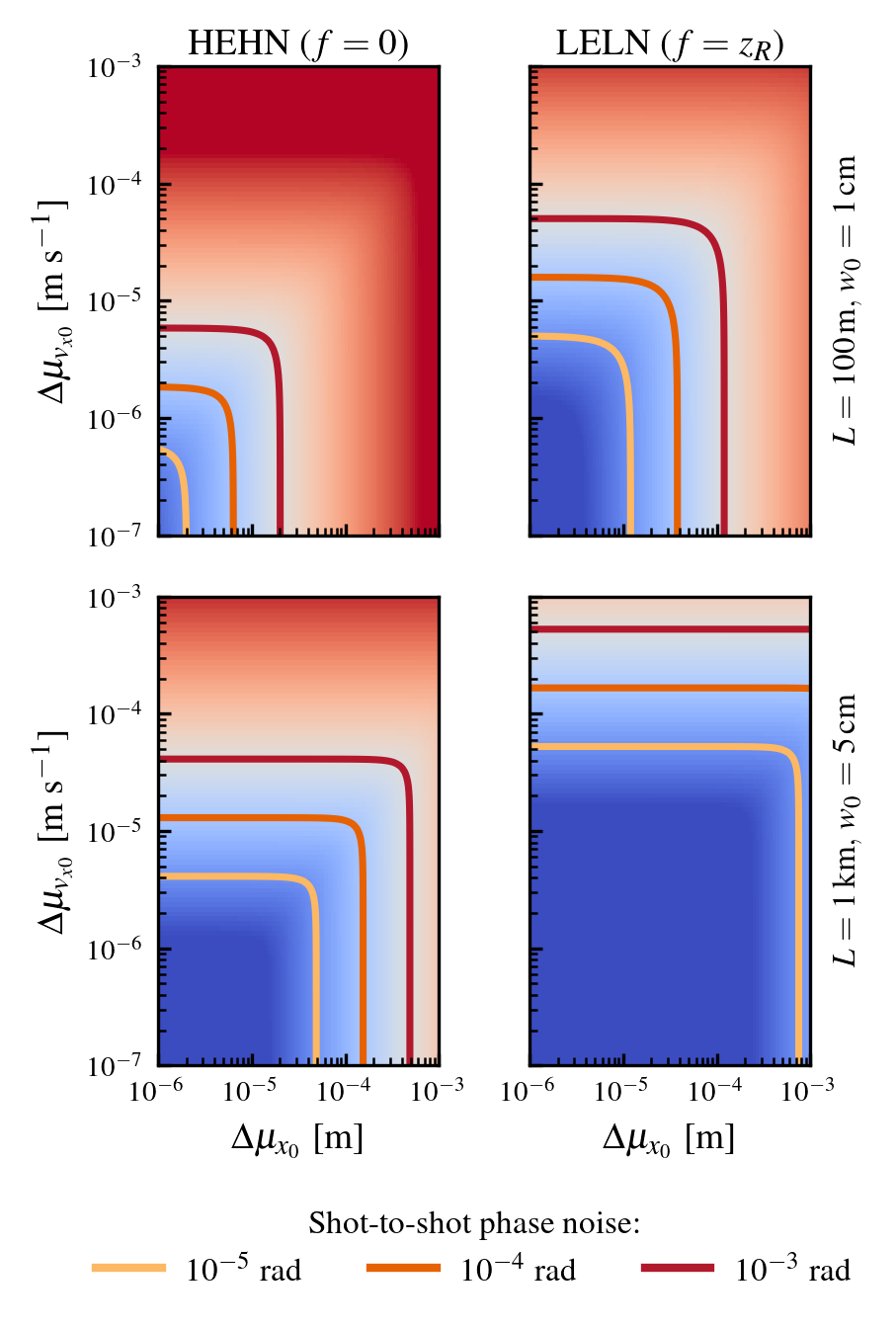
Figure 5: Curvature-induced differential phase noise σgrad versus shot-to-shot COM fluctuations for 100-m and 1-km gradiometers.
Mitigation via Position-Resolved Phase-Shift Readout
To overcome the trade-off between pulse efficiency and curvature noise, the authors propose a mitigation strategy based on position-resolved phase-shift readout, such as phase-shear imaging. This approach enables empirical learning and correction of wavefront-induced phase bias from measurable quantities: the final cloud position and the phase-shift gradient. Analytical models and simulations demonstrate that the phase bias is a smooth function of these observables, allowing for regression-based correction without detailed beam characterization.
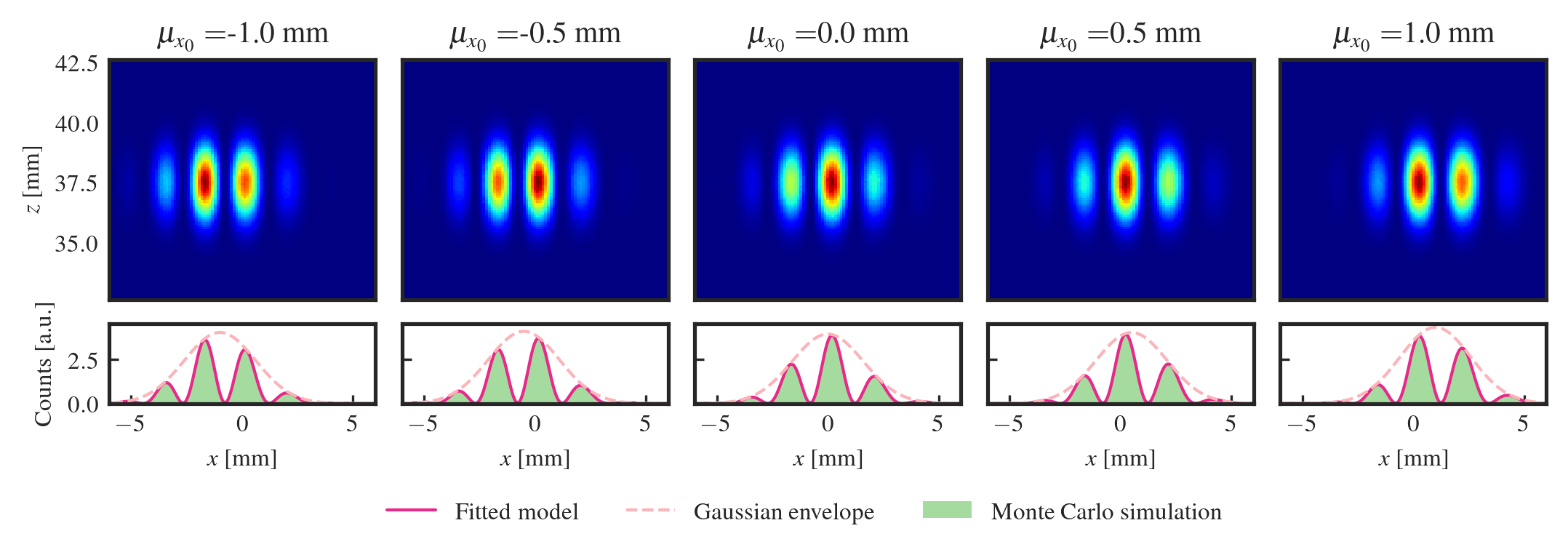
Figure 6: Ground-state port atom density for simulated 101ℏk LMT sequences in phase-shear readout, showing spatial interference fringes.
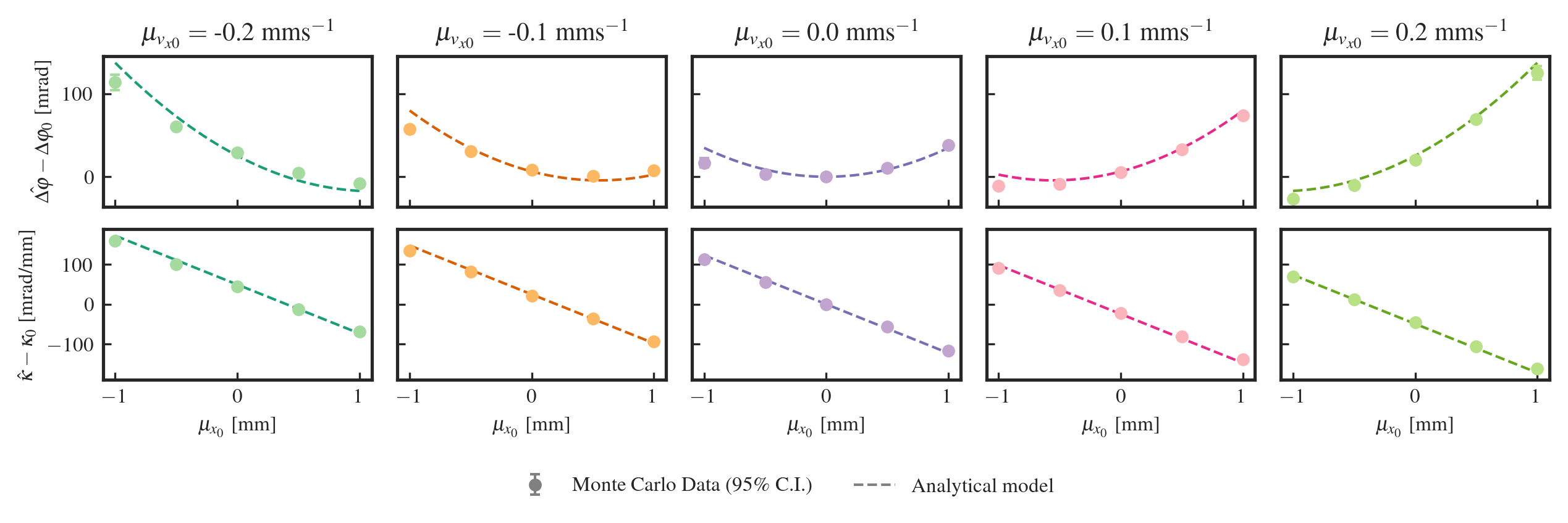
Figure 7: Comparison between Monte Carlo simulations and the analytical model for phase-shift and phase-shift gradient variations induced by transverse motion.
The mitigation strategy is shown to be robust, with the limiting factor being the measurement precision of the phase-shift gradient and COM position. Simulations indicate that the required precision is attainable with current imaging techniques and atom numbers, and the approach is extendable to two-dimensional readout.
Practical and Theoretical Implications
The results have direct implications for the design and operation of next-generation atom interferometers. The derived stability requirements set benchmarks for source preparation and control, particularly for experiments targeting gravitational wave detection and dark matter searches. The mitigation strategy provides a practical route to achieving high sensitivity in the maximum-pulse-efficiency configuration, circumventing the need for micron-level control of atomic motion or exhaustive beam characterization.
Theoretically, the work clarifies the scaling of curvature-induced noise with LMT order, beam geometry, and atomic ensemble properties. It also highlights the interplay between systematic suppression and operational efficiency, motivating further research into robust pulse sequences and advanced readout schemes.
Conclusion
This paper presents a rigorous analysis of wavefront curvature-induced phase noise in time-resolved atom interferometry, supported by analytical models and large-scale simulations. The trade-off between curvature noise suppression and pulse efficiency is quantitatively established, and a position-resolved readout strategy is proposed and validated as an effective mitigation technique. These findings provide a foundation for the realization of next-generation atom interferometers with sub-10−5 rad phase stability, advancing the prospects for precision quantum sensing in fundamental physics.