- The paper introduces FlowQ-Net, a framework that employs GFlowNets to automate quantum circuit design, enhancing expressivity and resource efficiency on NISQ devices.
- It utilizes a bi-level optimization approach that decouples discrete architecture synthesis from continuous parameter tuning, verifying its method on VQE, image classification, and Max-Cut tasks.
- Experiments demonstrate that FlowQ-Net generates compact circuits with fewer parameters and gates while preserving accuracy, indicating scalable solutions for practical quantum applications.
FlowQ-Net: A Generative Framework for Automated Quantum Circuit Design
Introduction
The paper "FlowQ-Net: A Generative Framework for Automated Quantum Circuit Design" introduces an innovative approach to quantum circuit synthesis using Generative Flow Networks (GFlowNets). This framework specifically targets the challenging optimization landscape associated with noisy intermediate-scale quantum (NISQ) devices by automating quantum circuit design to enhance both expressivity and resource efficiency. FlowQ-Net offers a novel solution by using stochastic policy learning that samples circuits according to a customizable reward function, allowing the generation of diverse high-quality architectures.
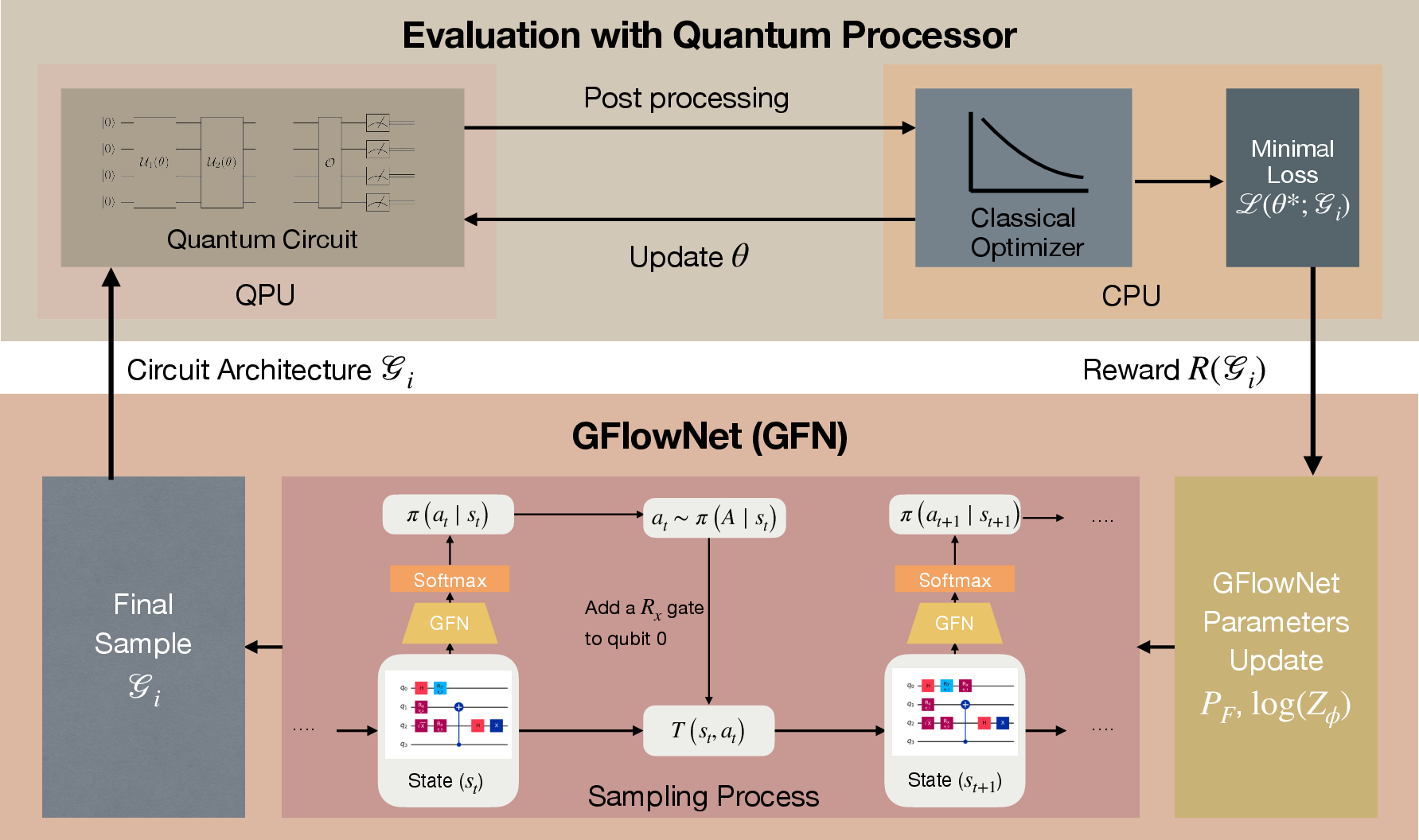
Figure 1: GFlowNet-guided VQA ansatz design. Top band: For each candidate architecture Gi, circuits are executed to obtain measurement outcomes which are post-processed to obtain a loss; the minimal loss updates FlowQ-Net components.
Methods
Variational Quantum Algorithms (VQA)
VQA employs parameterized quantum circuits constructed based on a discrete architecture to optimize specific tasks such as molecular ground state estimation and combinatorial optimization. FlowQ-Net distinguishes itself by handling the synthesis of the circuit architectures through GFlowNets, separating this discrete structure generation from the continuous parameter optimization. The framework is structured as a bi-level optimization problem where circuit architecture is sampled proportionally to a reward function encoding performance metrics.
Generative Flow Networks (GFlowNets)
GFlowNets propose a probabilistic approach to sample combinatorial objects in proportion to a defined reward function. Different from reinforcement learning strategies focused on a single high-reward trajectory, GFlowNets facilitate exploration by maintaining a distribution over possible high-reward objects. Training involves a trajectory balance loss which ensures consistent probability flows and enables effective exploration of complex design spaces.
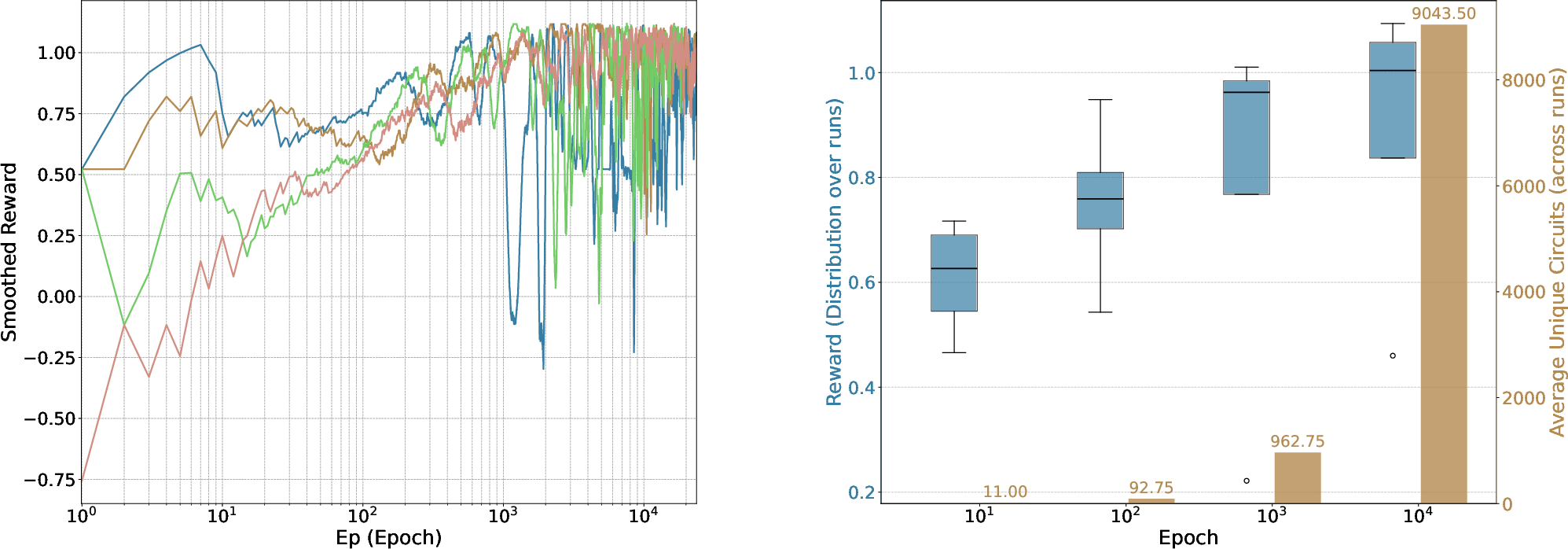
Figure 2: Learning dynamics of the FlowQ-Net on four independent $\mathrm{H_2$ (4-qubit) runs.
FlowQ-Net for Quantum Circuit Design
FlowQ-Net formulates the problem of quantum circuit synthesis as a sequence of actions sampled from the generative network, providing flexibility across various quantum computing tasks. The learning dynamics ensure a diverse generation of circuit architectures, leveraging constraints to adapt to practical execution on NISQ hardware.
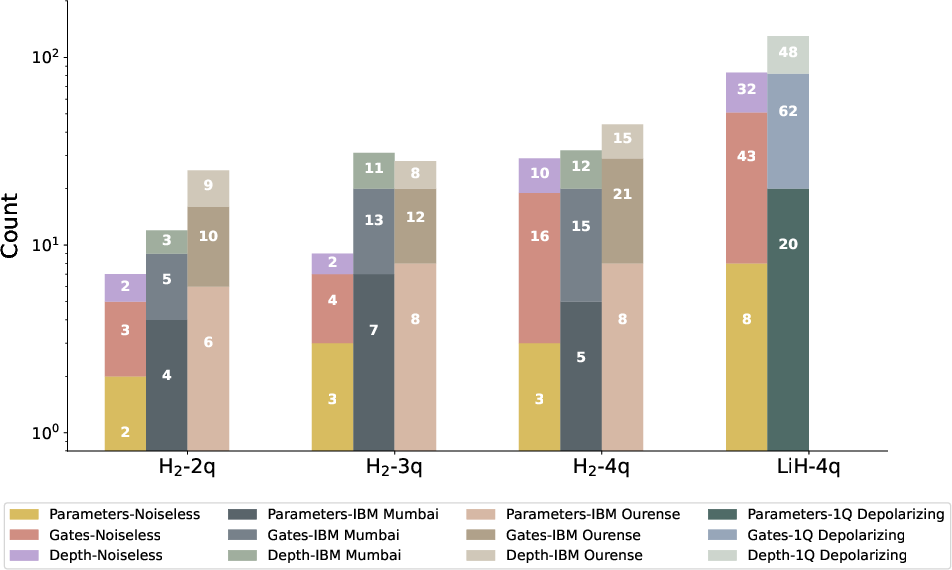
Figure 3: Quantum resource comparison across problem instances and noise models. Stacked bars report the number of circuit parameters (P), gate count (G), and circuit depth (D) on a log-scale y-axis for four molecular VQE benchmarks.
Experiments
Quantum Chemistry Benchmarks
FlowQ-Net was applied to VQE, demonstrating a significant reduction in circuit complexity while maintaining chemical accuracy. The framework consistently produced more compact circuits with fewer parameters and gates, presenting scalability advantages with increasing problem size.
Image Classification Using Quantum Neural Networks
FlowQ-Net was assessed on image classification tasks using quantum neural networks, achieving performance comparable to classical baselines while utilizing fewer computational resources. This underlines the practical applicability of the framework in fields requiring efficient quantum data processing.
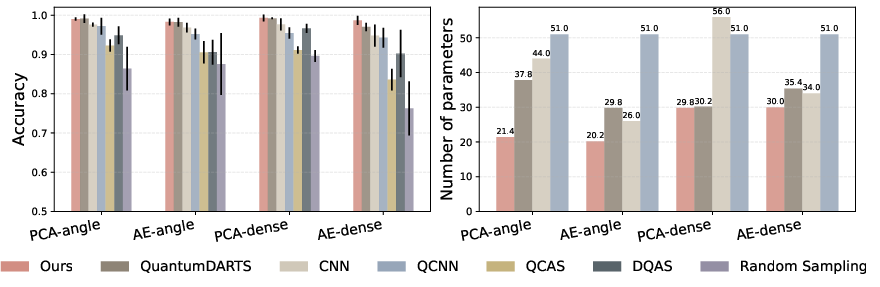
Figure 4: Comparison of our approach with quantum and classical baselines on four data encoding setups. Left Panel: Test accuracy. Right Panel: Average number of parameters.
Max-Cut Optimization
In optimization tasks involving the Max-Cut problem, FlowQ-Net demonstrated superior performance by designing quantum circuits that optimally leveraged quantum effects to achieve high fidelity cuts.
Conclusion
FlowQ-Net exemplifies a promising generative approach to quantum circuit design, emphasizing the importance of diverse and resource-efficient architectures suitable for NISQ devices. This framework can transform circuit synthesis across various quantum computational tasks, potentially accelerating progress in algorithm development and the realization of practical quantum applications. Future work may involve integrating explicit noise-aware criteria and exploring broader applications such as unitary compilation and quantum error correction.