- The paper’s main finding is the detection of parsec-scale spatial correlations in magnetospheric inclinations among Lupus CTTSs, indicating a systematic imprint from molecular cloud structures.
- The study employs HDBSCAN clustering, uniform shock temperature models, and extensive Monte Carlo sampling to robustly determine inclination angles across different subregions in Lupus.
- The results imply that coherent stellar system orientations may affect disk evolution and exoplanet survey biases, highlighting the role of initial cloud collapse in star formation.
Spatial Correlation of Magnetospheric Inclinations in Lupus: Evidence for Parsec-Scale Star-Cloud Connection
Introduction and Motivation
This study investigates the spatial correlation of magnetospheric inclinations (imag) among classical T Tauri stars (CTTSs) in the Lupus star-forming region, aiming to establish a direct link between parsec-scale molecular cloud structures and sub-au scale stellar system configurations. The work leverages a homogeneously characterized sample of 61 Lupus CTTSs, combining previous HST ULLYSES results with new VLT archival spectra, and applies advanced clustering techniques to probe the physical coherence of imag across the region.
Sample Characterization and Magnetospheric Inclination Measurement
The sample comprises 61 CTTSs distributed across Lupus I–IV and off-cloud sources, with reliable Gaia DR3 distances and well-constrained stellar parameters. Magnetospheric inclinations are derived via accretion flow modeling of Hα profiles, following the methodology established in Pittman et al. (2025). For non-ULLYSES targets, a uniform shock temperature is adopted, and model grids are computed over imag from 0∘ to 85∘ in 5∘ increments. The final imag values are determined from the top 1000 best-fit models, weighted by likelihood, and a conservative minimum uncertainty of 5∘ is enforced.
Consensus Clustering Analysis with HDBSCAN
To assess spatial correlations, the study employs HDBSCAN, a hierarchical density-based clustering algorithm, in a four-dimensional space (three spatial coordinates plus imag). Robust scaling ensures equal weighting of all parameters. Measurement uncertainties are incorporated via 5000 Monte Carlo realizations, with consensus clustering used to identify stable groups based on pairwise co-membership probabilities. Hyperparameters are optimized to recover the known Lupus subregions in 3D, then extended to 4D to test for imag coherence.
Results: Detection of Parsec-Scale imag Correlations
Spatial mapping reveals clear imag correlations within Lupus subregions, with distinct groupings in both the plane of the sky and 3D space. For example, Lupus III exhibits a high prevalence of large imag (median 77∘, MAD 6∘), while Lupus I splits into NW and SE subgroups with contrasting inclinations (79∘ vs. 50∘ median). The clustering analysis confirms that these groupings are robust against measurement uncertainties and inconsistent with random inclination assignments.
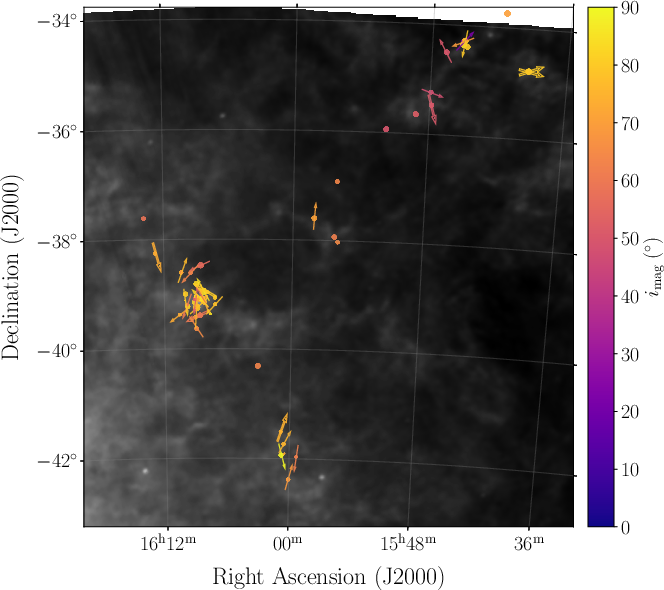
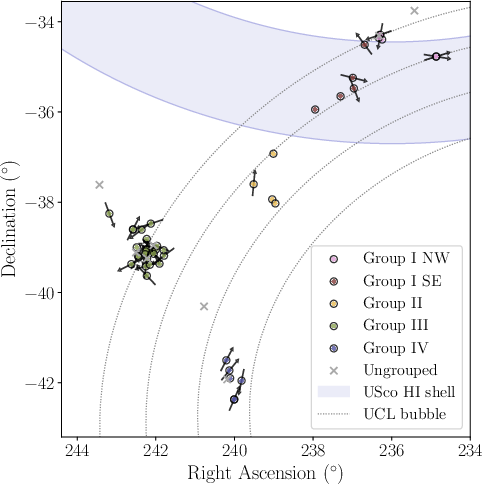
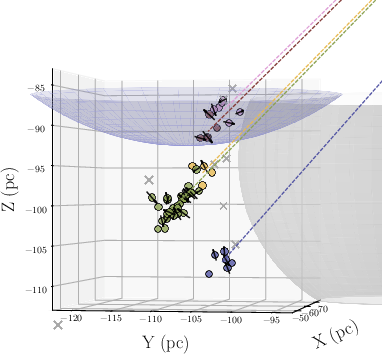
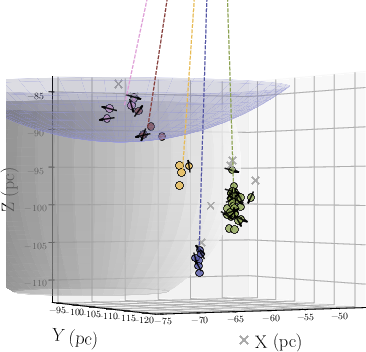
Figure 1: Map of Lupus CTTSs overlaid on IRIS 100 μm dust emission, with point color encoding magnetospheric inclination and size indicating distance.
The physical scale of these coherent groups is on the order of ∼3 pc, matching the typical filament lengths in Lupus. The group morphologies and disk position angles (PAs) further suggest alignment with large-scale cloud structures and external feedback from expanding shells (Upper Scorpius and Upper-Centaurus-Lupus).
Complementary Evidence and Validation
Comparison of imag with gas and dust disk inclinations (idisk, idust) from ALMA CO observations shows a moderate correlation (r=0.6), with 85% of measurements agreeing within 20∘ (Figure 2). Observational biases, such as reduced CO detectability in highly inclined disks, are discussed as sources of systematic offset. Intrinsic misalignments between stellar rotation, magnetic, and disk axes are also considered, consistent with observed obliquities in CTTSs.
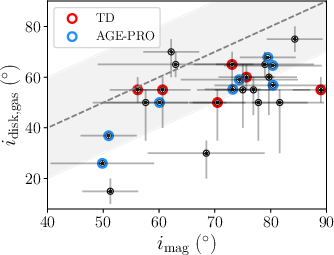
Figure 2: Comparison between magnetospheric and disk inclinations, with equality indicated by the dashed line and ±20∘ shaded region.
Additional support for spatial dependencies comes from accretion rate (M˙) studies, which find higher M˙ in Lupus III stars near the cluster center and increased similarity among close pairs, indicative of ongoing ISM infall. Disk PAs also show non-uniform distributions aligned with filamentary axes and shell fronts, reinforcing the star-cloud connection.
Physical Interpretation and Implications
The observed imag coherence is interpreted as a consequence of filamentary core elongation during cloud collapse, with rotation axes preferentially perpendicular to filament axes. In Lupus III, the high imag values and 3D alignment suggest that the line of sight is nearly parallel to the filament axis. In Lupus I, the NW and SE subgroups reflect differential compression and alignment due to external shell interactions.
The persistence of these spatial correlations over Myr timescales implies that initial conditions in molecular clouds can imprint coherent orientations on stellar systems, potentially affecting disk evolution and planet formation. The non-uniformity of imag within regions challenges the common assumption of random viewing angles in exoplanet occurrence rate calculations, with direct consequences for survey completeness corrections.
Methodological Advances
The use of consensus clustering with HDBSCAN in a 4D parameter space, combined with rigorous uncertainty propagation via Monte Carlo sampling, sets a methodological benchmark for future studies of spatial coherence in star-forming regions. The approach is validated against randomization and perturbation tests, ensuring that detected correlations are physical rather than artifacts of the clustering algorithm or measurement errors.
Future Directions
The study highlights the need for expanded samples in other regions (e.g., Chamaeleon I, Taurus, Orion OB1b) with high-resolution spectroscopy and homogeneous parameter determination to test the universality and longevity of imag spatial correlations. Investigations into older and more diffuse regions, as well as those lacking massive star feedback, will be critical for constraining the mechanisms driving orientation coherence.
Conclusion
This work provides the first direct observational evidence for parsec-scale spatial correlations of magnetospheric inclinations in a star-forming region, linking large-scale molecular cloud structures to sub-au scale stellar system properties. The results have significant implications for models of star and planet formation, survey design, and the interpretation of exoplanet demographics. The demonstrated methodology offers a robust framework for future studies of spatial coherence in astrophysical systems.

