- The paper demonstrates that high-resolution SPH-EXA simulations markedly reduce spurious nozzle shock dissipation at pericenter in TDEs.
- The study reveals that increasing particle count from 10^6 to 10^10 effectively suppresses artificial stream broadening and mass ejection.
- The results challenge prior models by confirming that stream collisions, rather than pericenter shocks, govern circularization in stellar disruptions.
Resolving the Return of the Stream in Tidal Disruption Events with SPH-EXA
Introduction and Context
Tidal disruption events (TDEs) are critical probes of supermassive black hole (SMBH) demographics and accretion physics. When a star is disrupted by the tidal field of an SMBH, the resulting debris forms a highly eccentric stream, a fraction of which returns to pericenter, circularizes, and accretes, powering luminous flares across the electromagnetic spectrum. The mechanism by which this debris circularizes—whether via shocks at pericenter ("nozzle shocks") or through stream-stream collisions induced by relativistic precession—remains a central theoretical uncertainty. Previous numerical studies, limited by resolution, have often found significant shock-induced dissipation at pericenter, suggesting efficient circularization and mass ejection. However, the convergence of these results with increasing resolution has been questioned, with some works attributing the observed dissipation to numerical artifacts.
This paper presents the highest-resolution smoothed-particle hydrodynamics (SPH) simulations to date of a canonical TDE (solar-like star, M⋆=1M⊙, R⋆=1R⊙, disrupted by a 106M⊙ SMBH), using the GPU-accelerated SPH-EXA code. The study systematically explores the effect of numerical resolution (from 106 to 1010 particles) on the dynamics and thermodynamics of the returning debris stream, with a focus on the width evolution and energy dissipation at pericenter.
Numerical Methodology and Simulation Setup
The SPH-EXA code leverages GPU acceleration and a novel oct-tree gravity solver to achieve unprecedented particle counts, enabling the resolution of the extreme spatial and temporal scales inherent to TDEs. The initial stellar model is a $5/3$-polytrope, constructed via a glass-like particle distribution to minimize initial noise, and relaxed in isolation before being placed on a parabolic orbit with pericenter at the tidal radius (rp=rtidal=100R⊙). The SMBH is modeled with a pseudo-Newtonian "Einstein potential" to capture relativistic apsidal precession.
A polytropic equation of state is used, with dissipation from artificial viscosity tracked but not included in the pressure support, ensuring that any measured shock heating is an upper bound. The simulations span N=106 to 1010 particles, with all runs performed on the ALPS supercomputer.
Resolution Dependence of Stream Morphology
A central result is the dramatic dependence of the outgoing stream width on numerical resolution. At moderate resolution (∼108 particles), the returning stream exhibits significant in-plane spreading at pericenter, consistent with previous claims of strong nozzle shocks and associated dissipation. However, as the resolution increases to R⋆=1R⊙0 particles, this effect is almost entirely suppressed: the outgoing stream remains as narrow as the incoming stream, with negligible broadening or mass ejection.

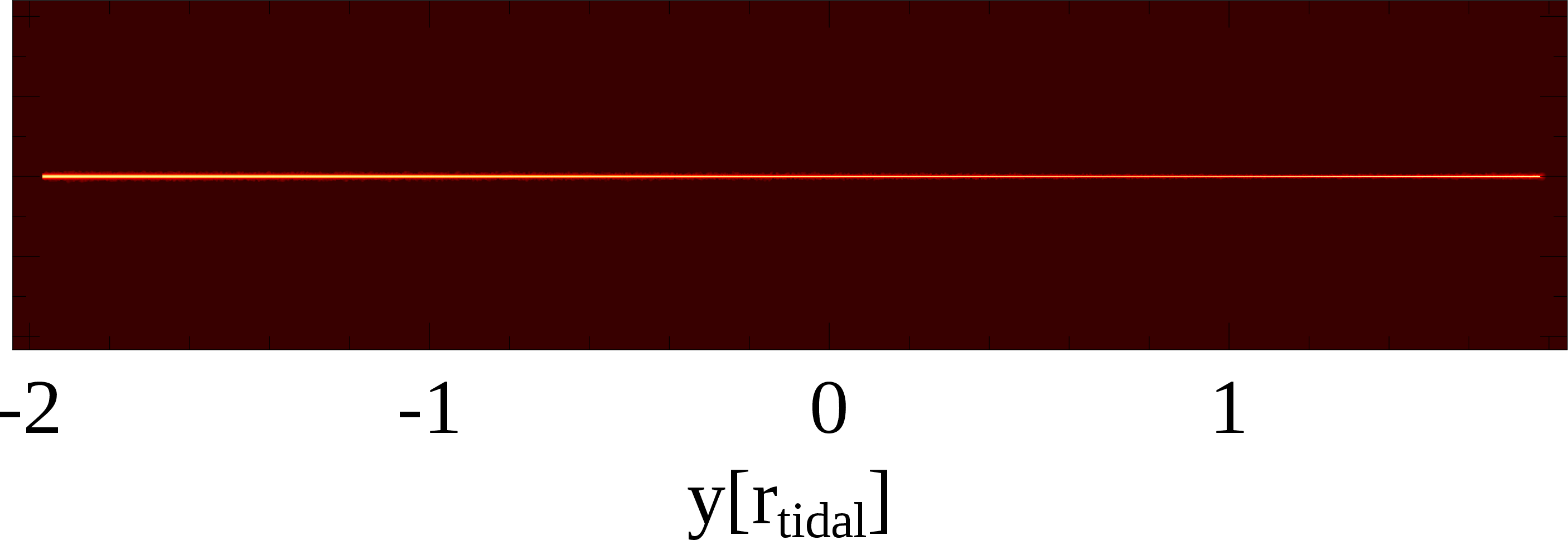
Figure 1: Surface density maps of the debris stream at R⋆=1R⊙1 for increasing resolution, showing the suppression of spurious stream broadening at high R⋆=1R⊙2.
This qualitative change is quantified by measuring the transverse widths of the incoming and outgoing streams as a function of distance from the SMBH. At low resolution, the outgoing stream is significantly broader than the incoming stream, but this difference vanishes at the highest resolution.
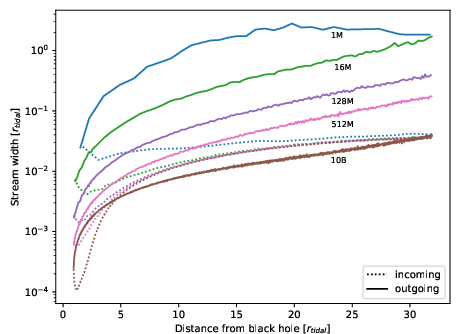
Figure 2: Widths of the incoming (dotted) and outgoing (solid) streams at R⋆=1R⊙3, as a function of distance from the SMBH, for different resolutions.
Energy Dissipation at Pericenter
The study directly measures the specific energy dissipated by shocks at pericenter by tracking parcels of gas through the pericenter passage and subtracting the reversible (adiabatic) contribution from the total change in internal energy. The dissipated energy, normalized to the kinetic energy at pericenter, decreases by more than two orders of magnitude as the resolution increases from R⋆=1R⊙4 to R⋆=1R⊙5 particles. At the highest resolution, the dissipated energy is R⋆=1R⊙6 of the kinetic energy, and this is an upper limit due to the adopted equation of state.
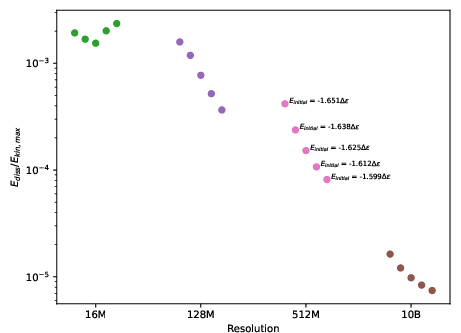
Figure 3: Energy dissipation at pericenter for different resolutions, measured at the time when the tip of the stream returns to pericenter at R⋆=1R⊙7.
This result directly contradicts previous claims that nozzle shocks at pericenter are a significant source of circularization and mass ejection. Instead, the findings support the original paradigm in which circularization is mediated by stream-stream collisions induced by relativistic precession, with negligible dissipation at pericenter prior to self-intersection.
Debris Energy Distribution and Code Validation
The energy distribution of the debris after disruption is shown to be robustly reproduced by SPH-EXA, matching previous results obtained with other codes and both Newtonian and relativistic potentials.
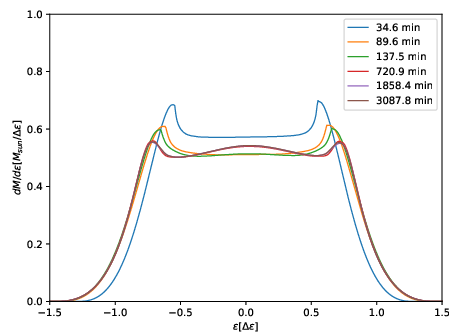
Figure 4: Left: Specific energy distribution of the stellar stream after disruption (512\,M, Newtonian potential). Right: Same for a 10\,B particle simulation with the Einstein potential.
This validates the code's ability to capture the essential dynamics of the disruption and fallback, and confirms that the suppression of spurious dissipation is not an artifact of the numerical method.
Implications for TDE Theory and Observations
The results have significant implications for both theoretical modeling and the interpretation of observed TDEs:
- Circularization Mechanism: The negligible dissipation at pericenter at high resolution rules out nozzle shocks as the primary circularization mechanism for canonical TDEs. Instead, stream-stream collisions, whose location and efficiency depend on the SMBH mass, spin, and orbital parameters, must dominate.
- Mass Ejection and Outflows: Previous claims of substantial mass ejection and the formation of quasi-spherical reprocessing envelopes due to pericenter shocks are not supported. Additional physics—such as stream collisions, radiative feedback, or recombination-driven thickening—must be invoked to explain observed outflows and emission features.
- Numerical Requirements: Resolving the true dynamics of the returning stream requires at least R⋆=1R⊙8 SPH particles for solar-type TDEs. Lower-resolution simulations are subject to severe numerical artifacts, including artificial broadening and spurious dissipation.
- Population Synthesis and Diversity: If stream collisions dominate, the diversity of TDE light curves and emission properties should reflect the distribution of SMBH and stellar parameters, rather than being universal. This is testable with upcoming large samples from facilities such as the Vera Rubin Observatory.
Future Directions
The study highlights the need for:
- Inclusion of Additional Physics: Effects such as recombination, radiative transfer, and magnetic fields may alter the stream structure and facilitate circularization or outflow production.
- Global Simulations of Stream Collisions: High-resolution, global simulations that follow the debris through self-intersection and subsequent disk formation are required to fully capture the circularization process and its observational signatures.
- Improved Observational Diagnostics: The dependence of stream collision location and efficiency on system parameters suggests that population studies of TDEs can constrain SMBH demographics and accretion physics.
Conclusion
This work demonstrates that, for canonical TDEs, the long-assumed paradigm of strong shock dissipation at pericenter is a numerical artifact arising from insufficient resolution. At the required resolution, the returning debris stream remains cold and narrow, with negligible energy dissipation prior to self-intersection. The dominant circularization mechanism is stream-stream collision, not nozzle shocks. These findings necessitate a revision of theoretical models for TDE emission and outflow production, and set stringent requirements for future numerical studies of TDE dynamics.

