BRIQA: Balanced Reweighting in Image Quality Assessment of Pediatric Brain MRI
Published 30 Oct 2025 in eess.IV and cs.CV | (2510.26661v1)
Abstract: Assessing the severity of artifacts in pediatric brain Magnetic Resonance Imaging (MRI) is critical for diagnostic accuracy, especially in low-field systems where the signal-to-noise ratio is reduced. Manual quality assessment is time-consuming and subjective, motivating the need for robust automated solutions. In this work, we propose BRIQA (Balanced Reweighting in Image Quality Assessment), which addresses class imbalance in artifact severity levels. BRIQA uses gradient-based loss reweighting to dynamically adjust per-class contributions and employs a rotating batching scheme to ensure consistent exposure to underrepresented classes. Through experiments, no single architecture performs best across all artifact types, emphasizing the importance of architectural diversity. The rotating batching configuration improves performance across metrics by promoting balanced learning when combined with cross-entropy loss. BRIQA improves average macro F1 score from 0.659 to 0.706, with notable gains in Noise (0.430), Zipper (0.098), Positioning (0.097), Contrast (0.217), Motion (0.022), and Banding (0.012) artifact severity classification. The code is available at https://github.com/BioMedIA-MBZUAI/BRIQA.
The paper introduces a novel multitask learning framework that employs gradient-based loss reweighting with a rotating batch configuration to address class imbalance in pediatric brain MRI IQA.
It combines specialized backbone architectures, including DenseNet, ResNet, and MedNeXtS, to improve artifact detection and achieve robust F1 scores across diverse artifact types.
The framework demonstrates clinical potential by reliably scoring artifact severity, offering a scalable solution for automated quality assessment in pediatric neuroimaging diagnostics.
Balanced Reweighting in Image Quality Assessment of Pediatric Brain MRI (BRIQA)
Introduction
The BRIQA framework addresses the challenge of automated image quality assessment (IQA) in pediatric brain MRI, particularly in low-field systems where artifact prevalence and class imbalance complicate reliable classification. The motivation stems from the need for objective, scalable, and reproducible artifact severity scoring, which is critical for diagnostic workflows and large-scale neurodevelopmental studies. BRIQA introduces a multi-architecture, multitask learning approach, integrating gradient-based loss reweighting and a novel rotating batch configuration to mitigate class imbalance and enhance generalization across artifact types.
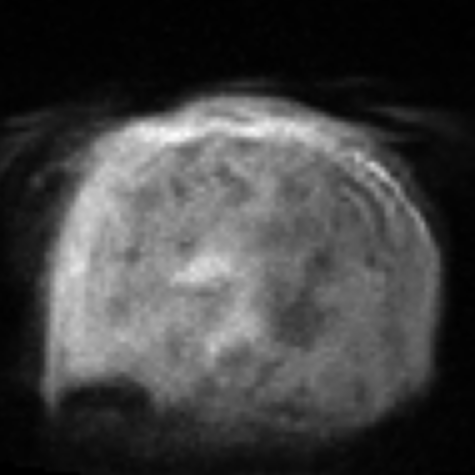
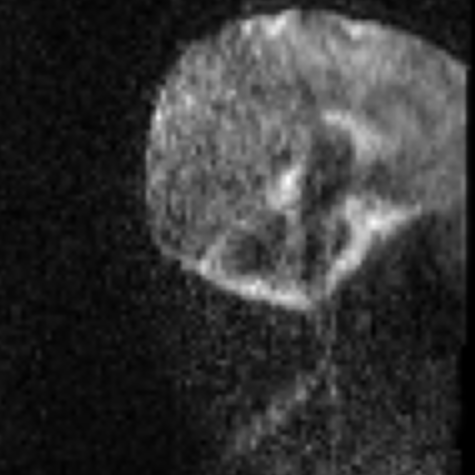
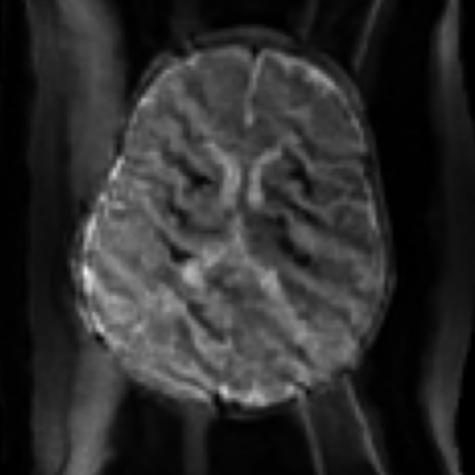
Scans from the 0.064T Hyperfine SWOOP system exhibit diverse and severe artifacts across anatomical planes, underscoring the complexity of the IQA task.
Figure 1: Scans from multiple patients obtained with the 0.064T Hyperfine SWOOP system, showing severe artifacts in different anatomical planes.
Methods
Dataset and Preprocessing
The LISA 2025 Challenge dataset comprises 532 low-field pediatric brain MRIs from 244 subjects, annotated for seven artifact types (Banding, Contrast, Motion, Distortion, Noise, Positioning, Zipper) on a three-point severity scale. Artifact simulation using TorchIO augments the dataset, particularly for underrepresented moderate and severe cases, but the distribution remains imbalanced post-simulation. Preprocessing includes resizing to 128×128×128, normalization, center cropping, and random rotation.
Model Architecture
BRIQA employs a multitask encoder fθ(⋅) with dual heads: one for artifact severity classification and one for scan plane (axis) prediction. Architectural diversity is a core design choice; DenseNet variants are used for localized artifacts (Noise, Zipper, Positioning), while ResNet variants target global artifacts (Banding, Motion, Contrast), and MedNeXtS is reserved for Distortion. This specialization is empirically justified by per-artifact performance variability.
Gradient-Based Loss Reweighting
To address class imbalance, BRIQA computes the ℓ2 norm of the gradient of the classification loss for each class c:
ϕc=∇θclsLcls(c)2
Class weights are normalized by the minimum observed norm:
αc=ϕcminc′ϕc′
The weighted classification loss is:
Lcls=c∈{0,1,2}∑αc⋅Lcls(c)
The total loss combines classification and axis prediction:
Ltotal=Lcls+Laxis
Rotating Batch Configuration
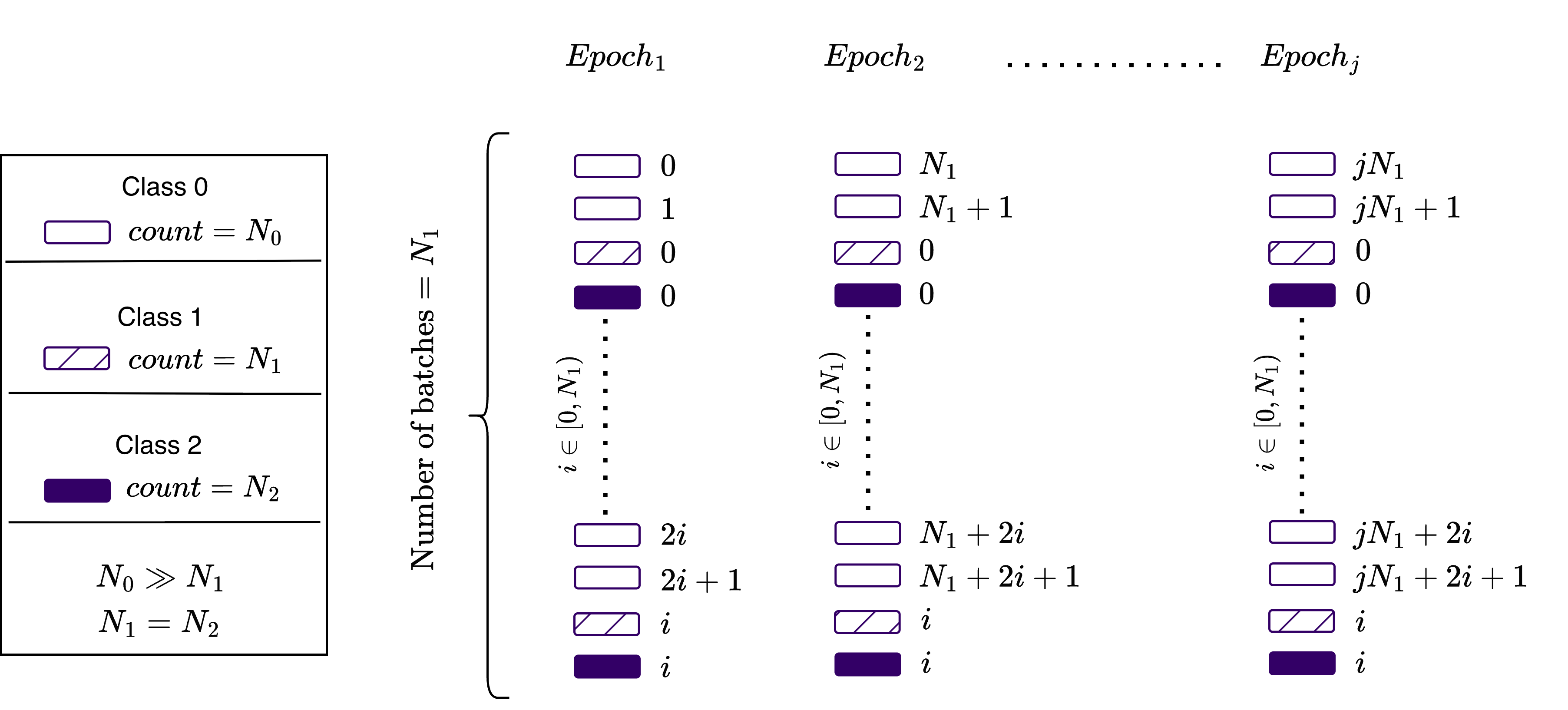
Standard random batching is replaced by a rotating batch strategy: each batch contains a fixed ratio (2:1:1) of class 0, 1, and 2 samples, with class 0 indices cyclically shifted across epochs. This ensures uniform exposure to majority class samples and consistent representation of minority classes, stabilizing gradient signals and preventing overfitting to dominant patterns.
Figure 2: Rotating batch configuration, cyclically shifting class 0 indices to ensure balanced and diverse batch composition across epochs.
Experimental Setup
Models are trained for 150 epochs on NVIDIA A100 GPUs, using Adam optimizer (1×10⁻⁵) and cosine annealing. The training/validation split is patient-wise (80/20). Comparative experiments include backbone selection, loss function variants (CE, weighted CE, focal, ordinal), regularization, and DFT-based frequency fusion.
Results
Backbone Diversity
No single architecture dominates across all artifact types. DenseNet169 achieves highest F1 for Zipper, Positioning, and Noise (0.844, 0.853, 0.872), while ResNet18 excels in Banding, Motion, and Contrast (0.947, 0.736, 0.822). MedNeXtS underperforms on Motion and Distortion. MLMambaOut, a single-backbone multi-label model, is consistently less effective.
Loss Function and Batching Impact
Weighted cross-entropy and ordinal loss outperform standard CE in baseline settings. However, when combined with BRIQA's rotating batching and gradient reweighting, standard CE achieves the highest mean F1 (0.799), macro F1 (0.706), and robust micro/weighted scores. Rotating batching is critical for generalization, especially for minority classes.
Artifact-Specific Gains
BRIQA yields substantial improvements in macro F1 for Noise (+0.430), Zipper (+0.098), Positioning (+0.097), Contrast (+0.217), Motion (+0.022), and Banding (+0.012). Weighted and micro metrics also improve, with the most pronounced gains in underrepresented artifact categories. Banding, while achieving the highest weighted/micro F1, shows less macro improvement due to its prevalence.
Discussion
Architectural Specialization
Empirical results confirm that backbone specialization is advantageous. ResNet's residual connections favor global artifact detection, while DenseNet's feature concatenation preserves local detail, aiding detection of textural and localized artifacts. This supports a multi-model approach over monolithic architectures for heterogeneous artifact patterns.
Loss and Augmentation Strategies
Gradient-based reweighting obviates the need for explicit class weighting or focal loss, allowing standard CE to perform optimally under balanced batch exposure. Rotation augmentation yields inconsistent benefits; in some settings, it degrades performance, likely by disrupting spatial integrity or introducing noise, especially when regularization is strong.
Batching and Imbalance
Rotating batching is a key innovation, systematically cycling majority class samples and enforcing minority class representation. This stabilizes training, prevents overfitting, and enhances sensitivity to rare artifact severities, which is critical for clinical reliability.
Frequency-Domain Fusion
DFT-based fusion provides complementary spectral features, improving macro metrics but not surpassing the best spatial-only configurations. More sophisticated fusion mechanisms (e.g., attention-based) may be required to fully leverage frequency information.
Computational Considerations
DenseNet-based models require 0.008–0.016 s/sample and 740 MB GPU memory; ResNet18 variants require 0.021 s and 4.3 GB; MedNeXtS for Distortion requires 0.041 s and 7.2 GB. The multi-architecture approach increases computational overhead but is justified by performance gains.
Conclusion
BRIQA advances automated pediatric brain MRI IQA by integrating architectural diversity, gradient-based loss reweighting, and rotating batch construction. The framework demonstrates improved generalization and sensitivity to artifact severity, particularly for underrepresented classes. Future directions include dynamic ensemble methods, artifact-specific expert models, and clinical validation on larger, multi-center datasets. Limitations include increased computational complexity and potential generalization constraints due to dataset size and simulated artifacts. BRIQA's methodological contributions—especially rotating batching and gradient reweighting—are broadly applicable to other imbalanced medical imaging tasks.