- The paper demonstrates a novel spectroscopic eclipse mapping technique using JWST to derive 2D thermal maps and identify distinct atmospheric regions on WASP-18b.
- Methodology involves the Eigenspectra approach combined with k-means clustering and atmospheric retrieval frameworks (HyDRA, Pyrat Bay) to extract precise thermal inversions and chemical signatures.
- Results reveal a hot substellar hotspot with a strong thermal inversion and a cooler ring region that challenge existing GCM predictions and illuminate complex heat transport processes.
Multidimensional Thermal and Chemical Mapping of WASP-18b with JWST Spectroscopic Eclipse Data
Introduction
This study presents a spectroscopic eclipse map of the ultra-hot Jupiter WASP-18b, leveraging JWST/NIRISS SOSS observations to resolve the planet's atmospheric structure in both horizontal and vertical dimensions. The analysis utilizes the Eigenspectra method to extract wavelength-dependent 2D brightness temperature maps, followed by clustering to identify regions with distinct spectral signatures. Atmospheric retrievals are then performed on these spatially resolved spectra using HyDRA and Pyrat Bay frameworks. The results provide direct constraints on the thermal gradients and chemical abundances across the dayside hemisphere, offering new insights into the interplay of radiative, chemical, and dynamical processes in highly irradiated exoplanet atmospheres.
Methodology: Spectroscopic Eclipse Mapping
The Eigenspectra approach decomposes the observed time-resolved spectra during secondary eclipse into a set of orthogonal light curve components, each corresponding to a spatial map on the planet. For each of 25 wavelength bins spanning 0.85–2.85 μm, 2D brightness temperature maps are fitted to the data, with the number of free parameters determined by the Bayesian Information Criterion. The resulting maps are then stacked, and k-means clustering is applied to identify regions with similar spectral shapes, yielding three principal groups: hotspot, ring, and outer regions.
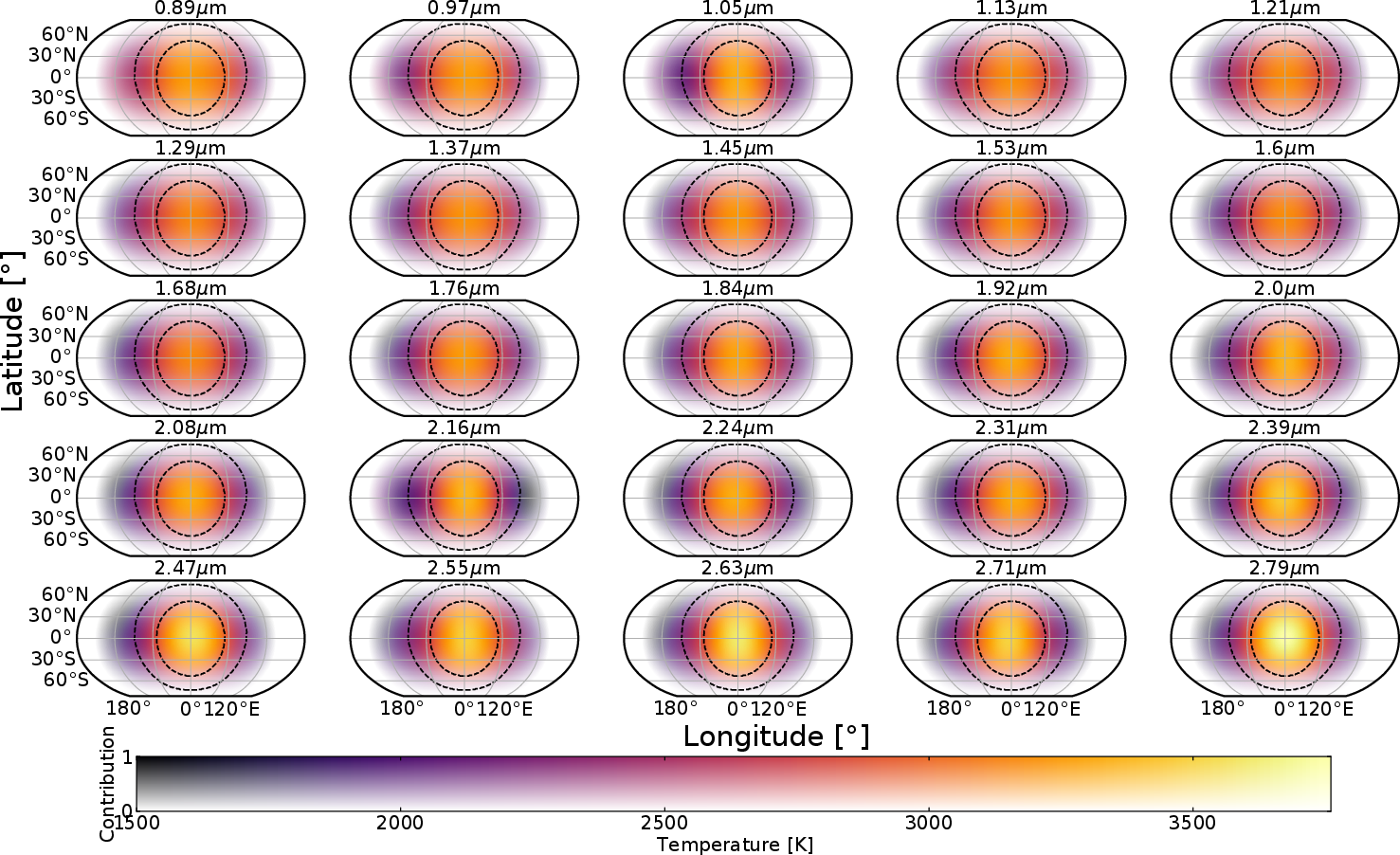
Figure 1: Two-dimensional brightness temperature maps and light curve fits for each of the 25 spectroscopic bins, revealing spatial and spectral structure across WASP-18b's dayside.
Longitudinal profiles are extracted by latitude-weighted averaging, and compared against GCM predictions (SPARC/MITgcm and RM-GCM) processed to remove eclipse-mapping null space components. The Eigenspectra method robustly identifies spatially distinct regions, with the grouping validated by MCMC sampling and signal-to-noise analysis.
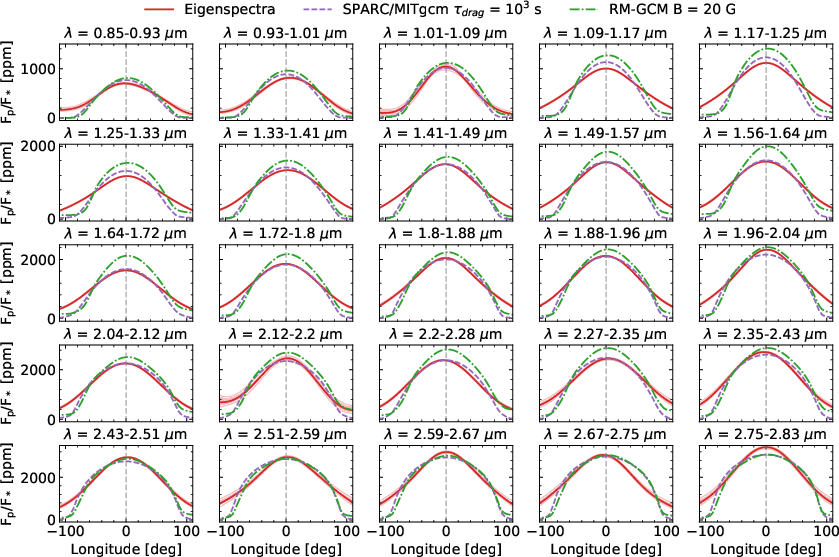
Figure 2: Retrieved longitudinal brightness profiles at each wavelength, compared to GCMs with different drag prescriptions; both data and models show small hotspot offsets and steep temperature gradients.
Results: Horizontal and Vertical Structure
The Eigenspectra mapping reveals three concentric regions centered on the substellar point. The hotspot region exhibits the highest brightness temperatures (up to 3362 K), while the ring region is significantly cooler (down to 2441 K), with the outer region contributing minimally to the observed flux due to limited visibility during the observation.
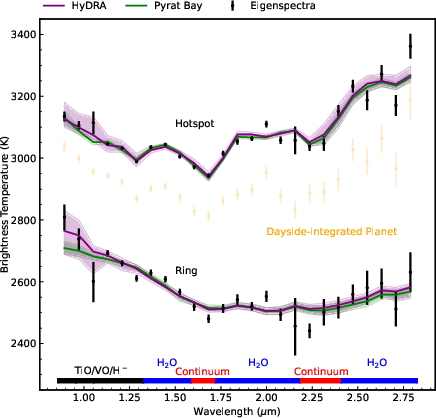
Figure 3: Emission spectra from the hotspot and ring groups bracket the full dayside-integrated spectrum; the hotspot is ∼150 K hotter, the ring ∼400 K colder than the average.
Atmospheric retrievals on the hotspot spectrum indicate a strong thermal inversion at pressures near 1 bar, consistent with the presence of optical absorbers (H−, TiO, VO) and a water abundance marginally lower than the hemispheric average. The detection significance for optical opacity sources is 5.1σ in the hotspot, compared to 4.6σ in the dayside average. The ring region shows colder temperatures and poorly constrained chemical abundances, with retrievals sensitive to model assumptions and geometric effects.
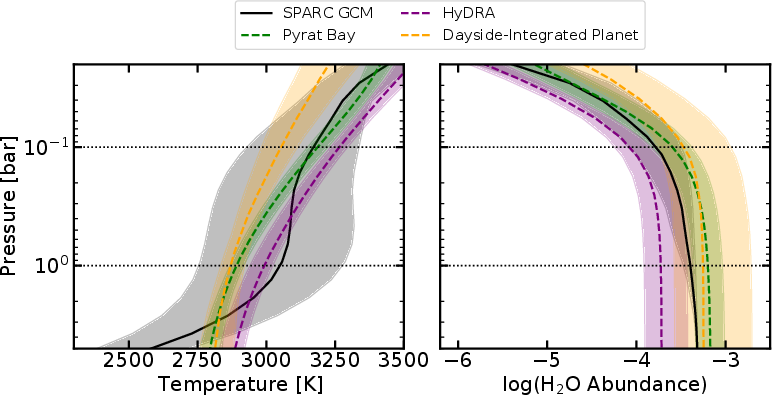
Figure 4: The hotspot group shows a slightly hotter T-P profile and lower H2O abundance than the full dayside-integrated result, consistent with increased thermal dissociation.
Comparison with General Circulation Models
The observed longitudinal profiles and temperature gradients are broadly consistent with GCMs incorporating atmospheric drag, which predict small hotspot offsets and steep substellar-to-limb gradients. However, the Eigenspectra maps show warmer limb temperatures than predicted, suggesting enhanced day-night heat transport potentially due to hydrogen dissociation and/or the presence of nightside clouds—effects not fully captured in current GCMs.
Retrievals and Model Sensitivities
Atmospheric retrievals using HyDRA and Pyrat Bay on the hotspot group yield well-constrained water abundances (lognH2O∼−3.2 to −3.7) and sub-solar metallicities, in agreement with previous hemisphere-integrated analyses. The ring group retrievals, however, produce physically implausible results (e.g., extremely low H2O abundances and high C/O ratios), likely due to limitations in 1D modeling of regions with complex viewing geometry and thermal inhomogeneity. Inclusion of a dilution parameter improves fits but does not resolve underlying physical ambiguities.
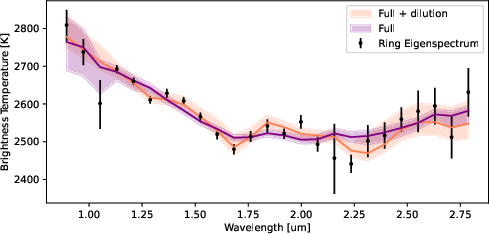
Figure 5: Comparison of ring group spectra fits with and without a dilution parameter; the standard+dilution model matches observed features but may obscure unaccounted-for physical effects.
Cross-Validation and Methodological Considerations
The ThERESA mapping method, which fits a 3D temperature grid to all spectroscopic light curves simultaneously, provides an independent check. While ThERESA reproduces the large-scale thermal structure, it struggles to match molecular emission features, highlighting the need for more flexible vertical profile parameterizations and improved treatment of contribution functions. Both methods underscore the importance of multidimensional mapping for robust atmospheric characterization.
Implications and Future Directions
This work demonstrates the feasibility and scientific value of multidimensional spectroscopic eclipse mapping with JWST. The results confirm theoretical predictions of water dissociation in the hottest regions and suggest that hydrogen dissociation and/or cloud formation play a significant role in shaping temperature gradients. The methodology enables isolation of regions with enhanced spectral features, potentially increasing chemical detection significance.
Future developments should focus on:
- Extending spectroscopic eclipse mapping to cooler exoplanets with larger hotspot offsets and more pronounced chemical gradients.
- Improving retrieval frameworks to account for non-uniform viewing geometry and thermal inhomogeneity.
- Integrating multidimensional mapping with GCM outputs to validate and refine model assumptions.
- Systematic studies of wavelength binning effects and simultaneous systematics correction and mapping.
Conclusion
The spectroscopic eclipse mapping of WASP-18b with JWST/NIRISS provides direct constraints on the planet's horizontal and vertical atmospheric structure, revealing a thermally inverted hotspot and a cooler ring region with complex chemical signatures. The results highlight the interplay of radiative, chemical, and dynamical processes in ultra-hot Jupiter atmospheres and establish a framework for future multidimensional characterization of exoplanets. This approach will be instrumental in constraining atmospheric dynamics, chemical transitions, and energy transport mechanisms across a diverse population of irradiated giant planets.