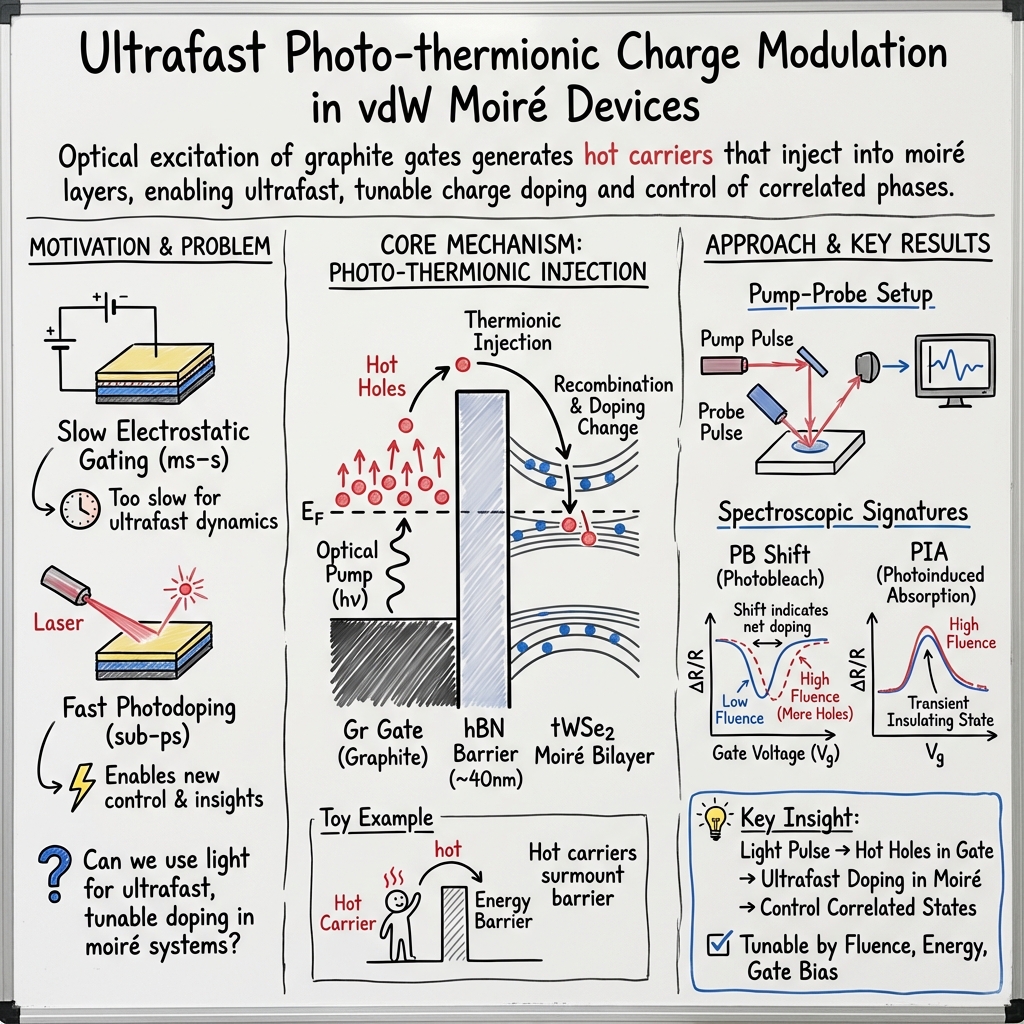
- The paper introduces a photo-thermionic emission mechanism that enables ultrafast charge-doping in twisted WSe2 bilayers.
- It employs transient reflectance spectroscopy to capture charge transfer dynamics spanning picoseconds to milliseconds.
- The study shows how tuning excitation energy, fluence, and gate bias can control carrier modulation in vdW heterostructures for optoelectronic applications.
Ultrafast Charge-Doping via Photo-Thermionic Injection in van der Waals Devices
Introduction
The exploration of quantum phenomena in van der Waals (vdW) heterostructures composed of two-dimensional (2D) materials has gained significant attention within the scientific community. These structures, including moiré superlattices, demonstrate a host of fascinating correlated quantum phases such as Mott insulators, generalized Wigner crystals, and quantum Hall states. The paper "Ultrafast Charge-Doping via Photo-Thermionic Injection in van der Waals Devices" (2510.21008), investigates the dynamic interaction of these systems under femtosecond laser excitation, specifically examining ultrafast photodoping in dual-gated twisted WSe2 bilayers. The authors utilize transient reflectance techniques to determine the mechanisms governing photodoping in vdW devices and highlight the role of photo-thermionic emission.
Photo-Thermionic Emission Mechanism
The study introduces a photo-thermionic emission process whereby optical excitation induces hole injection from the graphite gates into the twisted WSe2 bilayers. This mechanism is facilitated by the formation of a hot-carrier distribution within the graphite gates, overcoming the energy barrier provided by hexagonal boron nitride (hBN) spacers and subsequently resulting in interlayer charge transfer. Notably, this process provides insights into the potential modulation of carrier densities within the moiré superlattices by transiently altering the doping density.
Spectral and Temporal Signatures
The analysis centers on transient reflectance spectroscopy to track the charge-doping dynamics at microsecond timescales. Three key spectral features indicate successful photo-induced hole injection: shifts in gate voltages where correlated insulator signatures are detectable, persistent optical signatures of charge diffusion and accumulation, and evidence of photoinduced absorption hinting at correlated insulator formation. This characterization encompasses photodoping temporal dynamics ranging from picoseconds to milliseconds, offering a comprehensive view of the ultrafast interactions underpinning these phenomena.
Impact and Implications
The findings demonstrate robust control over the hole injection process by tuning external parameters such as excitation energy, fluence, and gate bias. This controllability underscores the viability of photo-thermionic emission as a rapid modulation strategy for carrier densities in quantum phases of 2D materials, representing a significant advancement over traditional electrostatic gating methods. The work has profound implications for designing ultrafast optoelectronic devices that exploit the tunable properties of vdW heterostructures.
Conclusion
The investigation into ultrafast charge-doping via photo-thermionic injection in van der Waals devices represents a pivotal step in utilizing the intricate structure of vdW heterostructures for the control and manipulation of quantum phases. Through detailed spectroscopic analysis, the authors reveal a potent mechanism for achieving dynamic carrier modulation with implications for future advancements in optoelectronic device engineering and the continued exploration of non-equilibrium quantum phenomena in 2D materials.