- The paper presents the detection and joint photometric and radial velocity analysis of two transiting exoplanets around thick disk star TOI-2345, spanning the radius valley.
- It employs TESS, CHEOPS, and HARPS data with advanced modeling techniques to accurately determine planetary masses, radii, densities, and atmospheric evolution.
- The findings challenge current planet formation theories by revealing a compositional link between host star and planets in a metal-poor, thick disk environment.
Ultra-Short Period Super-Earth and Sub-Neptune Spanning the Radius Valley Around the Thick Disk Star TOI-2345
Introduction and Context
The discovery and characterization of exoplanets orbiting chemically and kinematically distinct stellar populations is essential for constraining planet formation and evolution models. The paper presents the detection and detailed analysis of two transiting planets around TOI-2345, a metal-poor K-dwarf with thick disk kinematics. The system comprises TOI-2345 b, an ultra-short period (USP) super-Earth (P=1.05 d, R=1.50R⊕, M=3.49M⊕), and TOI-2345 c, a sub-Neptune (P=21.06 d, R=2.45R⊕, M=7.27M⊕), with the two planets straddling the radius valley. The host's thick disk membership is established via precise Gaia astrometry and kinematic analysis, providing a rare opportunity to probe planet formation in an old, α-enhanced, metal-poor environment.
Observational Campaign and Data Analysis
The system was identified in TESS photometry, with follow-up from CHEOPS for high-precision transit characterization and HARPS for radial velocity (RV) mass measurements. The photometric and spectroscopic data were jointly modeled using the juliet framework, incorporating Gaussian process noise modeling for TESS data and template-matched RV extraction via s-bart to optimize precision. The BLS periodogram of the TESS lightcurve revealed two significant periodicities corresponding to the two planets.
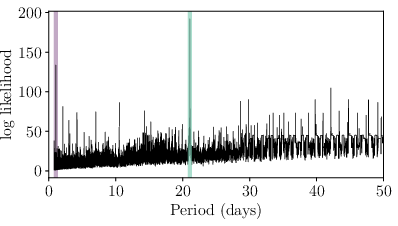
Figure 2: BLS periodogram of the TESS lightcurves of TOI-2345, with the two significant peaks corresponding to TOI-2345 b and c highlighted.
High-resolution SOAR imaging ruled out contaminating sources down to ΔI=5 mag at $1''$, ensuring the planetary radii are not underestimated due to blended light.
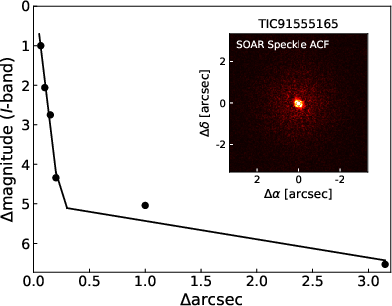
Figure 3: 5-σ detection sensitivity of the SOAR I-band observation of TOI-2345, confirming the absence of nearby contaminating stars.
No significant stellar activity or rotation period was detected in long-baseline ASAS-SN and WASP photometry, nor in HARPS activity indicators, supporting the planetary origin of the RV signals.
Planetary System Architecture and Joint Modeling
The joint photometric and RV analysis yields precise planetary parameters. TOI-2345 b is a dense, highly irradiated USP super-Earth (ρ=5.6−1.5+1.5 g/cm3, Teq=1478 K), while TOI-2345 c is a lower-density sub-Neptune (ρ=2.7−0.9+0.9 g/cm3, Teq=544 K). The two planets are widely separated in period, with no evidence for additional planets in the system from TTVs or RV residuals.
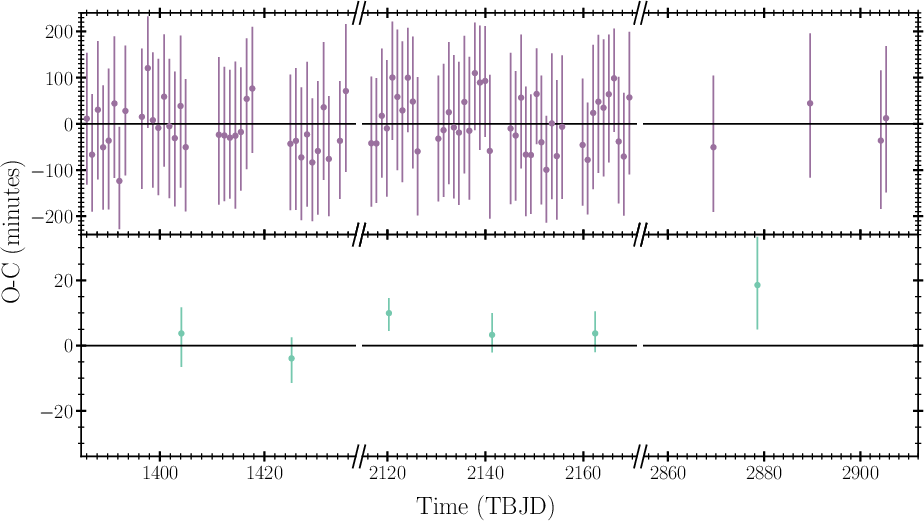
Figure 5: TTV analysis of TOI-2345, showing no significant transit timing variations for either planet.
The phase-folded transits and RV curves from the joint fit demonstrate the high S/N and precision of the characterization.
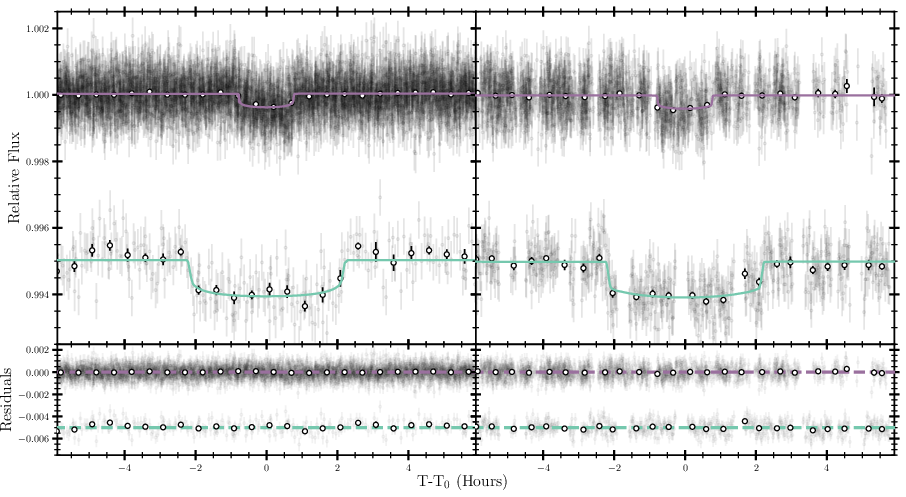
Figure 1: Phase-folded transits of TOI-2345 b (purple) and c (green) with the best-fit joint model.
Interior Structure and Atmospheric Evolution
The interior structures of both planets were modeled using the plaNETic framework, which leverages DNNs trained on a grid of planetary models with varying water and refractory content. Critically, the analysis incorporates devolatilized stellar abundances (via ExoInt) as priors for planetary composition, reflecting the expectation that refractory element ratios in planets mirror those of their host stars, modulo devolatilization.
For TOI-2345 b, both water-rich and water-poor priors yield a high mantle fraction, small core, and negligible atmosphere, consistent with complete atmospheric loss due to extreme irradiation. For TOI-2345 c, the water-rich prior allows for a significant water layer, but the water-poor prior yields a large rocky mantle and a modest H/He envelope (∼1% by mass).
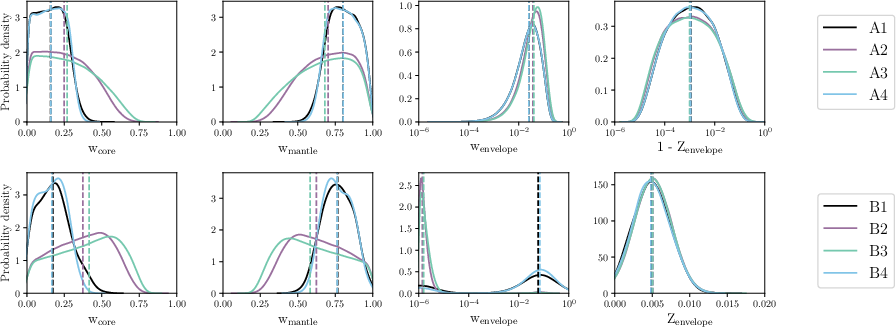
Figure 4: plaNETic posterior distributions for TOI-2345 b, showing the effect of different abundance priors on the inferred core, mantle, water, and atmosphere fractions.
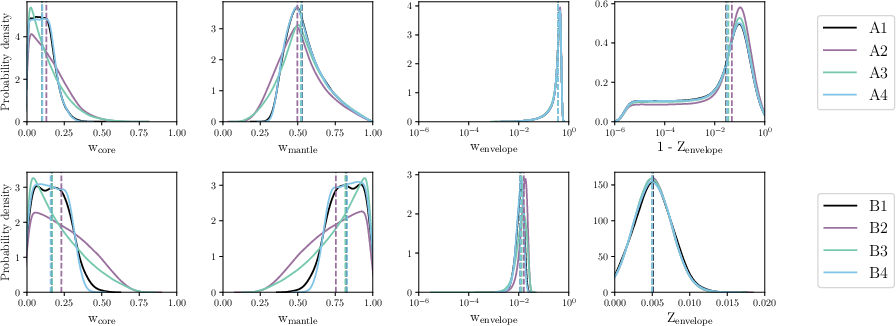
Figure 9: plaNETic posterior distributions for TOI-2345 c, illustrating the compositional degeneracy between water-rich and water-poor scenarios.
Atmospheric evolution modeling with PASTA, incorporating stellar rotation history and XUV-driven escape, confirms that TOI-2345 b has lost its primordial H/He envelope, while TOI-2345 c has retained most of its initial atmosphere.
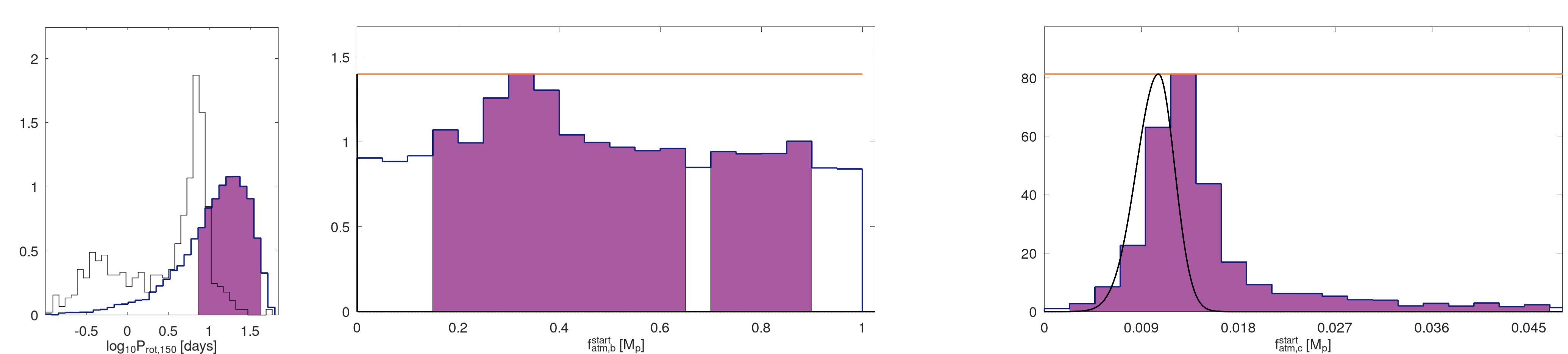
Figure 6: Posterior distributions from PASTA for the stellar rotation period at 150 Myr and the initial atmospheric mass fractions of TOI-2345 b and c.
Galactic Context and Population Implications
Kinematic analysis places TOI-2345 firmly in the thick disk, with an 85% probability, as visualized in the Toomre diagram.
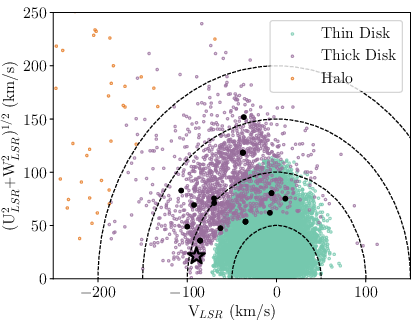
Figure 12: Toomre diagram showing the galactic kinematic classification of TOI-2345 and comparison stars.
Comparison with other well-characterized thick disk planetary systems reveals that TOI-2345 is one of only a handful of such systems with multiple small planets, and uniquely, its planets span the radius valley. The presence of a USP super-Earth and a widely separated sub-Neptune in a thick disk system is rare in both observed and synthetic populations, with population synthesis models predicting such architectures to be uncommon.
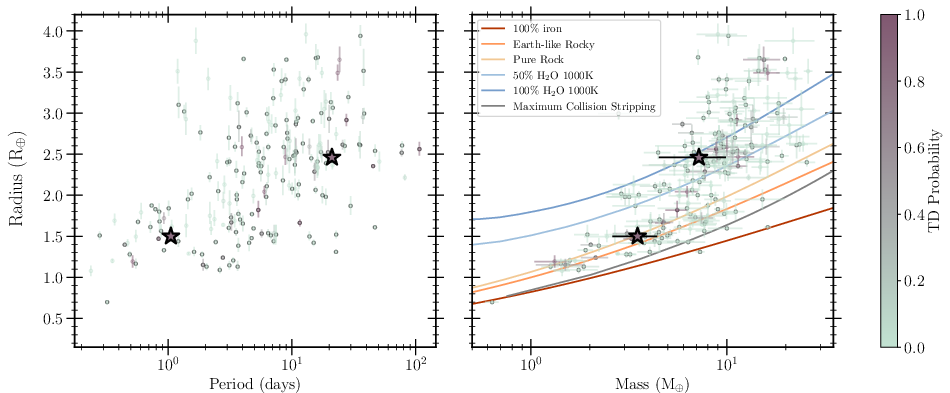
Figure 7: Comparison of TOI-2345 b and c to other well-characterized planets below 4R⊕, color-coded by host star thick disk probability. The planets span the radius valley and are highlighted as purple stars.
The system directly challenges predictions that small planets below the radius valley should be rare around thick disk stars, providing evidence against models that tie the radius valley's occurrence to galactic environment or stellar clustering.
Theoretical and Practical Implications
The detailed compositional modeling, leveraging devolatilized stellar abundances, supports a strong refractory element link between host star and planet, consistent with recent theoretical work. The negligible atmosphere of the USP planet and the modest envelope of the sub-Neptune are in line with expectations from photoevaporation and core-powered mass loss models, but the system's architecture—USP plus widely separated sub-Neptune—remains difficult to reproduce in current population synthesis, especially in metal-poor, thick disk environments.
The results have several implications:
- Planet formation in the thick disk: The existence of both a USP and a sub-Neptune spanning the radius valley around a thick disk star demonstrates that planet formation and migration mechanisms are robust to variations in galactic chemical evolution and initial disk conditions.
- Compositional link: The agreement between interior models using stellar and devolatilized abundances strengthens the case for a primordial compositional link, at least for refractory elements, between stars and their planets.
- Radius valley universality: The presence of planets spanning the radius valley in the thick disk suggests that the processes sculpting the valley (e.g., atmospheric escape) operate similarly across galactic populations.
- Architectural rarity: The wide period ratio and lack of intermediate planets in TOI-2345 are not commonly produced in synthetic populations, indicating either missing physics in models or a need for larger samples of thick disk systems.
Conclusion
The TOI-2345 system provides a benchmark for exoplanetary science in the context of galactic archaeology. The precise characterization of its USP super-Earth and sub-Neptune, both spanning the radius valley, in a thick disk environment, offers stringent constraints on planet formation, migration, and atmospheric evolution models. The system's architecture and compositional properties challenge several theoretical predictions, particularly regarding the frequency of small planets in the thick disk and the universality of the radius valley. As more thick disk planetary systems are discovered and characterized, the statistical significance of these findings will increase, enabling robust demographic and compositional studies across galactic populations.