- The paper presents new HST UV observations at ~1900 days that support a tidal disruption event as the origin for AT 2018cow.
- Accretion disk models fit the late-time UV lightcurve accurately, inferring an intermediate-mass black hole with a mass around 10^3.3 M☉.
- CSM interaction models are ruled out due to their inability to reproduce the persistent UV plateau, emphasizing the diagnostic value of prolonged monitoring.
AT 2018cow at ~5 Years: Evidence for a Tidal Disruption Event Origin
Introduction
AT 2018cow, the archetype of Luminous Fast Blue Optical Transients (LFBOTs), remains a subject of debate regarding its physical origin. LFBOTs are characterized by rapid photometric evolution, high peak luminosities (M≲−19), and blue, featureless early spectra. AT 2018cow, at a distance of 63 Mpc, has been extensively monitored across the electromagnetic spectrum, providing an unparalleled dataset for constraining progenitor models. The primary contenders for its origin include core-collapse supernovae with compact object engines, tidal disruption events (TDEs) involving intermediate-mass black holes (IMBHs), and interaction-powered supernovae with dense circumstellar material (CSM).
Recent late-time ultraviolet (UV) observations with the Hubble Space Telescope (HST) have revealed persistent UV emission several years post-explosion, inconsistent with standard supernova models but compatible with accretion disk emission from a TDE. This paper presents new HST data at ∼1900 days, analyzes the photometric evolution, and compares the results to predictions from accretion disk models and CSM interaction scenarios.
Observational Data and Photometric Analysis
The new HST/WFC3 observations span four filters (F225W, F336W, F555W, F814W) at epochs 1900 and 2043 days post-discovery. Photometry was performed using both aperture and PSF-fitting techniques, with careful alignment to previous epochs to ensure consistency. The UV bands (F225W, F336W) show only marginal fading, with significant decay detected solely in F336W. Optical bands are dominated by an underlying extended source, as evidenced by discrepancies between aperture and PSF photometry.
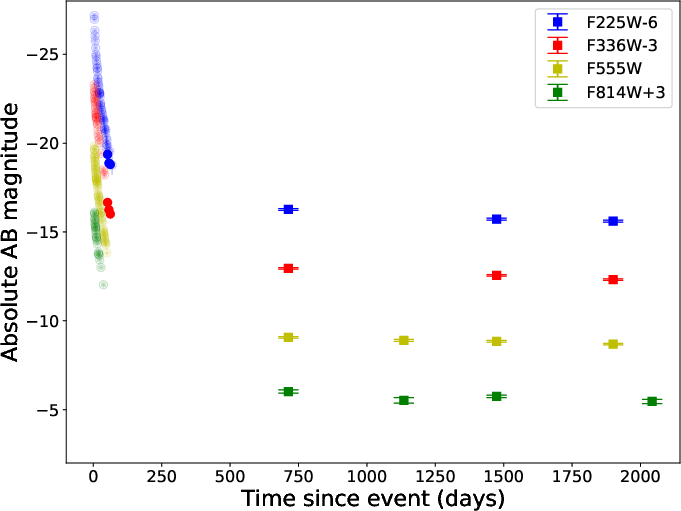
Figure 1: Lightcurves in four HST filters, showing the slowed decay rate at late times and the emergence of a UV plateau consistent with TDEs.
The UV plateau phase, now extending to nearly 2000 days, is a salient feature of TDEs around SMBHs and IMBHs, as established in recent population studies. The amplitude and duration of this plateau correlate with black hole mass via Lplat∝MBH2/3, and the observed luminosity in AT 2018cow implies an IMBH of MBH∼103.3±0.4M⊙.
Accretion Disk Modeling and TDE Scenario
The disk model, previously fit to early epochs, is extrapolated to the new data without further parameter adjustment. The observed UV magnitudes at 1900 days are fully consistent with the model predictions, supporting the hypothesis of a TDE origin involving the tidal disruption of a low-mass star by an IMBH.
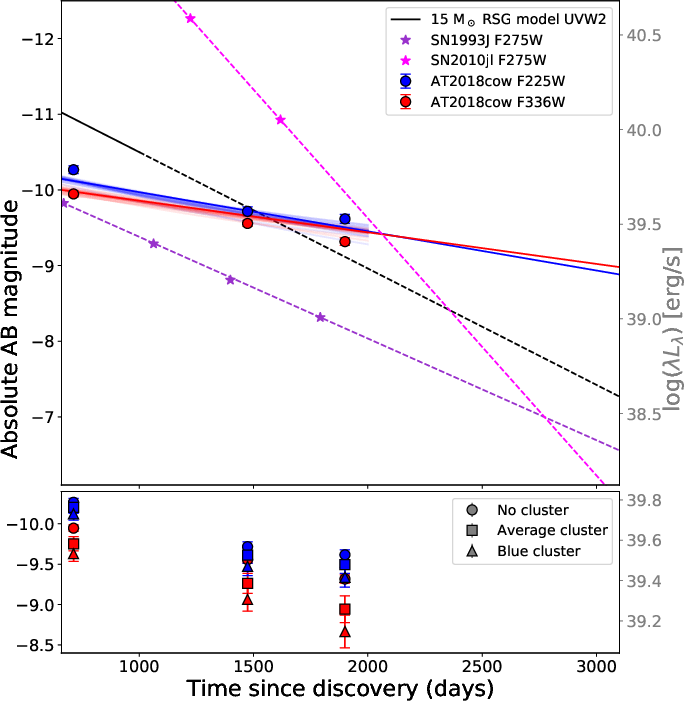
Figure 2: Late-time UV lightcurve of AT 2018cow in F225W and F336W, with accretion disk model predictions and comparison to interacting supernovae.
Disk models incorporating various assumptions about underlying stellar clusters (average and blue SEDs) yield black hole masses consistent within uncertainties, demonstrating robustness to host galaxy contamination. The plateau luminosity is only weakly dependent on the disrupted star's properties, allowing for alternative scenarios such as white dwarf disruptions with slightly higher black hole masses.
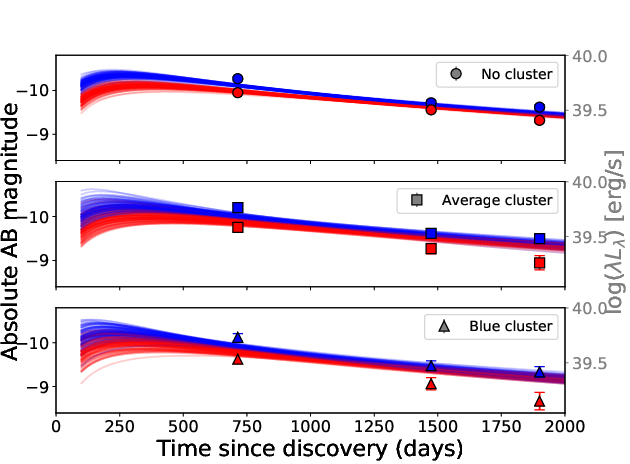
Figure 3: UV lightcurves and disk model fits under different assumptions for underlying cluster contribution, showing consistent black hole mass estimates.
Comparison to Supernova-CSM Interaction Models
Interacting supernovae, both observationally and in synthetic models, exhibit more rapid UV decay and lower late-time luminosities than AT 2018cow. Even the brightest known SN-CSM interactions, when extrapolated, fail to reproduce the persistent UV plateau observed. The difference in decay rates between TDE disk models and CSM interaction models will become more pronounced at later epochs, providing a clear discriminant in future observations.
Implications and Future Directions
The consistency of late-time UV emission with TDE disk models, the slow decay rate, and the inferred IMBH mass collectively strengthen the case for a tidal disruption origin for AT 2018cow. The results challenge the viability of CSM interaction models, especially as the UV plateau persists. However, the possibility of a blue underlying cluster contributing to the UV flux introduces some degeneracy, which can be resolved with further late-time monitoring.
Theoretical implications include the extension of TDE phenomenology to IMBHs in non-nuclear environments and the need for improved modeling of disk evolution and host galaxy contamination. Practically, the results motivate continued UV monitoring of LFBOTs and similar transients to exploit the diagnostic power of late-time emission.
Conclusion
The new HST observations of AT 2018cow at ∼5 years post-explosion provide additional evidence for a TDE origin, with the UV lightcurve matching accretion disk model predictions and diverging from CSM interaction scenarios. The inferred black hole mass remains consistent with previous estimates, and the UV plateau persists as a robust signature of tidal disruption. Future observations at ∼3000 days will be decisive in fully ruling out alternative models and refining our understanding of LFBOT progenitors.

