- The paper reports the first direct measurement of quasar-galaxy clustering at z≈7.3, setting new constraints on host halo masses and quasar duty cycles.
- It employs deep JWST/NIRCam imaging and NIRSpec/MSA spectroscopy to identify 51 z>5 galaxies and assess spatial overdensities around high-redshift quasars.
- The results indicate a low UV-luminous duty cycle (~0.1%) and suggest rapid, possibly obscured, SMBH growth in the early universe.
Quasar-Galaxy Clustering at z≃7.3: Environmental Constraints on Early SMBH Growth
Introduction
The assembly of supermassive black holes (SMBHs) in the first Gyr of cosmic history remains a central challenge in extragalactic astrophysics. The environments of high-redshift quasars, particularly their association with large-scale structure and dark matter halos, provide critical constraints on SMBH formation and growth models. This study presents the first direct measurement of quasar-galaxy clustering at z≃7.3 using JWST/NIRCam imaging and NIRSpec/MSA spectroscopy of two quasar fields, J0252−0503 (z=7.00) and J1007+2115 (z=7.51). The analysis yields new constraints on the clustering amplitude, host halo masses, and duty cycles of UV-luminous quasars at the redshift frontier.
Observational Strategy and Galaxy Identification
The observational program combined deep JWST/NIRCam imaging in four filters with ground-based optical data to select high-redshift galaxy candidates via Lyman-break and color criteria, followed by spectroscopic confirmation with NIRSpec/MSA. The selection function was carefully characterized, accounting for photometric completeness, MSA slit assignment, and spatial coverage.
A total of 51 z>5 galaxies were spectroscopically confirmed across both fields, with 8 galaxies found within a ΔvLOS=±1500 km s−1 window of the quasars, and 8 additional galaxies in the background. The galaxy sample spans MUV∼−19 to −23, with [OIII]λ5008 luminosities down to 0.5×1042 erg s−1.
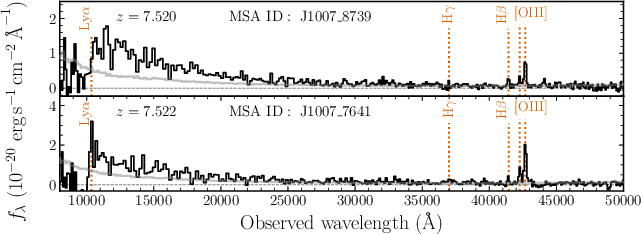
Figure 1: Discovery spectra of galaxies within ∣ΔvLOS∣=1500 km s−1 of the target quasars, showing emission line features and Lyman-α breaks.
The spatial distribution of galaxies relative to the quasars is visualized in NIRCam composites, highlighting the diversity of environments and the presence of close companions.
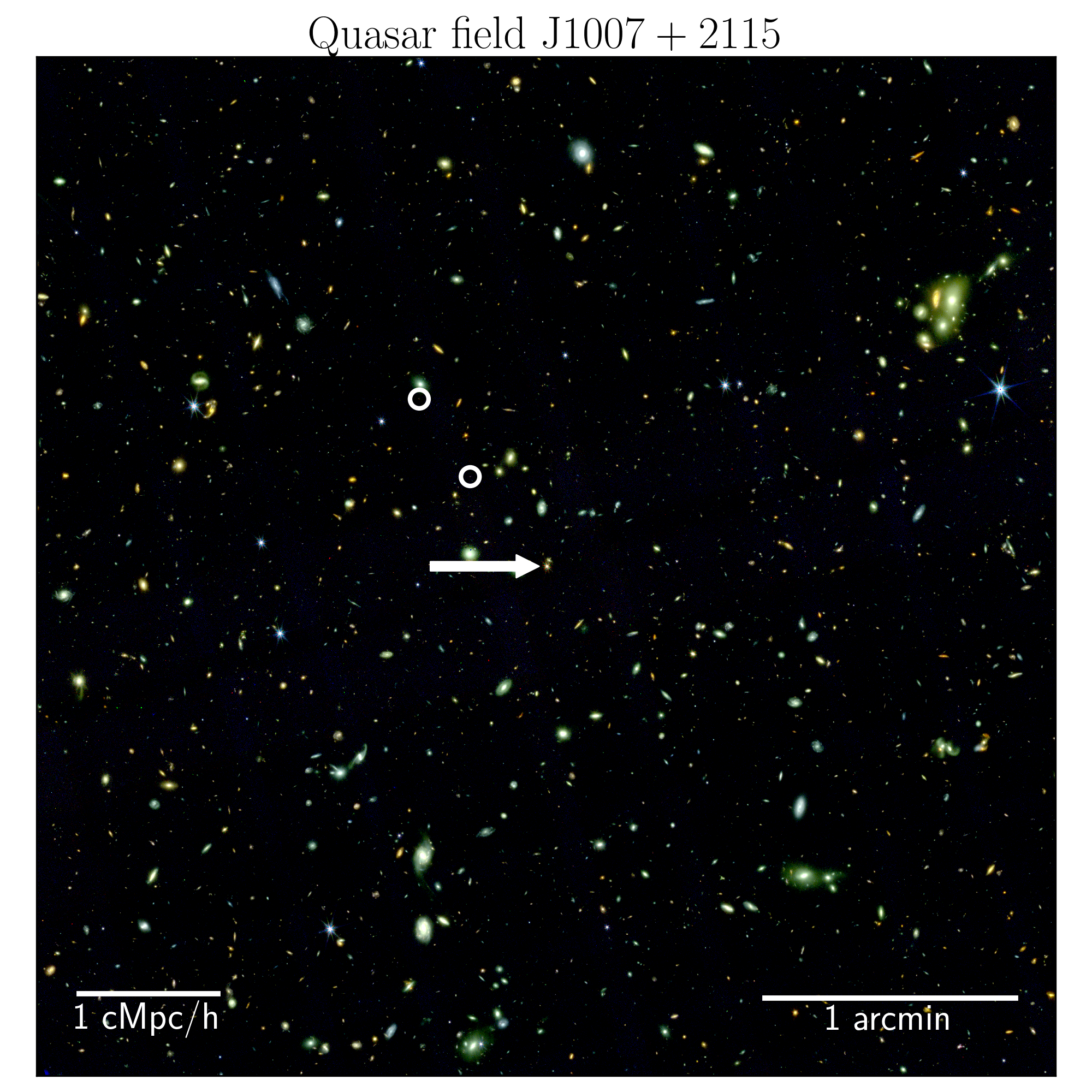
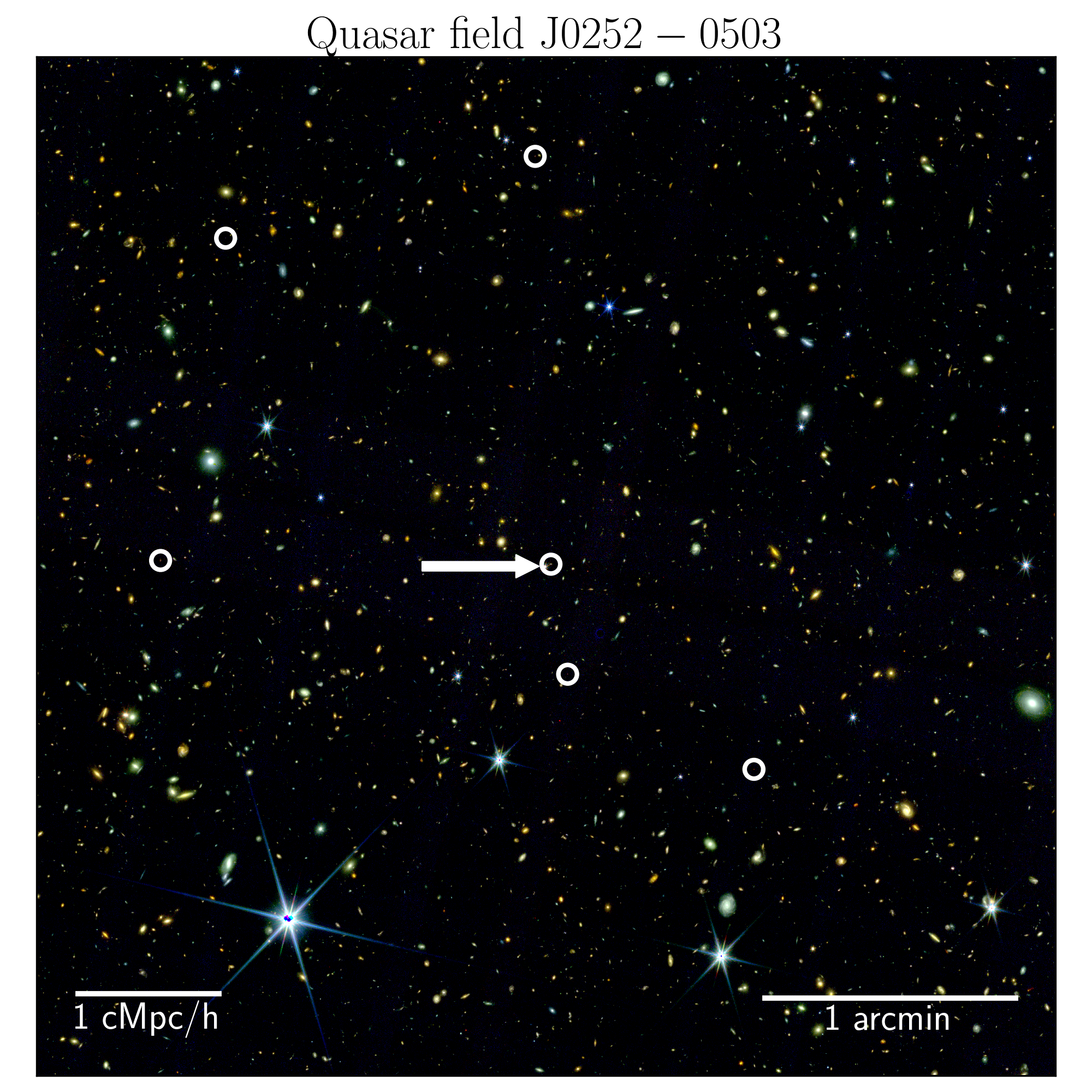
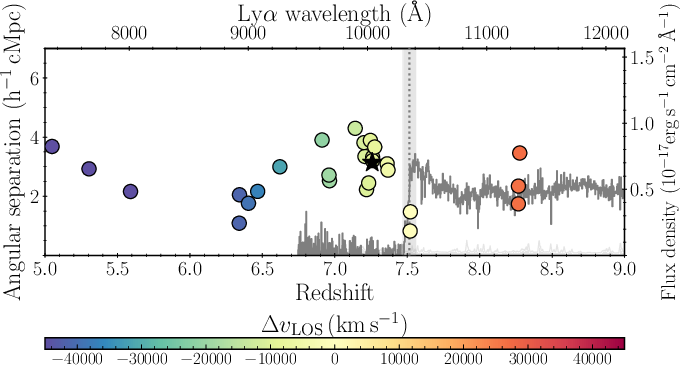
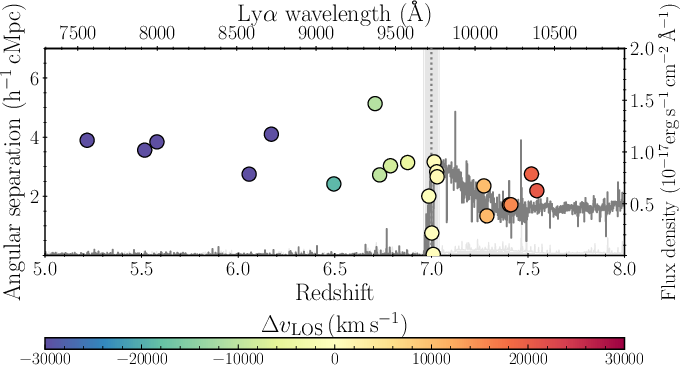
Figure 2: JWST NIRCam composite images of the J1007+2115 and J0252-0503 fields, with quasar positions and clustering galaxies marked.
A particularly notable system is the companion galaxy J0252_8713, located at a projected separation of 6.6 pkpc and ΔvLOS≈360 km s−1 from J0252−0503, representing a compelling candidate for a quasar-galaxy merger at z=7.
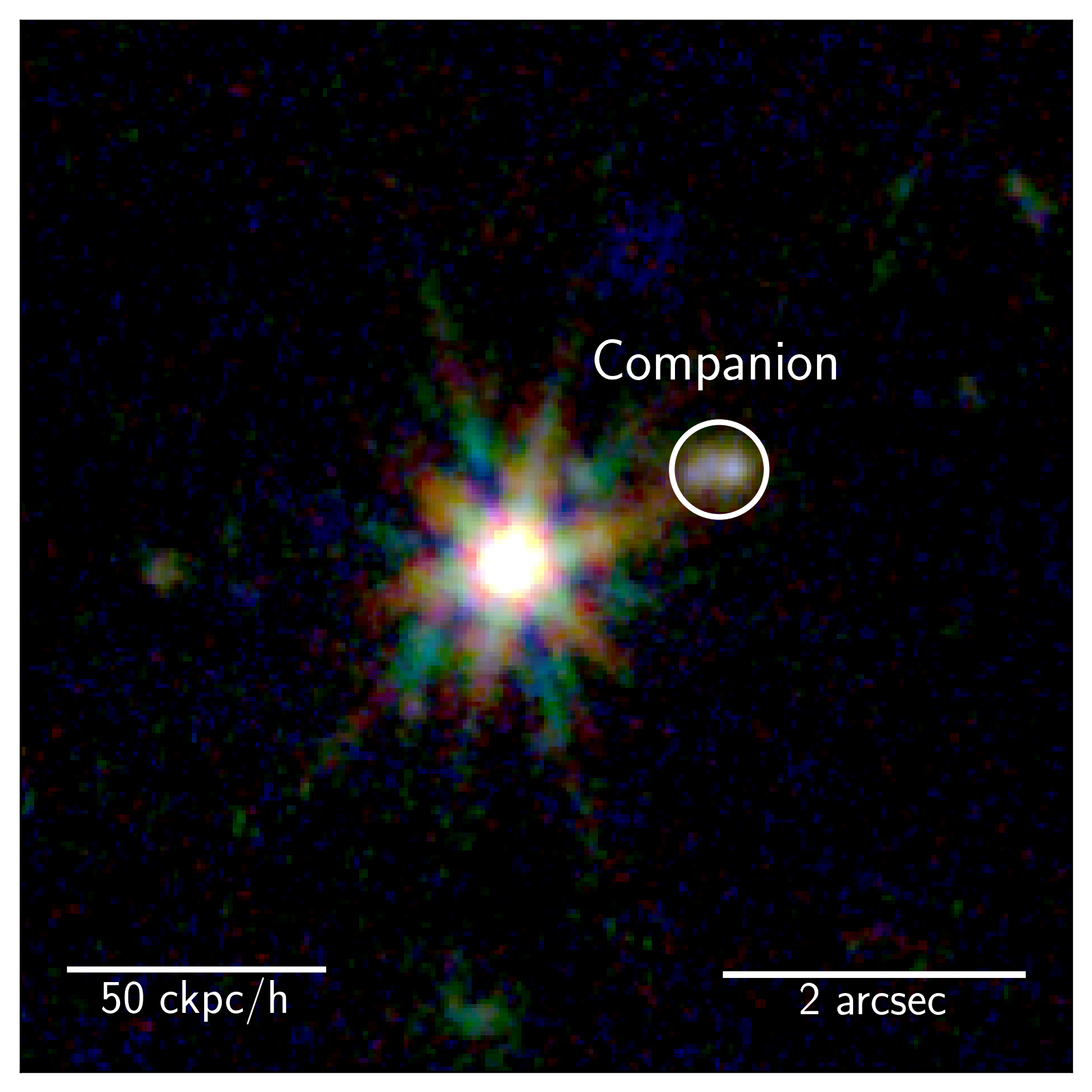
Figure 3: NIRCam cutout of J0252-0503 and its immediate environment, highlighting the close companion galaxy J0252_8713.
Clustering Measurement and Methodology
The quasar-galaxy cross-correlation function was measured in four logarithmically spaced radial bins out to 4.5 h−1 cMpc, using a cylindrical volume approach and correcting for the detailed selection function. The expected number of random quasar-galaxy pairs was estimated from the z∼7 UV luminosity function integrated to MUV=−19.2, yielding background densities of 4−6×10⁵ Gpc−3.
The observed environments are overdense by a factor of δ∼4 within 4.5 h−1 cMpc, with significant field-to-field variation (δ=4.8 for J0252−0503, δ=1.8 for J1007+2115), consistent with strong cosmic variance.
The cross-correlation function was modeled as a power law, ξQG(r)=(r/r0QG)−γ, with fixed slope γ=2.0. The best-fit cross-correlation length is r0QG≈7.6−1.6+1.7 h−1 cMpc.
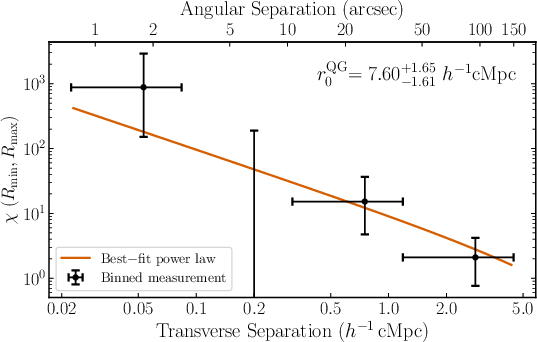
Figure 4: Volume-averaged cross-correlation function χ as a function of transverse separation, with the best-fit power-law model overplotted.
Assuming that quasars and galaxies trace the same underlying dark matter field, the quasar auto-correlation length was inferred using literature values for the galaxy auto-correlation length (r0GG∼5 h−1 cMpc), yielding r0QQ∼11−13 h−1 cMpc.
Host Halo Masses and Duty Cycles
The inferred quasar auto-correlation length was mapped to a minimum host halo mass using a standard halo model. The result is log10(Mhalo,min/M⊙)=11.6±0.6, corresponding to a cumulative halo abundance significantly exceeding the observed quasar number density at z∼7.3.
The implied quasar duty cycle is fduty≈0.1%, corresponding to a UV-luminous phase of ∼0.35 Myr. This is consistent with independent constraints from proximity zone and damping wing analyses, but is in tension with the need to assemble >109 M⊙ SMBHs within 700 Myr of cosmic time.
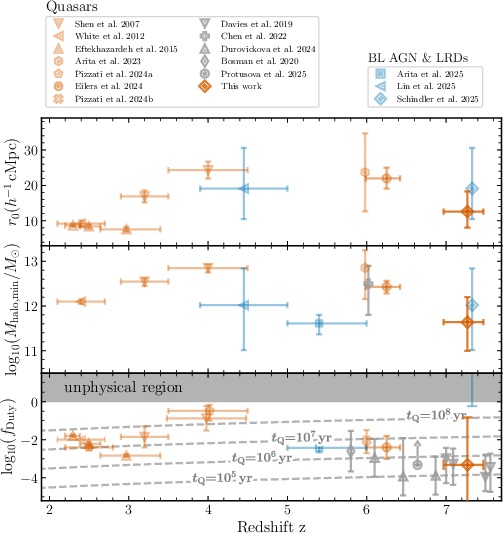
Figure 5: Redshift evolution of the quasar auto-correlation length, minimum host halo mass, and duty cycle, with results from this work and previous studies.
Systematic Uncertainties and Robustness
The analysis is limited by small number statistics (8 clustering galaxies in 2 fields) and significant cosmic variance. Systematic uncertainties arise from the choice of the faint-end limit of the luminosity function and the adopted galaxy auto-correlation length. Varying these parameters within plausible ranges changes the inferred r0QG and Mhalo,min by ∼0.2−0.3 dex, but the statistical uncertainties dominate.
The observed decline in host halo mass at z>7 compared to z=6−7 is robust to these systematics, but the sample size precludes definitive statements about the redshift evolution of quasar clustering.
Implications for Early SMBH Growth and Obscured AGN
The low duty cycle and short UV-luminous lifetimes inferred for z>7 quasars exacerbate the challenge of assembling massive SMBHs by this epoch. This result supports scenarios in which SMBH growth is either radiatively inefficient (low ϵ) or predominantly occurs in heavily obscured phases, with only brief unobscured quasar episodes.
The abundance of compact, red, broad-line AGN ("Little Red Dots") at z>5 revealed by JWST, with number densities 100× higher than UV-selected quasars, may represent the obscured growth phase required by these duty cycle constraints. However, clustering analyses indicate that LRDs typically reside in lower-mass halos than UV-luminous quasars, and their role as direct progenitors remains debated.
The diversity of quasar environments, including the discovery of close companions and overdensities around some LRDs, suggests a complex interplay between SMBH fueling, mergers, and large-scale structure at early times.
Future Prospects
The methodology developed here demonstrates the feasibility of quasar-galaxy clustering measurements at z>7 with JWST, but highlights the need for larger samples to overcome cosmic variance and improve statistical precision. Upcoming wide-area surveys (e.g., Euclid) are expected to increase the sample of z>7 quasars, enabling more robust clustering analyses and a comprehensive view of SMBH-galaxy coevolution at the highest redshifts.
Conclusion
This study provides the first direct measurement of quasar-galaxy clustering at z≃7.3, constraining the typical host halo mass and duty cycle of UV-luminous quasars at the redshift frontier. The results indicate a possible decline in host halo mass at z>7, a low duty cycle (∼0.1%), and short UV-luminous lifetimes, consistent with rapid, possibly obscured SMBH growth. These findings have significant implications for models of early SMBH assembly and the interpretation of the emerging population of faint, red AGN in JWST surveys. Future work with larger samples and improved selection techniques will be essential to refine these constraints and elucidate the physical processes governing SMBH-galaxy coevolution in the early universe.

