- The paper models how GenAI adoption elevates job demands and burnout risk using a combined JD–R framework and PLS-SEM analysis.
- It found that increased organizational pressure and workload amplify burnout while availability of autonomy and training helps mitigate the stress.
- The mixed-methods study surveyed 442 developers and explained 40% of burnout variance, offering actionable insights for organizational change.
Modeling Developer Burnout with GenAI Adoption
The paper "Modeling Developer Burnout with GenAI Adoption" explores the intricacies of how Generative AI (GenAI) adoption influences developer burnout. Using the Job Demands–Resources (JD–R) model as an analytical framework, the study combines quantitative and qualitative methods to understand these dynamics.
Introduction to GenAI and Developer Burnout
The progressive integration of GenAI in software engineering promises efficiency boosts but raises concerns regarding developer well-being. The study uses Partial Least Squares–Structural Equation Modeling (PLS-SEM) to explore relationships between GenAI adoption and burnout. This is complemented by qualitative analyses of developers' insights into how GenAI influences their work demands and resources.
Methodology: Utilizing JD–R Model
The research followed a concurrent embedded mixed-methods design to harness both quantitative and qualitative data. PLS-SEM was employed to discover interrelations among job demands, resources, and burnout, underpinned by the JD–R theoretical framework. The study involved a survey of 442 developers and explored hypotheses regarding how GenAI shapes demands and resources.
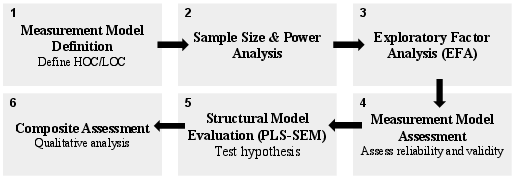
Figure 1: Overview of the analysis process for addressing RQ1.
Findings and Analysis
Quantitative Insights
- Job Demands and Burnout (H1): GenAI adoption heightens organizational pressures and workloads, correlating positively with burnout.
- Job Resources and Burnout (H2): Resources such as autonomy and learning opportunities counteract the pressures of GenAI, reducing burnout.
- AI Perceptions and Burnout (H3): Positive perceptions of AI capabilities help mitigate the feeling of burnout among developers.
The model explained around 40% of the variance in burnout (R2=0.398), indicating a complex interplay of factors influencing developer well-being.
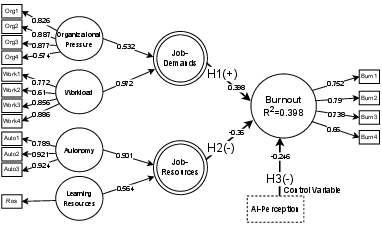
Figure 2: Outer loadings and path coefficients (p < 0.05 indicated by a full line). Higher order constructs (e.g., Job-Demands) are represented by double circles'' and have paths to their corresponding lower order constructs (e.g., Workload); a dashed rectangle representsControl Variable'' (e.g., AI-Perception).
Qualitative Insights
Open-ended survey responses highlighted developers' perceptions and experiences with GenAI adoption:
- Organizational Pressure: Developers felt pressured by management to adopt AI regardless of practical utility.
- Workload: GenAI sometimes increased workloads due to the need for additional validation and debugging of AI-generated content.
- Autonomy: Developers experienced varying levels of autonomy in AI usage, impacting their experience of stress and job satisfaction.
- Learning Resources: Access to training and organizational support differed, impacting the effective adoption of AI tools.
Influence of Developer Characteristics
The research also examined how developer characteristics, such as role, organization size, and seniority, affected their experiences with job demands, resources, and burnout:
- Organizational Pressure: Heightened for those in coding roles and larger organizations.
- Autonomy and Learning Resources: More prevalent in larger organizations and among senior developers, underscoring a disparity in resource distribution.
Implications for Practice and Research
The findings underscore several important implications:
- Workload Design: Organizations need to rethink performance metrics to incorporate AI-induced changes in workload, focusing on quality as well as quantity.
- Workforce Development: Emphasized the need for continuous learning opportunities and equitable access to AI training, particularly for less experienced developers.
- Team Workflow: Encouraged the creation of workflow adaptations that acknowledge the unique challenges posed by AI augmentation in collaboration settings.
Conclusion
This study sheds light on the nuanced impact of GenAI adoption within software development environments, particularly regarding developer burnout. It advocates for informed organizational practices that balance productivity gains with support structures to ensure developer well-being. By integrating quantitative models with qualitative insights from developers, this study provides a comprehensive view of how AI reshapes the fabric of software work environments, emphasizing the importance of sustainable AI integration.