- The paper presents JWST/MIRI medium-resolution spectroscopy that distinguishes the planetary atmosphere from its carbon-rich, oxygen-poor circumplanetary disk.
- It reports the absence of silicate features and evidence of grain growth and a dust cavity, indicating advanced disk evolution.
- The study detects extended H₂ emission indicative of disk winds, quantifying mass-loss rates that challenge traditional disk dispersal models.
Medium-Resolution JWST/MIRI Spectroscopy of Delorme 1 AB b: A Carbon-Rich Circumplanetary Disk and Evidence for Outflows
Introduction
The study presents JWST/MIRI Medium Resolution Spectrometer (MRS) observations of the young, accreting planetary-mass companion Delorme 1 AB b, a 13 MJup object at 84 AU from a close M-dwarf binary. The system is notable for its advanced age (30–45 Myr) relative to typical disk-bearing planetary-mass objects, challenging canonical disk dispersal timescales. The primary goals are to characterize the planet's atmosphere and to provide the first detailed mid-infrared (MIR) spectroscopic analysis of its circumplanetary disk (CPD), with a focus on molecular gas content, dust properties, and evidence for disk winds.
Observations and Data Reduction
JWST/MIRI MRS IFU data were obtained, covering 4.9–27.9 μm at Rλ∼3700. The data reduction pipeline included background subtraction, PSF fitting, and robust uncertainty estimation via aperture statistics. The resulting data cubes enable spatially and spectrally resolved analysis of both the planet and the host binary.
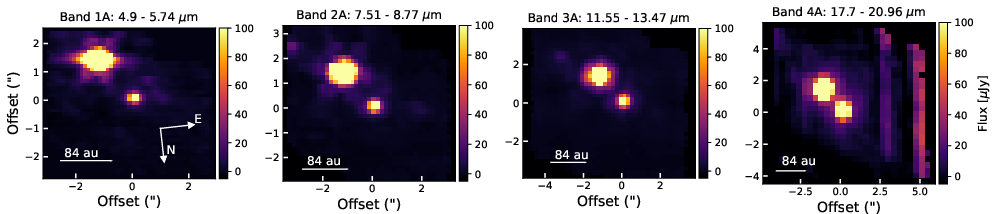
Figure 1: Median of the cubes for band A across all channels after removing the background contribution. The planet Delorme 1 AB b is in the middle of the field of view, while the point source in the upper corner represents the binary Delorme 1 AB. The vertical stripes observed in band 4A are caused by detector artifacts.
Spectral Morphology and Qualitative Features
The extracted spectrum of Delorme 1 AB b is characterized by a flat MIR SED, with a pronounced IR excess at λ>8 μm, inconsistent with a pure planetary photosphere. The contrast between the planet and the host binary decreases at longer wavelengths, indicating significant circumplanetary emission. The spectrum reveals strong molecular features, including the Q-branches of C2H2 and HCN, and multiple H2 emission lines. Notably, no silicate features are detected, implying grain growth and/or dust settling in the CPD.
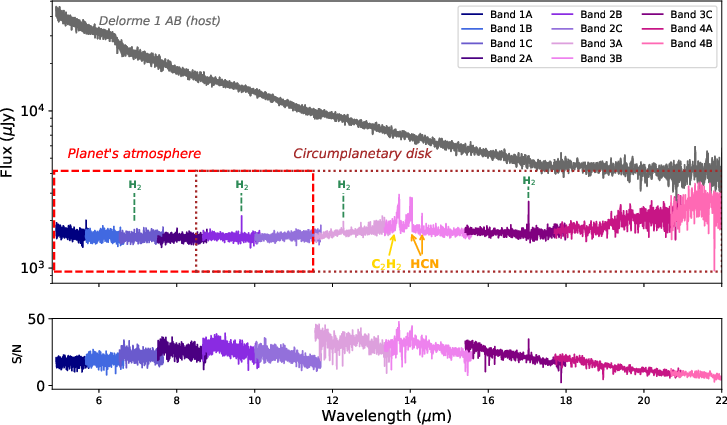
Figure 2: Top: Extracted spectra of the binary star (gray) and its companion Delorme 1 AB b (color-coded) across the MIRI/MRS bands. The dashed region outlined in red indicates the wavelength range where the planet's atmosphere is detected, while the brown, dotted region marks the wavelengths dominated by the circumplanetary disk. Bottom: S/N as a function of wavelength for the companion.
Planetary Atmosphere Characterization
Atmospheric Model Fitting
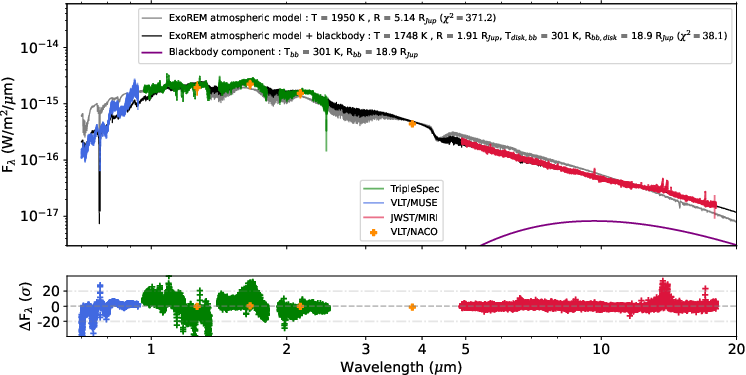
The planetary spectrum, combined with archival NIR data, was fit using multiple atmospheric model grids (Exo-REM, ATMO, Sonora, BT-Settl) via the species framework. All models require the addition of a blackbody component to account for the MIR excess, interpreted as CPD dust emission. The best-fit atmospheric parameters are:
Molecular Detections
Cross-correlation analysis confirms robust detection of H2O and CO in absorption in the planetary atmosphere up to ∼10 μm. No significant CH4 or NH3 is detected.
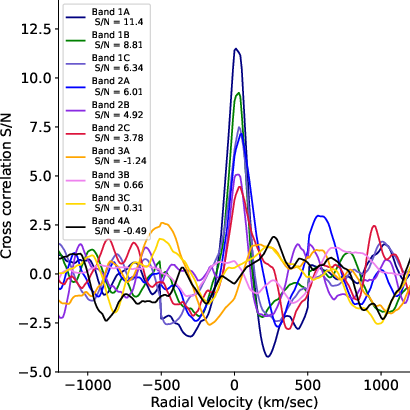
Figure 4: Cross-correlation with Exo-REM model in all bands individually. The planetary atmosphere is detected until band 2C (wavelengths ∼10 μm).
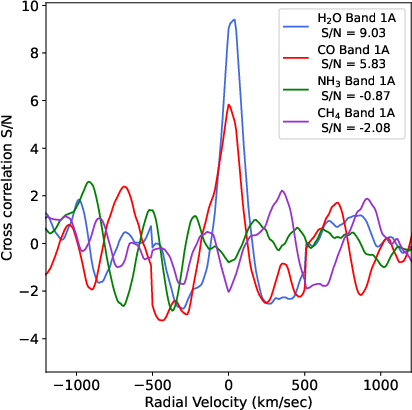
Figure 5: Cross-correlation with Exo-REM molecular absorption templates for the planetary atmosphere. Strong detections of H2O and CO are observed, while no significant signal is found for CH4 or NH3.
Model Limitations and Degeneracies
All atmospheric models exhibit degeneracies between Teff, logg, metallicity, and cloud properties. The best-fit radii are consistent with evolutionary models only when strong priors are imposed. The C/O and [Fe/H] values are highly model-dependent, and the fit quality is sensitive to the treatment of clouds and the inclusion of the CPD component.
Circumplanetary Disk: Gas and Dust Properties
Molecular Gas Emission
After continuum subtraction, the CPD spectrum reveals strong emission from C2H2 (both optically thick and thin components), HCN, and tentative 13CCH2. No O-bearing species (CO, CO2, H2O) are detected in emission, indicating a high C/O ratio in the CPD gas.
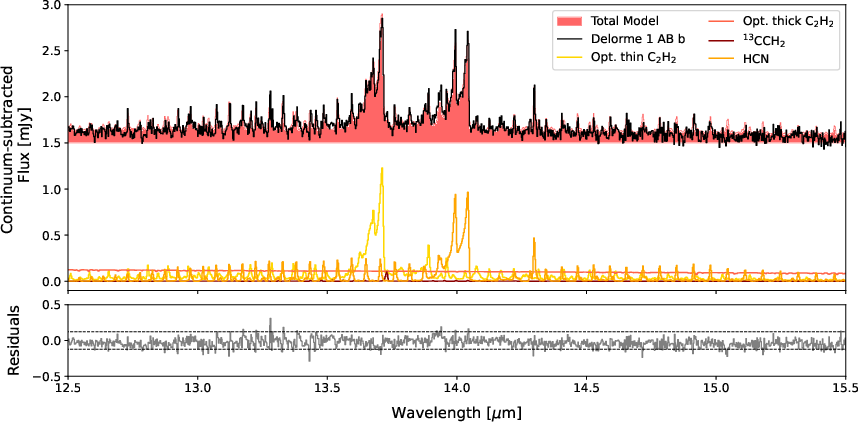
Figure 6: Modeling of the CPD gas. Top: The continuum-subtracted MIRI spectrum (black) compared to the best-fit total model (red). Emission from C2H2 is shown in yellow for the thin component and dark orange for the thick component, HCN is in orange, and 13CCH2 in dark red. Bottom: Residuals.
Extended H2 Emission and Disk Winds
Multiple H2 pure rotational lines are detected, with the S(3) and S(5) lines exhibiting spatially extended emission up to ∼40 AU, exceeding the expected CPD outer radius. The excitation temperature of the extended component is Texc∼1160 K, while the unresolved component is cooler (∼720 K). The mass of warm H2 is ∼1.2×10⁻⁶ MJup, and the inferred mass-loss rate is 2×10⁻¹⁰ MJup yr−1, yielding a wind-to-accretion ratio of $0.004$–$0.1$.
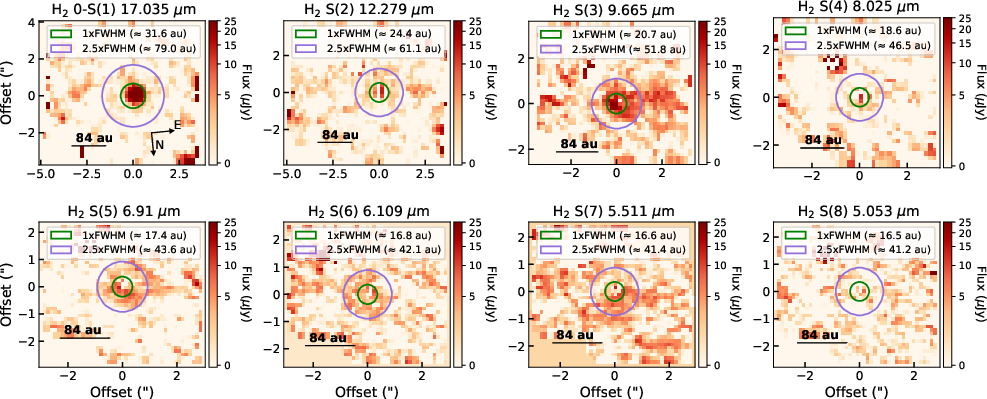
Figure 7: Residuals after PSF subtraction for each H2 line. Circles indicate concentric apertures at 1×FWHM in green and 2.5×FWHM in purple. This physical scale in AU depends on the pixel scale, which varies across spectral bands.
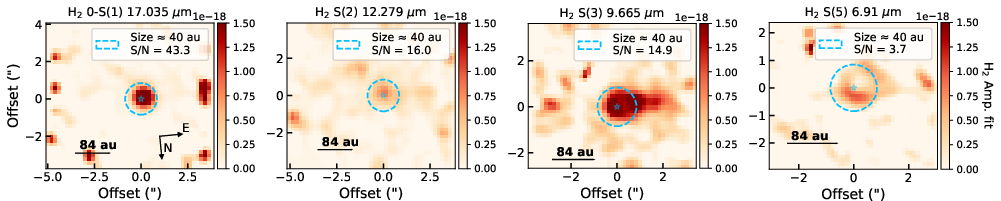
Figure 8: H2 amplitude maps: each pixel value corresponds to the amplitude of the H2 line Gaussian fit, in erg/cm2/s. The dashed circles indicate fixed-radius apertures of 40 AU for comparison. A Gaussian smoothing with σ=1 pixel has been applied to each image. The color scale is the same for each image.
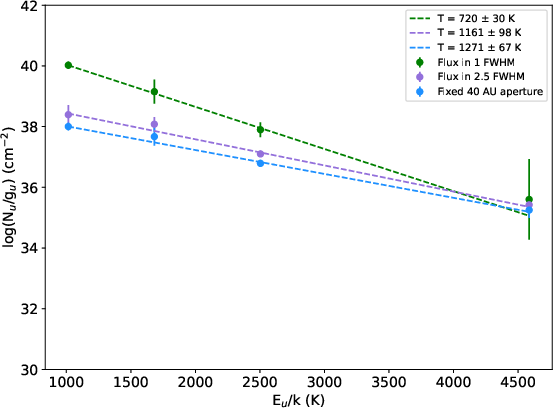
Figure 9: Rotation diagram to measure the excitation temperature of H2.
Disk Structure: Cavity, Grain Growth, and Chemistry
The absence of a 10 μm silicate feature indicates grain growth (a>5 μm) and/or dust settling. The CPD dust emission is well fit by a single blackbody at 295 K, with an effective radius of ∼19 RJup, suggesting a dust cavity. The inferred cavity size (∼33 RJup) is much larger than the dust sublimation radius, implying a depleted inner disk. The CPD outer radius, set by the Hill sphere, is ∼8 AU, but the H2 emission extends beyond this, consistent with a disk wind.
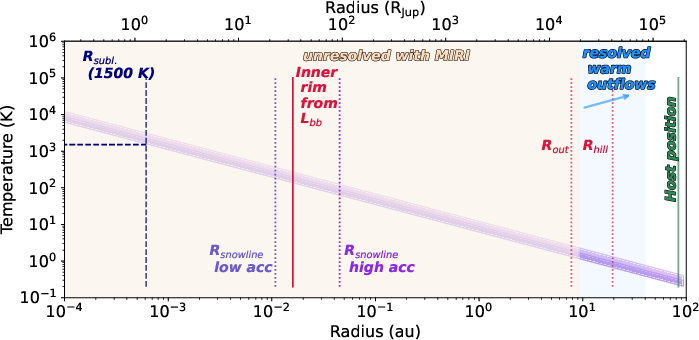
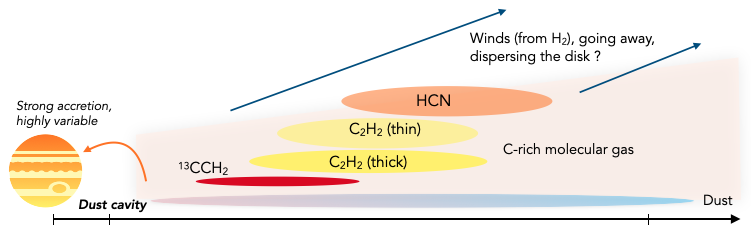
Figure 10: Schematic of the Delorme 1 AB b system: the planet and its CPD. Top: Temperature as a function of radius with both axes on a logarithmic scale. The upper and lower purple bounds correspond to scenarios with high and low accretion, respectively. Representative radius values are indicated. The beige region denotes scales below the spatial resolution of MIRI/MRS. Bottom: A schematic illustration of the CPD structure with the molecular gas species, intended as a simplified representation; it does not necessarily reflect the true spatial distribution of molecular species.
Comparative Disk Chemistry and Evolution
The CPD around Delorme 1 AB b is chemically distinct from T Tauri disks, with a lack of O-bearing molecules and a dominance of hydrocarbons, paralleling trends seen in disks around very low-mass stars and brown dwarfs. The molecular inventory is more limited than in higher-mass analogs, with no detection of C4H2, C6H6, or water emission. This supports a scenario where disks around substellar and planetary-mass objects evolve toward carbon-rich, oxygen-poor chemistries, possibly due to rapid dust evolution, accretion-driven chemistry, or initial conditions in low-mass environments.
The persistence of a gas-rich, carbon-rich CPD at ∼30–45 Myr challenges standard disk dispersal models and supports the existence of "Peter Pan" disks around low-mass objects. The high C/O ratio in the CPD may have significant implications for the composition of any forming satellites, potentially favoring carbon-rich moon systems. The detection of disk winds suggests ongoing mass loss, which may regulate disk lifetime and satellite formation efficiency.
Theoretical and Practical Implications
- Disk longevity: The presence of a massive, gas-rich CPD at this age requires revised models for disk dispersal, especially in low-mass, wide-separation systems.
- Chemical evolution: The observed C-rich, O-poor chemistry is consistent with models of disk evolution around low-mass stars and may be driven by accretion, dust evolution, or initial conditions.
- Planet formation: The system's mass, separation, and ongoing accretion are not easily explained by core accretion or disk instability, motivating further theoretical work on planet formation in circumbinary and low-mass environments.
- Observational strategies: The results demonstrate the power of JWST/MIRI MRS for spatially and spectrally resolved studies of CPDs, and highlight the need for multi-epoch, multi-wavelength campaigns to disentangle atmospheric and disk contributions.
Future Directions
- Expanded CPD sample: Additional JWST/MIRI observations of CPDs around planetary-mass companions are needed to establish the generality of the observed chemical trends.
- High-resolution spectroscopy: Future facilities (e.g., ELT/METIS) will enable velocity-resolved studies of CPD kinematics and chemistry.
- Time-domain studies: Monitoring accretion variability and its impact on disk chemistry will constrain the interplay between accretion, disk winds, and chemical evolution.
- Integrated modeling: Joint atmospheric and disk retrievals, incorporating evolutionary and chemical models, are required to robustly constrain system parameters and formation histories.
Conclusion
The JWST/MIRI MRS observations of Delorme 1 AB b provide the first medium-resolution MIR spectrum of a circumplanetary disk, revealing a carbon-rich, oxygen-poor molecular inventory, evidence for grain growth and a dust cavity, and spatially extended H2 emission consistent with a disk wind. These findings challenge standard models of disk dispersal and planet formation, and establish a new benchmark for the study of CPDs and their role in the final assembly of gas giants and their satellites. The results underscore the importance of MIR spectroscopy for probing the chemical and physical conditions of planet-forming environments at the lowest masses.