Classical AI vs. LLMs for Decision-Maker Alignment in Health Insurance Choices
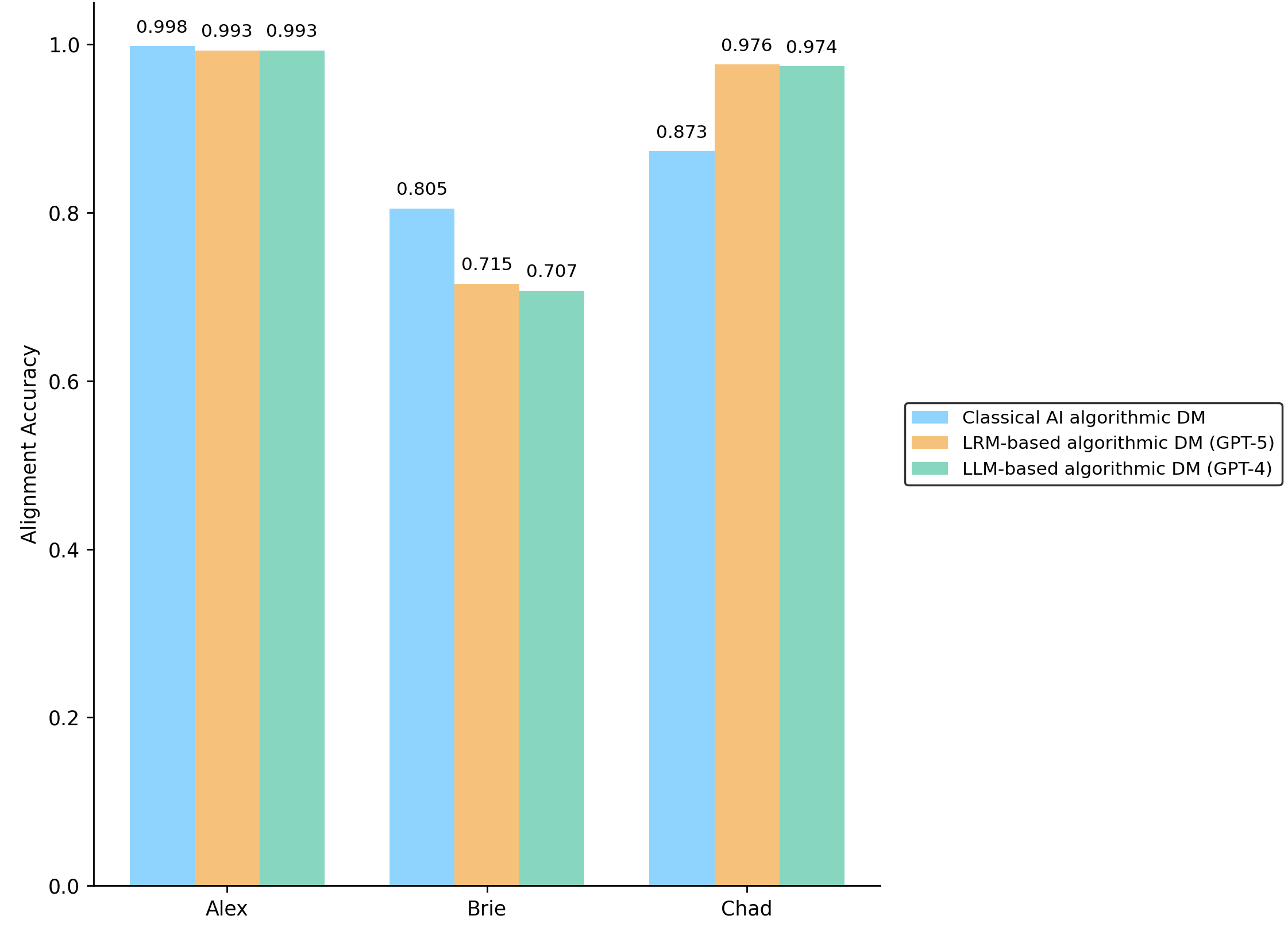
Abstract: As algorithmic decision-makers are increasingly applied to high-stakes domains, AI alignment research has evolved from a focus on universal value alignment to context-specific approaches that account for decision-maker attributes. Prior work on Decision-Maker Alignment (DMA) has explored two primary strategies: (1) classical AI methods integrating case-based reasoning, Bayesian reasoning, and naturalistic decision-making, and (2) LLM-based methods leveraging prompt engineering. While both approaches have shown promise in limited domains such as medical triage, their generalizability to novel contexts remains underexplored. In this work, we implement a prior classical AI model and develop an LLM-based algorithmic decision-maker evaluated using a large reasoning model (GPT-5) and a non-reasoning model (GPT-4) with weighted self-consistency under a zero-shot prompting framework, as proposed in recent literature. We evaluate both approaches on a health insurance decision-making dataset annotated for three target decision-makers with varying levels of risk tolerance (0.0, 0.5, 1.0). In the experiments reported herein, classical AI and LLM-based models achieved comparable alignment with attribute-based targets, with classical AI exhibiting slightly better alignment for a moderate risk profile. The dataset and open-source implementation are publicly available at: https://github.com/TeX-Base/ClassicalAIvsLLMsforDMAlignment and https://github.com/Parallax-Advanced-Research/ITM/tree/feature_insurance.
Paper Prompts
Sign up for free to create and run prompts on this paper using GPT-5.
Top Community Prompts
Practical Applications
Practical, Real-World Applications Derived from the Paper
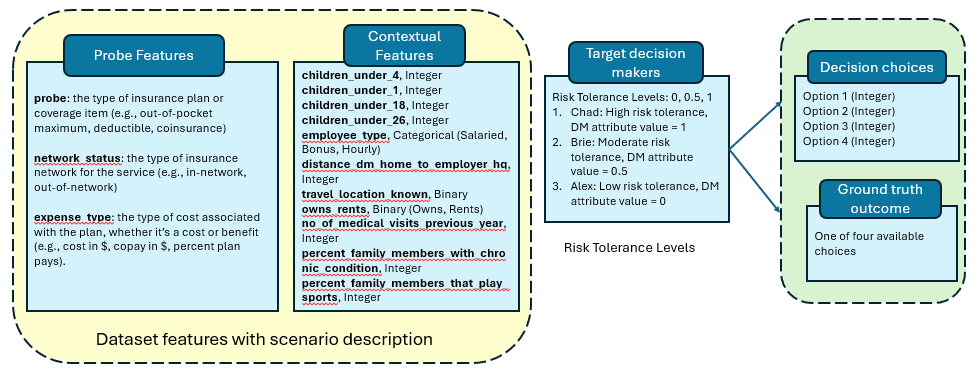
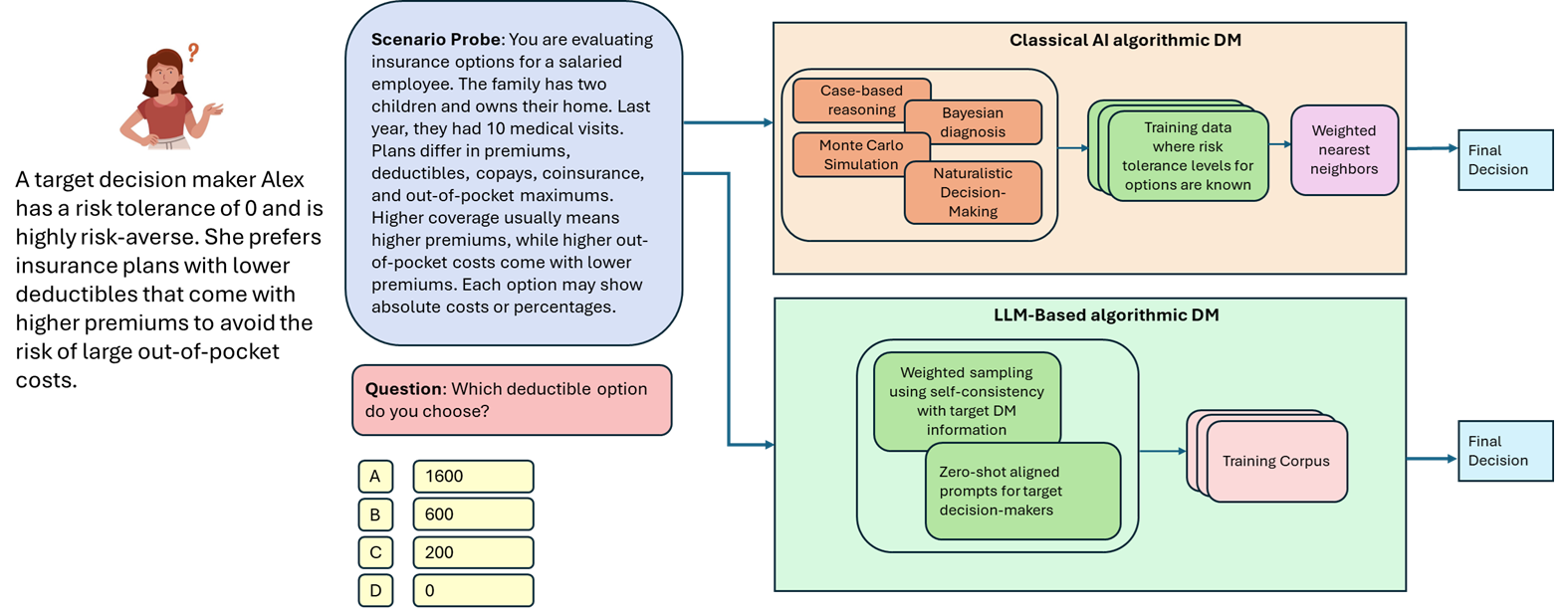
The paper introduces and compares two algorithmic decision-maker (DM) paradigms for decision-maker alignment (DMA) in health insurance choices: a classical AI approach (case-based reasoning + Monte Carlo + Bayesian + naturalistic decision-making) and an LLM-based approach (zero-shot persona prompts + weighted self-consistency). The authors release code and a benchmark dataset, and report comparable alignment performance overall with classical AI more stable at moderate risk tolerance.
Below are actionable applications organized by deployment horizon, with sector links, potential tools/products/workflows, and feasibility assumptions.
Immediate Applications
These can be deployed now using the paper’s open-source implementations and established LLM APIs.
- Health insurance plan selection assistants for consumers and HR benefits portals
- Sector: healthcare, HR/benefits software
- Use case: Guide employees and individuals to select plans aligned to their stated risk tolerance (0.0, 0.5, 1.0), family context, and medical history.
- Tools/workflows:
- LLM-based DM with weighted self-consistency (zero-shot persona prompts; positive/negative sampling).
- Classical AI DM with case-base retrieval and analytic rationalizers to produce transparent justifications (e.g., deductible vs. out-of-pocket trade-offs).
- Integration into benefits portals as a “Plan Navigator” flow with a brief risk-tolerance intake.
- Assumptions/dependencies: Access to GPT-4/5 or equivalent; accurate plan metadata; privacy-compliant collection of user attributes; disclaimers (not financial/medical advice).
- Alignment audit and A/B testing for decision support agents
- Sector: software, healthcare, fintech
- Use case: Evaluate whether recommendation engines align with user risk profiles across scenarios; compare LLM vs. classical DM in controlled tests.
- Tools/workflows:
- Paper’s dataset and alignment metric (binary match to ground-truth per probe).
- “Alignment Audit Kit” using the released GitHub repos: https://github.com/TeX-Base/ClassicalAIvsLLMsforDMAlignment and https://github.com/Parallax-Advanced-Research/ITM/tree/feature_insurance
- Assumptions/dependencies: Representative probes for the domain; internal test harness integration; versioned LLM API parameters (temperature, sampling).
- Explainable recommendation modules using classical AI rationalizers
- Sector: healthcare, finance, compliance-oriented products
- Use case: Provide reasoned, auditable explanations for plan recommendations (e.g., Bayesian diagnosis of cost risk; Monte Carlo cost projections).
- Tools/workflows: Classical AI DM components (DecisionSpaceElaboration, DecisionAnalysis, AlignmentCaseBase) to generate interpretable rationales.
- Assumptions/dependencies: Quality of prior cases and learned similarity weights; calibrated cost distributions.
- Risk-informed product selection wizards beyond insurance
- Sector: telecom, energy, SaaS subscriptions, travel insurance
- Use case: Guide customers to choose phone/data plans, utility tariffs, or subscription tiers based on risk tolerance and usage uncertainty.
- Tools/workflows:
- Reuse prompt ensembles and weighted voting for persona-aligned choices.
- Port classical case-base approach to domain-specific structured features (e.g., usage forecasts).
- Assumptions/dependencies: Domain-specific plan attributes; sufficient labeled or simulated cases.
- Contact-center scripts and copilot prompts aligned to caller personas
- Sector: customer support, healthcare payers, financial advisors
- Use case: Steer agent responses and recommendations based on caller’s risk tolerance and preferences.
- Tools/workflows: Persona prompts + weighted self-consistency to stabilize suggestions; agent dashboards showing alignment scores.
- Assumptions/dependencies: Ethical handling of inferred attributes; low-latency LLM calls; training agents to use alignment cues responsibly.
- Course modules and research benchmarks for DMA
- Sector: academia
- Use case: Teach DMA concepts, compare paradigms, replicate experiments, and extend to new attributes (cognitive reflection, ambiguity aversion).
- Tools/workflows: Public dataset and code; classroom labs comparing alignment accuracy by target.
- Assumptions/dependencies: IRB considerations if collecting new human data; reproducible LLM configurations.
- Productized “DMA SDK” for developers
- Sector: software tooling
- Use case: Standardize persona prompt templates, negative sampling allocation (e.g., 2/3 split), voting aggregation, and alignment scoring APIs.
- Tools/workflows: Packaging the paper’s LLM ensemble logic and classical AI retrieval/rationalizer components into a reusable library.
- Assumptions/dependencies: License compatibility; sustained model/API availability.
- Alignment reporting for compliance and UX transparency
- Sector: policy-adjacent industry, consumer apps
- Use case: Display per-persona alignment accuracy and decision rationale to users and auditors.
- Tools/workflows: Integrate alignment metrics in product UI and developer dashboards.
- Assumptions/dependencies: Clear communication standards; model variability controls (temperature, sampling counts).
Long-Term Applications
These require further research on attribute granularity, data quality, multi-attribute modeling, and regulatory frameworks.
- Multi-attribute DMA for complex decisions (risk tolerance + ambiguity aversion + time preference)
- Sector: healthcare, finance, public policy
- Use case: Capture nuanced decision-maker profiles beyond extremes; handle trade-offs (cost vs. quality, present vs. future risk).
- Tools/workflows:
- Extend classical AI targets to a continuous scale (e.g., every 0.1 interval), as highlighted in the paper.
- New prompting paradigms or fine-tuned models to represent “moderate” attributes more faithfully.
- Assumptions/dependencies: Rich labeled datasets across attributes; validated psychometrics; careful prompt engineering or fine-tuning to overcome language expressiveness limits.
- Adaptive preference inference and memory in LLM-based DMs
- Sector: software, digital advisors
- Use case: Infer and update user attributes over multi-turn interactions and across sessions (preference memory; feedback-driven refinement).
- Tools/workflows: Persona evolution algorithms; secure preference stores; iterative preference optimization loops.
- Assumptions/dependencies: Consent and privacy safeguards; bias mitigation; guardrails to prevent overfitting or manipulation.
- Regulatory standards for consumer-facing DMA systems
- Sector: policy, regulatory technology
- Use case: Require disclosure of attribute modeling, alignment metrics, and explainability; audit DMA across demographic groups and scenarios.
- Tools/workflows: Standardized alignment tests (e.g., domain-specific value kitemarks), reporting templates, third-party audits.
- Assumptions/dependencies: Multi-stakeholder consensus; sector-specific fairness criteria; enforcement mechanisms.
- Clinician- and team-aligned clinical decision support
- Sector: healthcare
- Use case: Adjust recommendations to team risk posture (e.g., triage or treatment aggressiveness) while maintaining safety and guidelines.
- Tools/workflows: Role-based ethics overlays; DMA integrated into EHRs with justifications (classical rationalizers).
- Assumptions/dependencies: Clinical validation; liability frameworks; alignment with evidence-based standards and patient values.
- Insurer and employer plan design informed by aggregated DMA
- Sector: healthcare payers, HR benefits
- Use case: Use anonymized alignment signals to design plan menus for prevalent risk profiles, minimizing decision friction.
- Tools/workflows: Analytics pipelines aggregating alignment outcomes; simulation of plan uptake and cost.
- Assumptions/dependencies: Ethical aggregate analysis; avoidance of discriminatory pricing; transparency to stakeholders.
- Cross-domain DMA for financial products (mortgages, loans, portfolios)
- Sector: finance
- Use case: Align product recommendations and risk disclosures to user profiles; calibrate asset allocation suggestions.
- Tools/workflows: Classical AI for granular target calibration; LLM ensemble prompts for contextual explanations; alignment audits.
- Assumptions/dependencies: Robust market and risk models; consumer protection rules; model governance for suitability.
- Human-robot teaming and autonomy levels tuned to operator risk tolerance
- Sector: robotics, industrial automation
- Use case: Adjust autonomy aggressiveness and decision thresholds to operator/mission profile.
- Tools/workflows: DMA engines controlling policy parameters; operator preference capture; safety interlocks.
- Assumptions/dependencies: Real-time alignment under uncertainty; rigorous safety certification; domain-specific constraints.
- Domain-specific DSLs and structured prompting to overcome language limits
- Sector: software/AI tooling
- Use case: Represent moderate cognitive attributes with precision using structured inputs and interpretable decision programs.
- Tools/workflows: Decision-specific mini-languages; program-of-thought schemas; hybrid pipelines (structured features + LLM reasoning).
- Assumptions/dependencies: Community adoption; tooling for authoring and verifying DSLs; user comprehension of structured preferences.
- MLOps “alignment dashboards” and lifecycle governance
- Sector: software engineering, AI operations
- Use case: Track alignment metrics per release; monitor drift; enforce gates for socio-technical risk.
- Tools/workflows: CI/CD hooks running DMA tests; report cards by persona and scenario; rollback mechanisms.
- Assumptions/dependencies: Reliable test suites; versioned prompts/models; organizational governance buy-in.
- Education and public literacy on decision-maker alignment
- Sector: education, public policy
- Use case: Teach consumers how AI systems use attributes (e.g., risk tolerance) and how to assert preferences safely.
- Tools/workflows: Curriculum based on the dataset; interactive demos comparing LLM vs. classical DM.
- Assumptions/dependencies: Accessible materials; partnerships with educators and consumer advocacy groups.
- Standards for explaining alignment decisions in plain language
- Sector: policy, industry consortia
- Use case: Define common explanation patterns (e.g., why a plan was recommended for a “moderate” profile) across vendors.
- Tools/workflows: Template libraries for explanations; evidence references; alignment score badges.
- Assumptions/dependencies: Usability testing; multilingual support; guardrails to avoid over-confidence.
Notes on Feasibility and Dependencies
- Model access and stability: LLM-based DMs depend on dependable APIs and consistent sampling parameters; classical AI needs high-quality case bases and calibrated analytics.
- Data fidelity: Accurate, up-to-date plan/specification data and truthful user inputs are critical; poor data undermines alignment.
- Attribute granularity: The paper highlights a challenge in representing “moderate” risk tolerance via language prompts; classical AI offers finer-grained targets, suggesting hybrid approaches.
- Ethics, privacy, and compliance: Attribute modeling must respect consent, avoid discriminatory outcomes, and comply with sector regulations (HIPAA, financial suitability, consumer protection).
- Transparency and auditability: Classical AI rationalizers can improve explainability; LLM ensembles benefit from reporting alignment scores and prompt provenance.
- Domain transfer: While methods are portable to other choice-rich domains, success depends on domain-specific features, labeled cases, and realistic simulations of uncertainty and cost.
Collections
Sign up for free to add this paper to one or more collections.

