- The paper introduces a semi-analytic jet-wind model that explains multi-year periodic flux and polarization variations in radio-identified supermassive black hole binaries.
- The model reproduces frequency-dependent phase lags and emission profiles by integrating Doppler boosting, helical jet propagation, and wind collimation effects.
- The findings have practical implications for gravitational wave searches and jet physics, setting priors for orbital parameters and aiding in the identification of SMBHB candidates.
Relativistic Jet and Wind Dynamics in Radio-Identified Supermassive Black Hole Binary Candidates
Introduction
This paper presents a semi-analytic model for the emission mechanisms in supermassive black hole binary (SMBHB) systems, focusing on two radio-identified blazar candidates: PKS 2131-021 and PKS J0805-0111. Both sources exhibit statistically significant, multi-year periodic flux density variations across the electromagnetic spectrum, interpreted as signatures of binary orbital motion. The model incorporates a mildly relativistic wind that collimates an ultra-relativistic jet, with the wind's orbital motion inducing a helical channel for jet propagation. This framework is designed to explain observed sinusoidal flux variations, phase lags across frequencies, and polarization properties, and is extensible to future SMBHB candidates.
The model posits a binary system where one black hole launches a relativistic jet, confined by a sub-relativistic wind originating from its accretion disk. The wind, with velocity βw<1, is modulated by the orbital velocity βH of the black hole, resulting in a conical-helical jet structure. The jet's direction is determined by the wind-jet interface, and the observed emission is dominated by Doppler boosting and aberration effects due to the periodic modulation of the jet's orientation.
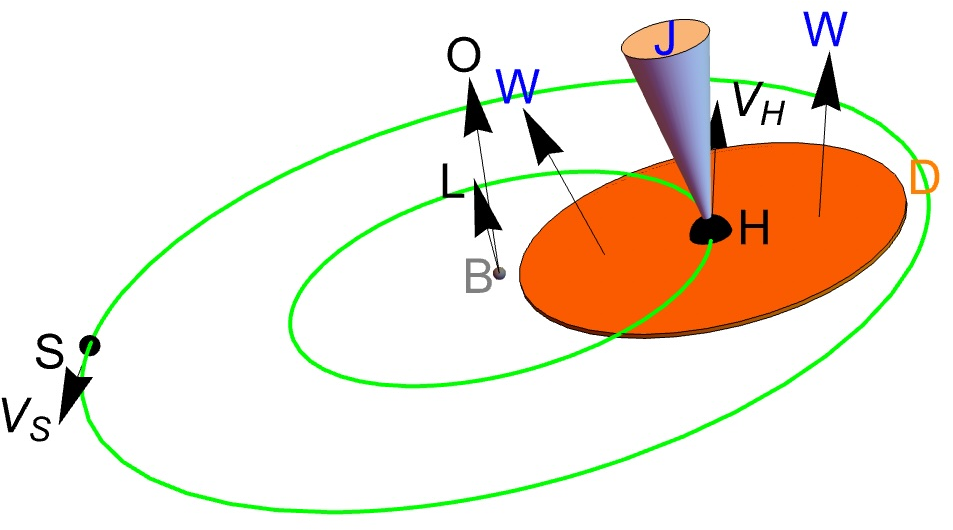
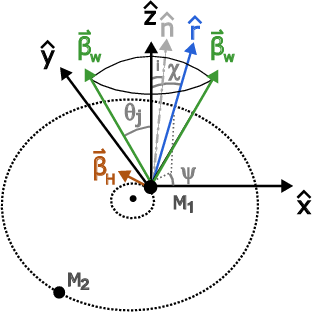
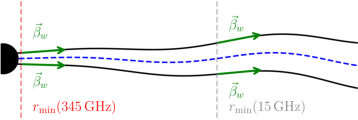
Figure 1: Schematic of the SMBHB system, showing the primary black hole, disk, wind, and jet geometry, with the wind collimating the jet into a conical helix.
The model assumes a synchrotron-emitting electron population with a power-law distribution, and the jet's bulk Lorentz factor Γj is typically set to 10. The wind's inertia dominates the jet-wind complex, and the jet's emission region locations are frequency-dependent due to optical depth effects. The phase offsets observed in multi-frequency light curves are attributed to the propagation speed of the helical structure, set by βw, allowing emission regions to be separated by tens of helical wavelengths rather than hundreds, as required in ballistic jet models.
Analytical Treatment of Flux and Polarization Variations
The jet is modeled as a cone with opening angle θj, and the observer's line of sight is inclined by i. The Doppler factor D and its variation δD are derived analytically, showing sinusoidal modulation with the binary period P. The amplitude of flux density variations depends on the ratio βH/βw, jet inclination βH0, and the integration bounds of the emission region.
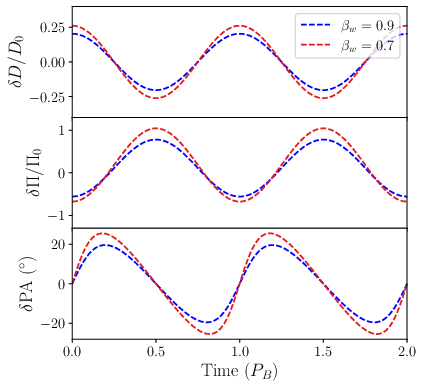
Figure 2: Local fractional variation in Doppler factor, polarization degree, and EVPA for different βH1 values, illustrating the sinusoidal modulation induced by orbital motion.
Polarization properties are computed assuming a transverse (toroidal) magnetic field, with the electric vector polarization angle (EVPA) and polarization degree (PD) varying periodically. The model predicts that maximum PD coincides with minimum flux, consistent with ALMA polarization data for PKS 2131.
Application to PKS 2131-021 and PKS J0805-0111
PKS 2131-021
PKS 2131 exhibits a βH2 day periodicity with βH3 significance, observed across radio, mm, sub-mm, and optical bands. The phase shifts between light curves at different frequencies follow a power-law trend, βH4, indicating frequency-dependent emission region locations.
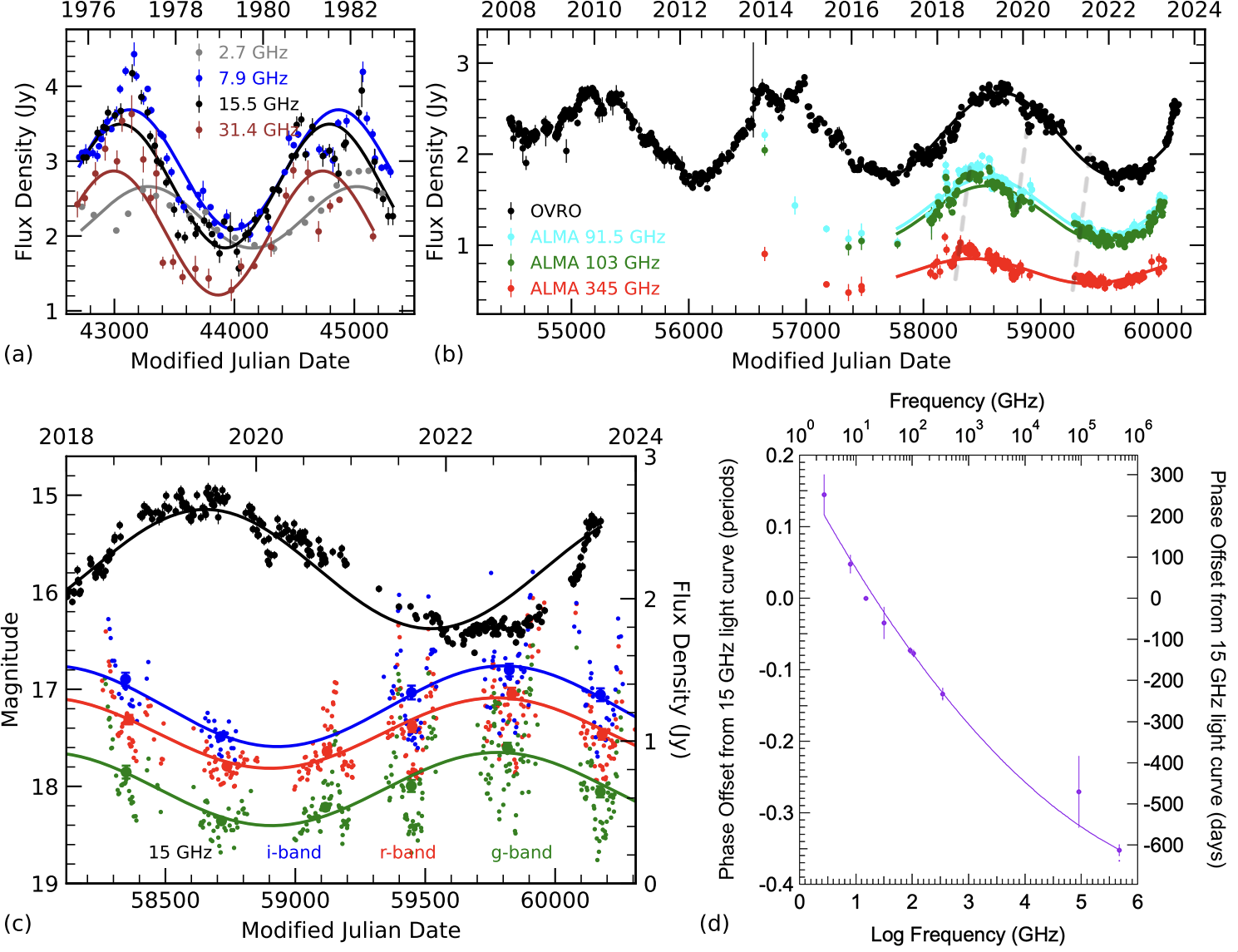
Figure 3: Multi-wavelength light curves of PKS 2131, showing coherent sinusoidal variability and phase shifts across radio and optical bands.
The model is calibrated with βH5, βH6, βH7, βH8, and jet powers βH9 erg sΓj0. The emission region radii are set to match observed phase shifts, with Γj1. The model reproduces the amplitude and phase trends of the observed light curves, requiring subtraction of a constant flux component attributed to large-scale, non-varying jet emission.
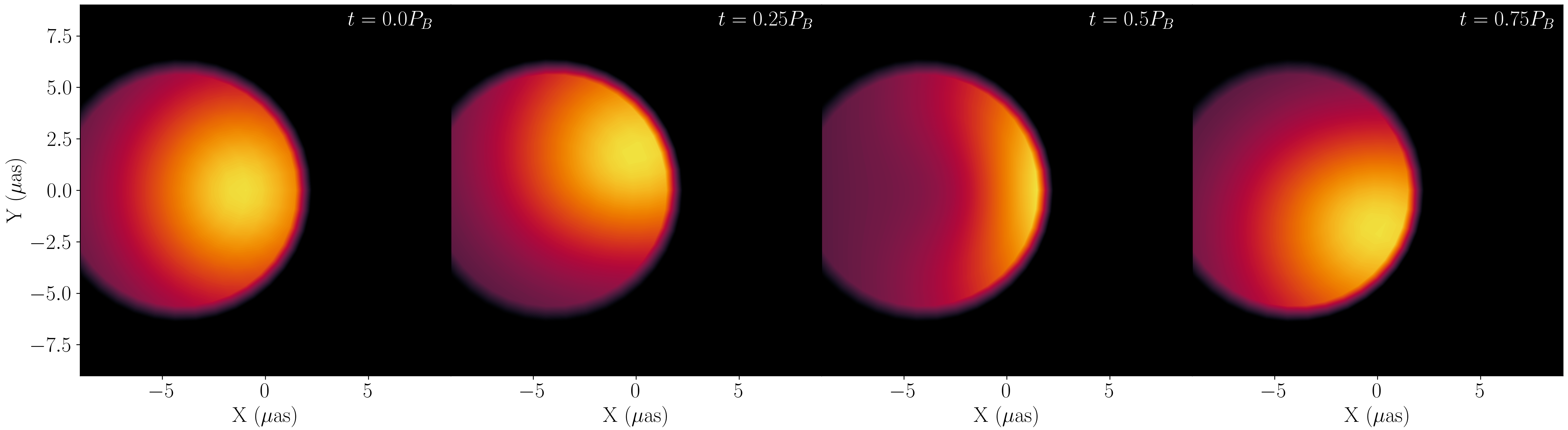
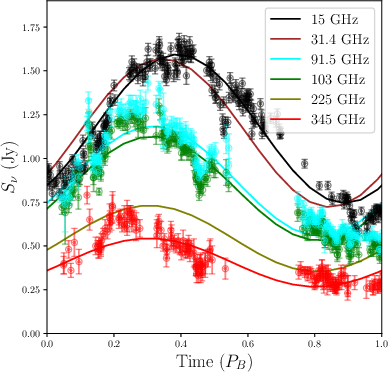
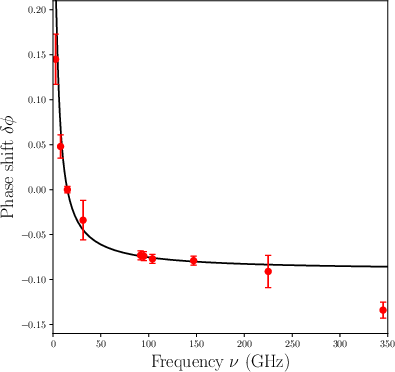
Figure 4: Model predictions for PKS 2131: intensity map at 230 GHz, flux density in observed bands, and phase shifts relative to 15 GHz data.
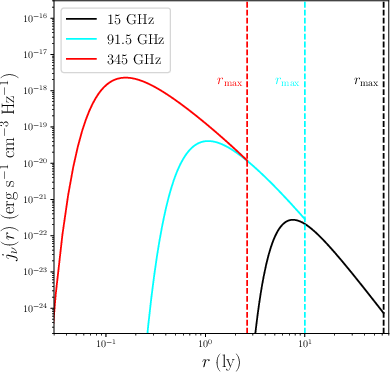
Figure 5: Emissivity profiles as a function of radius for different frequencies, illustrating the frequency-dependent emission region locations.
PKS J0805-0111
PKS J0805 shows a Γj2 day periodicity with Γj3 significance, and similar phase lag behavior as PKS 2131, with Γj4. The model parameters are analogous, with lower jet power (Γj5 erg sΓj6) and Γj7. The model matches the observed ACT and OVRO light curves and phase shifts, with minor constant flux offsets.
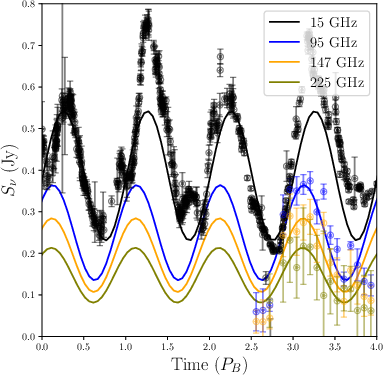
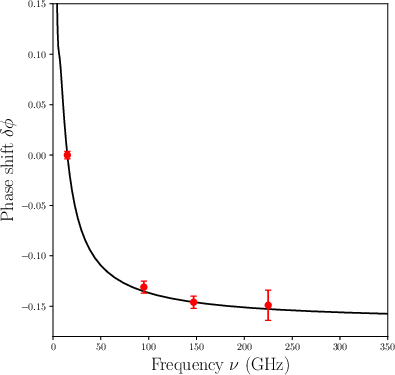
Figure 6: Model fit to PKS J0805: flux density in observed bands and phase shifts relative to 15 GHz data.
Predictions for Emission Line and Direct Imaging Variability
The model extends to predict variability in broad emission lines, assuming line-emitting clouds are entrained in the wind and follow helical magnetic field lines. The orbital motion induces periodic shifts in line center and width, with amplitudes of several angstroms for typical parameters. These shifts are measurable and provide constraints on orbital velocity and component masses.

Figure 7: Schematic of the wind-jet complex, with line-emitting clouds following helical trajectories in the wind.
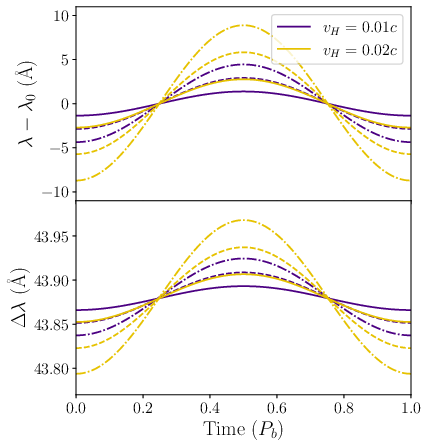
Figure 8: Predicted variation in emission line center and width for different orbital velocities and inclinations.
Direct imaging with mm-VLBI (e.g., EHT) could detect centroid shifts in the emission region, though the predicted shifts for PKS 2131 are below current resolution limits. Closer sources or larger emission regions could yield detectable spatial variability.
Gravitational Wave Implications
Both PKS 2131 and PKS J0805, with multi-year orbital periods, are expected contributors to the nHz GW background detected by PTAs. The model provides priors for targeted GW searches, including sky location, period, phase, and inclination. Current PTA data place upper limits on chirp masses (Γj8), and future observations may enable direct GW detection from these systems.
Theoretical and Practical Implications
The model demonstrates that periodic flux and polarization variations in blazars can be explained by jet-wind interactions modulated by binary orbital motion. The requirement for a trans-relativistic wind-jet boundary (Γj9) and high jet powers (βw0 erg sβw1) is consistent across both sources. The phase lag behavior provides a direct probe of jet internal structure and particle acceleration mechanisms, with implications for RMHD and kinetic simulations of jet stability and emission.
The model is generalizable to other SMBHB candidates and can be refined with future multi-wavelength, polarization, and spectroscopic observations. The detection of periodic emission line variability or direct GW signals would provide definitive confirmation of the binary nature of these systems.
Conclusion
This work presents a physically motivated, semi-analytic model for emission from jetted SMBHBs, successfully reproducing the observed periodic flux and phase lag phenomena in PKS 2131 and PKS J0805. The model's predictions for polarization, emission line variability, and direct imaging are testable with forthcoming observations. The results have significant implications for understanding jet physics, SMBHB demographics, and the sources of the nHz GW background. Future developments will benefit from extended monitoring, high-resolution imaging, and targeted numerical simulations to further constrain the jet-wind dynamics and binary parameters.