- The paper develops a coupled bi-virus SIS model integrating game-theoretic social distancing to analyze equilibrium conditions under various epidemic scenarios.
- Numerical simulations validate stability results for disease-free, unilateral, and coexistence equilibria, highlighting the role of reproduction numbers and cost parameters.
- The findings emphasize aligning social distancing incentives with infection risk as a key strategy for managing multi-strain epidemic outbreaks.
Game-theoretic Social Distancing in Competitive Bi-Virus SIS Epidemics
This paper develops a coupled dynamical system integrating competitive bi-virus SIS epidemic dynamics with game-theoretic social distancing behavior. The population is well-mixed and of unit mass, with individuals classified as susceptible, infected with virus 1, or infected with virus 2. Each virus propagates with its own contact rate (β1, β2) and recovery rate (δ1, δ2). Social distancing is modeled as a binary action (distancing or not), with the reduction in contact parameterized by q∈(0,1). The behavioral dynamics are governed by replicator equations, where payoffs depend on perceived infection risk and the cost of distancing.
The system is described by five coupled ODEs for the masses of infected individuals (y1, y2) and the fractions of distancing individuals among susceptible and infected subpopulations (zS, z1, z2). The payoffs for distancing and non-distancing actions are functions of current infection levels and cost parameters, with the assumption that the cost of socializing while infected (ci) exceeds the cost of distancing (cD).
Fixed Point Analysis
The analysis identifies three classes of equilibria:
- Disease-Free Equilibria (DFE): Both viruses extinct, with either no one or everyone practicing social distancing.
- Unilateral Equilibria: Only one virus persists, with varying levels of social distancing.
- Coexistence Equilibria: Both viruses persist, possible only when their basic reproduction numbers are equal (R0=β1/δ1=β2/δ2).
The system admits isolated fixed points for DFE and unilateral endemic states, and lines (manifolds) of coexistence equilibria when R0 is matched. The explicit conditions for existence and stability of these equilibria are derived analytically, with the stability determined by the eigenvalues of the Jacobian at each fixed point.
Stability Results
Disease-Free Equilibria
The DFE with no distancing ([0,0,0,1,1]) is locally exponentially stable if δk>qβk for both viruses. The DFE with full distancing ([0,0,1,1,1]) is always unstable due to the positive payoff for abandoning distancing when no infection is present.
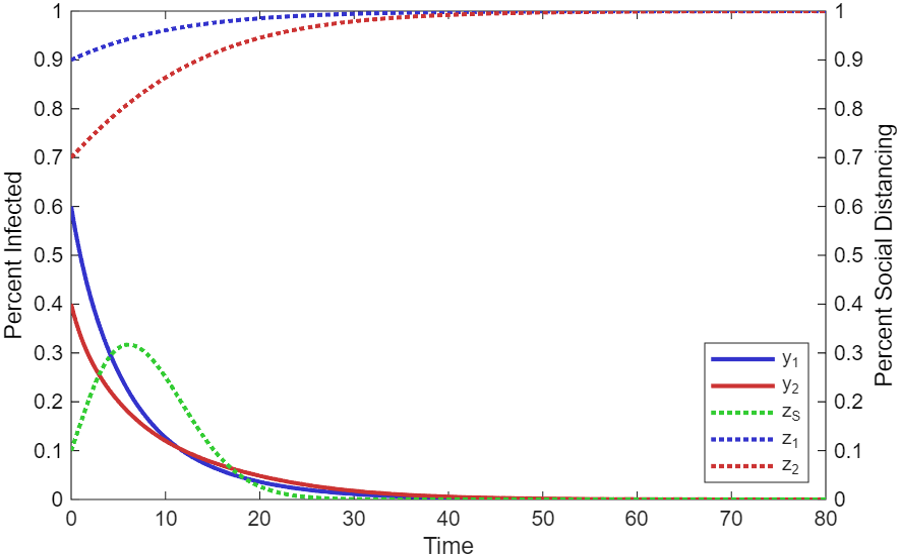
Figure 1: Simulation showing both viruses dying out and the system converging to the disease-free equilibrium.
Unilateral Endemic States
Unilateral equilibria are stable when the surviving virus has a higher effective reproduction number than the extinct one, and the cost and risk parameters satisfy derived inequalities. The analysis provides explicit conditions for stability, including the requirement that the fraction of distancing individuals among susceptibles is within (0,1) for partial distancing equilibria.
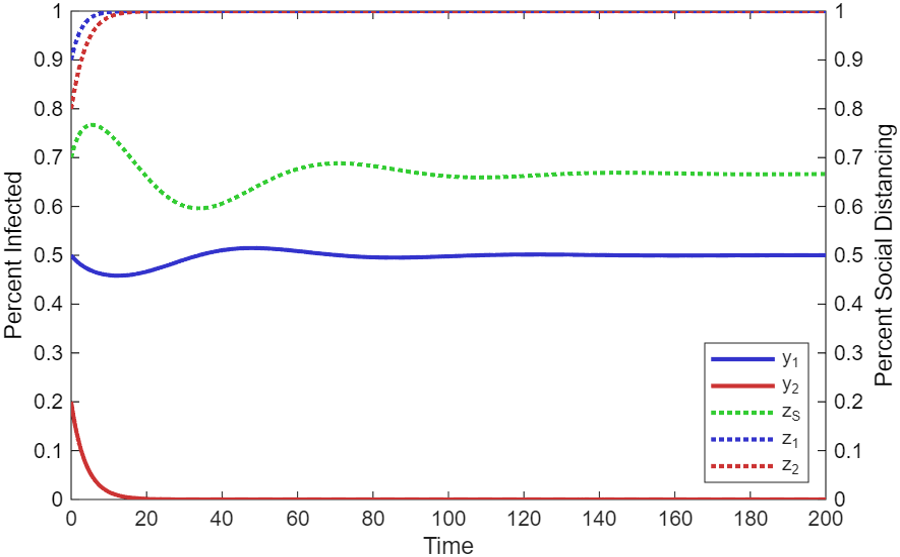
Figure 2: Simulation showing virus~1 endemic and virus~2 dying out with partial social distancing in the healthy population, i.e., the system converging to the unilateral endemic equilibrium.
Coexistence Equilibria
Coexistence is only possible when R0 is identical for both viruses. The system admits lines of equilibria parameterized by the distribution of infections between the two viruses and the level of social distancing. The stability of these lines depends on the relationship between the total infection level and the cost/risk parameters. Notably, the lines L0 (no distancing) and L1 (full distancing) cannot be simultaneously stable.
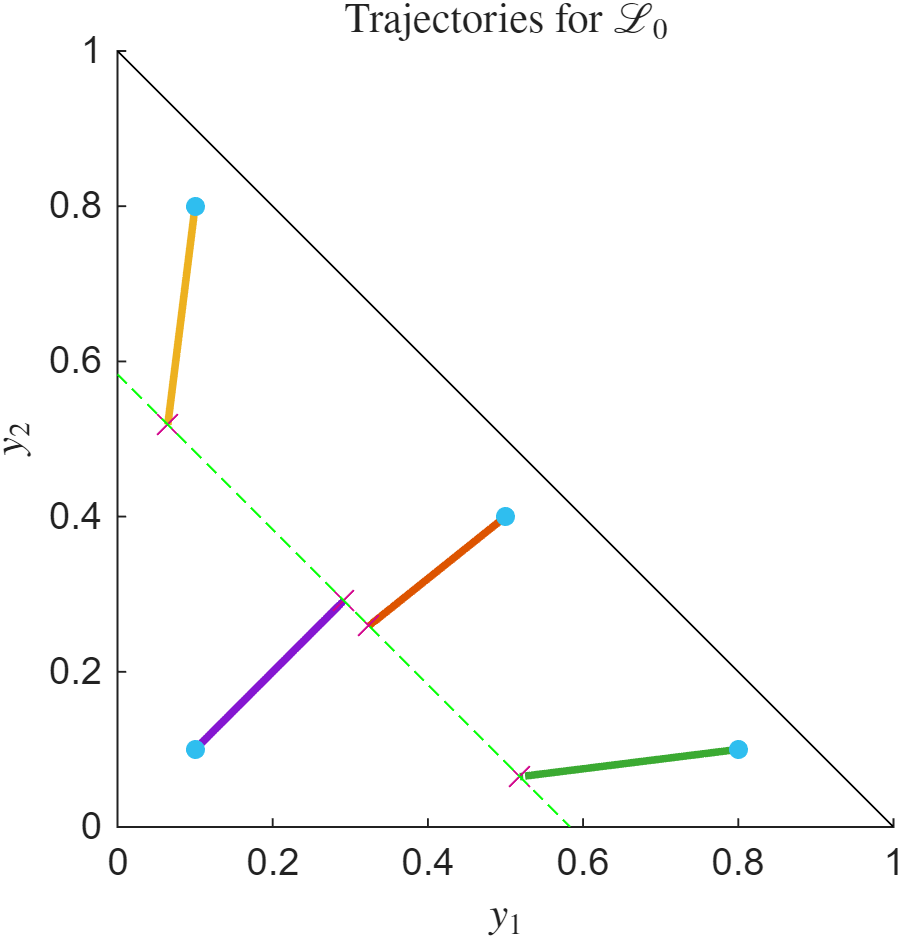
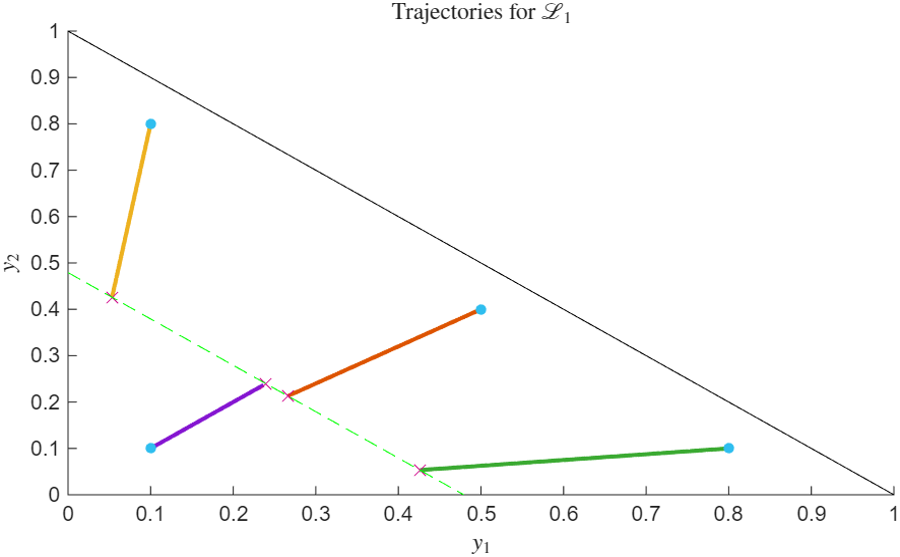
Figure 3: Simulation of L0, illustrating convergence to a line of coexistence equilibria when both viruses have matched reproduction numbers.
Numerical Simulations
Simulations validate the theoretical results, demonstrating convergence to the predicted equilibria under various parameter regimes. The system exhibits rapid extinction of both viruses when R0<1, stable unilateral endemicity when one virus dominates, and convergence to coexistence lines when R0 is matched. The role of social distancing is shown to be critical in modulating the effective reproduction number and the stability of equilibria.
Implications and Future Directions
The integration of evolutionary game theory with multi-strain epidemic dynamics provides a rigorous framework for analyzing the feedback between behavioral adaptation and disease spread. The explicit characterization of equilibria and their stability offers insight into the conditions under which social distancing can eradicate, suppress, or allow coexistence of competing pathogens.
From a practical perspective, the results highlight the importance of aligning perceived risk and cost parameters with epidemiological realities to achieve desired public health outcomes. The finding that coexistence is only possible under matched R0 values is robust and independent of behavioral parameters, suggesting that interventions targeting the reproduction number are essential for controlling multi-strain epidemics.
Theoretical extensions could include networked populations, heterogeneous mixing, and more complex behavioral strategies. Control-theoretic approaches leveraging the replicator dynamics could be developed to design optimal interventions. The framework is also amenable to generalization for other feedback-evolving systems in socio-technical domains.
Conclusion
This work provides a comprehensive analysis of a coupled bi-virus SIS epidemic model with game-theoretic social distancing. The explicit identification and stability characterization of all fixed points, including lines of coexistence equilibria, advances the understanding of epidemic-behavior feedback systems. The results have direct implications for the design of behavioral interventions and the management of multi-strain infectious diseases, and open avenues for further research in evolutionary dynamics and epidemic control.