- The paper demonstrates harmonic decomposition of JWST data to reveal cloud-driven atmospheric dynamics in SIMP J0136.
- The study maps vertical atmospheric layers via contribution functions, highlighting variations in cloud structure and molecular features.
- Findings indicate that cloud formation modulates local chemical equilibrium and suggests auroral heating in high-altitude regions.
Mapping Cloud-Driven Atmospheric Dynamics and Chemistry in an Isolated Exoplanet Analog via Harmonic Signatures
Introduction
This study presents a comprehensive analysis of the atmospheric dynamics and chemistry of the young, isolated planetary-mass object SIMP J013656.5+093347 (SIMP~J0136), a T2.5 brown dwarf at the L/T transition. The work leverages time-resolved, low- to mid-resolution spectroscopy from JWST/NIRISS and NIRSpec to dissect the vertical and temporal structure of the atmosphere, focusing on the interplay between cloud formation, molecular chemistry, and dynamic processes. The methodology centers on harmonic decomposition of spectrophotometric variability, enabling the mapping of atmospheric features as a function of both wavelength and pressure.
Observational Data and Reduction
The analysis utilizes two epochs of JWST observations separated by approximately 35 hours, corresponding to ~15 rotation periods of SIMP~J0136. NIRISS/SOSS provided R∼1200 spectra from 0.85–2.83 μm, while NIRSpec/PRISM delivered R=30–300 spectra from 0.6–5.3 μm. Both datasets were binned temporally and spectrally to optimize S/N and facilitate direct comparison of spectral features across pressure levels.
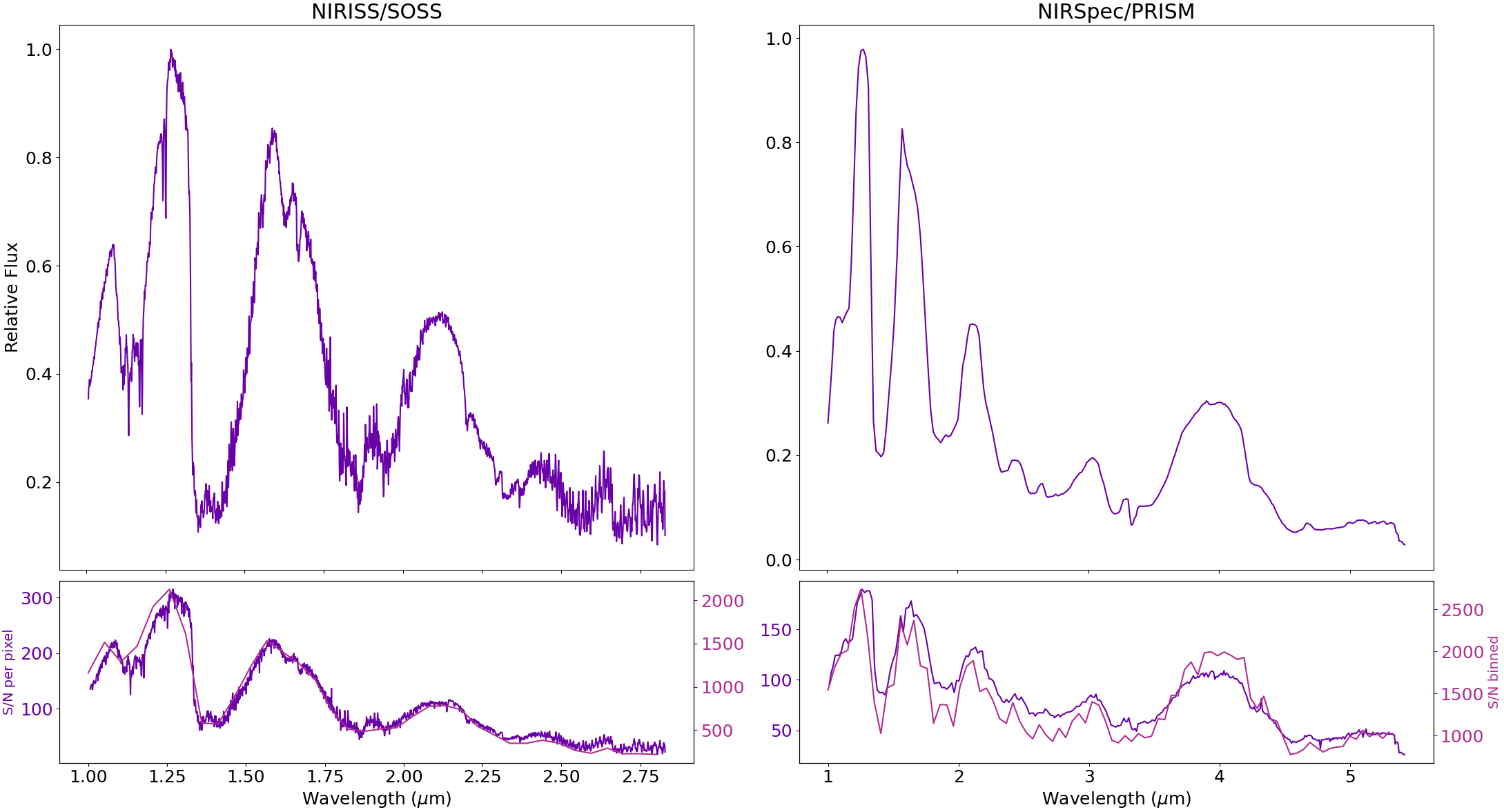
Figure 1: Time-averaged NIRISS/SOSS and NIRSpec/PRISM spectra for SIMP~J0136, with per-pixel and binned S/N ratios.
Dynamic spectra (variability maps) were constructed to visualize the normalized flux variability as a function of wavelength and time, revealing complex, multi-periodic behavior across the NIR.
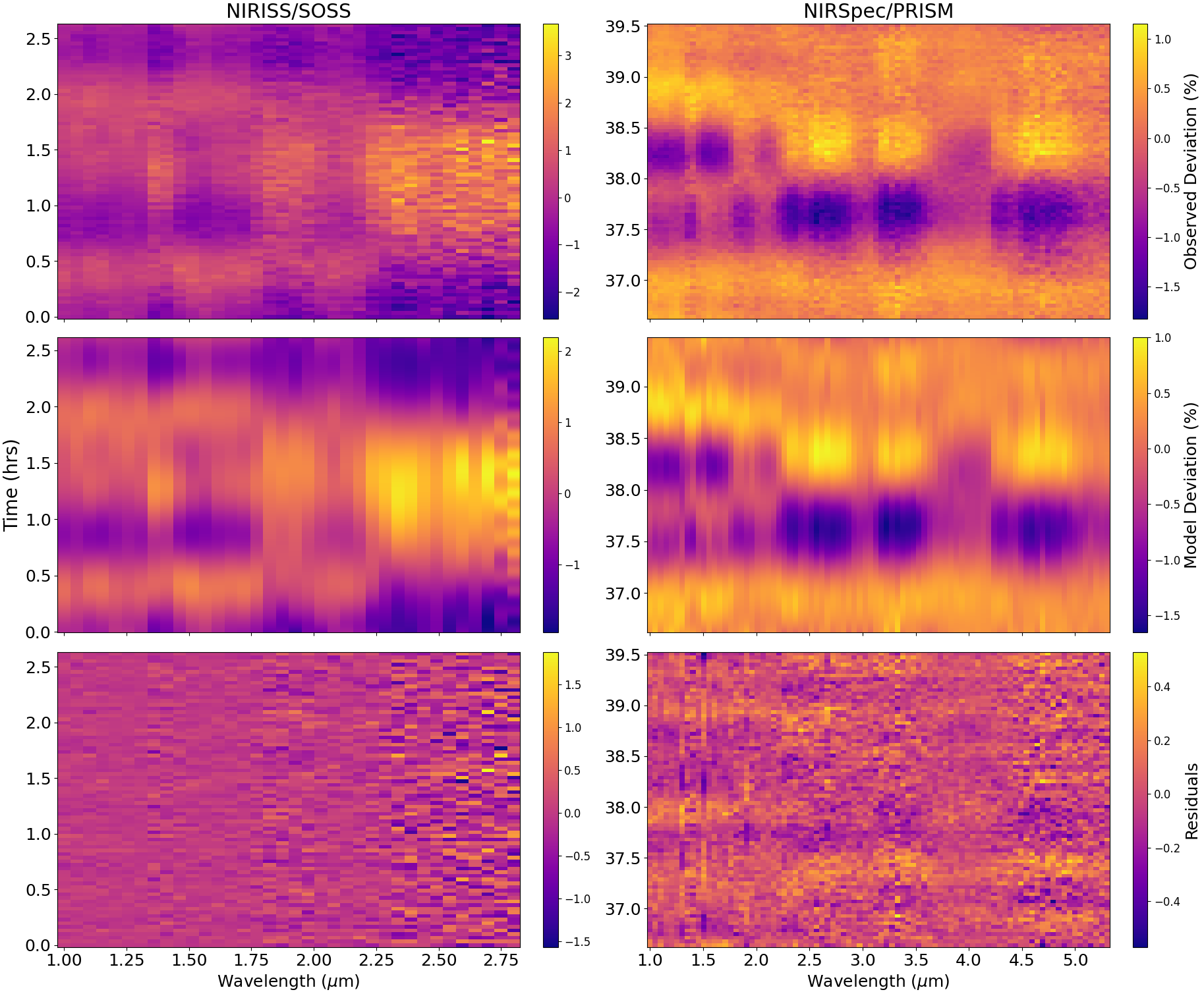
Figure 2: Dynamic spectra (variability maps) for NIRISS/SOSS and NIRSpec/PRISM, showing observed, best-fit, and residual variability.
Harmonic Decomposition and Model Fitting
The core analysis employs the Imber code, which fits each lightcurve with a sum of damped Fourier modes (harmonics) using Bayesian nested sampling. The model:
F(t)=C0+C1t+i=1∑NAisin(2πt/Pi+ϕi)exp(−λit)
allows for the extraction of amplitude, period, phase, and damping for each harmonic. Model selection is based on Bayesian evidence and BIC, ensuring robust identification of the dominant periodicities at each wavelength.
Vertical Mapping via Contribution Functions
To translate wavelength-dependent variability into pressure space, the study employs contribution functions from Sonora Bobcat cloudless atmospheric models (Teff=1150 K, logg=4.5), mapping each spectral bin to its characteristic pressure level. This enables the construction of vertical variability maps, revealing the temporal evolution of atmospheric structure as a function of depth.
Results: Harmonic Structure and Atmospheric Stratification
Harmonic Content Across Wavelengths
Harmonic decomposition reveals that the lowest-order (k=1) periodicity matches the rotation period (∼2.4 h), while higher-order harmonics (k=2,3) are preferentially detected at wavelengths probing deeper atmospheric layers (≳1 bar), particularly those associated with iron and forsterite cloud formation.
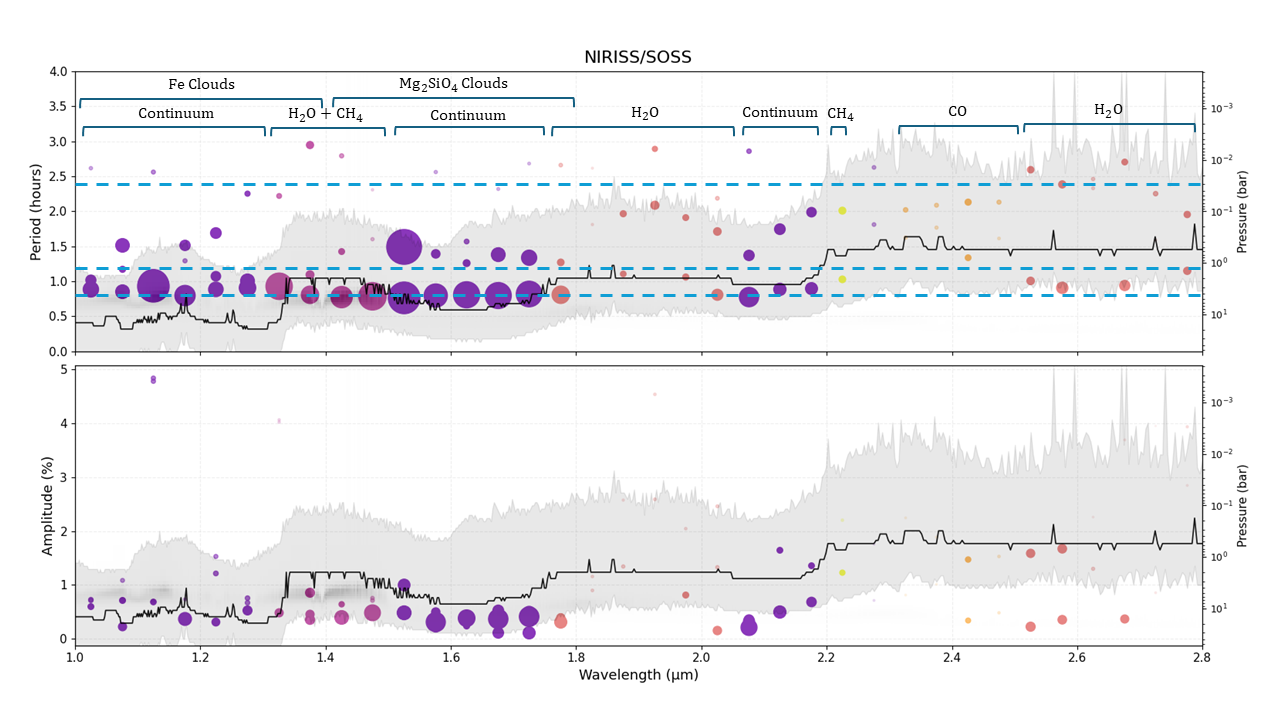
Figure 3: NIRISS/SOSS: Retrieved harmonic periods and amplitudes as a function of wavelength, with color coding for dominant molecular features and overlaid contribution function.
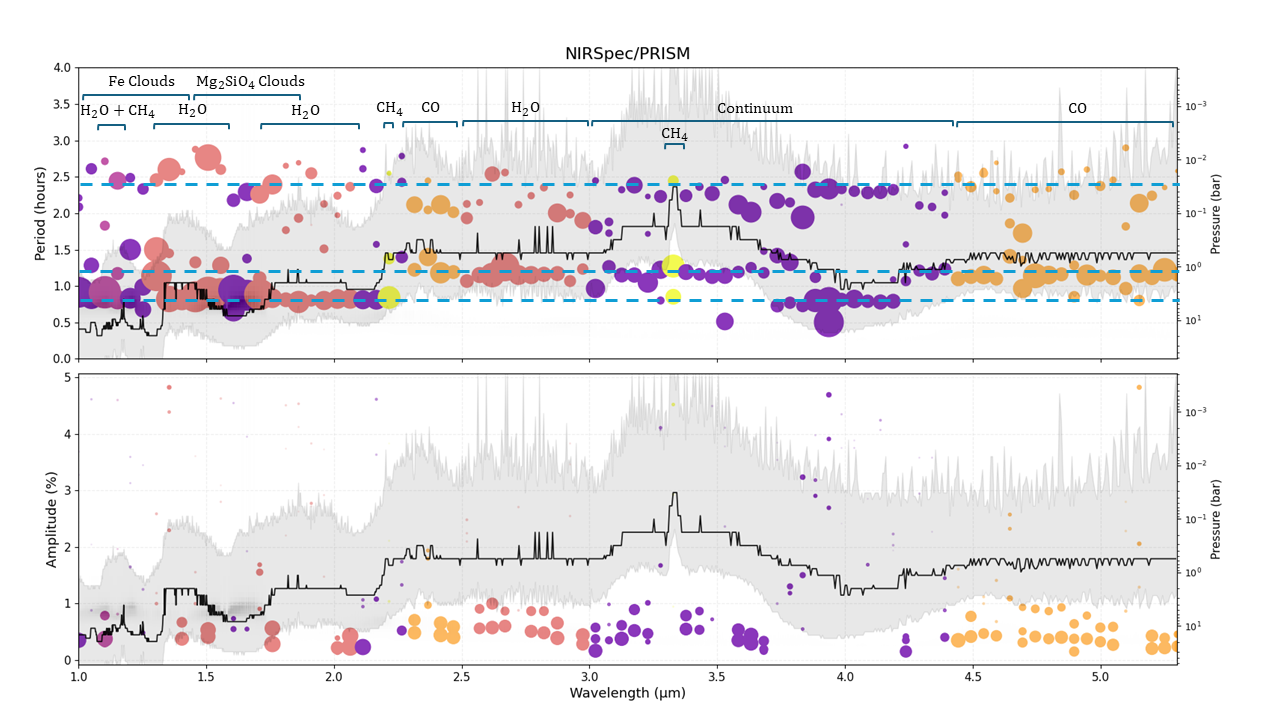
Figure 4: NIRSpec/PRISM: Retrieved harmonic periods and amplitudes as a function of wavelength, with color coding for dominant molecular features and overlaid contribution function.
The k=3 (0.8 h) harmonic is robustly detected at deep pressures, with minimal posterior uncertainty, indicating persistent, high-frequency variability in the cloud-forming regions. Beating patterns between k=1 and k=2 harmonics are observed in CO and H2O bands, consistent with multi-layered atmospheric dynamics.
Vertical Variability Maps
Composite vertical variability maps constructed from the best-fit harmonic models and contribution functions reveal a stratified atmosphere with at least two dynamically interacting layers: a deep, cloud-forming region (≳1 bar) and an overlying, more radiative layer. The boundary between these layers is time-variable, indicating evolving vertical cloud structure.
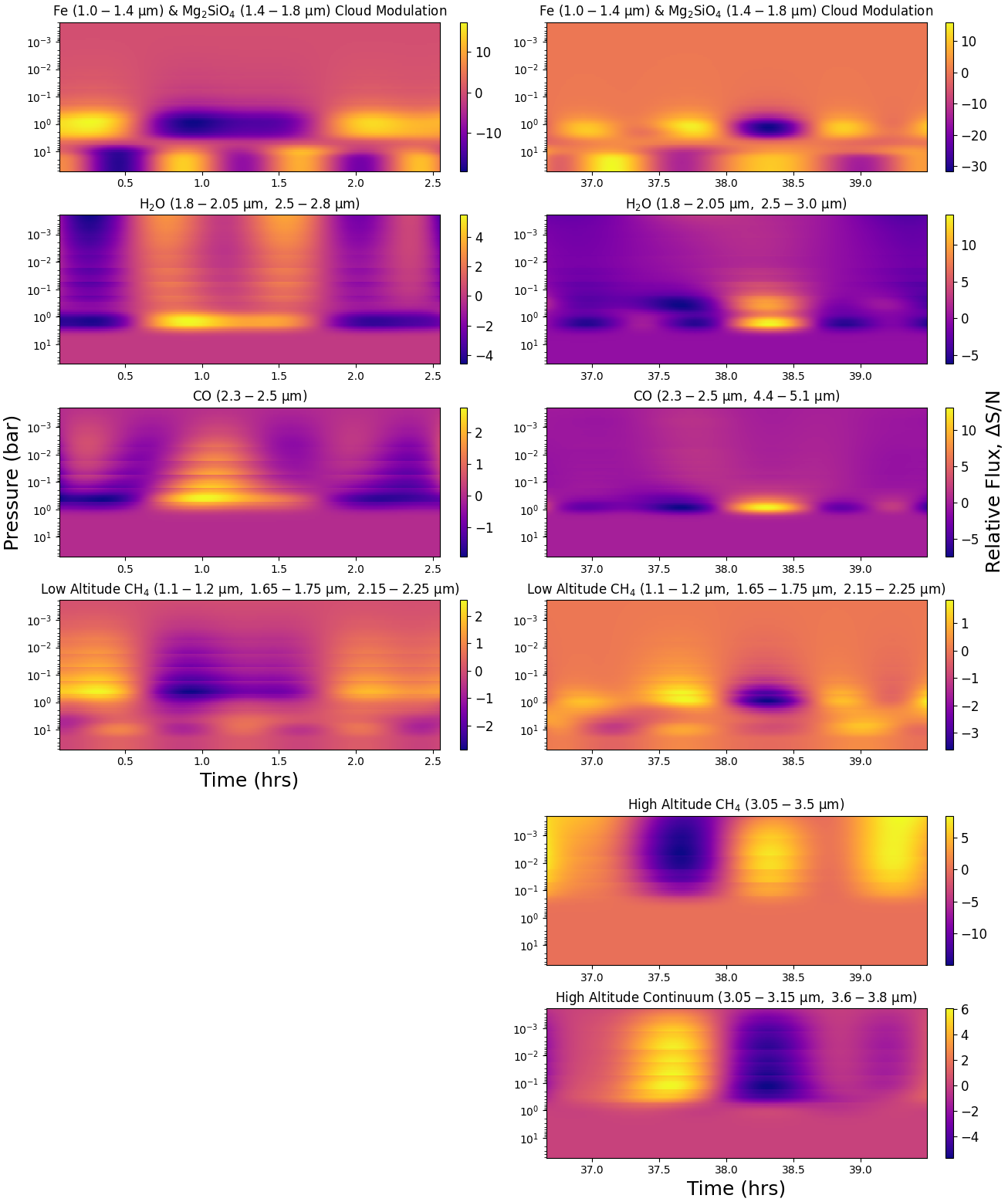
Figure 5: Spectrally-unique vertical variability maps for SIMP~J0136, showing cloud modulation and molecular absorption variability as a function of pressure and time.
Spectrally-unique maps demonstrate that forsterite cloud modulation (1.4–1.8 μm) is anti-correlated with H2O and CO absorption, but correlated with deep CH4 absorption and high-altitude continuum variability. Notably, high-altitude CH4 features transition from absorption to emission at low pressures (≲100 mbar), consistent with auroral heating.
Interpretation: Atmospheric Dynamics, Chemistry, and Heating
Odd Harmonics and Hemispheric Asymmetry
The detection of odd (k=3) harmonics at deep pressures and cloud-sensitive wavelengths is interpreted as evidence for North/South hemispheric asymmetry in the cloud structure, likely concentrated near the equator. This is consistent with the known tendency for equatorial regions in brown dwarfs to be cloudier than the poles. The presence of such asymmetry has implications for future Doppler imaging and constraints on inclination.
Cloud-Driven Chemical Disequilibrium
The anti-correlation between forsterite cloud modulation and H2O/CO absorption, alongside the correlation with CH4, suggests that cloud formation modulates the local temperature structure and chemical equilibrium. Forsterite cloud formation sequesters oxygen, favoring CH4 over CO as the dominant carbon reservoir at lower temperatures, and depleting H2O via the reaction:
CO+3H2↔CH4+H2O
and forsterite formation:
2Mg+3H2O+SiO→Mg2SiO4(s,l)+3H2
This mechanism explains the observed disequilibrium carbon chemistry and the vertical/longitudinal variability in molecular abundances.
High-Altitude Heating and Auroral Processes
The transition of high-altitude CH4 features from absorption to emission, with distinct harmonic behavior from lower-altitude CH4, is interpreted as evidence for auroral heating via electron precipitation. The required power for the observed temperature inversion (∼265 K at 10−3 bar) exceeds that available from Jupiter-like auroral processes, suggesting either more efficient electron precipitation or additional heating mechanisms (e.g., gravity wave breaking, Joule heating).
Implications and Future Directions
This work demonstrates that time-resolved, multi-wavelength spectroscopy combined with harmonic analysis provides a powerful diagnostic of atmospheric dynamics, cloud structure, and chemistry in substellar objects. The detection of persistent, high-frequency harmonics at deep pressures, strong anti-correlations between cloud and molecular features, and evidence for auroral heating collectively indicate a highly dynamic, chemically stratified atmosphere in SIMP~J0136.
The methodology is broadly applicable to other variable brown dwarfs and directly imaged exoplanets, particularly as JWST and future ELT-class facilities expand the available time-resolved spectroscopic dataset. The results motivate further multi-epoch, high-cadence observations to constrain the temporal evolution of atmospheric features and to disentangle the contributions of clouds, chemistry, and external heating.
Conclusion
The harmonic mapping of SIMP~J0136's atmosphere reveals a vertically and longitudinally structured system, with cloud-driven modulation of both temperature and chemical abundances, and signatures of high-altitude auroral heating. The approach outlined in this study sets a new standard for dissecting the complex atmospheric physics of isolated exoplanet analogs, providing a template for future investigations of substellar atmospheric variability and dynamics.

