- The paper demonstrates that vigorous convective motions in progenitor cores yield stochastic angular momentum sufficient to seed transient accretion disks.
- It uses detailed MESA simulations across 12–40 M☉ models with varied envelope stripping to compare free-fall times and shock revival scenarios.
- The analysis supports the universal operation of the jittering jets mechanism, suggesting robust jet-driven explosions even in envelope-stripped stars.
Jittering Jets in Stripped-Envelope Core-Collapse Supernovae: A Detailed Analysis
Introduction
This study investigates the viability of the Jittering Jets Explosion Mechanism (JJEM) in stripped-envelope core-collapse supernovae (SECCSNe), focusing on progenitors of Types Ib and Ic SNe. The JJEM posits that stochastic angular momentum fluctuations, seeded by vigorous pre-collapse convection in the stellar core, lead to the formation of intermittent accretion disks around the nascent neutron star (NS). These disks launch pairs of jets with rapidly changing axes, which collectively drive the supernova explosion. The work addresses a gap in prior JJEM studies, which have primarily focused on hydrogen-rich progenitors, by systematically analyzing the convective and angular momentum properties of stripped-envelope models across a broad mass range.
Numerical Methodology
The authors employ the MESA stellar evolution code (v24.08.1) to simulate massive stars with zero-age main sequence (ZAMS) masses from 12M⊙ to 40M⊙. For each mass, three envelope configurations are considered: (1) full hydrogen-rich envelope, (2) hydrogen-stripped (He-rich), and (3) hydrogen and helium stripped (CO core). Envelope removal is implemented via a radius-based criterion, with hydrogen removal triggered at R∗=800R⊙ and helium removal at central He depletion. The nuclear network mesa_80 is used to ensure accurate treatment of advanced burning stages.
The simulations are terminated at the onset of core collapse, defined as the point when the infall velocity at the iron core exceeds 300kms−1, with analysis focused on slightly earlier times to avoid numerical instabilities. Convective velocities are computed using mixing length theory (MLT) with αMLT=1.5, and the angular momentum parameter j(m)=rvconv is used as a proxy for the stochastic angular momentum available to seed disk formation.
Convective Structure and Angular Momentum in SECCSN Progenitors
The analysis reveals that, independent of envelope configuration, all models exhibit at least one strong convective zone in the inner core at the pre-collapse stage. These zones are typically located near the Fe/Si and Si/O interfaces, corresponding to regions of active silicon and oxygen burning. The convective velocities in these layers are substantial, and the associated angular momentum parameter j(m) frequently exceeds 2×1015cm2s−1 within the mass coordinate corresponding to the maximum baryonic mass of a NS (∼2.65M⊙).
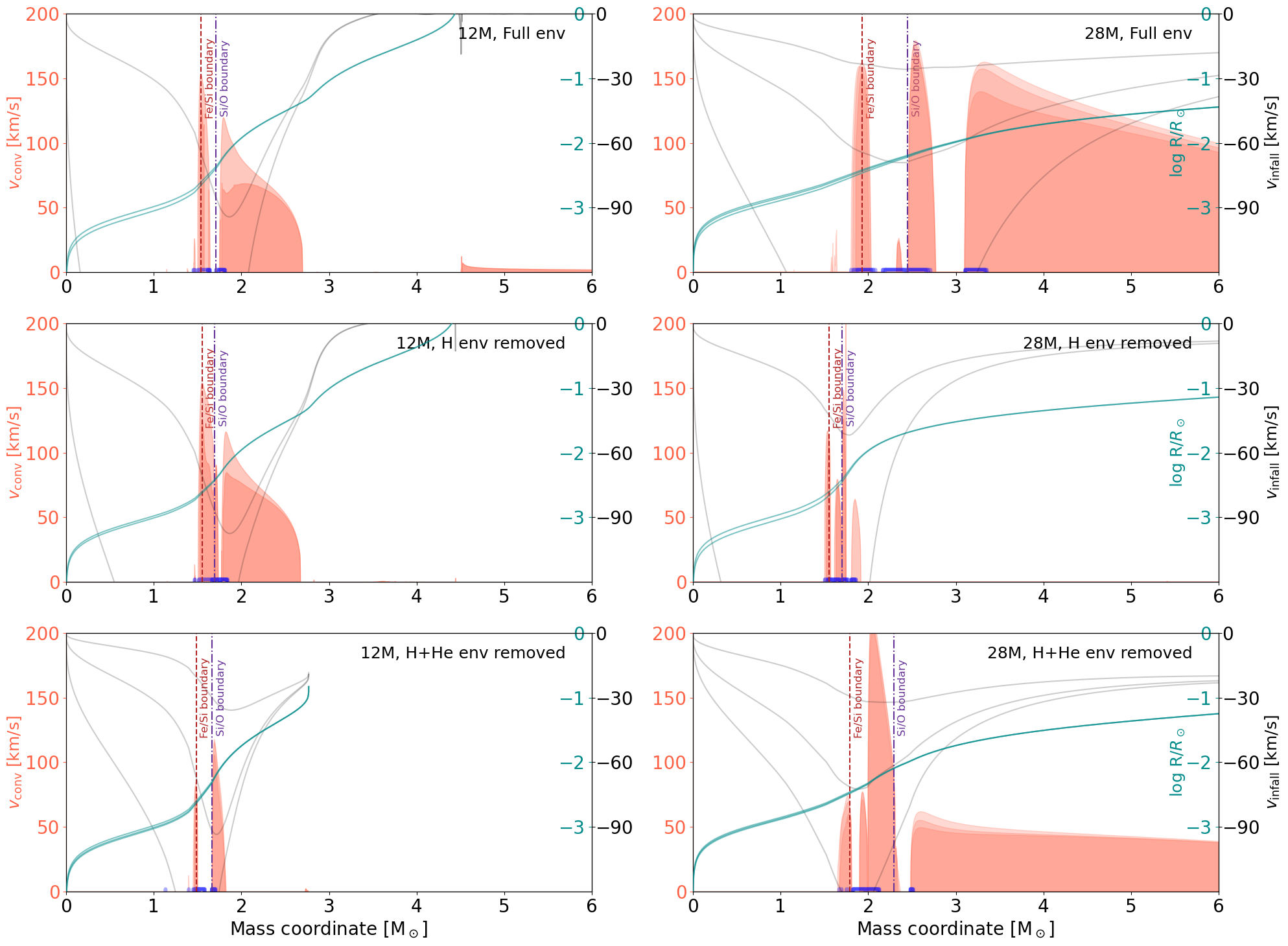
Figure 1: Convective velocity profiles, vconv(m), for 12M⊙ and 28M⊙ models, showing persistent strong convection in the inner core across all envelope configurations.
The location and extent of these convective zones are sensitive to both initial mass and envelope stripping. In stripped-envelope models, the outer convective regions (ONe layers) exhibit higher convective velocities due to lower densities and higher opacities, which enhance the efficiency of convection for a given nuclear energy generation rate. The angular momentum parameter j(m) in these regions is sufficient to satisfy the empirical threshold for intermittent disk formation posited by previous JJEM studies.
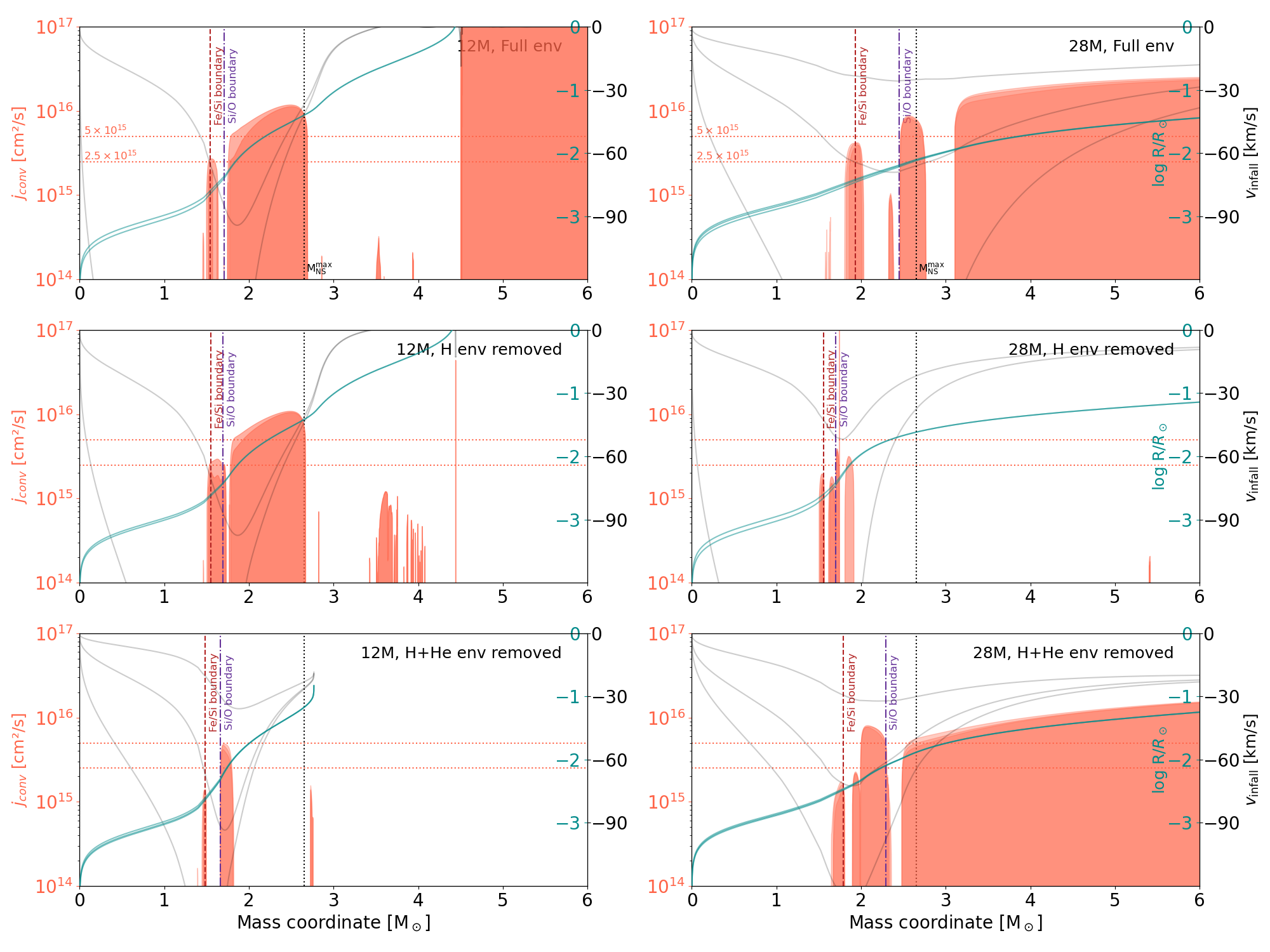
Figure 2: The angular momentum parameter j(m) as a function of mass for six models, demonstrating that j(m) exceeds the JJEM threshold within the NS-forming core in all cases.
Implications for the Jittering Jets Mechanism
The presence of robust convective zones with high j(m) in all models, including those with both hydrogen and helium stripped, supports the central tenet of the JJEM: that stochastic angular momentum fluctuations are ubiquitous in massive star cores at collapse, regardless of envelope structure. This result implies that intermittent accretion disk formation and jet launching are generic features of CCSN progenitors, not limited to hydrogen-rich stars.
The study further demonstrates that in massive, envelope-stripped stars, the convective zones with high j(m) tend to shift to lower mass coordinates, often corresponding to the oxygen or silicon burning regions. This ensures that, upon collapse, the nascent NS will accrete material with significant stochastic angular momentum, facilitating the formation of transient disks and the launching of jets.
Explosion Timing and Comparison with Neutrino-Driven Mechanism
A key aspect of the analysis is the timing of the explosion relative to the accretion of convective interfaces. The authors compare the free-fall times from the Fe/Si and Si/O boundaries to the timescales for shock revival in neutrino-driven explosion models. They find that, in the majority of cases, the accretion of the convective Fe/Si and Si/O interfaces occurs before the stalled shock is revived by neutrino heating. This temporal ordering suggests that, even in models where the neutrino mechanism might eventually succeed, the JJEM would initiate the explosion earlier.
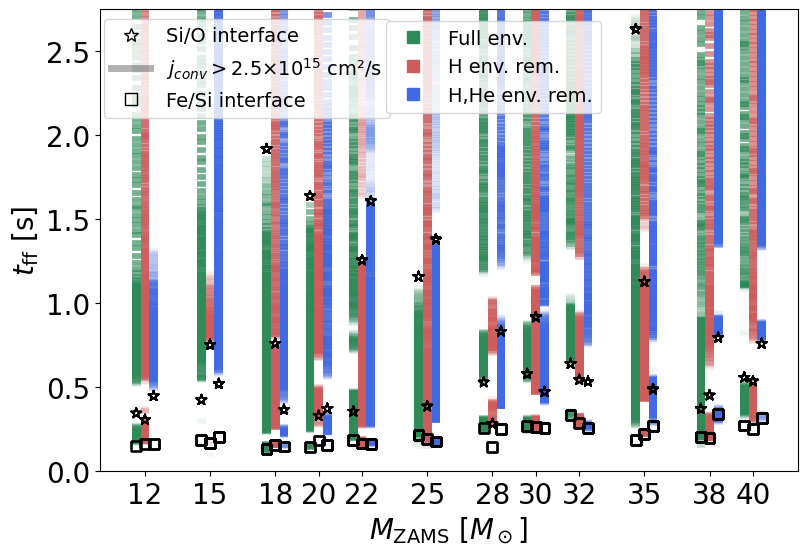
Figure 3: Free-fall times from the Fe/Si and Si/O boundaries at the onset of collapse, indicating that these interfaces are accreted before shock revival in neutrino-driven models.
The authors highlight that recent 1D and 3D simulations of the neutrino mechanism yield either low explosion energies or a high fraction of failed explosions, in contradiction with observations. In contrast, the JJEM, as supported by the present results, predicts robust explosions for all massive stars with non-rotating cores, with black hole formation restricted to rapidly rotating progenitors.
Numerical and Physical Robustness
The study includes extensive tests of numerical consistency, varying initial mass by small amounts and exploring different envelope removal schemes and retained envelope masses. While the detailed structure of convective zones and core composition can vary stochastically with these parameters, the existence of at least one strong convective zone with j(m) above the JJEM threshold in the NS-forming core is a robust outcome.
Theoretical and Observational Implications
The findings have several important implications:
- Universality of JJEM: The results support the claim that the JJEM can operate in all CCSNe, including SECCSNe, and that failed supernovae are not expected except in the case of rapidly rotating cores.
- Morphological Predictions: The prevalence of point-symmetric morphologies in observed CCSN remnants is naturally explained by the JJEM, whereas the neutrino mechanism lacks a corresponding prediction.
- Explosion Energetics: The JJEM can account for the observed range of explosion energies, including superluminous events, without invoking additional energy sources such as magnetars.
- Black Hole Formation: The restriction of black hole formation to rapidly rotating cores provides a natural explanation for the observed mass gap and the distribution of compact remnant masses.
Future Directions
The study underscores the need for multidimensional simulations capable of resolving the interplay between convection, angular momentum transport, and disk formation in the final seconds before collapse. The limitations of 1D MLT-based models are acknowledged, with 3D simulations indicating even higher convective velocities and larger-scale angular momentum fluctuations. Further work is required to directly simulate the formation and evolution of intermittent accretion disks and jet launching in the context of the JJEM.
Conclusion
This work provides strong theoretical support for the operation of the Jittering Jets Explosion Mechanism in stripped-envelope core-collapse supernovae. The presence of vigorous convection and substantial stochastic angular momentum in the pre-collapse cores of all models studied implies that intermittent disk formation and jet-driven explosions are generic outcomes for massive stars, independent of envelope structure. These results challenge the necessity of the neutrino-driven mechanism for explaining CCSNe and offer a unified framework for understanding the diversity of explosion outcomes and remnant properties observed in nature.