- The paper introduces a new mass-loss regime, TEMP, that couples hydrodynamic escape with planetary evolution to explain the extreme properties of super-puff planets.
- The authors integrate a 1D hydrodynamic photoevaporation model with detailed interior evolution, capturing transitions from boil-off to photoevaporation phases.
- Results constrain atmospheric metallicity and demonstrate that early boil-off, rather than prolonged photoevaporation, dominates envelope loss in low-gravity planets.
A Coupled Evolutionary and Hydrodynamic Framework for Super-Puff Planets
Introduction and Motivation
The discovery of super-puff exoplanets—low-mass, large-radius planets with extremely low bulk densities—has posed significant challenges to standard models of planet formation and atmospheric evolution. These objects, typified by the Kepler-51 system, require high H/He mass fractions to explain their radii, yet such envelopes are expected to be highly susceptible to atmospheric escape. The paper "Understanding the Origins of Super-Puff Planets: A New Mass-Loss Regime Coupled to Planetary Evolution" (2510.02201) addresses this tension by developing a fully coupled evolutionary and hydrodynamic model, introducing a new mass-loss regime—thermal-energy-mediated photoevaporation (TEMP)—and providing a comprehensive analysis of the physical processes governing the formation, evolution, and survival of super-puffs.
Model Architecture and Methodology
The framework integrates a 1D hydrodynamic photoevaporation model with a detailed planetary interior and thermal evolution code. The interior model includes an iron core, silicate mantle, and a convective H/He envelope, with a radiative atmosphere extending to nbar pressure levels. The model self-consistently tracks the evolution of each layer, including latent heat release during core solidification, and incorporates realistic T-P profiles using the Guillot (2010) radiative transfer formalism.
A key innovation is the explicit coupling of the hydrodynamic escape calculation to the evolving planetary structure at each timestep, rather than relying on precomputed grids or static boundary conditions. The model transitions smoothly between the boil-off phase (modeled as an isothermal Parker wind) and the photoevaporation phase, with the lower boundary for photoevaporation set by a physically motivated transition between hydrostatic and wind-dominated regimes.
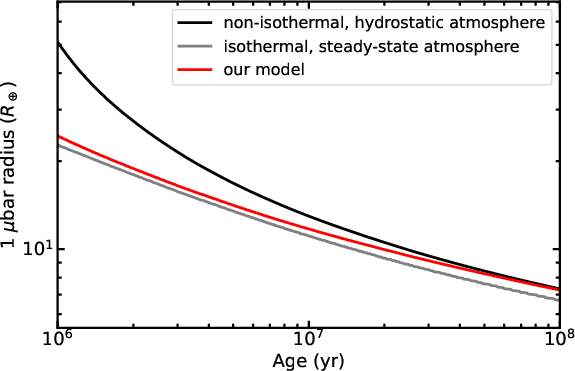
Figure 1: 1μbar radii calculated from the isothermal Parker wind (gray) and non-isothermal, hydrostatic atmosphere (black), with the transition regime (red) providing the lower boundary for the photoevaporation model.
The photoevaporation module solves the steady-state hydrodynamics and ionization balance for XUV-driven winds, including PdV work, advective cooling, and Ly-α cooling, and is optimized for the low-gravity, extended atmospheres characteristic of super-puffs.
Mass-Loss Regimes: From Energy-Limited to TEMP
The study demonstrates that the canonical energy-limited escape prescription, widely used in sub-Neptune evolution models, systematically overestimates mass-loss rates for low-gravity planets. In these objects, the atmospheric scale height is large, the photoionization base is located at high altitudes (low pressures), and the wind is only weakly ionized.
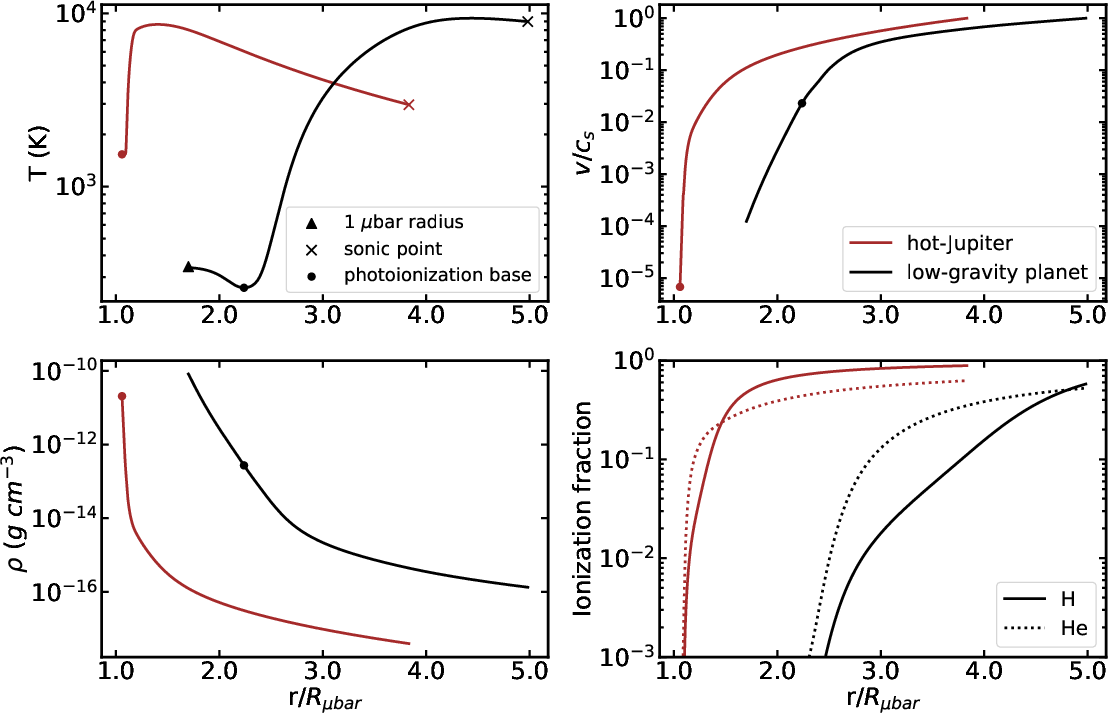
Figure 2: Radial profiles of temperature, Mach number, density, and ionization fraction for a super-puff (Kepler-51b, black) and a hot Jupiter (HD 209458b, red), highlighting the extended, weakly ionized wind in the super-puff.
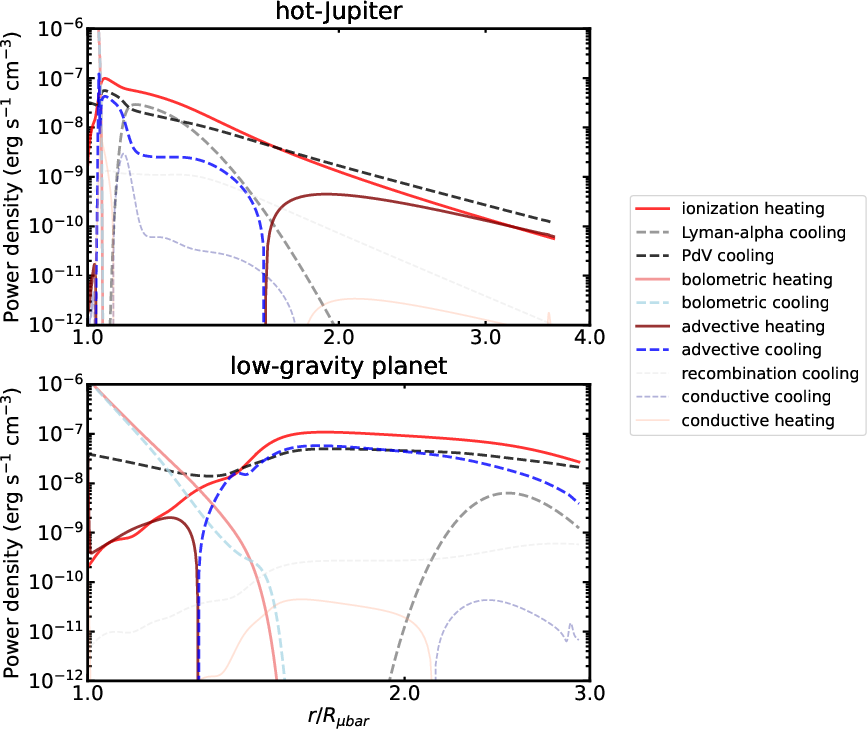
Figure 3: Energy budgets for high-gravity (top) and low-gravity (bottom) planets, showing the dominance of PdV work and advective cooling in the super-puff regime.
The authors introduce the TEMP regime, in which the majority of the XUV energy input is converted into thermal energy and used to drive the wind to the sonic point, rather than being expended primarily against the gravitational potential. The transition between energy-limited and TEMP regimes is governed by the escape parameter at the sonic point, λs=(GMp/Rs)/(kTs/μs), with TEMP dominating for λs<1.
The mass-loss rate in the TEMP regime is given by:
M˙TEMP=(γ−1γ+2γ)kTsπαFEUVRbase2μs
where Ts is the temperature at the sonic point, μs is the mean molecular weight, and α is an order-unity factor determined numerically.
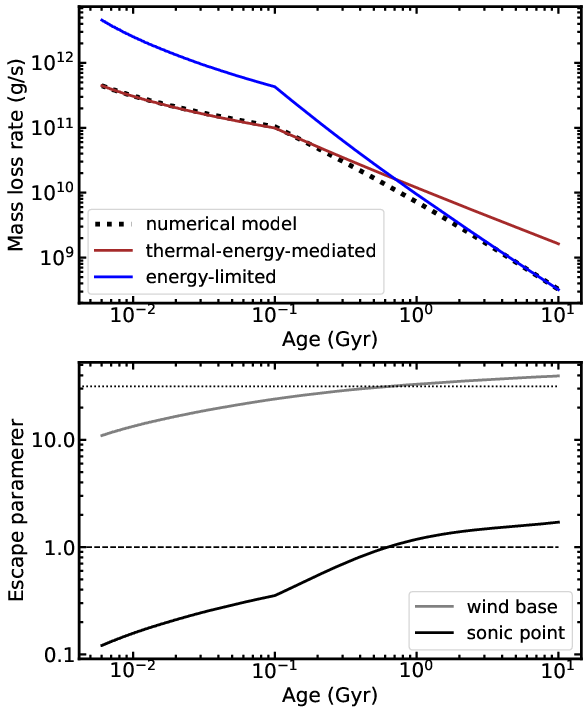
Figure 4: Comparison of mass-loss rates: thermal-energy-mediated (red), energy-limited (blue), and the full numerical model (black dashed). The lower panel shows the evolution of the escape parameter at the sonic point.
The model provides analytical fits for Ts as a function of EUV flux and for the location of the photoionization base, enabling rapid evaluation of the mass-loss regime for arbitrary planetary parameters.
Evolutionary Pathways and Comparison to Observations
The coupled model is applied to a suite of observed super-puffs and young, low-density planets. The evolutionary tracks reproduce the observed radii and H/He mass fractions for a range of system ages and atmospheric pressures, with the best agreement for transit pressures in the 1–100 nbar range for hazy atmospheres and ∼20 mbar for clear atmospheres.
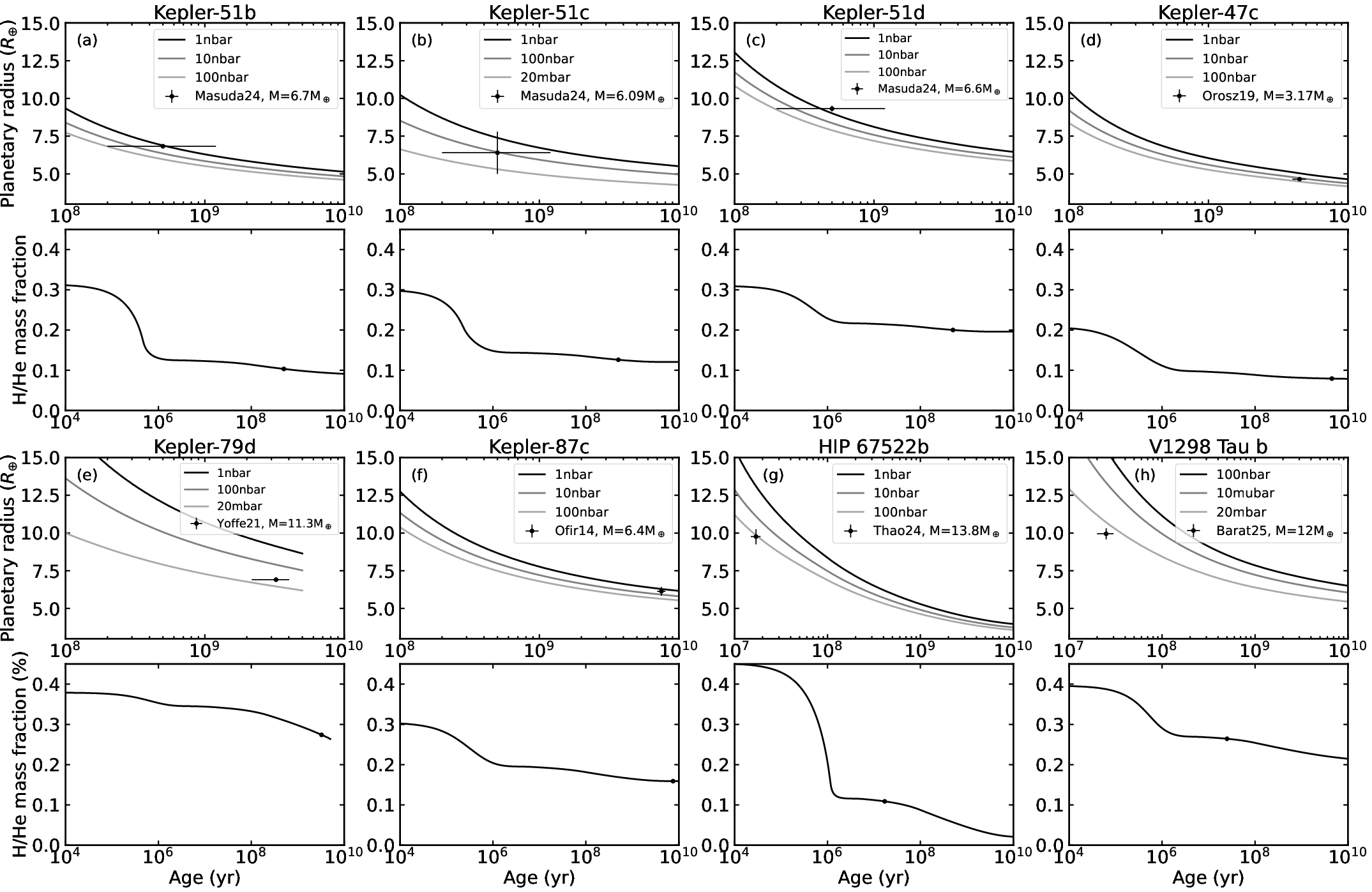
Figure 5: Evolutionary tracks of planetary radii and H/He mass fractions for super-puffs and young planets, with observational data points overlaid.
Mass-radius relations as a function of pressure level, age, and incident flux are constructed, demonstrating that super-puffs occupy a narrow region of parameter space: intermediate masses (5–10 M⊕), low-to-moderate stellar insolation (≲30F⊕), and low atmospheric metallicity.
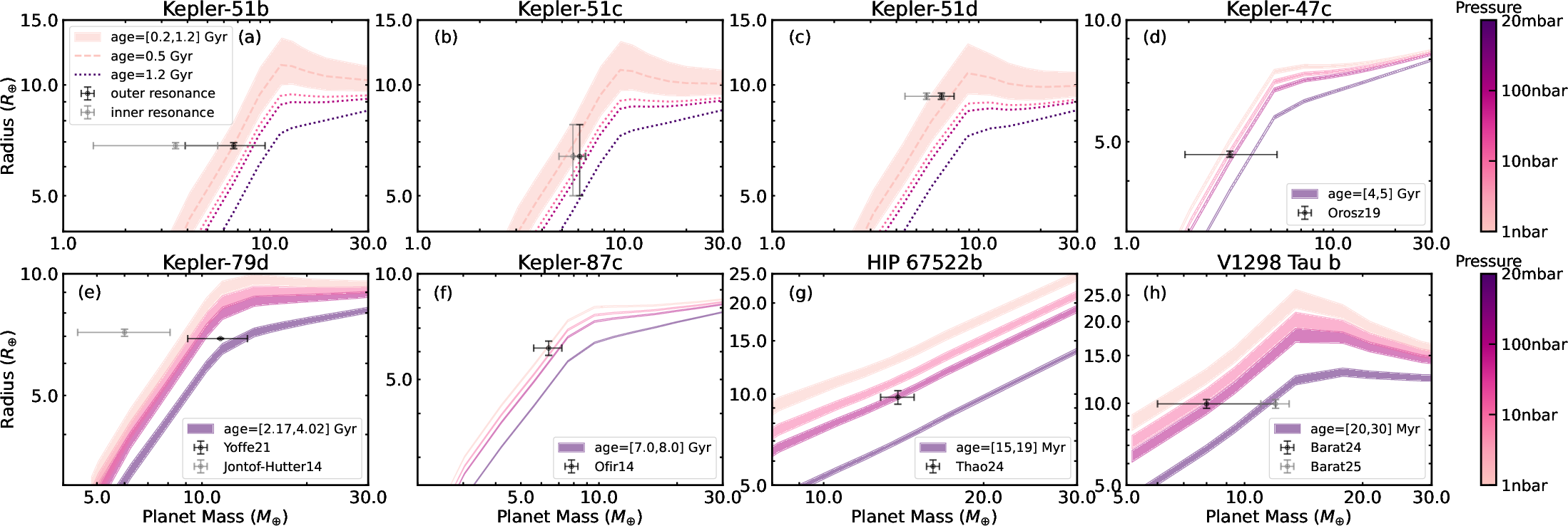
Figure 6: M-R curves for super-puffs and young planets at different pressure levels, with shaded regions reflecting age uncertainties and observational data overlaid.
The model robustly predicts that boil-off dominates the early mass loss, typically removing 80–90% of the initial envelope mass within the first few Myr, with photoevaporation contributing only a minor fraction over Gyr timescales. This is in contrast to previous models, which overestimated the role of photoevaporation due to neglecting boil-off and misapplying the energy-limited prescription.
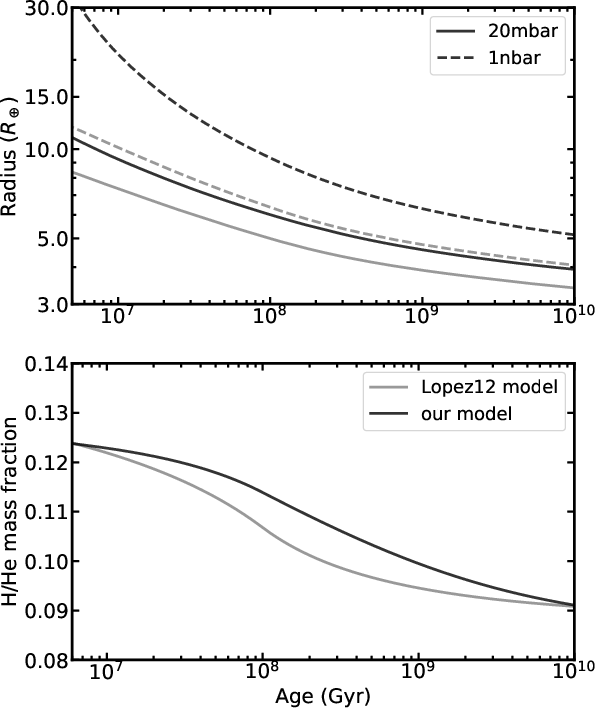
Figure 7: Comparison of planetary evolution for Kepler-51b between the new coupled framework (black) and a previous energy-limited, constant scale height model (gray), showing significant underestimation of radius in the latter.
The model explores the impact of atmospheric metallicity on the evolution and observability of super-puffs. Increased metallicity reduces the scale height and suppresses both boil-off and photoevaporation, but also slows cooling and can inflate the envelope. The net effect is a monotonic decrease in transit radius with increasing metallicity for most of the relevant parameter space.
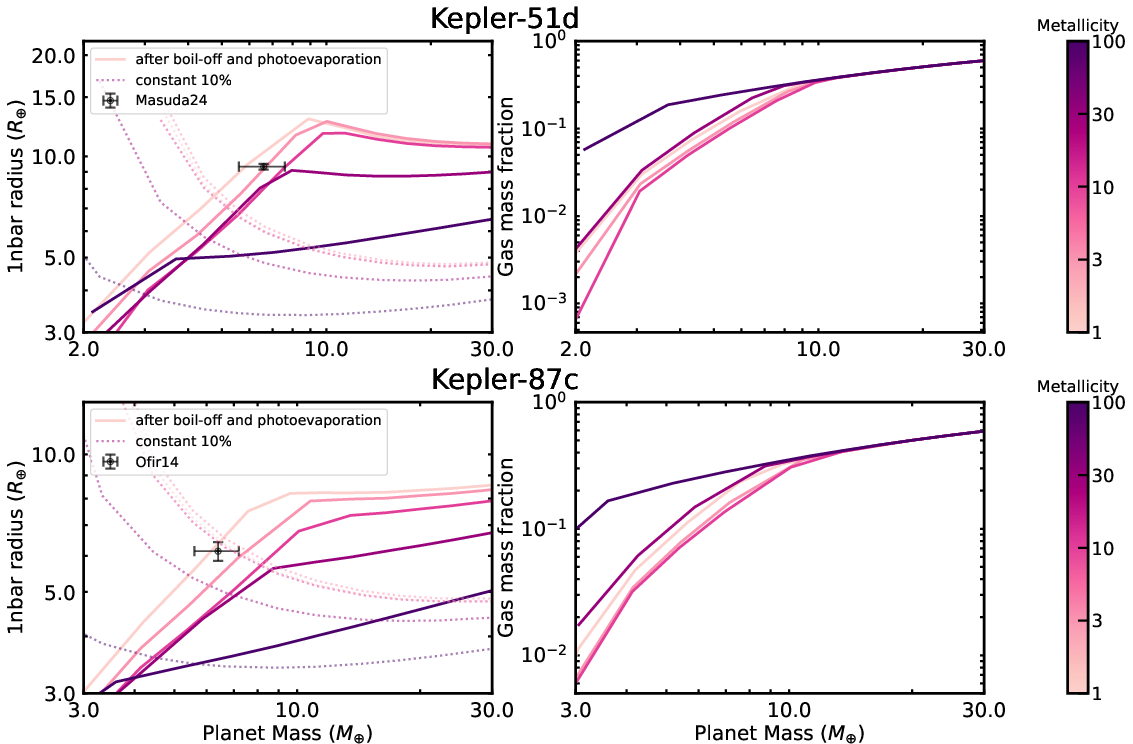
Figure 8: M-R curves and gas mass fraction as a function of planetary mass for varied metallicity, showing that super-puffs require low atmospheric metallicity (≲10× solar) to match observed radii.
The analysis places upper limits on the metallicity of super-puff atmospheres, with values above 10× solar excluded for Kepler-51d and above 3× solar for Kepler-87c, given current mass and radius constraints.
Theoretical and Observational Implications
The results have several important implications:
- Super-puff formation and survival: Super-puffs can form in situ with moderate H/He envelopes and survive both boil-off and photoevaporation if they reside in the appropriate mass and flux regime. High envelope mass fractions (>30%) are not required, and inward migration is not necessary for their survival.
- Dominance of boil-off: The early, rapid boil-off phase is the primary determinant of the final envelope mass and radius for low-mass, low-gravity planets. Photoevaporation is subdominant except for higher-mass or more highly irradiated objects.
- TEMP regime: The identification and quantification of the TEMP regime resolves the discrepancy between observed super-puff properties and previous model predictions, and provides a physically motivated, analytically tractable prescription for mass loss in low-gravity planets.
- Metallicity constraints: The requirement of low atmospheric metallicity for super-puffs to maintain large radii is consistent with the observed trend of decreasing metallicity with increasing planet mass, and has implications for haze formation and transmission spectroscopy.
- Host star dependence: Super-puffs are favored around FGK stars at moderate separations; formation and survival around M-dwarfs is disfavored due to more extreme boil-off and photoevaporation histories.
Limitations and Future Directions
The model does not include the evolution of envelope-free planets, which is relevant for understanding the lower edge of the radius valley. The treatment of metal line cooling in the wind is simplified, and the impact of stellar wind confinement is neglected but found to be subdominant for the parameter space explored. Tidal heating is generally negligible except for close-in, rapidly rotating planets.
Future work should extend the population synthesis to a broader range of stellar types, incorporate envelope-free evolution, and refine the treatment of atmospheric chemistry and haze formation.
Conclusion
This study provides a comprehensive, physically self-consistent framework for the coupled thermal and hydrodynamic evolution of super-puff planets. The introduction of the TEMP regime and the explicit modeling of the boil-off phase resolve longstanding discrepancies in the interpretation of super-puff observations. The results place strong constraints on the formation, composition, and survivability of low-density exoplanets, and provide a robust foundation for future theoretical and observational studies of planetary atmospheres and evolution.

