- The paper introduces a CNN-based Autoproof system that uses manual ground-truth to automate merge corrections in connectomics, cutting manual effort by up to fivefold.
- It integrates 3D convolution with shape and synaptic connectivity features to achieve over 90% precision at 90% recall, optimizing both focused merge and orphan link workflows.
- The system demonstrates scalable improvements in Drosophila CNS reconstruction and paves the way for future cross-dataset generalization and integration with emerging modalities.
Automated Segmentation Proofreading for Connectomics: The Autoproof System
Introduction
The Autoproof system addresses the persistent bottleneck in large-scale electron microscopy (EM) connectomics: the extensive manual proofreading required to correct segmentation errors. While automated segmentation algorithms have advanced, the high accuracy demands of connectome reconstruction—where false merges or splits can severely compromise downstream analyses—necessitate substantial human intervention. Autoproof leverages the ground-truth data generated during manual proofreading to train machine learning models that automate or optimize key proofreading workflows, specifically focused merge and orphan link tasks. This approach is validated on the complete reconstruction of the Drosophila male central nervous system (CNS), demonstrating substantial reductions in manual effort and improvements in connectome completeness.
Proofreading Workflows and Segmentation Challenges
Connectomics segmentation workflows typically involve three main proofreading protocols: cleaving (correcting false merges), focused proofreading (guided correction of false splits), and orphan linking (unguided reconnection of disconnected fragments). The costliest errors are false merges, leading segmentation models to favor conservative over-segmentation, which increases the burden of correcting false splits. Focused proofreading presents candidate merges to proofreaders for binary decisions, while orphan linking requires proofreaders to manually search for connections for orphan fragments, making it more labor-intensive.
Autoproof's core is a 3D convolutional neural network (CNN) with a VGG-like architecture, designed to predict merge decisions in the focused proofreading workflow. The model ingests local grayscale EM data centered at candidate merge locations, augmented with binary masks for the two candidate segments. Training utilizes binary cross-entropy loss, with ground-truth labels derived from manual proofreading annotations.
To enhance predictive performance and generalizability, Autoproof incorporates additional information sources:
- Shape Information: Point clouds sampled from candidate segment volumes are processed using EdgeConv, enabling larger context and potential cross-dataset generalization.
- Synaptic Connectivity: Feature vectors encoding synapse counts to common inputs/outputs and cell types are input to an SVM, capturing the intuition that fragments of the same neuron share connectivity patterns.
- Synapse Proximity: A fourth CNN channel encodes proximity to predicted synapses, reflecting manual annotation observations that true neuron terminations often coincide with synapse locations.
- Neurotransmitter Predictions: Preliminary experiments suggest neurotransmitter type consistency may help rule out incorrect merges, though current prediction accuracy limits utility.
Autoproof is trained and validated on focused merge decisions from the Drosophila CNS dataset, with 40k training and 20k test examples. The CNN model, with a receptive field of 1303 voxels, is complemented by point cloud and synaptic features, combined via SVM. Performance is benchmarked against the baseline agglomeration scores from Flood Filling Networks.
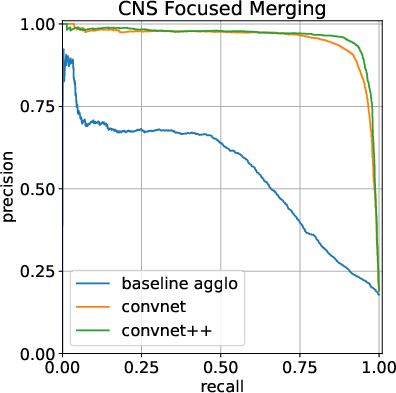
Figure 1: Focused merge precision-recall curves comparing baseline agglomeration, CNN-only, and CNN with shape and synapse information (convnet++).
Autoproof achieves high precision across a range of recall values, with the convnet++ model (CNN + shape + synapse) outperforming both the baseline and CNN-only approaches. Notably, Autoproof attains above 90% precision at 90% recall, enabling 90% of merges to be identified with only 20% of the manual effort and no loss in accuracy. This result implies a fivefold reduction in required human labor for focused proofreading, with the potential for fully automated acceptance of high-confidence merge decisions.
Orphan Link Workflow: Large-Scale Automated Merging
The orphan link workflow is reframed as a focused merge problem by generating candidate merges via spatial adjacency. Autoproof's CNN model is applied to approximately one million orphan fragments (synaptic weight 10–100), generating candidate merges for each fragment and proofread neuron pair.
Performance is evaluated by manual review of 2000 randomly sampled merges, with two proofreaders assessing correctness and indeterminacy.
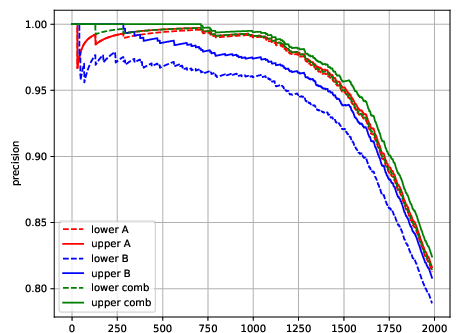
Figure 2: Precision of Autoproof orphan link merges under different proofreader assessments and indeterminacy handling.
Autoproof achieves precision above 0.95 for most of the sampled range, with a conservative threshold selected to ensure an error rate below 3%. The system automatically accepts 200,000 merges, adding 309,000 T-bars and 2.4 million PSDs, and increasing the connectivity completion rate by 1.3 percentage points. This automation is equivalent to four person-years of manual proofreading, demonstrating substantial scalability and impact.
Implementation Considerations and Limitations
Autoproof's deployment requires access to versioned segmentation and annotation data, as provided by systems like DVID. The CNN model's receptive field and point cloud sampling parameters must be tuned to balance context size and computational efficiency. While the system demonstrates strong performance on the Drosophila CNS dataset, cross-dataset generalization remains an open challenge, particularly for shape and connectivity features. Neurotransmitter predictions, though promising, currently lack sufficient accuracy for reliable merge validation.
Resource requirements are dominated by CNN inference over large volumetric datasets and candidate pair generation, necessitating parallelization and efficient data management. The system is designed for in-the-loop retraining, adapting to new ground-truth as manual proofreading progresses.
Implications and Future Directions
Autoproof demonstrates that leveraging manual proofreading ground-truth for model training can dramatically reduce annotation bottlenecks in EM connectomics. The approach is tightly coupled to real-world workflows, enabling direct integration into ongoing reconstruction efforts. As segmentation algorithms improve, the nature of errors will shift, but manual proofreading is likely to remain necessary for the foreseeable future, especially in resource-constrained projects.
Future work will focus on:
- Cross-dataset Generalization: Enhancing shape and connectivity features for transferability across reconstructions.
- Integration with New Modalities: Adapting Autoproof to light-microscopy-based connectomics (e.g., LICONN).
- Self-supervised Learning: Exploiting unsupervised signals for improved error detection and correction.
- Expanded Use of Neurotransmitter and Cell-type Information: Refining merge validation with multimodal biological data.
Conclusion
Autoproof provides a robust, scalable solution for automating segmentation proofreading in connectomics, leveraging manual annotation ground-truth to train high-precision models. The system achieves substantial reductions in manual effort and measurable improvements in connectome completeness, with demonstrated applicability to both guided and unguided proofreading workflows. Continued development will focus on generalization, integration with emerging modalities, and incorporation of richer biological signals, with the goal of further accelerating and democratizing large-scale connectome reconstruction.