- The paper introduces a near-linear time algorithm that reconstructs the true order of EM image stacks using a five-phase sparse graph and chaining methodology.
- It employs advanced techniques such as Random-Hook Borůvka, iterative condensation, and SuperChain assembly to ensure high accuracy and robustness even in noisy conditions.
- The method significantly reduces computation time, achieving up to 6.6× speed-ups on large datasets while providing theoretical guarantees for exact recovery.
Sparse Graph Reconstruction and Seriation for Large-Scale Image Stacks
Introduction and Motivation
The paper addresses the computational challenge of reconstructing the correct linear order of large-scale, unordered image stacks, a problem central to high-throughput connectomics pipelines where section order is lost during wafer-based collection. Traditional approaches, such as exhaustive pairwise similarity computation and spectral seriation, are computationally prohibitive and often unreliable due to the highly local and noisy nature of similarity signals in electron microscopy (EM) images. The authors propose a near-linear time, provably correct algorithm for seriation that leverages sparse graph construction and a robust chaining strategy, enabling efficient and accurate ordering of thousands of sections.
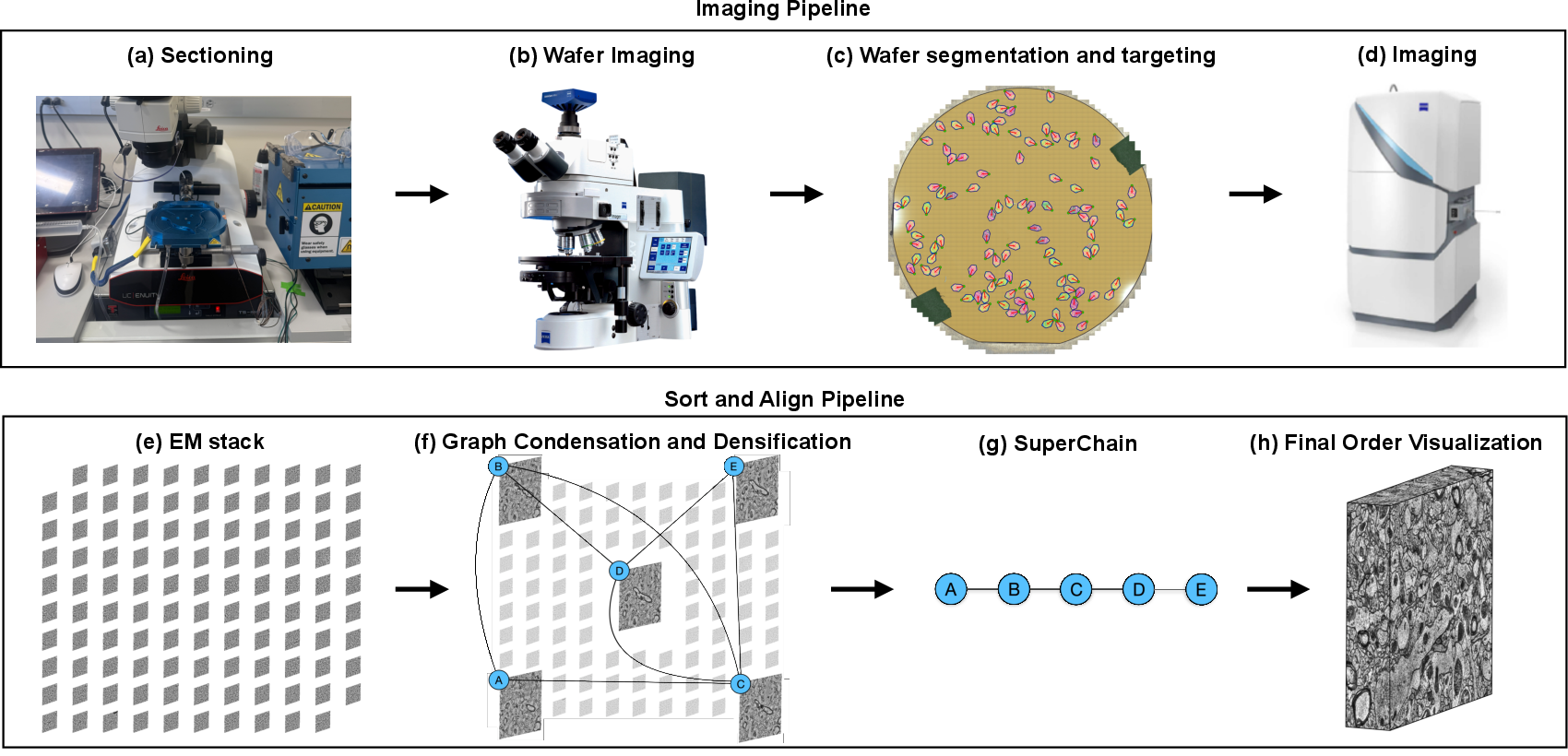
Figure 1: WaferTools pipeline for wafer-to-volume EM sorting, illustrating the transition from unordered section collection to final ordered EM stacks.
Sparse Graph Construction Pipeline
The core contribution is a five-phase pipeline that constructs a sparse graph containing all edges necessary for exact seriation, while minimizing the number of expensive similarity queries. The pipeline consists of:
- Random-Hook Borůvka Phase: Establishes initial connectivity using a randomized variant of Borůvka's algorithm, requiring only O(NlogN) queries. Each component samples a logarithmic number of candidate partners, efficiently discovering short-range connections.
- Iterative Condensation: Reduces the graph diameter by adding edges from farthest vertices to their short-range neighbors, halving the effective diameter in each round. After O(logN) rounds, the diameter is bounded by a small constant.
- Double-Sweep BFS: Produces a provisional global ordering by performing breadth-first search from the diameter endpoints, ensuring that true neighbors are within a bounded window in the provisional order.
- K-Window Densification: Locally densifies the graph by querying all pairs within a fixed window K around each vertex in the provisional order, guaranteeing that all true adjacent pairs are included.
- SuperChain Assembly: Recovers the final order using a greedy chaining algorithm that exploits empirical top-1 and top-2 similarity margins.
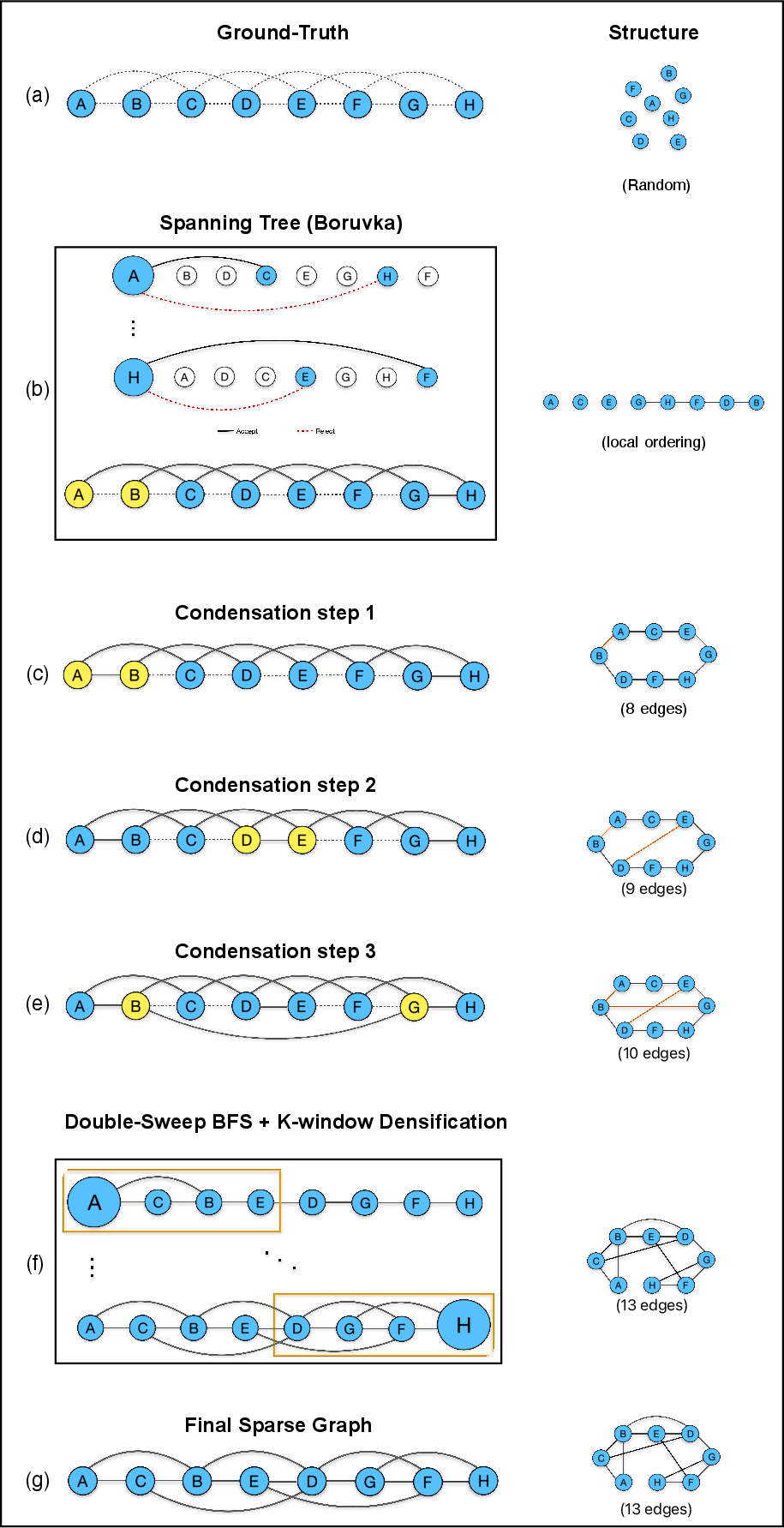
Figure 3: Four-phase sparse graph construction, from initial connectivity to final sparse graph containing all essential edges for seriation.
Feature Matching and Similarity Computation
The similarity between section pairs is computed using a multi-stage feature-matching pipeline:
- SIFT Keypoint Extraction: Detects robust local features in each section.
- FLANN Matching: Establishes putative correspondences between keypoints.
- RANSAC Geometric Verification: Filters matches to retain only those consistent with an affine transformation, rejecting outliers.
- SSIM Computation: Measures fine-scale morphological similarity on the aligned overlap region.
The final similarity score is the product of SSIM and the number of inliers, ensuring robustness to imaging artifacts and registration errors.

Figure 2: Feature-matching pipeline for similarity computation, integrating SIFT, FLANN, RANSAC, and SSIM.
SuperChain: Robust Order Recovery
After sparse graph construction, the SuperChain algorithm reconstructs the global order by iteratively merging path components according to four rules: maximize-chain, unbroken-chain, end-to-end chain, and fallback chain. The process starts from mini-chains formed by reciprocal best matches and extends them via endpoint connections, ensuring that the true order is recovered as long as a sufficient fraction of top-2 neighborhoods are correct.
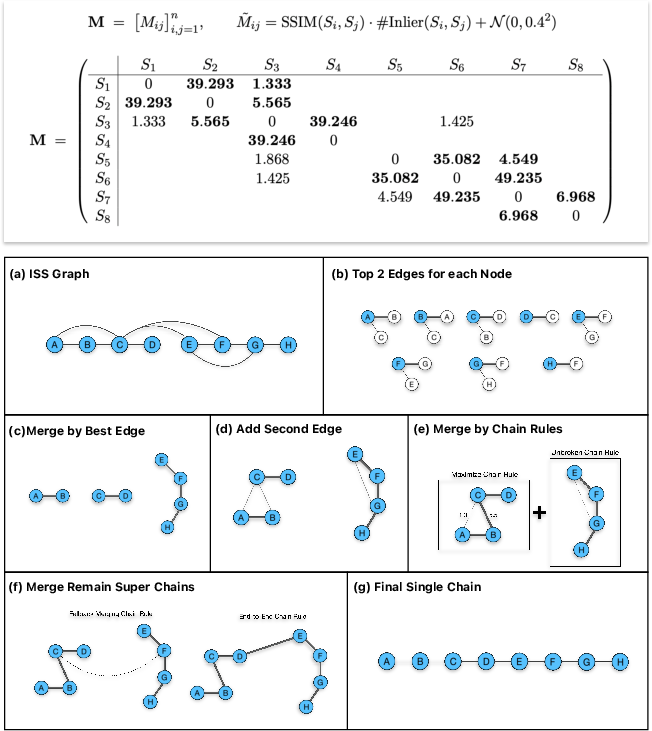
Figure 4: SuperChain assembly process, from initial ISS graph to final single chain representing the complete section order.
Empirical Evaluation
Scalability and Efficiency
The proposed Graph Condensation approach achieves substantial speed-ups over fully-pairwise methods. For 100, 500, and 1000 sections, speed-up factors of 2.5×, 5.1×, and 6.6× are observed, respectively, with the full pipeline runtime for 1000 sections reduced from over 4.5 hours to under 1 hour on a single CPU core.
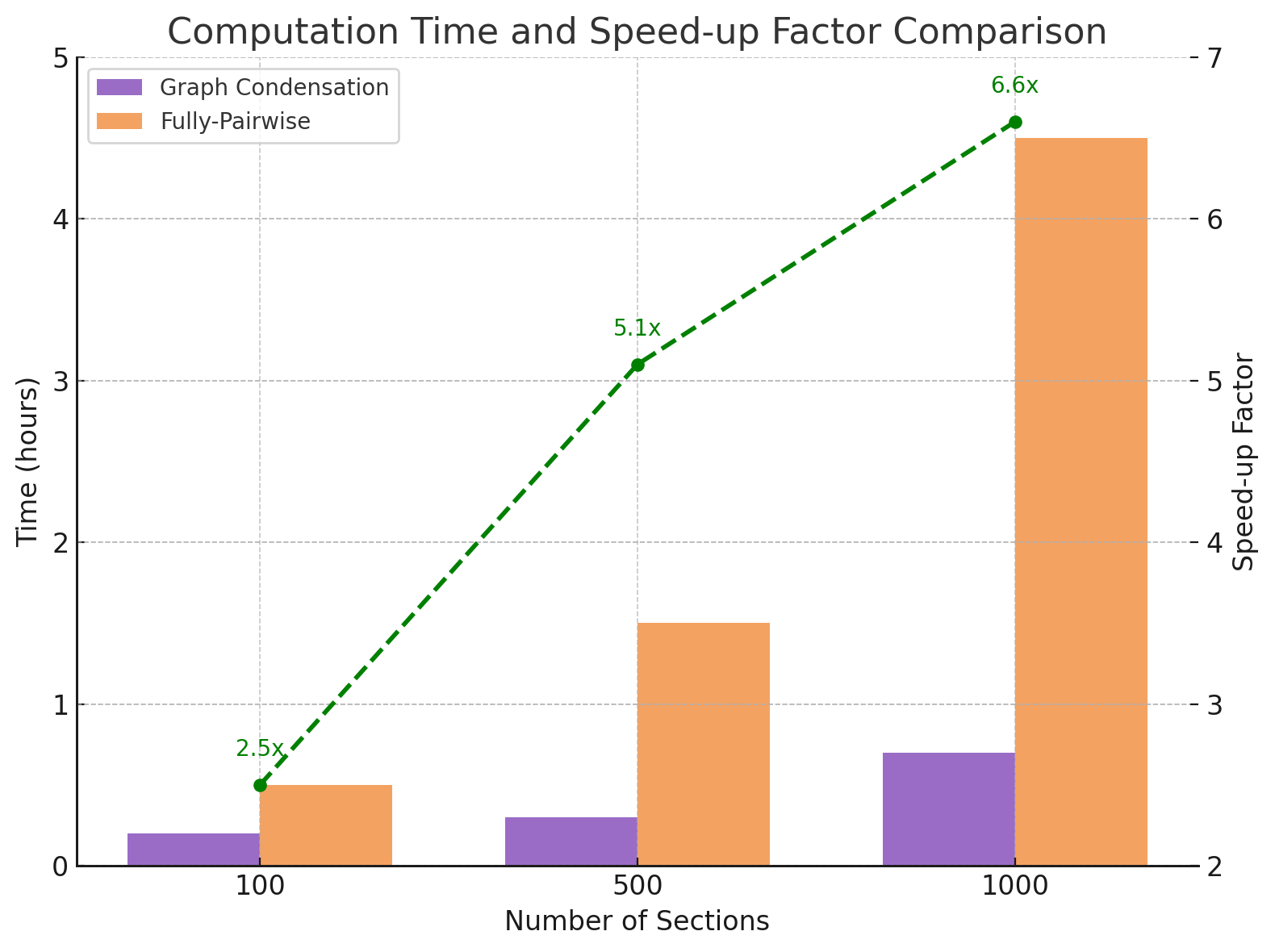
Figure 5: Similarity computation time and speed-up factor comparison between Graph Condensation and fully-pairwise methods.
Accuracy and Robustness
SuperChain consistently achieves perfect accuracy (1.00) across all tested dataset sizes, outperforming MST, Fiedler, and recent matrix-reordering baselines, which degrade in accuracy as the number of sections increases or under increased noise. The method maintains sub-second ordering times for 1000 sections, with the full pipeline remaining tractable for large-scale datasets.
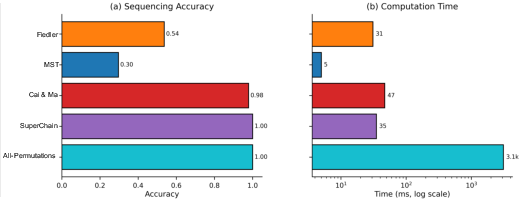
Figure 6: Comparison of sequencing algorithms on an 8-section H01 example, showing SuperChain's superior accuracy and efficiency.
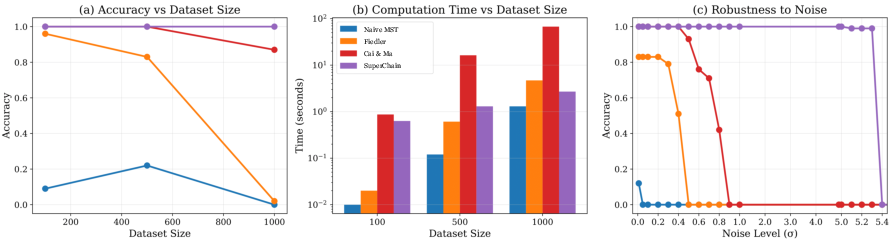
Figure 7: Accuracy and computation time comparison across 100, 500, and 1000 section stacks, and robustness to Gaussian noise.
Theoretical Guarantees
The algorithm is proven to recover the true order with O(N(logN+K)) queries under both binary and noisy distance oracle models, provided a sufficient margin between true and false edges. The condensation and densification phases ensure that all necessary edges are discovered, while SuperChain guarantees exact recovery under mild assumptions on the similarity margin and endpoint purity.
Monte Carlo and Ablation Studies
Monte Carlo experiments confirm that SuperChain maintains high recovery probability even when only ∼2N/3 of second-best neighbors are correct, whereas spectral and TSP-based methods collapse to random performance under similar conditions.
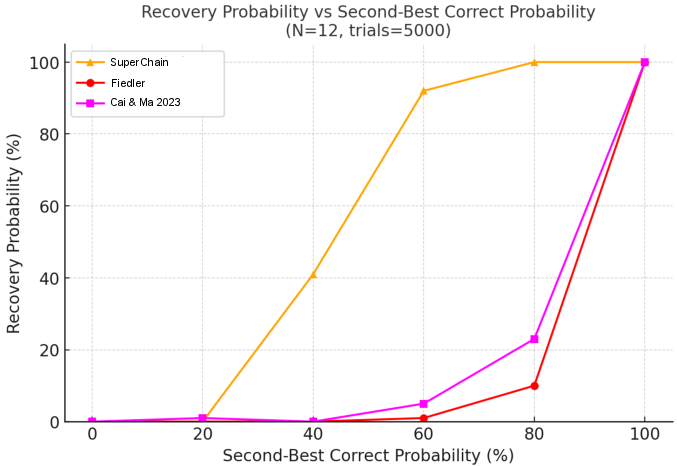
Figure 8: Monte Carlo recovery probability as a function of second-best edge correctness rate, demonstrating SuperChain's robustness.
Ablation studies show that omitting condensation or densification significantly increases the edge-edit rate, and that the probe budget and window size must be carefully balanced for optimal performance.
Imaging Parameter Trade-offs
A systematic analysis of field-of-view (FOV) and resolution reveals that FOV is the dominant factor in computational cost, with large FOVs leading to superlinear increases in runtime. High resolution has a modest effect due to saturation in feature extraction. The operational regime for successful seriation is identified as moderate FOV and resolution, where overlap and runtime are balanced.
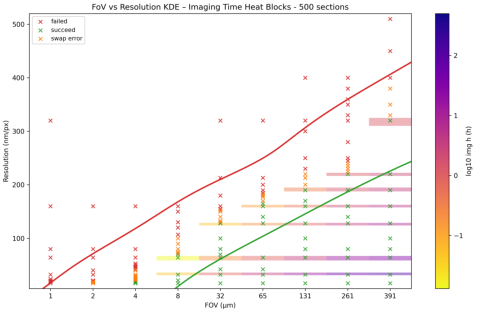
Figure 9: FoV–Resolution landscape for a 500-section H01 stack, showing operational regimes for successful seriation and computational cost.
Beyond a critical FOV, computational time exceeds imaging time, highlighting a scalability bottleneck for naïve pairwise approaches.
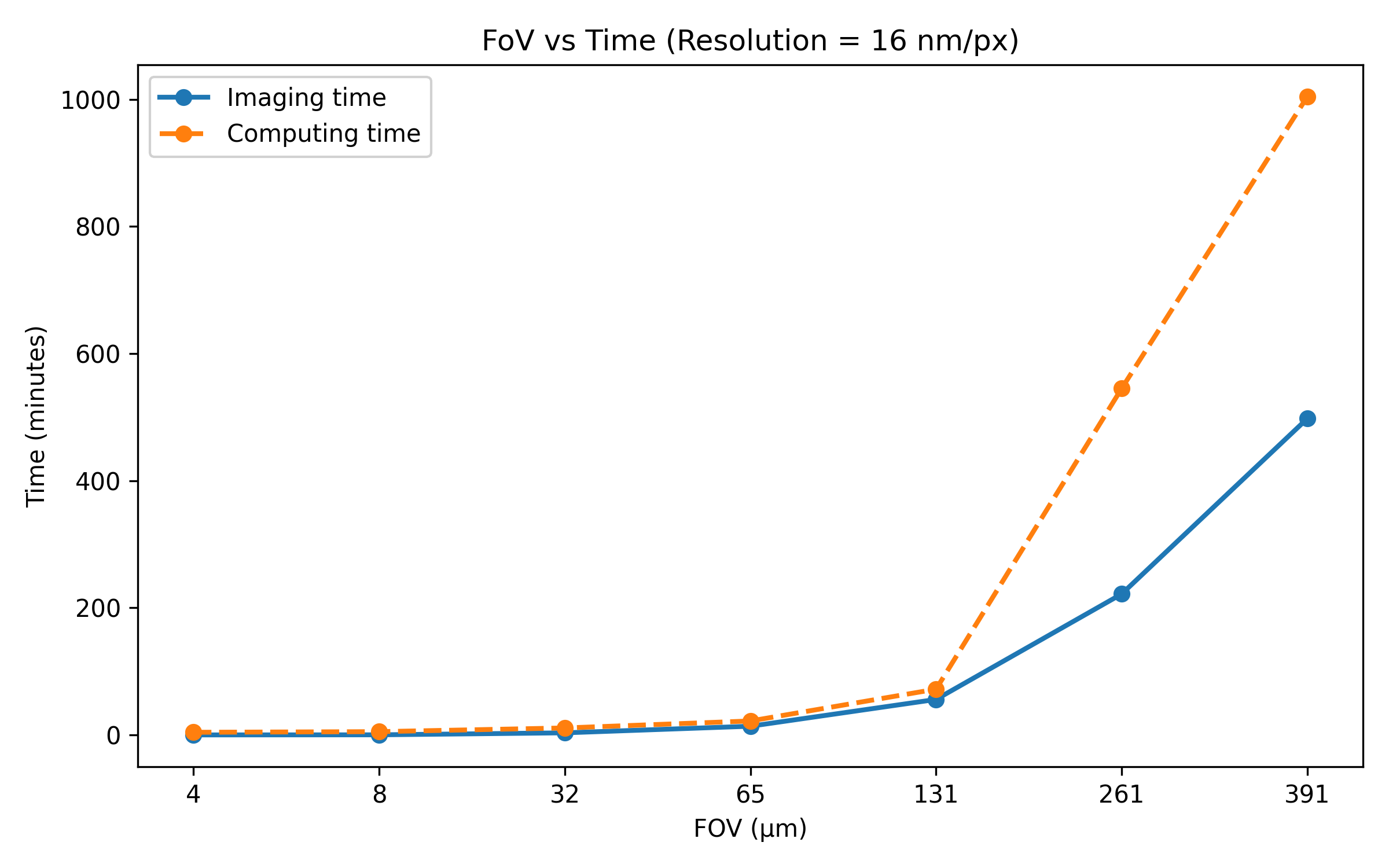
Figure 10: Trade-off between imaging time and computational burden across field-of-view, with computation dominating beyond ∼131 µm FOV.
Implications and Future Directions
The presented pipeline enables overnight, high-accuracy ordering of thousands of EM sections on commodity hardware, removing a major bottleneck in large-scale connectome reconstruction. The approach is broadly applicable to other seriation problems with local structure, including temporal ordering, archaeological seriation, and tour construction. The theoretical framework and empirical results suggest that further improvements may be possible by integrating learned similarity metrics or adaptive windowing strategies. The released code and benchmark dataset provide a foundation for future research in scalable seriation and graph-based ordering.
Conclusion
This work introduces a provably efficient, scalable, and robust solution to the seriation problem for large-scale image stacks, combining sparse graph construction with a robust chaining algorithm. The method achieves near-linear complexity, perfect empirical accuracy, and strong theoretical guarantees, enabling practical deployment in high-throughput connectomics and related domains. The results establish a new standard for tractable, reliable section ordering in large-scale imaging pipelines.