- The paper demonstrates that an outflow–cloud interaction in the circumnuclear medium explains the unexpected radio emission features in TDE AT2018cqh.
- Hydrodynamic simulations with ZEUS-3D successfully reproduce the evolving SED and light curve bump, showing a steady rise in peak flux and frequency over ~1000 days.
- Equipartition analysis reveals a compact emission region with a constant radius and an increasing ambient density, supporting a clumpy broad-line environment.
Outflow–Cloud Interaction as the Origin of Peculiar Radio Emission in the Tidal Disruption Event AT2018cqh
Introduction
This study presents a comprehensive multi-epoch radio analysis of the tidal disruption event (TDE) AT2018cqh, discovered in a dwarf galaxy and characterized by delayed X-ray and radio flares. The work leverages high-resolution VLBA and e-MERLIN observations, as well as ASKAP and uGMRT data, to probe the parsec-scale radio morphology, light curve evolution, and spectral energy distribution (SED) of AT2018cqh over a period extending to ∼2510 days post optical discovery. The observed radio properties—specifically, a compact, unresolved source with high brightness temperature, a steadily rising radio SED peaking at higher frequencies and flux densities, and a light curve exhibiting a pronounced bump—are inconsistent with standard outflow–circumnuclear medium (CNM) interaction models. Instead, hydrodynamic simulations demonstrate that these features can be naturally explained by the interaction of a TDE-driven outflow with dense clouds in the circumnuclear environment, likely associated with a pre-existing broad-line region (BLR) in the host AGN.
Observational Results: Morphology and Light Curve Evolution
VLBA imaging at 1.56, 4.74, and 7.63 GHz reveals a compact radio source unresolved at scales down to 0.13 pc at 7.6 GHz, with a brightness temperature Tb∼4×10⁹ K, well above the threshold for star formation and indicative of non-thermal synchrotron emission. No extended emission is detected in e-MERLIN observations at 1.51 and 5.07 GHz, further supporting the compactness of the radio source.
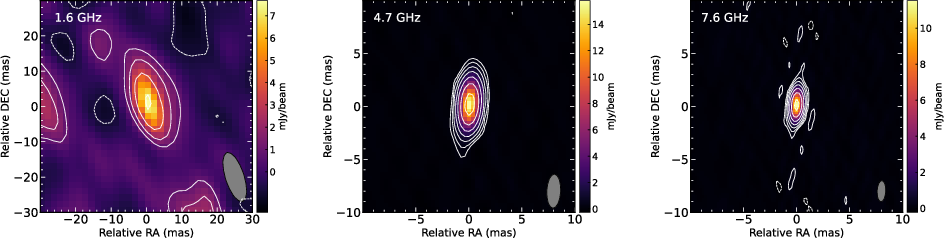
Figure 1: VLBA images of AT2018cqh at three frequencies, showing unresolved compact emission at sub-parsec scales.
The radio light curves, particularly at 0.89 GHz (ASKAP), display a continuous rise in flux with a distinct bump lasting ∼240 days and a rapid rise to peak over 115 days. Variability amplitudes post-bump are in the range of 7.4%–27.5%, with a median of 10.8%. While interstellar scintillation (ISS) may contribute to short-term variability, the magnitude and regularity of the bump feature cannot be attributed to ISS, suggesting intrinsic source variability.
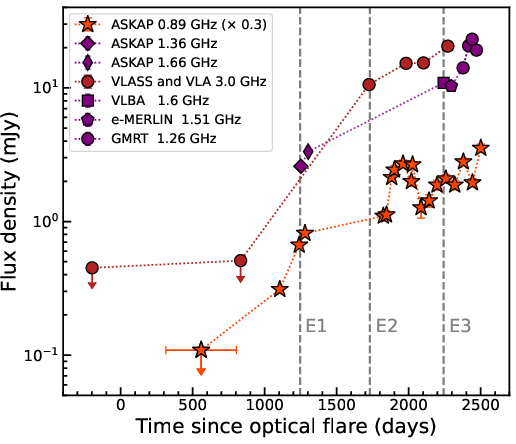
Figure 2: Multi-frequency radio light curves of AT2018cqh, highlighting the delayed onset and continued brightening, as well as the pronounced bump at 0.89 GHz.
Radio SED Evolution and Equipartition Analysis
Quasi-simultaneous VLBA and e-MERLIN observations enable detailed modeling of the radio SED at three epochs. MCMC fitting of a synchrotron emission model (non-relativistic outflow into CNM, n∝r−k) reveals a steady increase in both peak flux density (Fν,p) and peak frequency (νp) over ∼1000 days, from 2.47 mJy/1.42 GHz to 18.73 mJy/3.22 GHz. Equipartition analysis yields a nearly constant radius for the radio-emitting region (Req∼2×1017 cm) and an ambient electron density increasing by a factor of ∼3, with similar trends for both spherical and collimated outflow geometries.
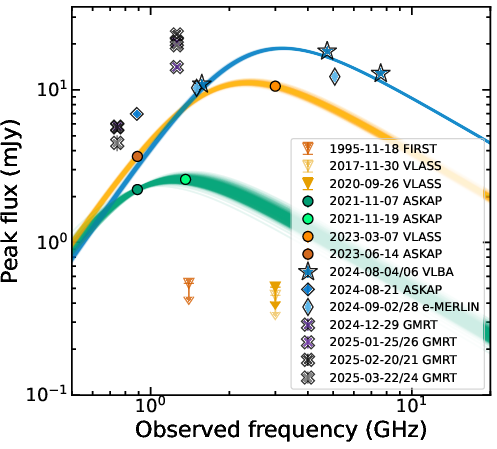
Figure 3: Radio SEDs at three epochs, showing a steady rise in both peak flux density and frequency, with MCMC model fits.
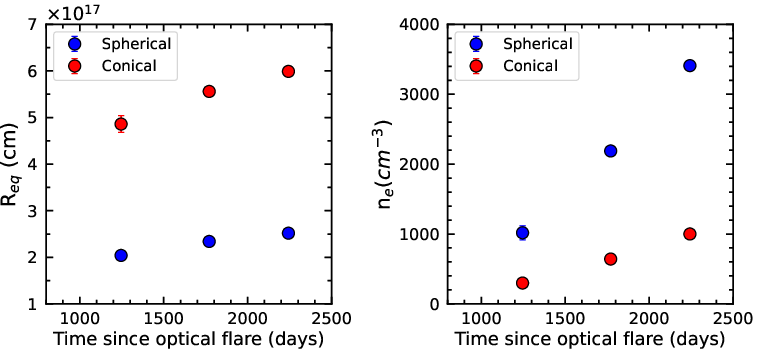
Figure 4: Temporal evolution of the equipartition radius and kinetic energy for spherical and conical outflow models, indicating minimal expansion and increasing ambient density.
The observed SED evolution—specifically, the shift to higher peak frequencies and flux densities—is unprecedented among known TDEs and contradicts the standard outflow–CNM scenario, which predicts a decline in both parameters over time. The lack of significant expansion in the emission region and the rapid variability further challenge the conventional model.
Hydrodynamic Simulations: Outflow–Cloud Interaction
To reconcile these observations, the study implements hydrodynamic simulations using ZEUS-3D, treating cosmic ray electrons (CRe) as a second fluid and modeling the interaction of a TDE-driven outflow with a dense, spherical cloud at sub-pc scales. The outflow is injected with a time-dependent mass-loss rate and velocity profile, confined within bipolar cones. The cloud, with a radius of 0.08 pc and located 0.43 pc from the SMBH, is impacted by the outflow, forming a bow shock that accelerates electrons and amplifies magnetic fields.
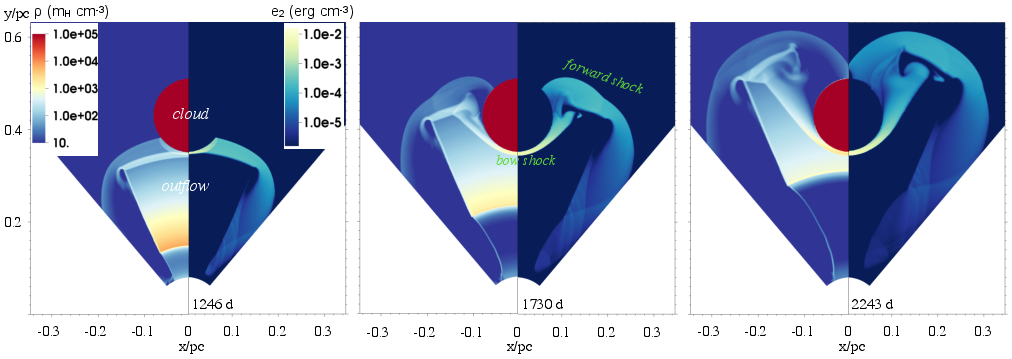
Figure 5: Hydrodynamic simulation snapshots showing density and CRe energy distributions at three epochs, illustrating the evolution of the bow shock and emission region.
The simulations reproduce the observed radio SEDs, with the emission region size remaining comparable to the cloud size and the SED peaking at higher frequencies and flux densities over time. The thin, non-spherical radiation shell formed by the bow shock is consistent with the unresolved VLBA observations and the lack of extended emission in e-MERLIN data.
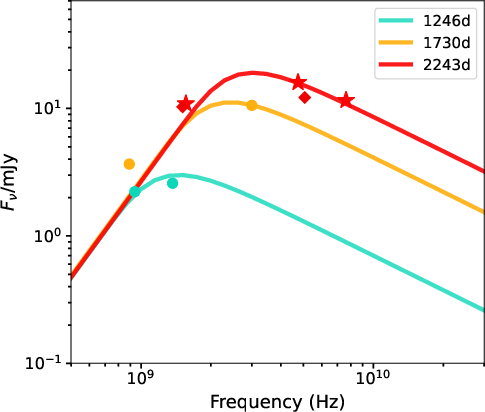
Figure 6: Simulated radio SEDs at three epochs, matching the observed evolution in peak flux density and frequency.
Implications and Theoretical Considerations
The outflow–cloud interaction model provides a self-consistent explanation for the peculiar radio properties of AT2018cqh, including the delayed onset, rapid brightening, and SED evolution. The presence of dense clouds in the circumnuclear environment is supported by the AGN classification of the host galaxy, suggesting a BLR origin. The model also accounts for the rapid variability and bump features in the light curve, which are difficult to reconcile with homogeneous CNM scenarios.
The equipartition analysis indicates that the shock velocity decreases significantly over time, and the energy dissipation rate cannot be explained by radiative cooling, given the long cooling timescales. This further supports the need for a clumpy CNM with dense clouds to explain the observed phenomena.
Theoretical studies suggest that outflow–cloud interactions can also produce X-ray emission when the shock propagates through the cloud. Simulations estimate an intrinsic X-ray luminosity of LX∼1041 erg sTb∼4×1090, an order of magnitude lower than current observations, which are dominated by thermal disk emission. Future sensitive X-ray observations, once the disk emission fades, could provide additional tests of the model.
Conclusion
The multi-epoch, multi-frequency radio observations of AT2018cqh reveal a compact, non-thermal source with unique SED evolution and light curve features that are inconsistent with standard outflow–CNM models. Hydrodynamic simulations of outflow–cloud interactions successfully reproduce the observed radio properties, providing a robust framework for interpreting delayed and rapidly rising radio emission in TDEs, particularly those in AGN hosts with clumpy circumnuclear environments. Continued radio and X-ray monitoring will be essential for further constraining the model parameters and elucidating the physical processes governing TDE outflows and their interactions with the ambient medium. The implications extend to understanding the diversity of TDE radio emission and the role of environmental structure in shaping transient phenomena around SMBHs.

