- The paper introduces Trans-CO, a novel framework that robustly integrates transfer learning with influential point detection in regression models.
- It employs a mean-shift model with a Θ-IPOD algorithm and a composite objective function to optimize performance, especially in high-dimensional settings.
- Experiments, including Beijing air quality prediction, demonstrate that Trans-CO achieves lower MSE and higher F1-scores than benchmarks, highlighting its practical utility.
Transfer Learning in Regression with Influential Points
The study investigates transfer learning in regression models affected by influential points, introducing a robust framework called Transfer Learning Collaborative Optimization (Trans-CO). The paper emphasizes the need for effective transfer learning approaches in scenarios where target domain data is limited and contaminated by influential points, presenting a novel method to tackle these challenges.
Methodology
Robust Regression Model for Influential Point Detection
The study addresses influential points by adopting a robust regression approach, where a mean-shift model is used to accommodate any observation as a potential influential point:
Yi=Xiβ+γi+ϵi,i=1,...,n,
where β is the coefficient vector, and γi identifies influential points. The method incorporates a Θ-IPOD algorithm, leveraging thresholding to handle non-convex penalties and ensure robust estimation.
Transfer Learning Collaborative Optimization Framework
The Trans-CO framework integrates knowledge from K source datasets under linear approximation assumptions, formalized as:
β=Bw+δ,
where B represents source model coefficients and δ is a sparse vector indicating discrepancies. The method iteratively estimates model parameters by minimizing a composite objective function combining model fitting and detection of influential points.
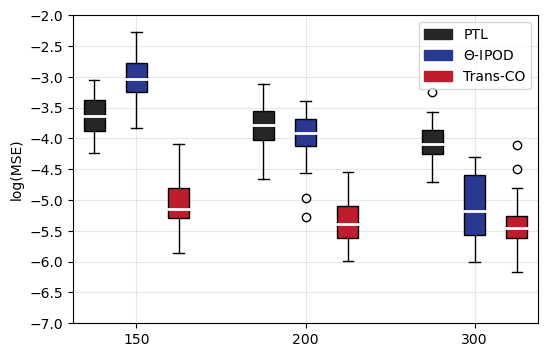
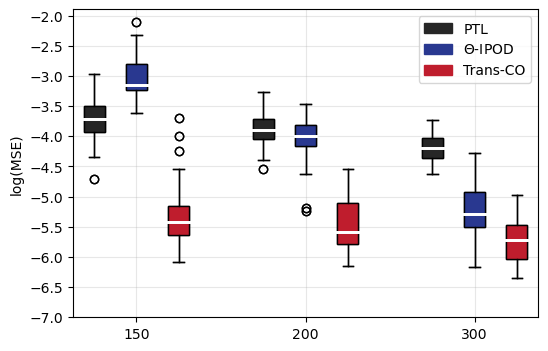
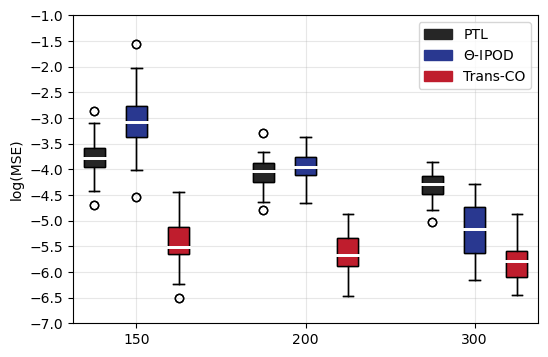
Figure 1: Comparison of different methods for different sample size of target dataset and source datasets when s=25 in Example \ref{ex1}.
Simulation Experiments
Impact of Sample Size and Dimensionality
Simulations evaluate the efficacy of Trans-CO against benchmarks: Profiled Transfer Learning (PTL) and Θ-IPOD. Even in high-dimensional settings (n<p), Trans-CO demonstrates minimal Mean Squared Error (MSE) and superior F1-scores for influential point detection, asserting its robustness and adaptability.
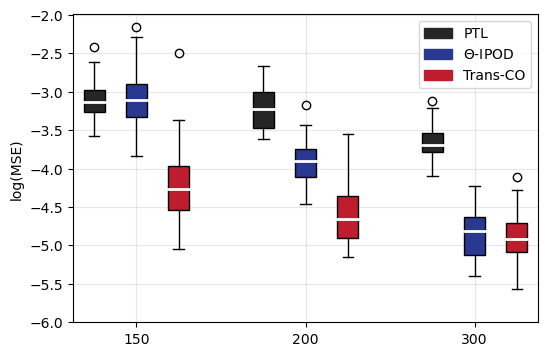
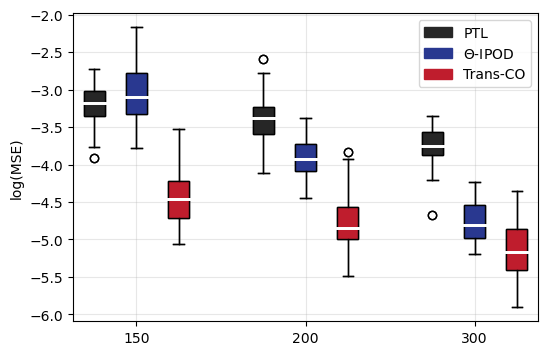
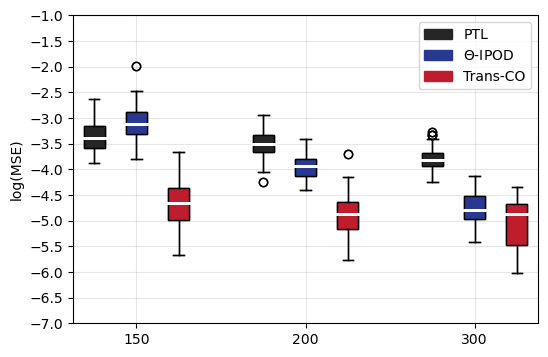
Figure 2: Comparison of different methods for different sample size of target dataset and source datasets when s=75 in Example \ref{ex1}.
Sensitivity to Influential Points
Trans-CO outperforms alternative methods in scenarios with varying influential point proportions, showcasing stability in log(MSE) and consistently achieving higher detection accuracy, proving effective under challenging conditions such as heteroscedasticity and when unique identification assumptions are unmet.
Real Data Application
Beijing Air Quality Prediction
Trans-CO's real-world applicability is demonstrated through Beijing Multi-Site Air Quality data, predicting CO levels using data from multiple sites as source domains. It achieves the lowest Huber Loss and highest R-squared values compared to PTL and Θ-IPOD, underscoring its practical utility.
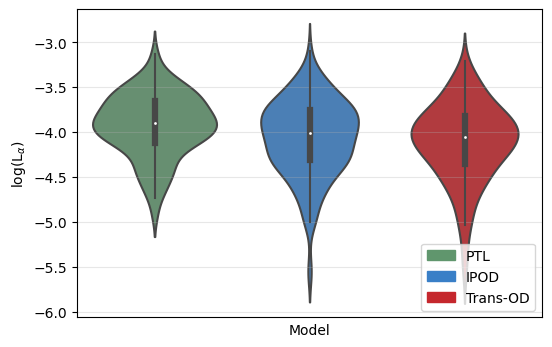
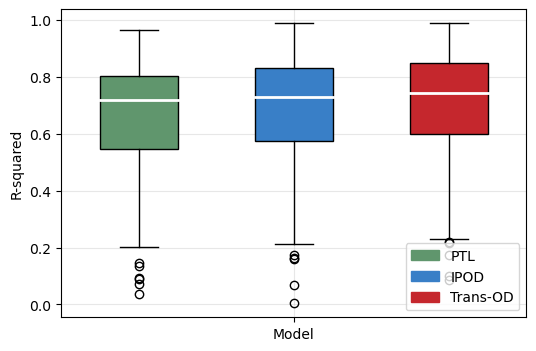
Figure 3: Comparison of the predicted Log(Lα) and R-squared on the test set of the target dataset.
Conclusion and Discussion
The study confirms that the Trans-CO framework significantly enhances model fitting by leveraging information from source domains. Despite added computational complexity, its accuracy improvements are substantial. Future work will aim to optimize runtime and explore broader applications.
In conclusion, Trans-CO provides an efficient solution for regression problems riddled with influential points and data scarcity, fostering innovation in fields like finance and healthcare where such challenges are prevalent.