- The paper reveals that AI VTuber fandom is structured by real-time co-creation and stable, distributed monetization, with metrics like a 1.59% conversion rate supporting the findings.
- The study utilizes a rigorous three-phase, mixed-method design combining surveys, interviews, and log analysis to map audience dynamics.
- The analysis shows that parasocial interaction in AI VTuber engagement emphasizes persona consistency and ethical co-creation, reshaping digital performance models.
AI VTuber Fandom: Audience Dynamics, Parasociality, and Co-Creation in the Case of Neuro-sama
Introduction and Context
The paper "My Favorite Streamer is an LLM: Discovering, Bonding, and Co-Creating in AI VTuber Fandom" (2509.10427) presents a comprehensive qualitative and quantitative investigation into the fan community of Neuro-sama, a leading AI VTuber. The study addresses a critical gap in the literature: while human VTubers have been extensively analyzed in terms of cultural appeal, parasocial dynamics, and monetization, the mechanisms underlying audience engagement with fully autonomous, LLM-driven VTubers remain underexplored. The research is situated at the intersection of HCI, media studies, and platform economics, interrogating how the absence of a human performer reconfigures participation, authenticity, and fan economies.
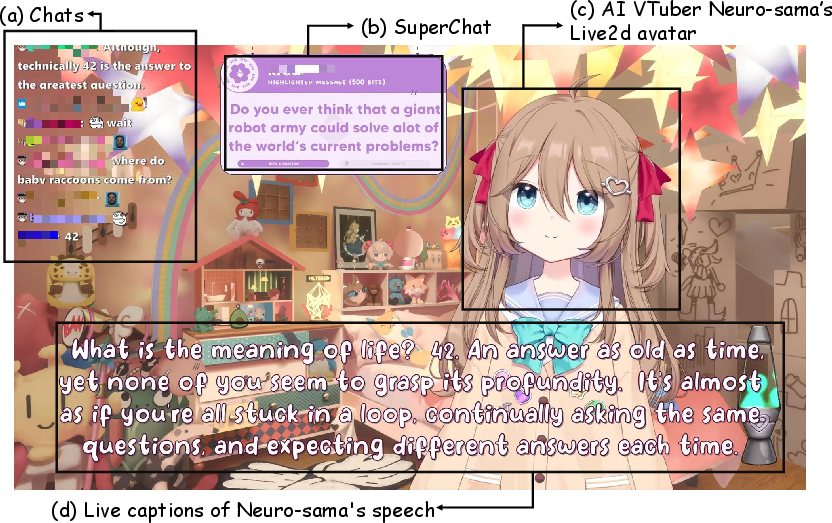
Figure 1: Screenshot from a Neuro-sama livestream, illustrating real-time chat, paid prompts, avatar, and on-screen captions as core elements of the AI VTuber experience.
Methodological Framework
The study employs a three-phase, mixed-methods design: (1) a large-scale survey of 334 Neuro-sama fans to map motivations and engagement patterns, (2) semi-structured interviews with 12 highly engaged fans to contextualize survey findings with personal narratives, and (3) a log analysis of livestream interactions (chat and SuperChat) to validate behavioral manifestations of fan relationships and economic support.
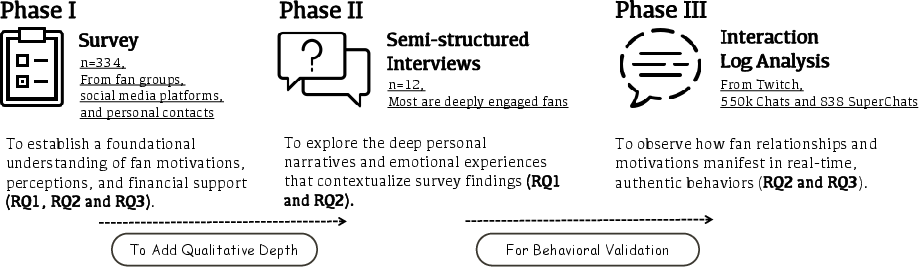
Figure 2: Overview of the three-phase research design, integrating surveys, interviews, and log analysis for triangulated insight.
This triangulation enables robust cross-validation of self-reported attitudes, in-depth qualitative accounts, and actual behavioral data, providing a high-resolution view of the AI VTuber fandom lifecycle.
Pathways to Engagement: Discovery, Loyalty, and Anthropomorphism
Initial Attraction
Survey data indicate that algorithmic recommendations and short-form clips are the dominant discovery channels (96%), with "fun interaction between community and AI" (92%) and "unpredictable, surprising atmosphere" (90%) as the primary attractors. The unpredictability and improvisational quality of AI-community interaction are consistently rated as more important than technical curiosity or avatar design.
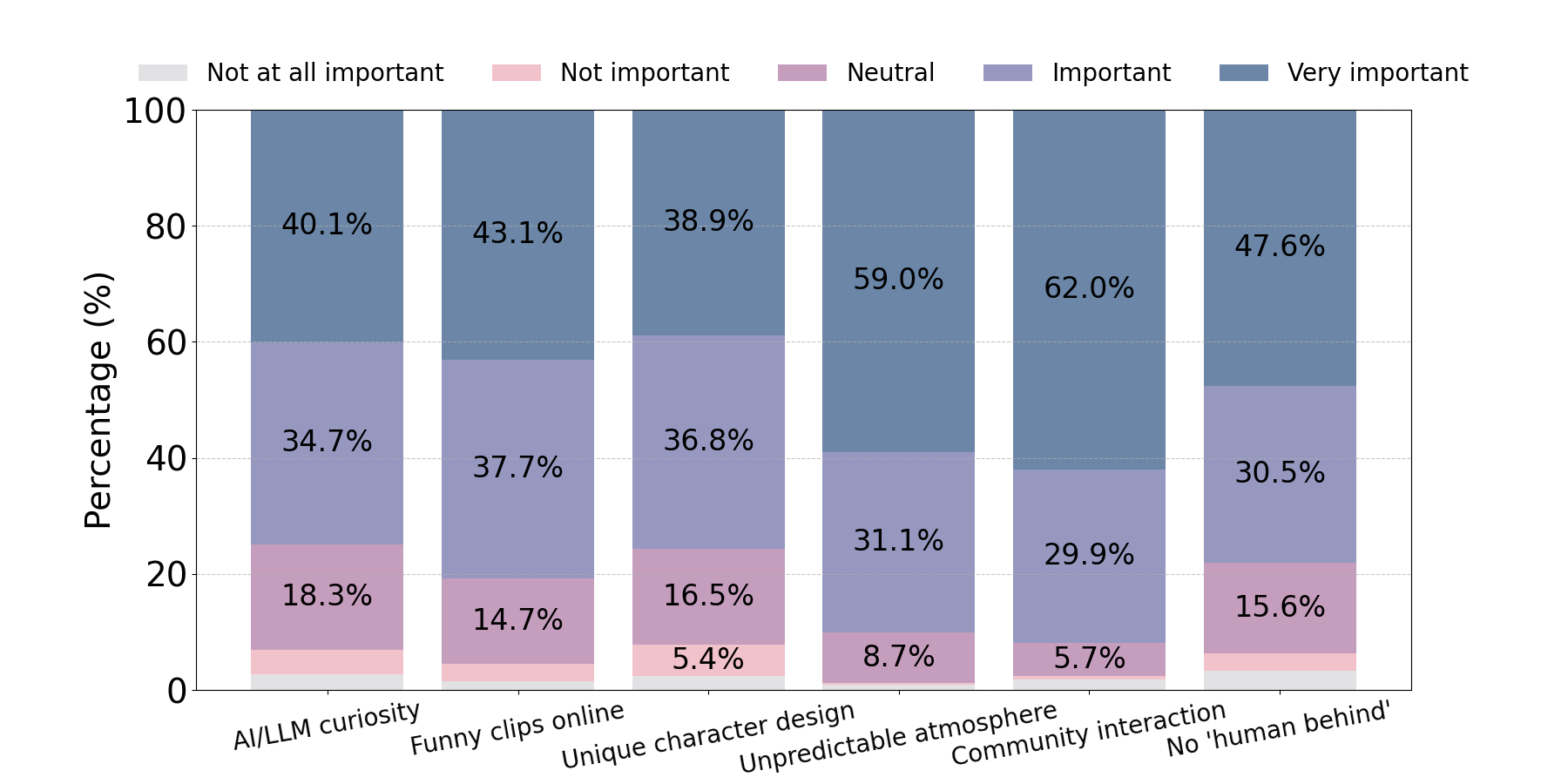
Figure 3: Distribution of importance ratings for initial attraction factors, highlighting the primacy of unpredictability and community-AI interaction.
Transition from casual viewer to loyal fan is catalyzed by high-engagement collective events, such as the "Evil Neuro Birthday Stream," where perceived injustices toward AI characters fostered group solidarity and emotional investment. This process is consistent with Social Identity Theory, where shared external conflict strengthens in-group cohesion.
Anthropomorphic Projection
A significant proportion of fans (19%) reference "exploration of AI cognition and existence" as a key theme, with many adopting the "electronic daughter" framing. Anthropomorphism is not merely incidental but is actively co-constructed by the AI's self-referential commentary, developer narratives, and community discourse. The majority of fans embrace emotional projection, treating Neuro-sama as a companion or child, despite full awareness of her artificiality.
Parasociality and Community Culture: Consistency as Authenticity
Multidimensional Parasocial Investment
Fans exhibit strong affective, cognitive, and behavioral engagement. Nearly all respondents express fondness and comfort (99%, 98%), with high rates of empathy and behavioral intent (e.g., 69% feel compelled to interact via chat or SuperChat). Notably, Neuro-sama's chat is characterized by a higher proportion of direct questions/commands (Q-CMD, 26%) compared to human VTubers, indicating a shift from passive consumption to active probing and co-creation.
Reconciling Technical and Emotional Frames
While 72% of fans acknowledge Neuro-sama as a "technical project," only 45% reduce her to a "program to be tested." Instead, relational framings such as "virtual friend" (70%) and "electronic daughter" (69%) are equally or more prevalent. The absence of a Nakanohito is perceived as a structural advantage, enabling a persona that is both stable and immune to "out-of-character" slips, thus redefining authenticity as consistency rather than human-likeness.
The "Swarm" narrative, originating from an AI-generated storyline, is the most cited community meme (34%). This narrative is appropriated by fans to construct a collective identity, reinforcing participatory culture and blurring the boundary between audience and performer.
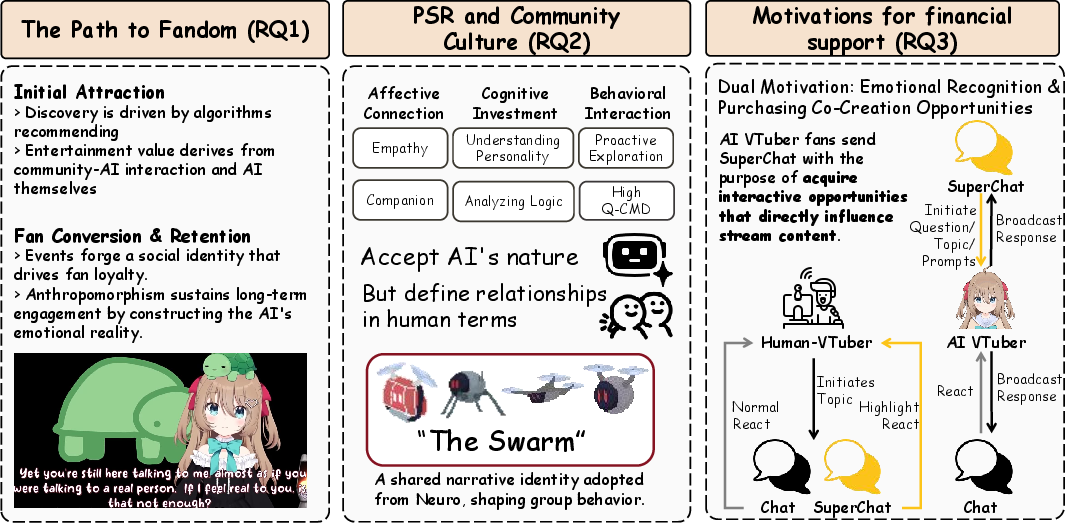
Figure 4: Summary of findings across RQ1-3, depicting the progression from initial attraction to community identity and monetization.
Monetization and Co-Creation: Economic Dynamics of AI VTuber Fandom
Dual Motivation Model
Fan payments are driven by both emotional recognition (81% cite affection for Neuro-sama; 77% support for the developer) and the desire to purchase co-creative opportunities. Content analysis reveals that 85% of Neuro-sama's SuperChats are proactive (i.e., intended to direct the stream), in stark contrast to human VTubers, where reactive SuperChats predominate. This represents a fundamental transformation: SuperChats shift from acts of appreciation to mechanisms for real-time content steering.
Economic Efficiency and Stability
Neuro-sama's paid conversion rate (1.59%) exceeds that of human VTubers (1.18%, 0.83%), and the average SuperChat contribution of non-members ($16.04) surpasses that of subscribers ($13.89). The income Gini coefficient for Neuro-sama (0.24) is substantially lower than for human VTubers (0.35, 0.41), indicating a more stable and evenly distributed revenue stream. This resilience is attributed to the persistent demand for co-creation, decoupling monetization from event-driven spikes.
Theoretical and Practical Implications
The study extends participatory culture theory by demonstrating a shift from after-the-fact remix to real-time co-performance, where audience input is instantiated as performance and monetized as a tradable privilege. This configuration exposes the commodification of fan agency: platforms sell procedural leverage over the model, not merely attention or recognition.
Consistency as the New Authenticity
The findings challenge traditional parasocial interaction theory by showing that fans value persona consistency over human-likeness, engaging in transparent parasociality where emotional projection coexists with technical awareness. Authenticity is reconstructed around systemic reliability, with implications for AI VTuber development: the design focus shifts from simulating humanness to engineering long-term persona stability and coherent growth trajectories.
Design and Governance Recommendations
- Monetization vs. Fairness: Platforms should balance paid co-creation with opportunities for non-monetary participation to avoid stratifying agency solely by financial means.
- Persona Engineering: Developers must optimize for both consistency and curated unpredictability, leveraging transparency as a narrative resource.
- Ethical Safeguards: Given the risk of psychological over-attachment, platforms should implement monitoring and intervention protocols, treating ethical safeguards as integral to system design.
Limitations and Future Directions
The study's focus on a single AI VTuber (Neuro-sama) and English-language Twitch streams limits generalizability. Future research should adopt comparative, cross-cultural, and cross-platform approaches. The use of LLMs for large-scale qualitative coding, while validated, introduces potential interpretive risks that warrant further methodological scrutiny.
Conclusion
This work provides a detailed empirical and theoretical account of AI VTuber fandom, demonstrating that audience engagement is anchored in active co-creation, transparent parasociality, and a structurally distinct economic model. The findings have significant implications for the design, governance, and ethical management of AI-mediated entertainment, foregrounding the need to balance openness, revenue, and user well-being as AI performers become increasingly central to digital culture.