- The paper presents a novel simulation pipeline combining constrained zoom-in N-body techniques with calibrated subgrid models to resolve internal and external ionizing sources during the Epoch of Reionization.
- Key results demonstrate an inside-out reionization topology for the Milky Way and Andromeda, where central halos ionize their surroundings earlier than external fronts.
- The analysis links earlier reionization epochs to satellite assembly, showing that satellites forming pre-reionization are systematically more massive, a prediction testable by future observations.
Reionization in HESTIA: Local Group Reionization via Zoom Simulations
Introduction
This paper presents a comprehensive analysis of the reionization history of the Local Group (LG)—specifically the Milky Way (MW), Andromeda (M31), and their satellite systems—using the HESTIA suite of constrained cosmological simulations. The study leverages high-resolution zoom-in $N$-body simulations, coupled with radiative transfer (RT) post-processing and subgrid modeling, to resolve the interplay between internal and external ionizing sources during the Epoch of Reionization (EoR). The methodology is calibrated against global reionization observables and designed to address the spatial and temporal heterogeneity of reionization in a realistic LG context.
Simulation Framework and Subgrid Modeling
The analysis utilizes two primary $N$-body simulations: a uniform-resolution HESTIA-1024 run for global calibration and a HESTIA-zoom run with $4096^3$ effective resolution in the LG region. The initial conditions are constrained to reproduce the observed LG cosmography, including the MW–M31 pair, the Local Void, and the Virgo cluster. Halo identification is performed with AHF, and merger trees are constructed to track the assembly histories.
A critical aspect is the subgrid modeling of low-mass atomic cooling haloes (LMACHs, $10^8$–$10^9\,M_\odot$), which are unresolved in the global simulation but contribute significantly to the ionizing photon budget. The collapse fraction $f_{\text{coll}}$ is modeled as a function of local overdensity, calibrated against a high-resolution $4096^3$ simulation (S1). This approach enables the statistical inclusion of LMACHs and unresolved high-mass atomic cooling haloes (HMACHs, $>10^9\,M_\odot$) in the RT calculations.
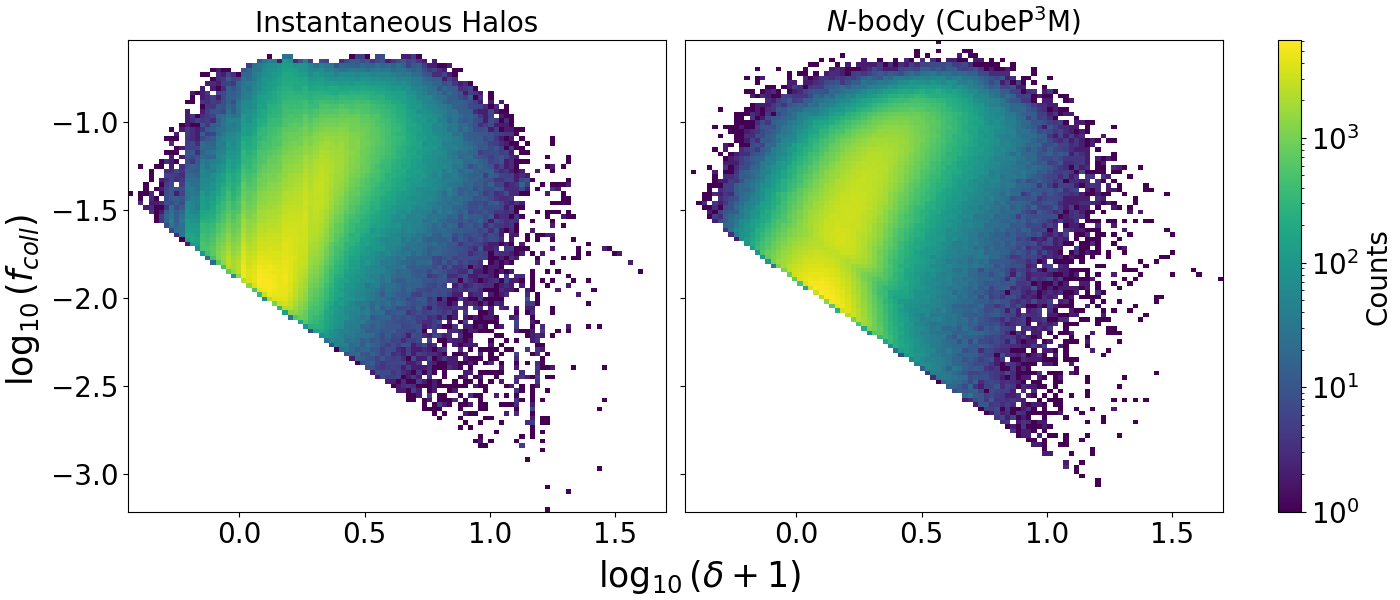
Figure 1: Collapsed fraction of LMACHs ($f_{\text{coll}}$) as a function of cell overdensity at $z=8.899$, comparing subgrid mock haloes and direct $N$-body data.
Radiative Transfer and Source Suppression Models
RT post-processing is performed using PyC$^2$Ray on a $256^3$ grid, with source models calibrated to match global constraints on the neutral hydrogen fraction, Thomson optical depth, and photoionization rate. Two suppression models are considered:
- Full Suppression: LMACHs are completely suppressed in ionized regions.
- Partial Suppression: LMACHs retain HMACH-like efficiency in ionized regions.
Four RT scenarios are constructed by varying the source efficiencies and suppression models, enabling controlled comparisons of feedback effects and reionization timing.
Global Reionization Constraints
The subgrid-coupled simulations reproduce the observed evolution of the global neutral hydrogen fraction, optical depth, and photoionization rate. All models complete reionization by $z\sim6$, with Thomson optical depths consistent with Planck constraints. The calibration ensures that differences in LG reionization are attributable to local physics rather than global mismatches.
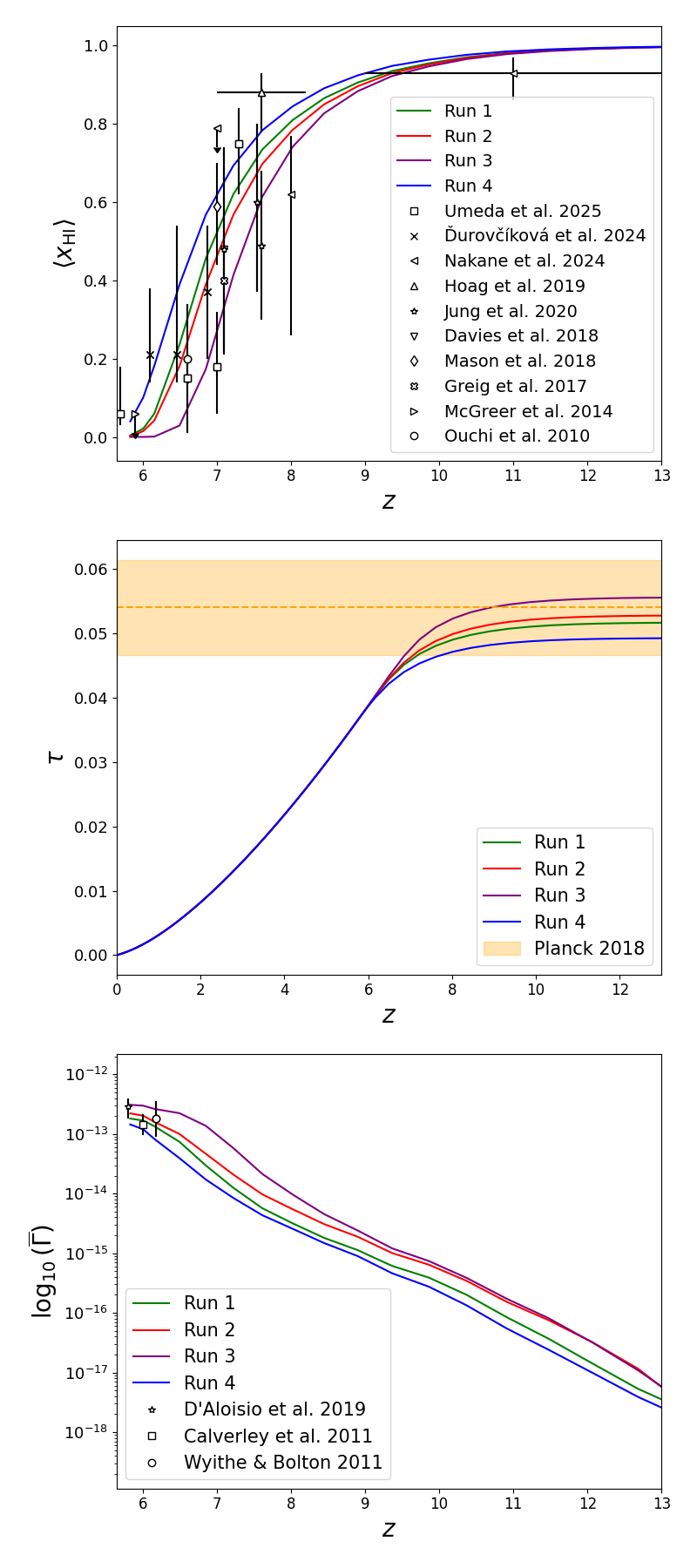
Figure 2: Volume-weighted mean neutral hydrogen fraction, Thomson optical depth, and photoionization rate for four subgrid model runs, compared to observational constraints.
Local Group Reionization Topology
Reionization maps centered on the MW and M31 progenitors reveal a robust inside-out topology: the central haloes ionize their surroundings prior to the arrival of external fronts, regardless of the suppression model. The zoom-in simulations, which lack resolved external sources, closely match the subgrid-coupled results, validating the use of zoom techniques for LG reionization studies.
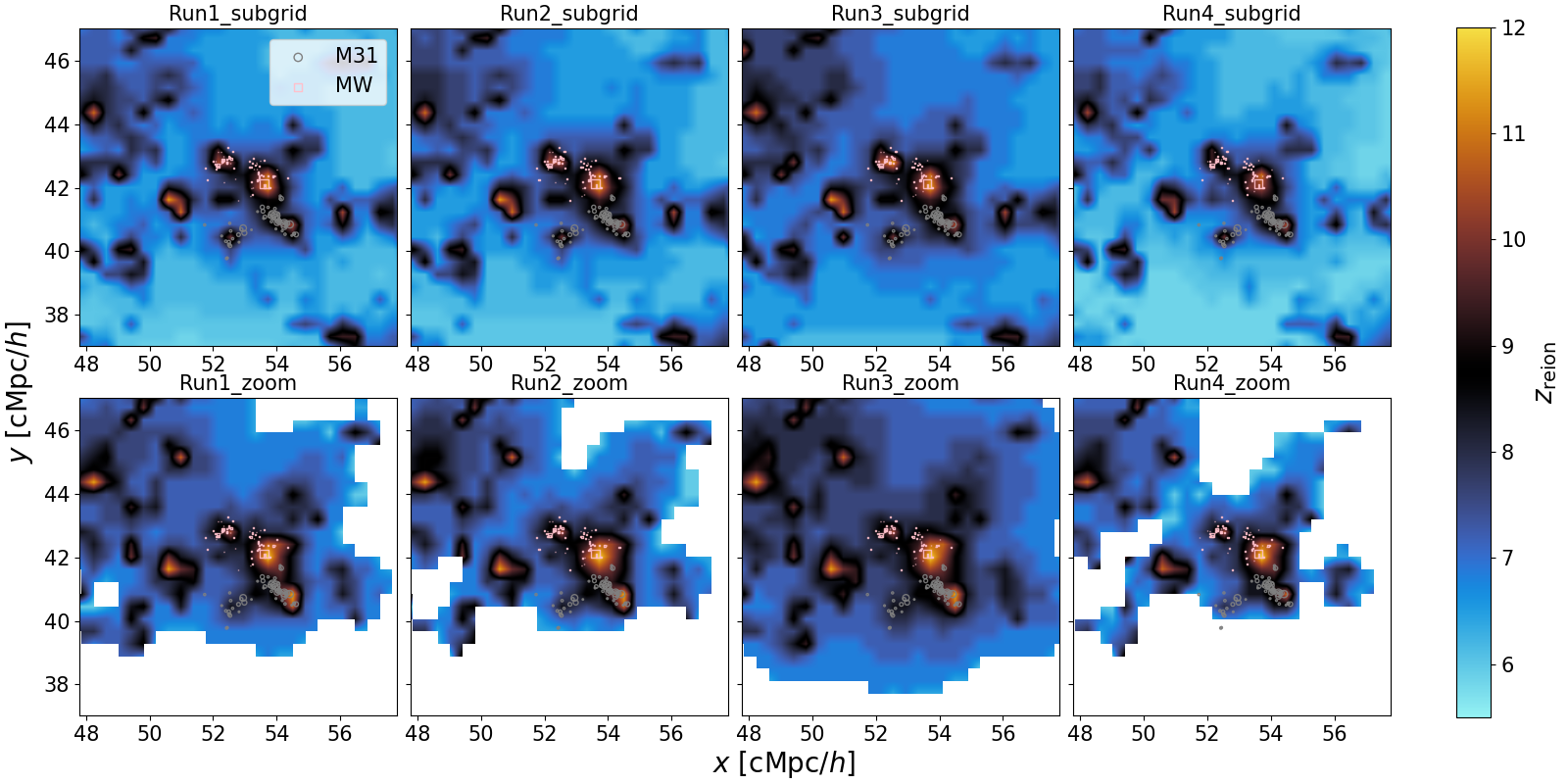
Figure 3: Projected reionization redshift map centered on the LG at $z=9.5$, showing early internal reionization of MW and M31 progenitors.
Mass Accretion and Halo Assembly
The mass accretion histories of the MW and M31 haloes in the zoom simulation are consistent with observational estimates and previous HESTIA runs. The MW and M31 haloes are identified as infalling, with masses and separations matching LG constraints.
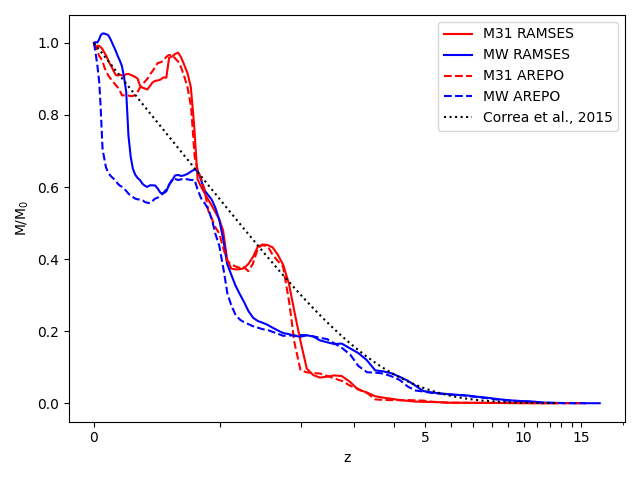
Figure 4: Mass accretion history of MW (blue) and M31 (red) haloes, comparing RAMSES and AREPO runs.
Lagrangian Reionization Histories
The mass-weighted ionization histories of the MW and M31 haloes show that 50% of their material is ionized by $z\approx8.7$–$9.3$, significantly earlier than the global midpoint ($z\approx7.1$–$7.7$). The onset of reionization is earlier for the MW, but M31 completes reionization first due to more rapid progenitor growth.
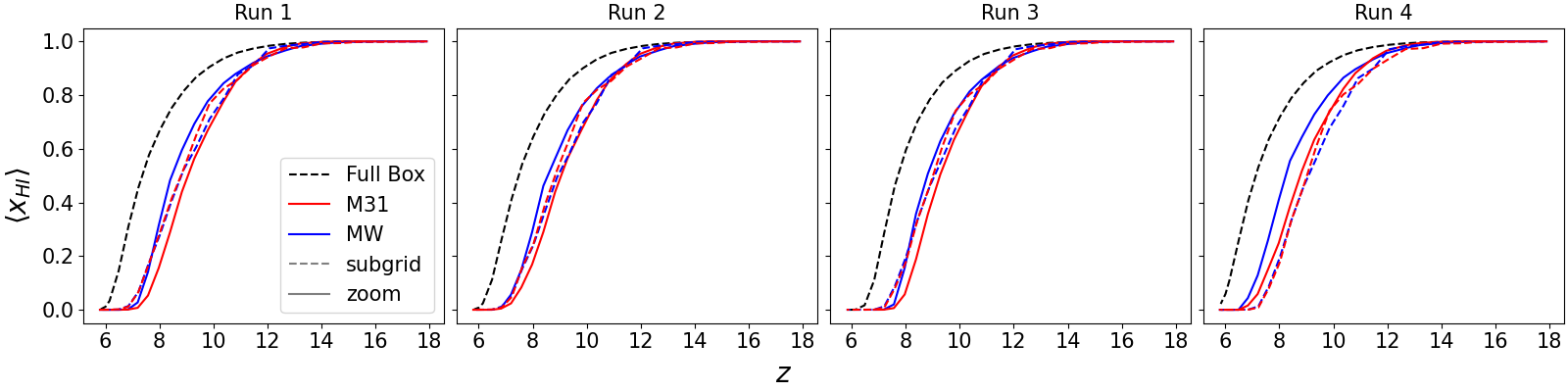
Figure 5: Mass-weighted ionization history for the full box, MW, and M31 haloes across four RT scenarios.
Satellite Galaxy Reionization and Assembly
Satellite galaxies within the MW and M31 virial radii exhibit only a weak correlation between their reionization redshift and present-day radial distance, with slightly tighter trends for M31. The scatter is attributed to the ability of massive satellites to self-ionize. Satellites that assembled before reionization are systematically more massive at $z=0$, as confirmed by Kolmogorov–Smirnov tests ($p<0.001$).
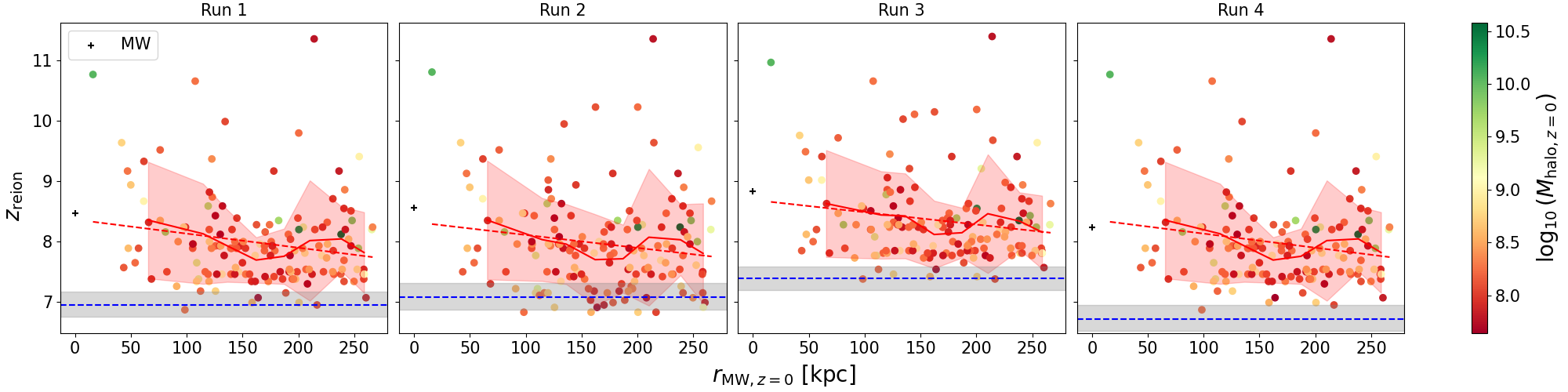
Figure 6: Redshift of reionization for MW satellites versus present-day radial distance, colored by satellite mass.
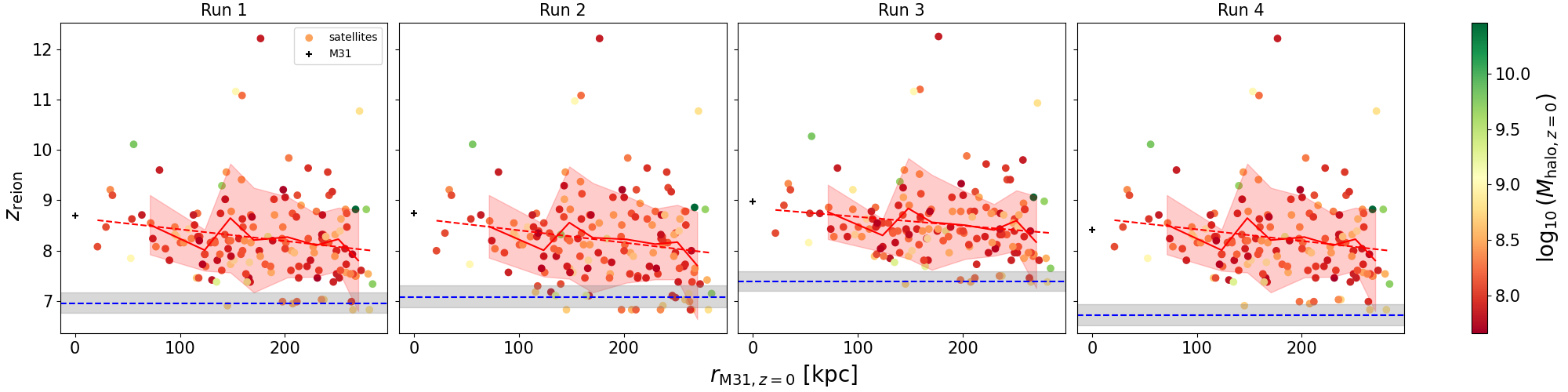
Figure 7: Same as Figure 6, but for M31 satellites.
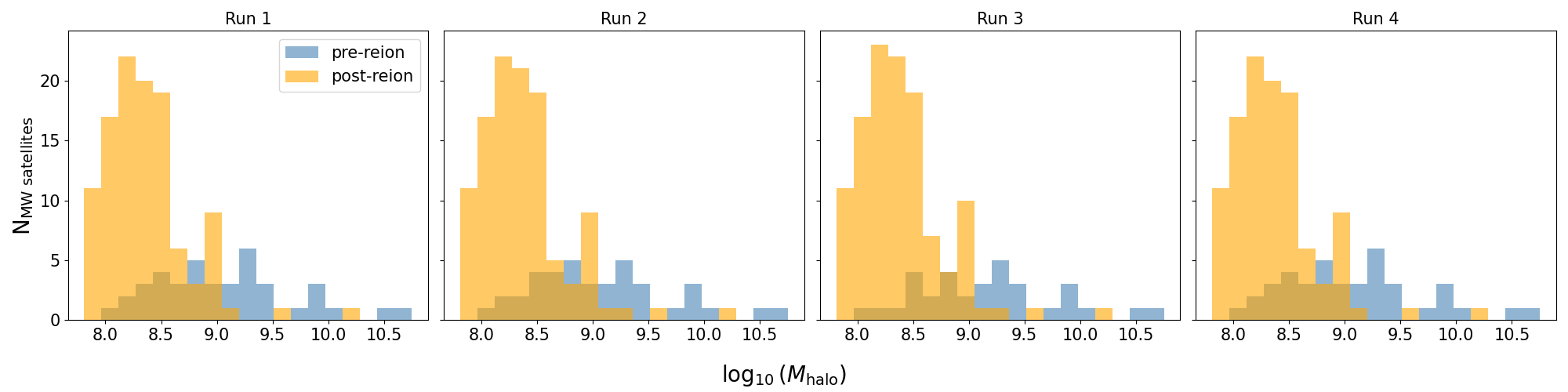
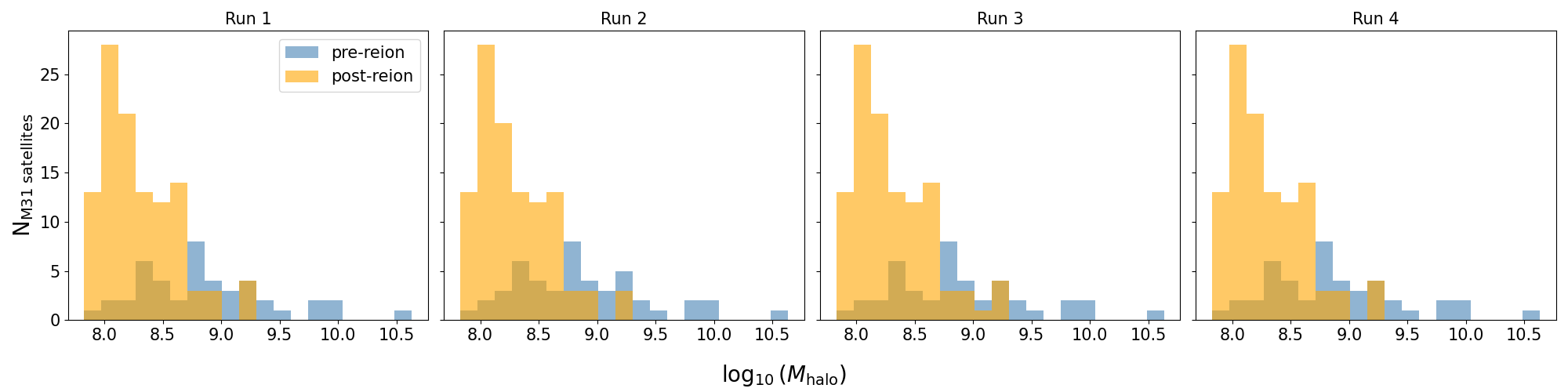
Figure 8: Present-day halo mass histograms for MW and M31 satellites, split by formation history (pre- vs. post-reionization).
Implications and Future Directions
The results demonstrate that LG reionization is dominated by internal sources, with external fronts playing a negligible role even under permissive feedback models. The early reionization of LG haloes is attributed to their overdense Lagrangian environments. The correlation between satellite mass and reionization epoch implies that the oldest stellar populations preferentially reside in the most massive subhaloes, providing a testable prediction for future deep surveys.
The methodology—calibrating source models on global runs and applying them to zoom-in simulations—offers a computationally efficient pipeline for LG reionization studies. The approach is validated against more conservative boundary treatments (e.g., THESAN-ZOOM), and is appropriate for scenarios where internal sources dominate.
Conclusion
This study provides a detailed, physically motivated account of LG reionization using the HESTIA simulation suite. The findings confirm the inside-out reionization paradigm for the MW and M31, establish the limited role of external ionizing fronts, and elucidate the connection between satellite assembly and reionization history. The pipeline developed here is well-suited for future investigations of environmental dependence and satellite quenching in constrained cosmological volumes. The robust numerical results and predictive correlations offer valuable constraints for both theoretical models and observational programs targeting the faintest LG satellites.

