- The paper demonstrates that lower-hybrid drift instability, not second-order Fermi acceleration, is responsible for significant ion energization.
- Advanced diagnostics like interferometry, ToF spectroscopy, and FLASH MHD simulations accurately measured key plasma parameters including electron density (~3×10¹⁹ cm⁻³) and magnetic fields (40–230 kG).
- The findings provide new insights into plasma transport mechanisms relevant to cosmic ray acceleration in astrophysical environments.
Measurement of Ion Acceleration and Diffusion in a Laser-Driven Magnetized Plasma
Introduction
This paper presents a comprehensive experimental investigation into the mechanisms of ion acceleration and diffusion within a laser-driven, magnetized plasma. The study is motivated by the unresolved question of cosmic ray (CR) acceleration in astrophysical environments, where turbulence and wave-particle interactions are hypothesized to play a central role. The experiment, conducted at the GSI Helmholtz Centre for Heavy Ion Research, utilizes a monoenergetic chromium ion beam as a surrogate for CRs, probing a plasma interaction region generated by the collision of two counter-propagating, laser-ablated jets. The work combines advanced diagnostics—laser interferometry, ion deflectrometry, and time-of-flight (ToF) spectroscopy—with supporting FLASH MHD simulations to constrain plasma parameters and elucidate the underlying acceleration mechanisms.
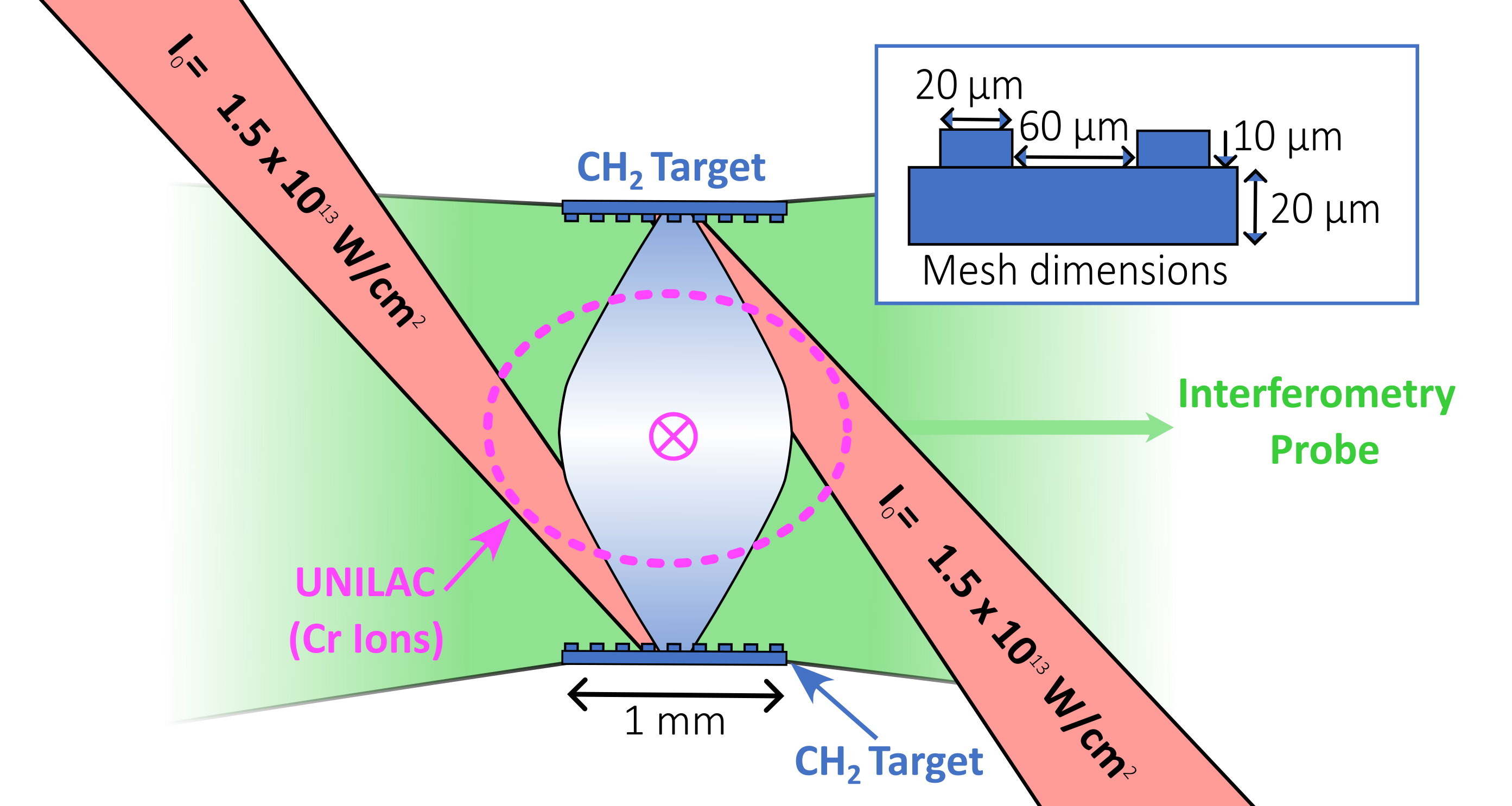
Figure 1: Schematic of the experimental setup, showing the configuration of target foils, laser beams, ion beam trajectory, and diagnostic axes.
The experimental platform is designed to generate a magnetized plasma interaction region via the collision of two supersonic jets, each produced by laser ablation of polypropylene foils with embedded grid structures. The Biermann battery effect seeds azimuthal magnetic fields, and the grid-induced density perturbations are intended to drive turbulent mixing. The plasma conditions are characterized by electron densities ne∼3×1019 cm−3 and temperatures in the low hundreds of eV, as inferred from interferometry and isothermal expansion models.
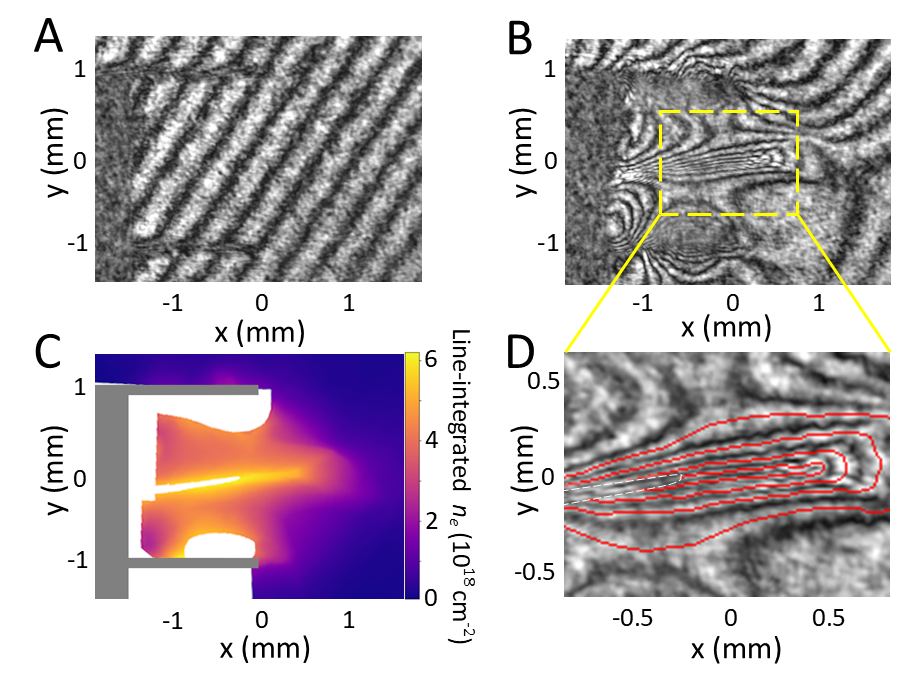
Figure 2: Interferometry data at t=10 ns, showing the formation of the interaction region and line-integrated electron density map.
The UNILAC accelerator provides a monoenergetic \textsuperscript{52}Cr ion beam (8.75–8.66 MeV/u, charge states 14+ and 20+), which traverses the plasma region. Downstream diagnostics include a diamond detector for ToF measurements and a CR-39 nuclear track detector for ion deflectrometry, enabling spatially and temporally resolved characterization of ion energy spectra and beam deflection.
Plasma Characterization and Turbulence Constraints
Laser interferometry yields line-integrated electron density maps, allowing for the estimation of plasma density, temperature, and the degree of fluid-scale turbulence. The data reveal a predominantly laminar interaction region, with no evidence of large-scale density fluctuations indicative of strong turbulence. Upper bounds on turbulent velocity uturb≲30 km/s are established via analysis of residual density fluctuations, which are further used to constrain the magnitude of second-order Fermi acceleration.
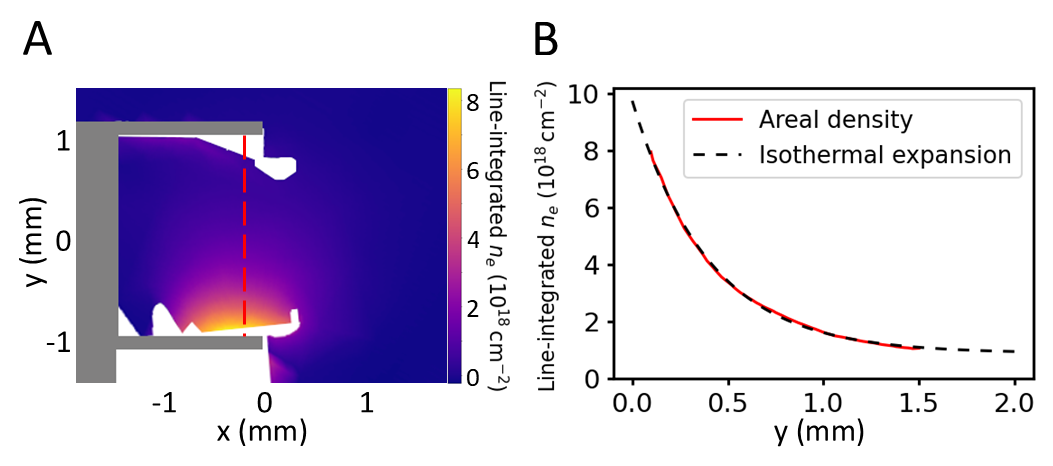
Figure 3: Isothermal expansion analysis of a single plasma jet, used to estimate pre-collision temperature from density profile fits.
Magnetic field strength is constrained by ion deflectrometry, with measured RMS deflection angles corresponding to Brms in the range 40–230 kG. The ion beam is unmagnetized (rc≫ℓB), and deflection accumulates via small-angle scattering in a random walk process, consistent with Gaussian statistics.
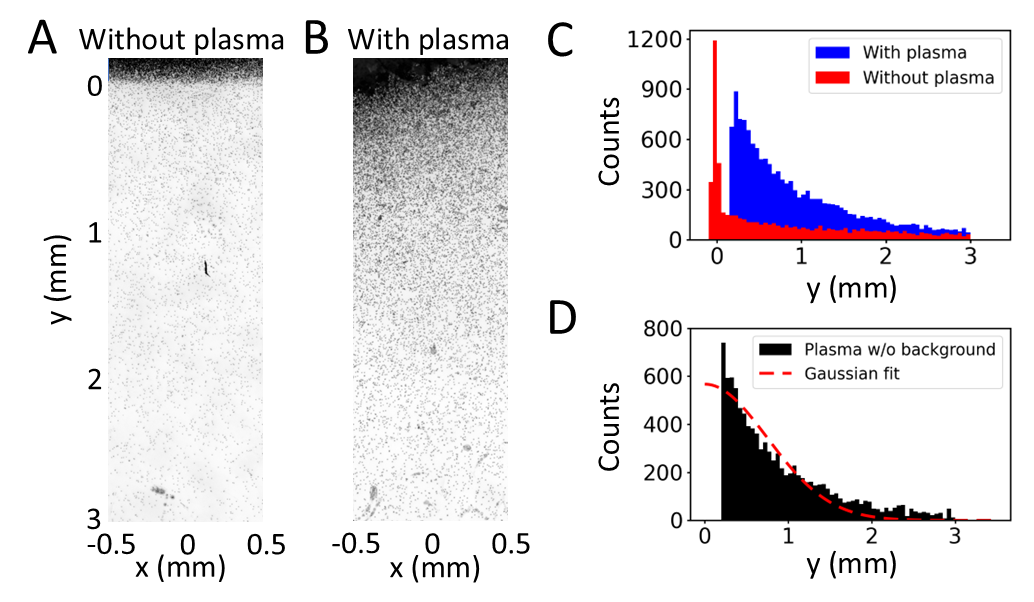
Figure 4: CR-39 nuclear track data showing spatial distribution of ion impacts and quantification of beam deflection due to plasma magnetic fields.
Ion Acceleration and Diffusion: Experimental Results
ToF spectroscopy provides pulse-resolved ion energy spectra, enabling quantification of both mean energy shifts and energy spread (diffusion) as the beam traverses the plasma. The data exhibit significant shot-to-shot variability, reflecting the stochastic nature of beam-plasma interactions. Double-sided drive configurations yield pronounced acceleration and diffusion, while single-sided drives show minimal effects.
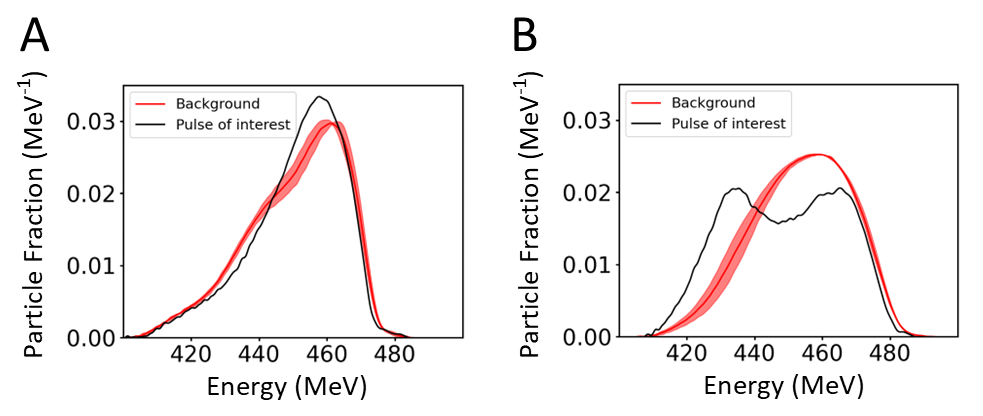
Figure 5: Representative ion energy spectra from ToF data, comparing background and plasma-interacting pulses.
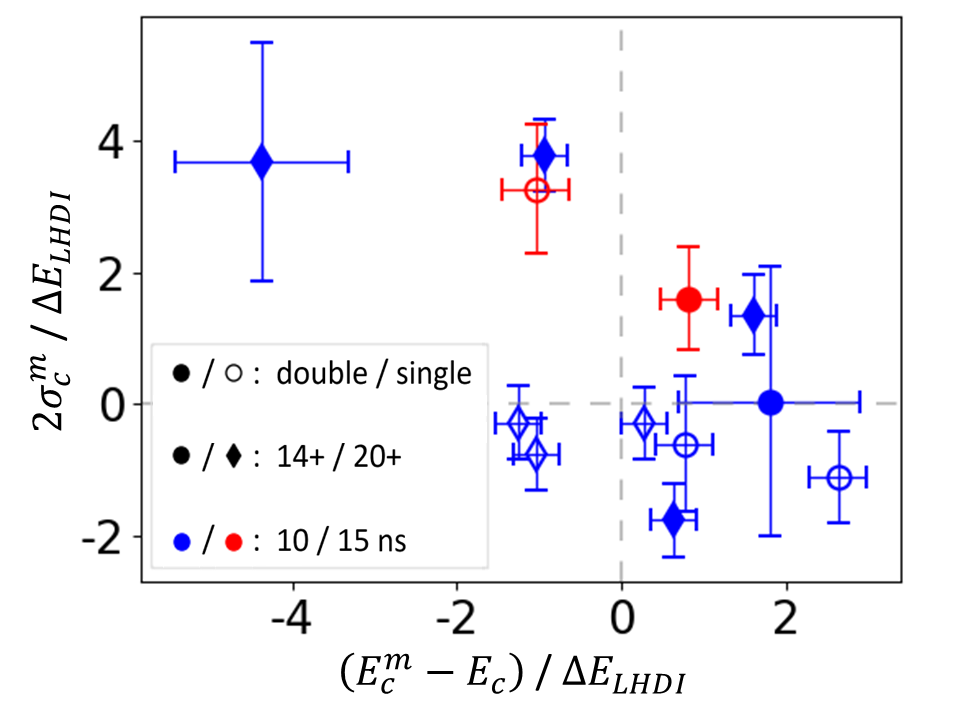
Figure 6: Scatter plot of measured energy shift versus width change, normalized to predicted LHDI acceleration values, distinguishing single- and double-sided drive regimes.
Charge transfer processes between beam and plasma ions are accounted for via a semi-empirical Gus'kov model, correcting the effective charge state Zc for accurate energy change calculations.
Mechanistic Interpretation: Fermi Acceleration vs. Lower-Hybrid Drift Instability
The observed energy shifts and diffusion are compared against theoretical predictions for two candidate mechanisms:
- Second-order Fermi acceleration: Energy gain via stochastic interactions with magnetized plasma turbulence is found to be negligible (ΔEFermi≪0.4 MeV), insufficient to account for the measured effects given the constrained uturb and Brms.
- Lower-hybrid drift instability (LHDI): Kinetic instability driven by strong density and magnetic field gradients, capable of exciting lower-hybrid waves (LHWs) and inducing significant ion acceleration. The calculated growth rates (−30 s−31) and predicted energy changes (−32 up to −33 MeV) are consistent with experimental observations, supporting LHDI as the dominant mechanism.
The analysis also considers the role of short-scale electrostatic turbulence, below the resolution of interferometry, in generating coherent wave structures that facilitate particle acceleration.
Implications and Future Directions
The results provide direct laboratory evidence for ion acceleration and diffusion in a weakly turbulent, magnetized plasma, with wave-particle interactions—specifically LHDI—identified as the primary mechanism. The absence of strong fluid turbulence and the dominance of kinetic instabilities have significant implications for models of CR acceleration in astrophysical environments, suggesting that short-scale electrostatic turbulence may play a more critical role than previously assumed.
The experimental platform demonstrates the utility of laboratory astrophysics in isolating and probing specific acceleration mechanisms, complementing in situ measurements and simulations. Future work should focus on enhancing diagnostic resolution to access smaller-scale turbulence, exploring parameter regimes with higher magnetic Reynolds numbers, and extending the study to electron acceleration and multi-species ion beams.
Conclusion
This study presents a detailed experimental characterization of ion acceleration and diffusion in a laser-driven magnetized plasma, demonstrating that wave-particle interactions—most notably the lower-hybrid drift instability—can drive significant energization and diffusion of ions in the absence of strong fluid turbulence. The findings constrain the relative contributions of Fermi acceleration and kinetic instabilities, providing new insights into plasma transport and acceleration mechanisms relevant to cosmic ray physics and laboratory astrophysics. The results underscore the importance of short-scale turbulence and coherent wave structures in particle energization, with implications for both theoretical modeling and future experimental design.

