- The paper introduces a decoupled framework using Schur complement decomposition to isolate rotational and translational subspaces for robust degeneracy detection.
- The paper employs a targeted mitigation strategy with a preconditioned conjugate gradient method and eigenvalue clamping, achieving 20–50% accuracy improvements and 5–100x speedup.
- The paper validates its approach on both simulated and real-world datasets, providing an interpretable framework for diagnosing and resolving LiDAR registration challenges.
Decoupled Characterization for Efficient Degenerate LiDAR Registration: A Technical Analysis
Introduction and Motivation
DCReg introduces a principled framework for addressing ill-conditioned LiDAR point cloud registration, a critical challenge in robotic perception and navigation. In environments with geometric degeneracy—such as corridors, tunnels, and open fields—registration problems become numerically unstable due to insufficient constraints along certain motion directions. This instability manifests as amplified error propagation and unreliable solutions, severely impacting autonomous system reliability. Existing methods either fail to detect degeneracy reliably, cannot interpret its physical origins, or apply mitigation strategies that indiscriminately alter the optimization landscape, often corrupting well-constrained directions.
Theoretical Foundations: Decoupling and Schur Complement
DCReg's core innovation is the use of Schur complement decomposition to decouple the Hessian matrix into clean rotational and translational subspaces. This approach eliminates the masking effects of rotation-translation coupling and scale disparity, which are prevalent in conventional eigenvalue-based analyses. By isolating these subspaces, DCReg enables robust detection of ill-conditioning and exposes degeneracy patterns that are otherwise hidden.
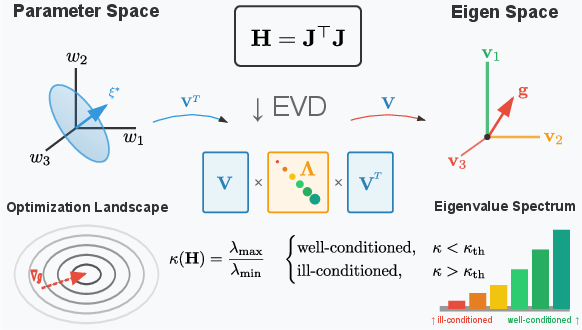
Figure 1: Physical interpretation of Hessian eigendecomposition in ICP. Transformation between parameter space and eigenspace reveals degenerate directions and their corresponding space projections, enabling principled degeneracy characterization.
The condition number κ(H) is used as a quantitative metric for ill-conditioning, acting as an error amplifier. DCReg computes direction-specific condition numbers within the decoupled subspaces, allowing for precise identification of weakly constrained motion components.
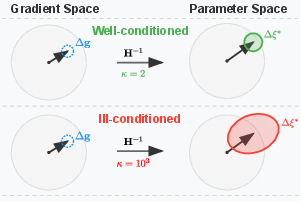
Figure 2: The error amplification effect in ill-conditioning. Visualization of how condition number determines the upper bound on relative parameter error given relative perturbations in the optimization space.
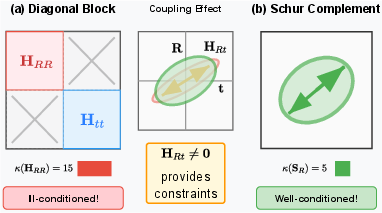
Figure 3: Visualization of rotation-translation coupling effect on ill-conditioning detection. (a) Traditional diagonal subspace decoupling ignores cross-coupling terms, which may hide existing ill-conditioning. (b) Schur complement decoupling properly isolates subspaces by accounting for coupling effects, enabling reliable degeneracy detection in the clean parameter subspace.
Quantitative Characterization: Mapping Eigenspace to Physical Motion
A major limitation of prior work is the lack of physical interpretability of eigenvectors obtained from Hessian analysis. DCReg resolves this by establishing explicit mappings between eigenspace directions and physical motion axes using inner-product matching, maximum component analysis, and Gram-Schmidt orthogonalization. This process addresses sign, ordering, and basis ambiguities inherent in eigen decomposition, enabling actionable diagnosis of which specific motions lack constraints.
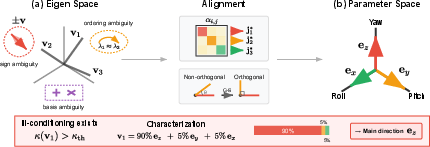
Figure 4: Pipeline for quantitative ill-conditioning characterization. The three-stage process addresses eigenvector ambiguities in optimization subspaces: (1) Inner product matching resolves sign ambiguity and determines linear combinations in parameter space; (2) Maximum component analysis resolves ordering ambiguity to identify principal axis alignment; (3) Gram-Schmidt orthogonalization resolves basis ambiguity, producing a stable orthonormal basis aligned with the parameter space for subsequent degeneracy mitigation.
Targeted Mitigation: Preconditioned Conjugate Gradient with Eigenvalue Clamping
DCReg introduces a targeted mitigation strategy via a novel preconditioner that selectively stabilizes only the identified ill-conditioned directions. This is achieved through cluster-wise eigenvalue clamping in the Schur complement eigenspace, ensuring that the condition number of the system remains bounded. The approach is implemented within a Preconditioned Conjugate Gradient (PCG) framework, which preserves all well-constrained information and accelerates convergence.
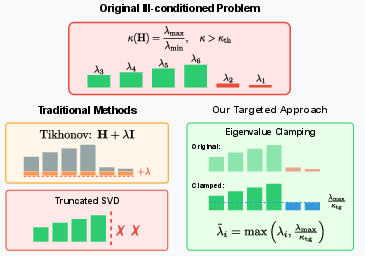
Figure 5: Algorithmic principles for mitigating ill-conditioned optimization. Visualization of how different methods modify the solution space to mitigate numerical degeneracy in point cloud registration.
The preconditioner is parameterized by a single interpretable condition number bound, simplifying deployment and tuning. Unlike Tikhonov regularization or truncated SVD, DCReg's mitigation does not inject artificial constraints or discard valid information, maintaining the integrity of the original optimization problem.
Experimental Validation
DCReg is evaluated on both simulated and real-world datasets, including scenarios with severe geometric degeneracy (cylinders, corridors, stairs, caves, parking lots). The framework demonstrates:
- 20–50% improvement in localization accuracy and 5–100x speedup over state-of-the-art methods.
- Robust convergence in degenerate scenarios where other methods fail or require excessive iterations.
- Superior mapping accuracy, as evidenced by error maps and trajectory metrics.
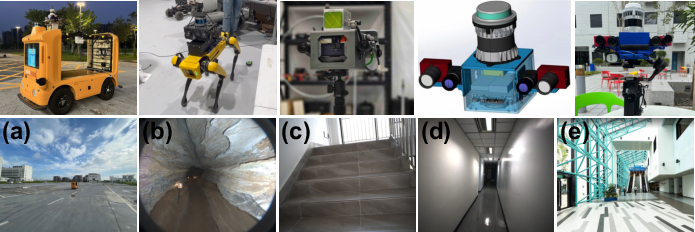
Figure 6: Dataset scenarios and robotic platforms. The experimental environments include: (a) open parking lot, (b) narrow cave, (c) confined stairway, (d) narrow corridor, and (e) indoor hallway.
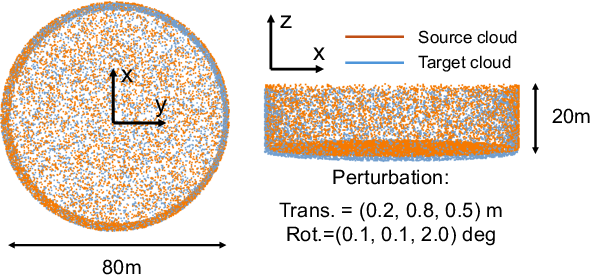
Figure 7: Symmetric cylinder scene for simulated experiments. (Left) Top-down view and (Right) side view of the cylindrical point cloud containing 7600 points.
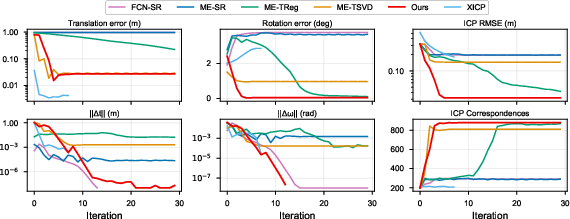
Figure 8: Iterative convergence process under cylindrical degeneracy. Plots show translation/rotation errors, update magnitudes, ICP residuals, and correspondence counts over iterations. Our method exhibits faster convergence, smaller pose errors, and more stable correspondence growth than all baselines, validating its robustness in degenerate configurations.
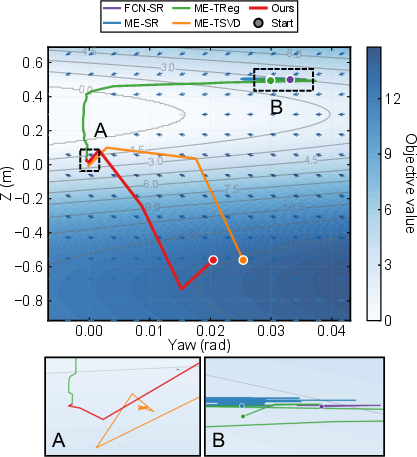
Figure 9: Optimization landscape with gradient field visualization in the cylinder scenario after 5000 iterations. Arrows indicate negative gradient directions, with optimization trajectories overlaid. Our method demonstrates the most rapid convergence.
(Figure 10)
Figure 10: Condition number evolution over iteration in the cylinder degeneracy scenario. Left: Full Hessian condition numbers for all methods. Right: Schur and diagonal condition numbers for our approach.
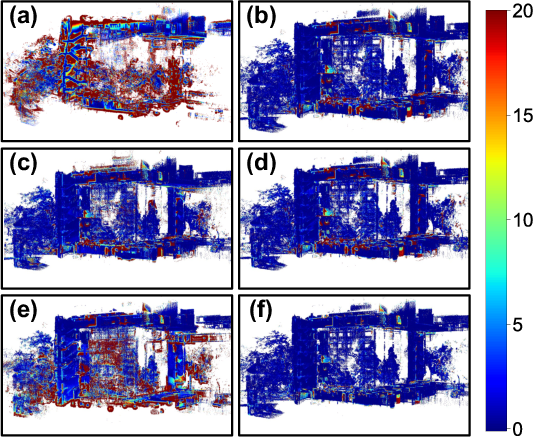
Figure 11: Map error comparison across different methods in the stairs scenario. The error maps use a blue-to-red scale indicating increasing error magnitude. DCReg exhibits predominantly blue regions compared to others, demonstrating superior mapping accuracy.
Degeneracy Detection and Characterization
DCReg's detection module reliably identifies both translational and rotational degeneracies, even in scenarios where traditional methods fail due to scale disparity or coupling effects. The framework provides detailed characterization of degeneracy sources, quantifying the contribution of each physical axis to the detected ill-conditioned directions.
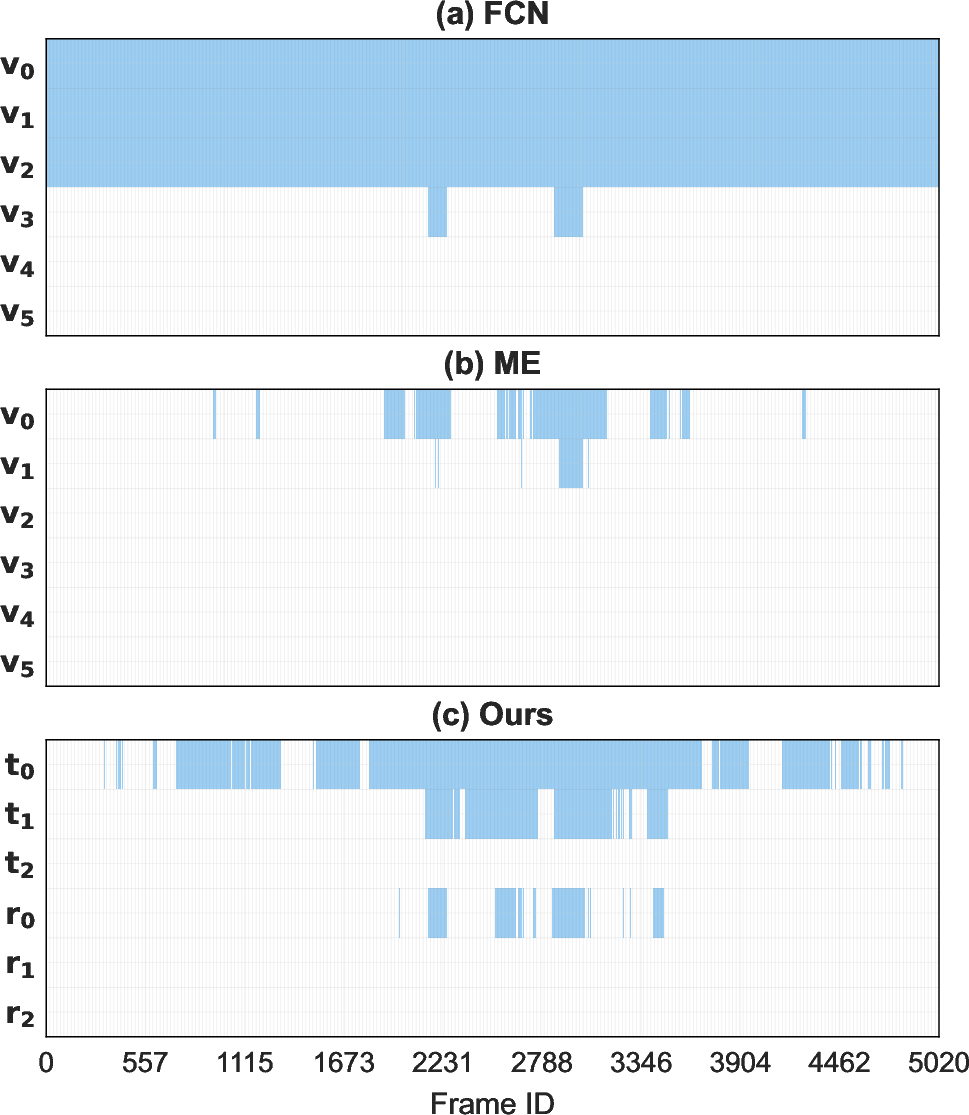
Figure 12: Temporal evolution of degeneracy detection across different directions in eigenspace on the parking lot scenario. The light blue indicating detected degeneracy. The vertical axes represent eigenvectors ordered by ascending eigenvalues.
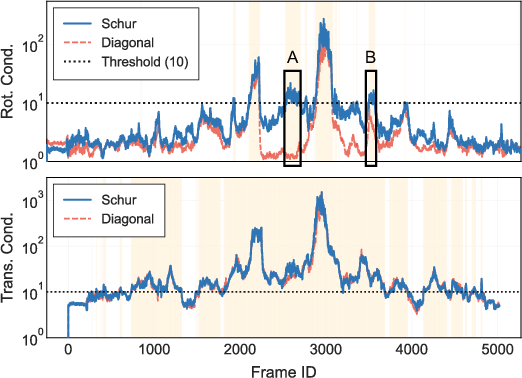
Figure 13: Condition number comparison in translational (Down) and rotational (Top) subspaces over time on the parking lot dataset. Light yellow regions indicate detected degeneracy areas with detection thresholds set to 10. Regions A and B demonstrate cases where rotational degeneracy is masked by diagonal methods.
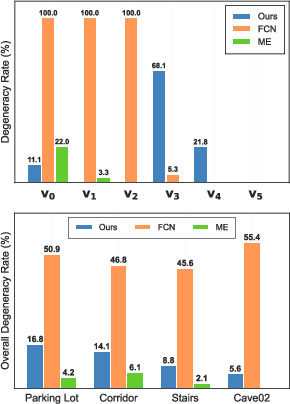
Figure 14: Top: degeneracy ratio comparison across different eigen directions (v0–v5) for various algorithms on the parkinglot dataset. Down: overall degeneracy ratio comparison across different algorithms on multiple datasets.
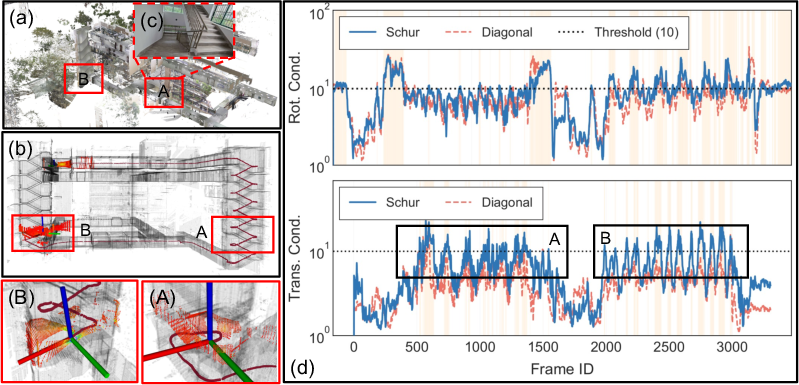
Figure 15: The figure compares two different degeneracy case caused by narrow scenarios during (A) downstairs (Z degenerate) and (B) upstairs (Roll-Pitch degenerate), with (c) showing the real-world image. (a): the ground truth point cloud map. (d): the evolution of translational and rotational condition numbers computed using our Schur complement versus traditional diagonal condition numbers over time. Regions A and B clearly demonstrate condition number variations corresponding to scenarios (A) and (B).
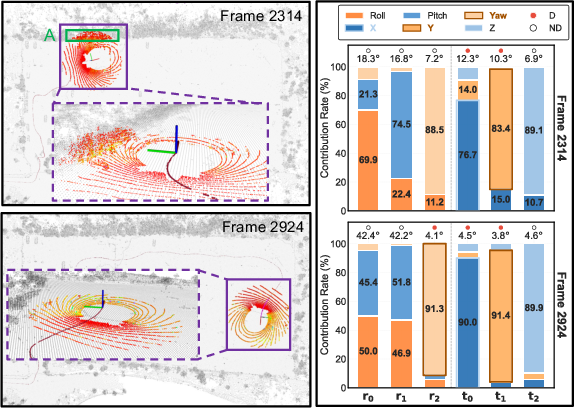
Figure 16: Planar degeneracy analysis and characterization in the parkinglot sequence. The figure illustrates degeneracy scenarios comparison between frames 2314 and 2924. In frame 2314, with the curb point clouds (region A), only X and Y degenerate. Frame 2924 contains predominantly planar point clouds, resulting in additional yaw degenerate. The right panels show the precise contribution (%) and strength (angles °) of each dimension in eigenspace (r0–r2, t0–t2) in terms of physical motion directions (X–yaw), enabling analysis of degeneracy motion sources.
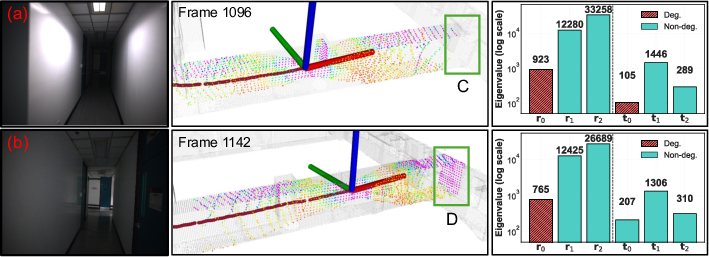
Figure 17: Eigenvector ordering ambiguity in corridor scenarios. Left: Real-world images at frames 1096 and 1142. Middle: Localization (red trajectory) and mapping results. Right: Eigenvalues at first ICP iteration. Frame 1096 shows X and roll degeneracy, while frame 1142 shows only roll degeneracy due to wall points in region D. Rotational eigenvalues are not consistently larger than translational ones, demonstrating ordering ambiguity that impacts degeneracy detection.
Ablation and Hybrid Analysis
Ablation studies confirm that both the detection and targeted mitigation modules are essential for optimal performance. Hybrid configurations using DCReg's detection with traditional mitigation strategies (SR, TSVD, TReg) outperform their respective baselines, but the full DCReg pipeline yields the best results in both accuracy and efficiency.
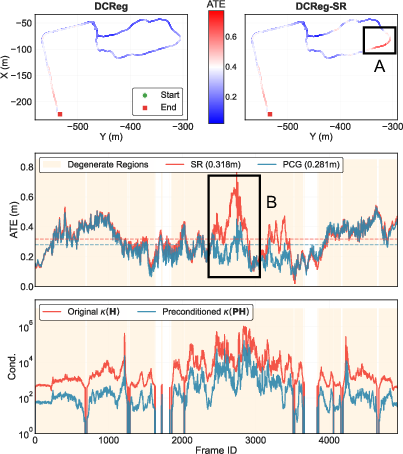
Figure 18: Trajectory error and ATE comparison over time between DCReg and DCReg-SR on the parkinglot dataset. DCReg-SR exhibits significantly increased errors (Region A and B) during trajectory segments where XY and Yaw degenerate simultaneously, demonstrating the advantages of our targeted PCG method over SR.
Parameter Sensitivity and Robustness
DCReg requires only a single threshold parameter for degeneracy detection and a target condition number for mitigation. Both parameters exhibit robust performance across diverse scenarios, with minimal need for environment-specific tuning. Theoretical and empirical analysis confirms that setting the target condition number in the range 1<κ<10 ensures stable accuracy and efficient convergence.
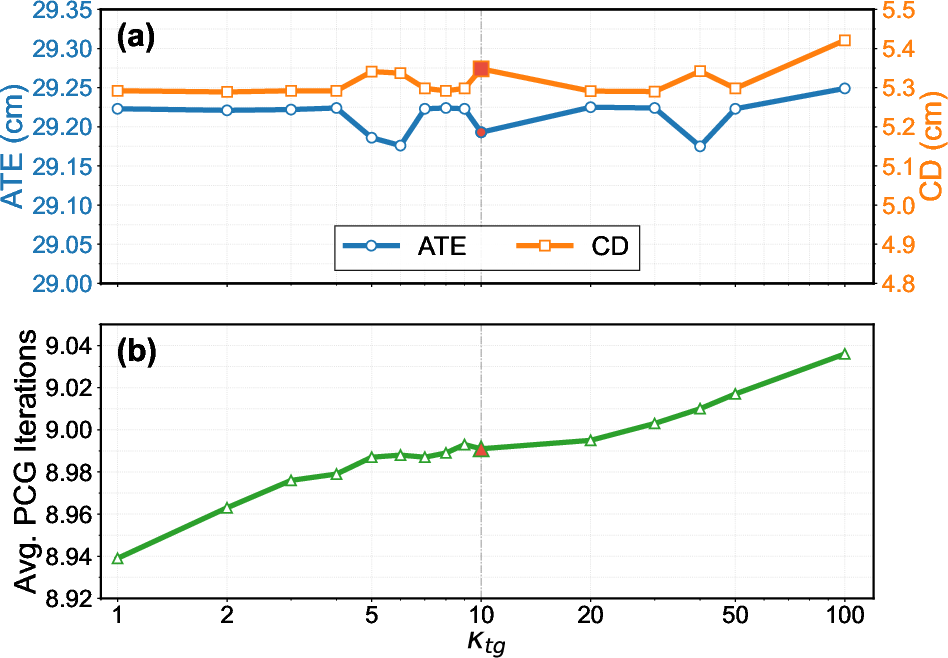
Figure 19: Parameter analysis on the parking lot dataset. (a) ATE and CD. (c) Average PCG iterations of each frame. The degeneracy detection threshold is set to 10. While PCG iterations increase monotonically with κ, both ATE and CD remain stable for 1<κ<10, demonstrating DCReg's robustness to parameter tuning.
Practical and Theoretical Implications
DCReg establishes a rigorous analytical framework for degenerate registration, integrating concepts from linear algebra, geometry, estimation theory, and optimization. The approach is broadly applicable to other ill-conditioned estimation problems in robotics and computer vision, including multi-modal sensor fusion and dynamic environment handling. The explicit mapping between eigenspace and physical motion directions enables practitioners to diagnose and resolve degeneracy with actionable insights, facilitating robust deployment in real-world autonomous systems.
Conclusion
DCReg provides a comprehensive solution for efficient and reliable LiDAR registration in degenerate environments. By decoupling the parameter space, quantitatively characterizing degeneracy, and applying targeted mitigation, the framework achieves superior accuracy, convergence, and computational efficiency. The open-source implementation and theoretical foundation support broad adoption and future extensions to more complex perception tasks. The work demonstrates that principled numerical analysis and physically interpretable regularization are essential for advancing robust autonomous navigation in challenging scenarios.

