Papers
Topics
Authors
Recent
2000 character limit reached

Context dependent adaptation in a neural computation (2509.01760v1)

Published 1 Sep 2025 in q-bio.NC and physics.bio-ph

Abstract: Brains adapt to the statistical structure of their input. In the visual system, local light intensities change rapidly, the variance of the intensity changes more slowly, and the dynamic range of contrast itself changes more slowly still. We use a motion-sensitive neuron in the fly visual system to probe this hierarchy of adaptation phenomena, delivering naturalistic stimuli that have been simplified to have a clear separation of time scales. We show that the neural response to visual motion depends on contrast, and this dependence itself varies with context. Using the spike-triggered average velocity trajectory as a response measure, we find that context dependence is confined to a low-dimensional space, with a single dominant dimension. Across a wide range of conditions this adaptation serves to match the integration time to the mean interval between spikes, reducing redundancy.
Summary

  • The paper demonstrates that adaptation in H1 neurons is context-dependent, modulating responses based on both instantaneous contrast and its statistical distribution.
  • It employs synthetic natural stimuli and singular value decomposition to reveal that adaptation is confined to a low-dimensional subspace dominated by a principal mode.
  • It finds that the neuron's integration time is tightly coupled to the mean interspike interval, optimizing the neural code by reducing redundancy.

Context-Dependent Adaptation in Neural Computation: Analysis of Contrast and Context in Fly Visual Motion Processing

Introduction

This paper investigates the mechanisms of context-dependent adaptation in the motion-sensitive neuron H1 of the fly visual system, focusing on how neural responses to visual motion are modulated by both instantaneous contrast and the statistical context defined by the distribution of contrast values. The study leverages naturalistic, temporally structured stimuli to dissect the hierarchy of adaptation phenomena, providing quantitative evidence that adaptation is confined to a low-dimensional subspace and is dominated by a single principal mode. The work extends the efficient coding hypothesis to neural computation, demonstrating that adaptation serves to match the integration time of the neuron to the mean interspike interval, thereby reducing redundancy in the neural code.

Experimental Design and Stimulus Construction

The authors designed stimuli that mimic the statistical structure of natural visual inputs while allowing precise control over contrast and its distribution. The stimulus is a two-dimensional intensity field I(x,y,t)I(x, y, t), constructed by translating a synthetic natural scene F(x,y)F(x, y) along a velocity trajectory v(t)v(t), with contrast c(t)c(t) modulated as a temporally correlated random process. The dynamic range of contrast, climc_{\rm lim}, is varied across experimental blocks, establishing different contexts for adaptation.

The contrast is defined as the fractional root-mean-square variation in intensity, and the spatial pattern F(x,y)F(x, y) is generated in Fourier space to ensure scale invariance and binary structure, facilitating control over contrast while maintaining fixed spatial correlations. The velocity input v(t)v(t) is Gaussian white noise, ensuring independence between velocity and contrast.

Measurement and Analysis of Neural Responses

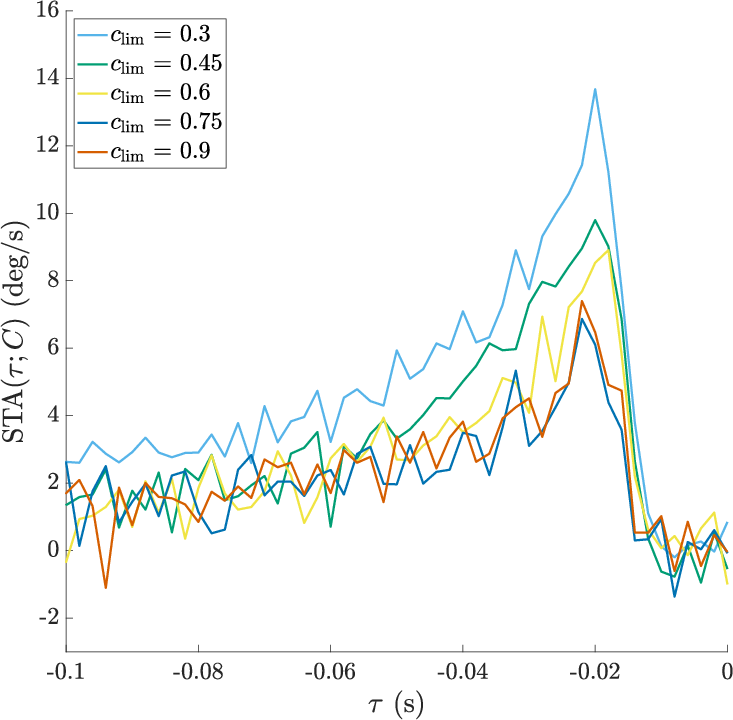
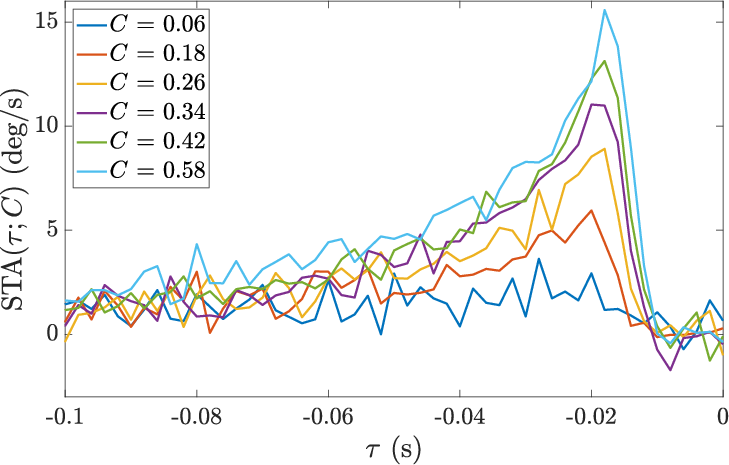
Neural responses are characterized by the spike-triggered average (STA) of velocity, STA(τ){\rm STA}(\tau), and its contrast-conditioned variant STA(τ;C){\rm STA}(\tau; C), which quantifies the average velocity trajectory preceding a spike for a given contrast bin. The STA is computed as an M×LM \times L matrix, where MM is the number of contrast bins and LL is the number of time points sampled.

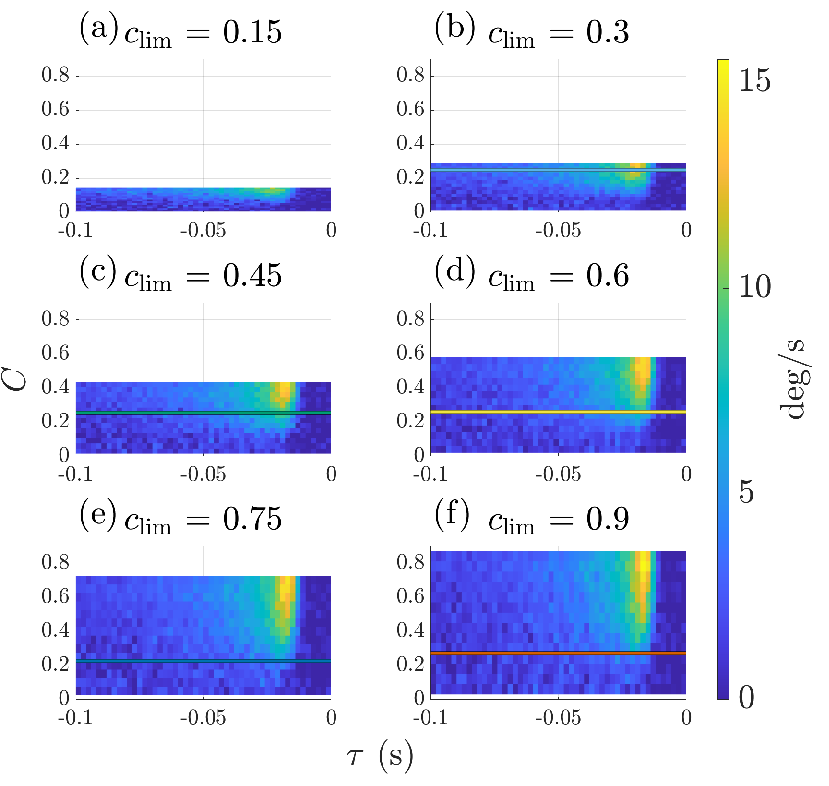
The central analytical approach involves comparing STAs across different contrast distributions (contexts) to assess context dependence. If adaptation were solely dependent on instantaneous contrast, STA(τ;C){\rm STA}(\tau; C) would be invariant across contexts. However, the results demonstrate that the response to a given contrast value is modulated by the context, indicating adaptation at the distributional level. Figure 1

Figure 1: Contrast-dependent spike-triggered averages, STA(τ;C){\rm STA}(\tau; C), illustrating the modulation of neural response by contrast.

Figure 2

Figure 2: Contrast-dependent spike-triggered averages across six values of climc_{\rm lim}, showing context-dependent adaptation.

Figure 3

Figure 3: The STA(τ;C=0.25){\rm STA}(\tau; C = 0.25) contour for each context, demonstrating non-invariance of response at fixed contrast across contexts.

Low-Rank Structure of Adaptation

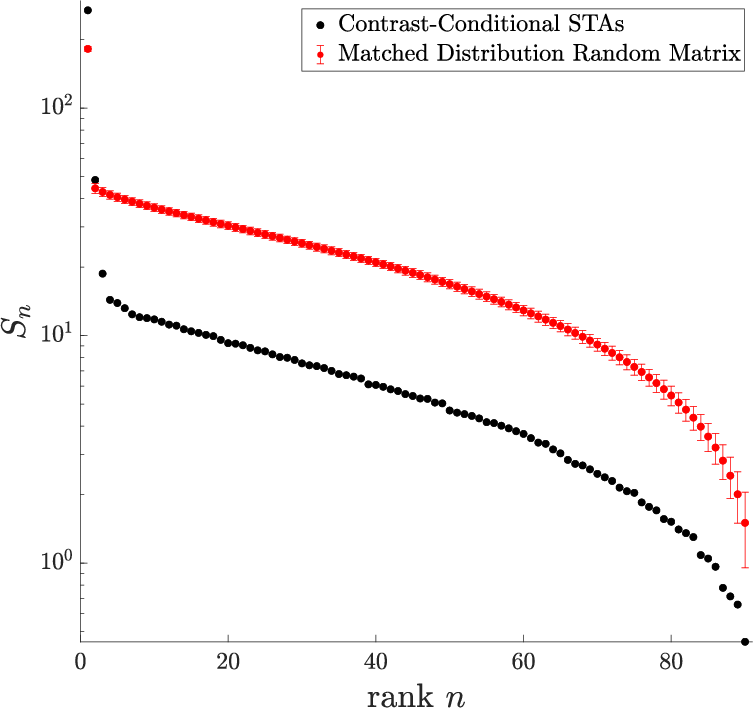
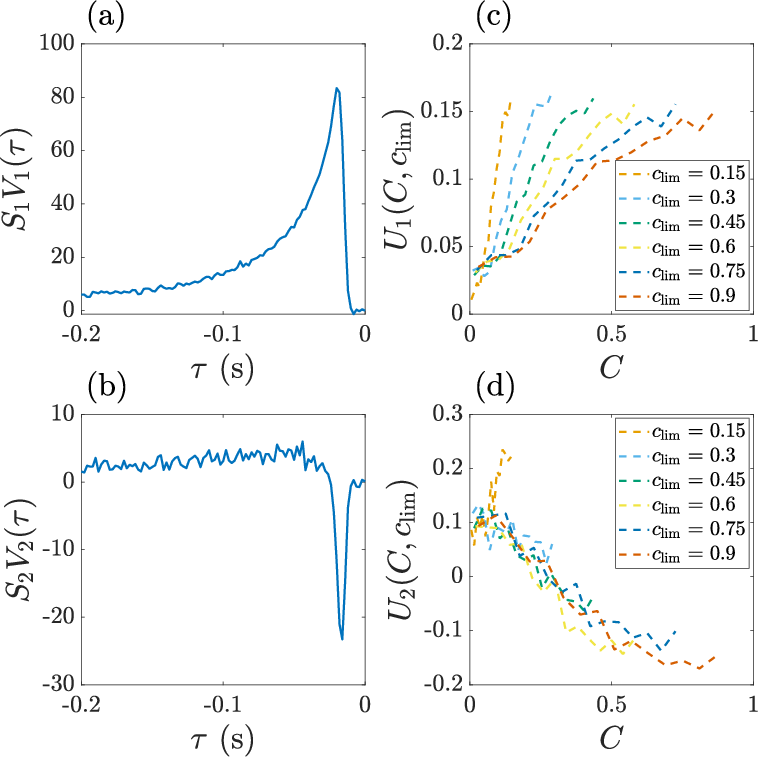
A key finding is that the space of contrast-conditional STAs is low-rank, with the majority of variance explained by a single dominant mode and a secondary component. Singular value decomposition (SVD) of the stacked STA matrices across all contexts reveals that only two singular values are significant, indicating that adaptation operates within a two-dimensional subspace of possible velocity trajectories. Figure 4

Figure 4: Singular values SnS_n versus rank nn for the stacked STA matrix, confirming the low-rank structure of adaptation.

Figure 5

Figure 5: Significant components of the SVD decomposition: (a) V1(τ)V_1(\tau), (b) V2(τ)V_2(\tau), (c) U1(C,clim)U_1(C, c_{\rm lim}), (d) U2(C,clim)U_2(C, c_{\rm lim}).

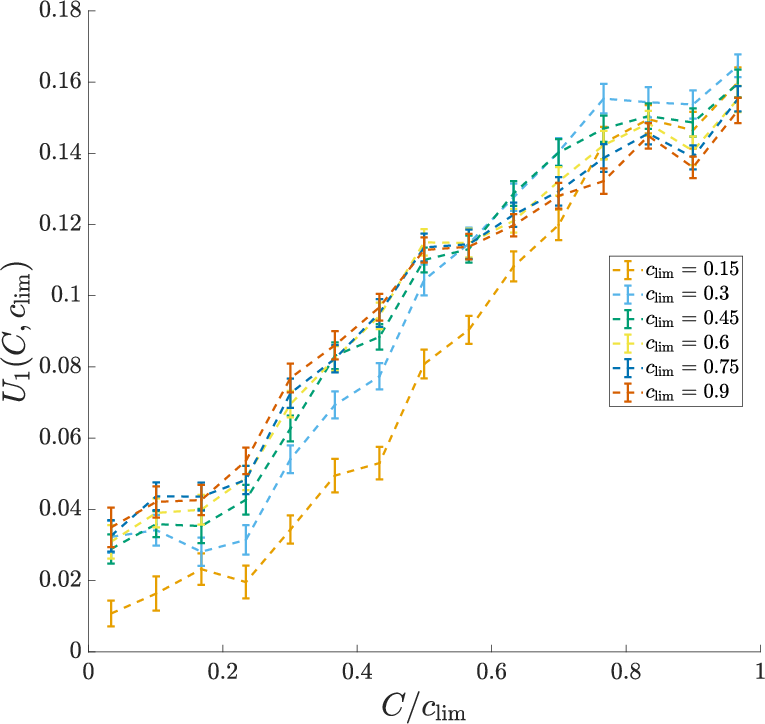
The first mode, V1(τ)V_1(\tau), captures the basic profile of the STA, while V2(τ)V_2(\tau) adjusts the peak and width. The corresponding left singular vectors U1(C,clim)U_1(C, c_{\rm lim}) and U2(C,clim)U_2(C, c_{\rm lim}) encode the dependence on contrast and context. Notably, U1U_1 is well-approximated by a function of C/climC / c_{\rm lim}, indicating normalization to the dynamic range, while U2U_2 depends primarily on absolute contrast. Figure 6

Figure 6: The contribution of the dominant mode U1(C,clim)U_1(C, c_{\rm lim}) as a function of scaled contrast, showing normalization to context.

Temporal Dynamics and Redundancy Reduction

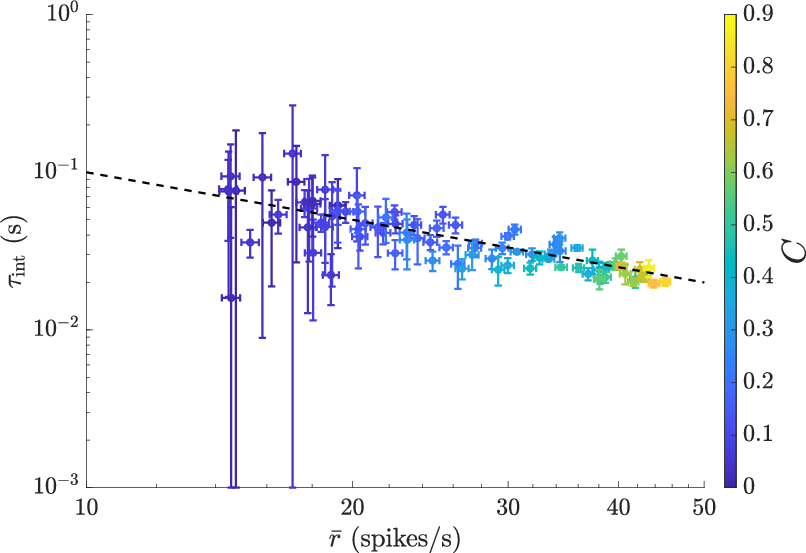
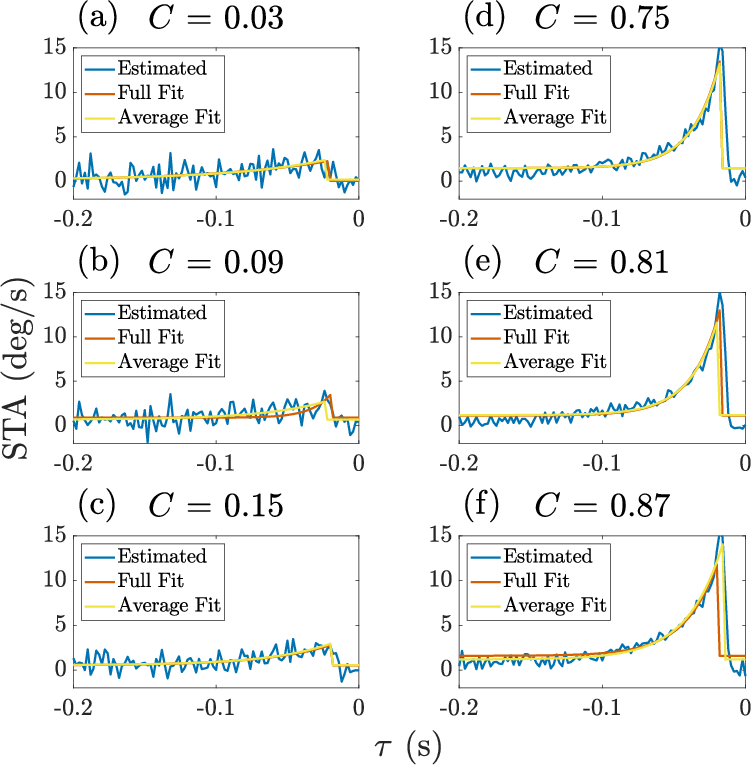
The study further analyzes the temporal integration properties of H1 by fitting the STA to an exponential decay model, extracting the integration time τint\tau_{\rm int}. Across all combinations of contrast and context, the integration time is tightly coupled to the mean interspike interval, with rˉτint1\bar{r} \tau_{\rm int} \approx 1. This relationship suggests that the neuron adapts its integration window to maintain independence between successive spikes, thereby minimizing redundancy in the neural code. Figure 7

Figure 7: Integration time τint\tau_{\rm int} versus mean spike rate rˉ\bar{r}, demonstrating the balance between integration and spike rate.

Figure 8

Figure 8: Example of contrast-conditional STAs and their exponential fits, illustrating the extraction of integration time.

Implications and Theoretical Significance

The results provide quantitative evidence for context-dependent adaptation in neural computation, extending the efficient coding hypothesis beyond coding to inference. The low-rank structure of adaptation implies that the neural system leverages a compact representation to modulate its response, facilitating rapid and efficient adjustment to changing input statistics. The normalization of response to the dynamic range of contrast is consistent with optimal coding strategies, while the tight coupling between integration time and spike rate supports the notion of redundancy reduction.

These findings have broad implications for understanding sensory adaptation in biological systems. The demonstration of adaptation to both instantaneous and distributional properties of stimuli suggests that neural circuits are equipped to track and respond to environmental statistics over multiple time scales. The low-dimensionality of adaptation mechanisms may reflect a general principle of neural computation, enabling efficient and robust processing in the face of complex, variable inputs.

Future Directions

Further research could explore the molecular and circuit-level mechanisms underlying context-dependent adaptation, as well as its generality across sensory modalities and species. The extension of these principles to artificial neural systems may inform the design of adaptive algorithms for dynamic environments. Additionally, the interplay between adaptation and information transmission warrants deeper investigation, particularly in regimes where noise and ambiguity introduce additional computational constraints.

Conclusion

This study elucidates the mechanisms of context-dependent adaptation in the fly visual system, demonstrating that neural responses to motion are modulated by both contrast and its statistical context. Adaptation is confined to a low-dimensional subspace, dominated by normalization to the dynamic range of contrast, and serves to balance integration time with spike rate, minimizing redundancy. These results advance the understanding of efficient coding and adaptive computation in neural systems, with implications for both biological and artificial intelligence.

Whiteboard

Video Overview

Explain it Like I'm 14

Plain-language summary of “Context dependent adaptation in a neural computation”

1. What is this paper about?

This paper explores how a single motion-sensing neuron in a fly’s brain automatically adjusts the way it reads visual motion depending on the situation. The key idea is that the neuron doesn’t just react to what’s happening right now (how “contrasty” the image is at this moment), but also to the broader context—what range of contrasts it has been seeing recently. The authors show that this “context-dependent adaptation” helps the neuron use its spikes efficiently so that each spike carries fresh, non-redundant information.

2. What did the researchers want to find out?

They asked simple versions of these questions:

  • How does a motion-sensing neuron’s response change when the contrast (how much images vary between light and dark) goes up or down?
  • Does the response depend only on the current contrast, or also on the bigger picture—the range of contrasts the fly has been seeing over the last minutes (the “context”)?
  • Can these changes be described simply, or are they complicated?
  • Do these adjustments help the neuron avoid repeating itself (sending multiple spikes that say the same thing)?

3. How did they study it?

They recorded spikes from a well-studied fly neuron called H1, which detects horizontal motion. To test adaptation cleanly, they built visual movies with a clear separation of time scales:

  • Making the scene: They showed the fly a textured, natural-looking pattern and moved it randomly left-right so the “speed” (velocity) changed very fast.
  • Controlling contrast: They slowly changed how strongly light and dark patches differed (the “contrast,” like turning the sharpness up or down). This slow contrast was the “instantaneous” condition the neuron saw.
  • Setting context: They grouped experiments by the overall range of contrasts allowed (from narrow to wide). That range is the “context”—like telling the system, “In this session, contrasts will vary only a little,” or “In this session, they may vary a lot.”
  • Measuring the neuron’s motion response: They used the spike-triggered average (STA). Think of this as the “average mini-movie of speed” right before each spike. If you line up many spikes and average the motion that came before them, you see the typical motion pattern that makes the neuron fire. They did this separately for different contrast levels and different contexts.
  • Finding the main patterns: They looked for the simplest way to describe how all these STAs change with contrast and context. In everyday terms, this is like finding the top two or three “themes” that explain most of the changes, instead of needing to track every tiny detail.

Key idea in plain terms:

  • Spike-triggered average (STA): Like rewinding a few frames before every “beep” the neuron makes and averaging those frames to see the typical speed pattern that triggers the beep.
  • Context: Not just the current picture’s contrast, but the recent “rules of the game” about how big contrasts can get.
  • Main patterns analysis: Like discovering most songs on an album share the same beat and melody, and you only need those few ingredients to explain the whole album.

4. What did they find, and why does it matter?

Main results:

  • The neuron’s motion response depends on both current contrast and context.
    • Higher contrast made the neuron more sensitive to motion and shortened how long it “listens” (its integration time). That makes sense: when the picture is clear, you don’t need to listen for long to be confident.
    • But the same contrast value produced different responses in different contexts. For example, “25% contrast” triggered a stronger or weaker response depending on whether the overall session allowed only small or very large contrasts. So the neuron doesn’t just look at “now”; it also adjusts to what it has been seeing lately. That’s context-dependent adaptation.
  • Simple structure: Despite many possible ways the response could change, almost everything was explained by just two main patterns (a low-dimensional, rank-2 description).
    • The dominant pattern mostly depended on “contrast divided by the context’s range” (current contrast scaled by how big contrasts have been recently). This is like normalizing the current signal to the size of the whole playing field.
    • A second, smaller pattern depended on absolute contrast (the raw level), almost independent of context. This may help resolve situations when the signal is small and noise matters.
  • Timing is tuned to reduce redundancy: The neuron’s “listening window” (integration time) was about the same as the average time between spikes. In other words, τ_integration ≈ 1 / spike rate.
    • Why is this interesting? If the neuron listened much longer than the gap between spikes, different spikes would contain overlapping information about the same bit of motion—wasting spikes by repeating the message. Matching the two time scales helps each spike carry fresh information.
    • They observed this across many contrasts and contexts—suggesting the neuron actively keeps itself out of a “rate coding” regime where you need many spikes to say one thing. Instead, it aims for “one spike per meaningful moment.”

Why this matters:

  • It shows a neuron can adapt not only to “what’s happening now” but also to “what usually happens around here.” This is a hallmark of efficient coding—saving resources while keeping important information.
  • The discovery that adaptation fits into just two main patterns means the brain may use simple rules to manage complex inputs.

5. What could this mean going forward?

  • For neuroscience: The brain seems to constantly match its computations to the statistics of the world—normalizing signals to their recent range and tuning timing so each spike matters. This supports the idea that nervous systems aim for efficient, low-redundancy codes.
  • For other senses and species: Similar context-sensitive strategies may be common in seeing, hearing, and touch across animals.
  • For technology: Cameras and sensors could borrow this trick—automatically scaling their sensitivity to the recent range of inputs and adjusting how long they “listen” so each data point adds new information.
  • For understanding behavior: Efficient spikes likely help fast, reliable behaviors (like flight control in flies), where quick, non-repetitive messages are crucial.

In short, this study shows that a fly’s motion neuron constantly adjusts how strongly and how long it listens to the world, based on both the current clarity of the scene and the broader context of recent visual experience. It keeps its messages short, timely, and informative—so every spike counts.

Open Problems

We haven't generated a list of open problems mentioned in this paper yet.

Collections

Sign up for free to add this paper to one or more collections.