- The paper introduces a novel machine learning framework (MACE) to simulate DFT-level accuracy in predicting synthesizability of high entropy oxides.
- It leverages entropy and enthalpy descriptors in tetravalent systems to efficiently screen candidate compositions and reduce computational expenses.
- Results demonstrate strong concordance between MACE predictions and DFT, validating the approach while identifying promising 4- and 5-component HEO candidates.
Expanding the Search Space of High Entropy Oxides Using Machine Learning
This essay provides an authoritative overview of the research paper "Expanding the search space of high entropy oxides and predicting synthesizability using machine learning interatomic potentials" (2508.13389). The paper presents a novel methodology to expedite the discovery of high entropy oxides (HEOs) through the application of machine learning interatomic potentials, specifically focusing on tetravalent systems.
Methodological Advancements
The research introduces a computational paradigm aimed at predicting the synthesizability of HEOs within a vast compositional space. This methodology integrates machine learning interatomic potentials, primarily the MACE foundation model, to simulate DFT-level accuracy while significantly reducing computational costs. Emphasizing tetravalent HEOs, the study leverages entropy and enthalpy descriptors to identify promising candidates among 4- and 5-component systems.
The process starts with selecting appropriate crystal structures and elements, followed by the creation of large random unit cells for each candidate composition. These cells undergo structural relaxation using the MACE model to ensure a faithful representation of the atomic arrangements. The study introduces innovative descriptors: the entropy descriptor, based on the variance in cation energies, and the enthalpy descriptor, linked to the enthalpy of mixing.
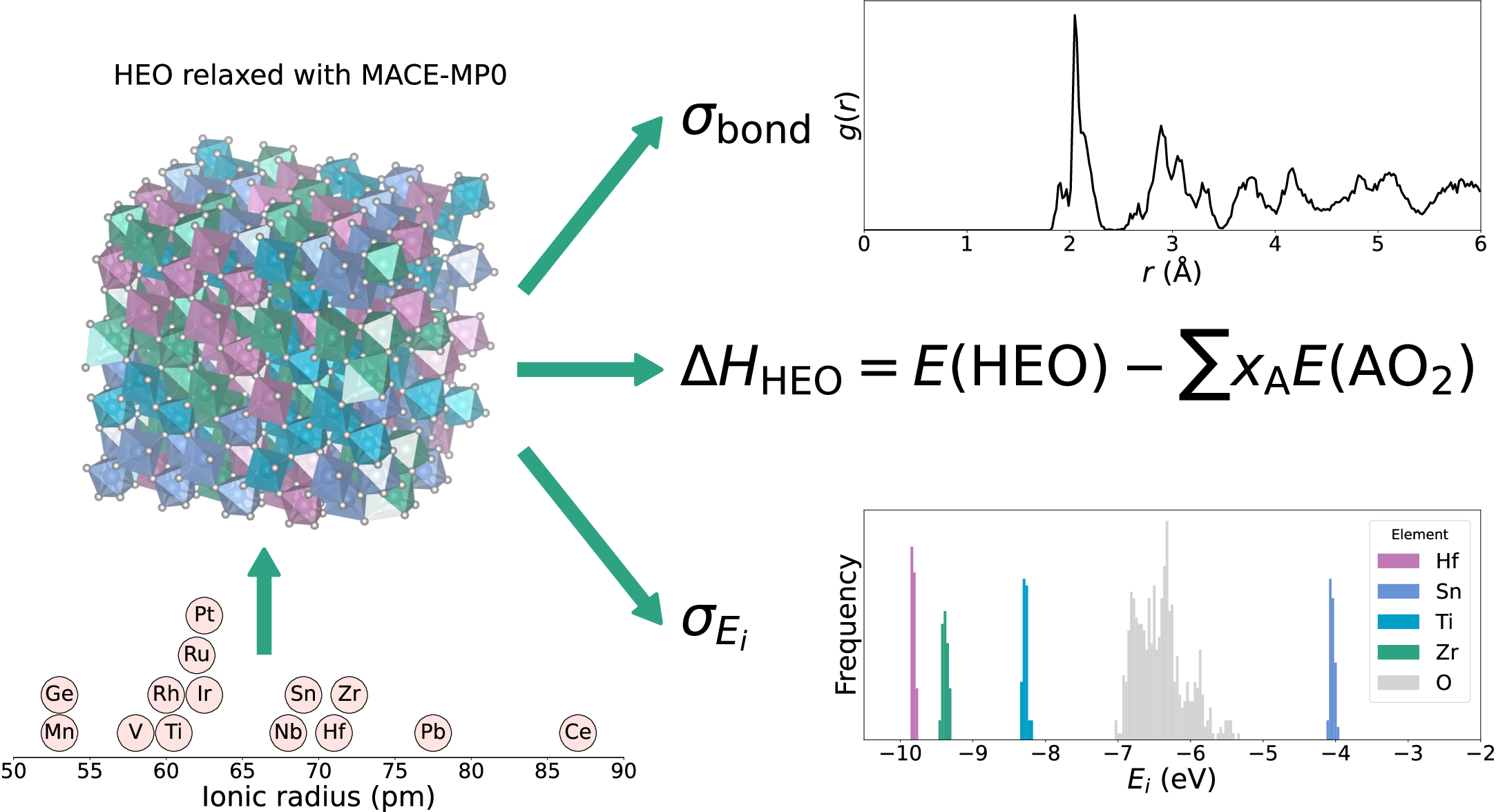
Figure 1: An outline of the methodology for calculating synthesizability of tetravalent HEOs.
Results and Comparative Analysis
The study validates its approach by contrasting MACE calculations with traditional DFT results across a subset of 7 elements, extending the analysis to a broader set involving 14 elements and three crystal structures. This comparative study showcases the efficacy of MACE in approximating the DFT-calculated enthalpy of mixing, achieving a root mean square error in line with state-of-the-art machine learning potentials. It also confirms the predictive strength of the new entropy descriptor, which effectively differentiates synthesizable compounds.
The results reveal that MACE-enhanced calculations provide a substantial reduction in computational expenses, allowing for the exploration of large HEO candidates efficiently. This method successfully predicted the only known stable 4-component HEO in the α-PbO2 structure and proposed additional 5-component candidates with potential synthesizability.
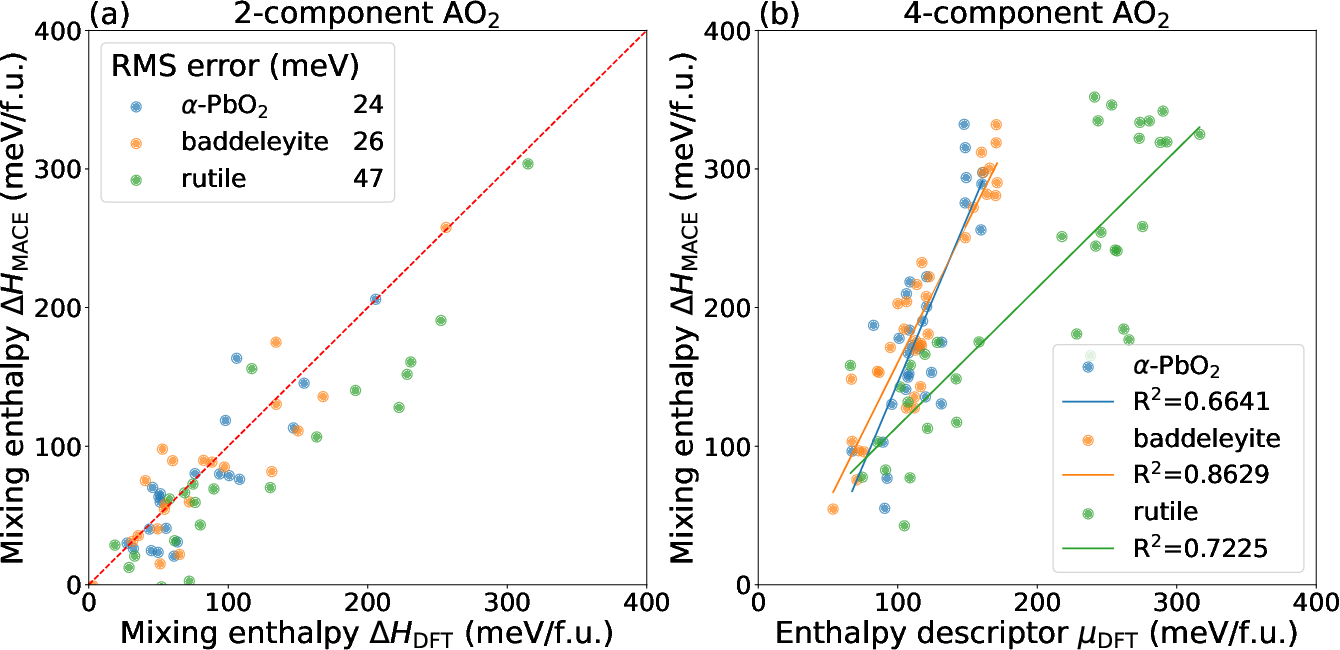
Figure 2: Comparison of the mixing enthalpies of 2-component AO2 SQS cells calculated using MACE versus DFT.
Implications and Future Directions
The proposed methodology holds significant implications for accelerating HEO discovery. By mitigating the limitations of DFT in managing large-scale simulations, the approach enables rapid and thorough screening of potential HEO compositions, minimizing experimental trial-and-error. The strategy can be readily adapted to explore new elements and crystal structures, signaling a shift toward more systematic material discovery processes.
Moreover, this research paves the way for incorporating more sophisticated machine learning models, like fine-tuned MACE variants, to enhance prediction accuracy further. Future developments could involve integrating improved datasets to refine machine learning potentials, potentially expanding the parameter space to include non-tetravalent systems and tailoring the method for off-equimolar compositions. The adaptive nature of machine learning models presents a versatile tool for exploring the vast chemical spaces inherent in HEOs and beyond.
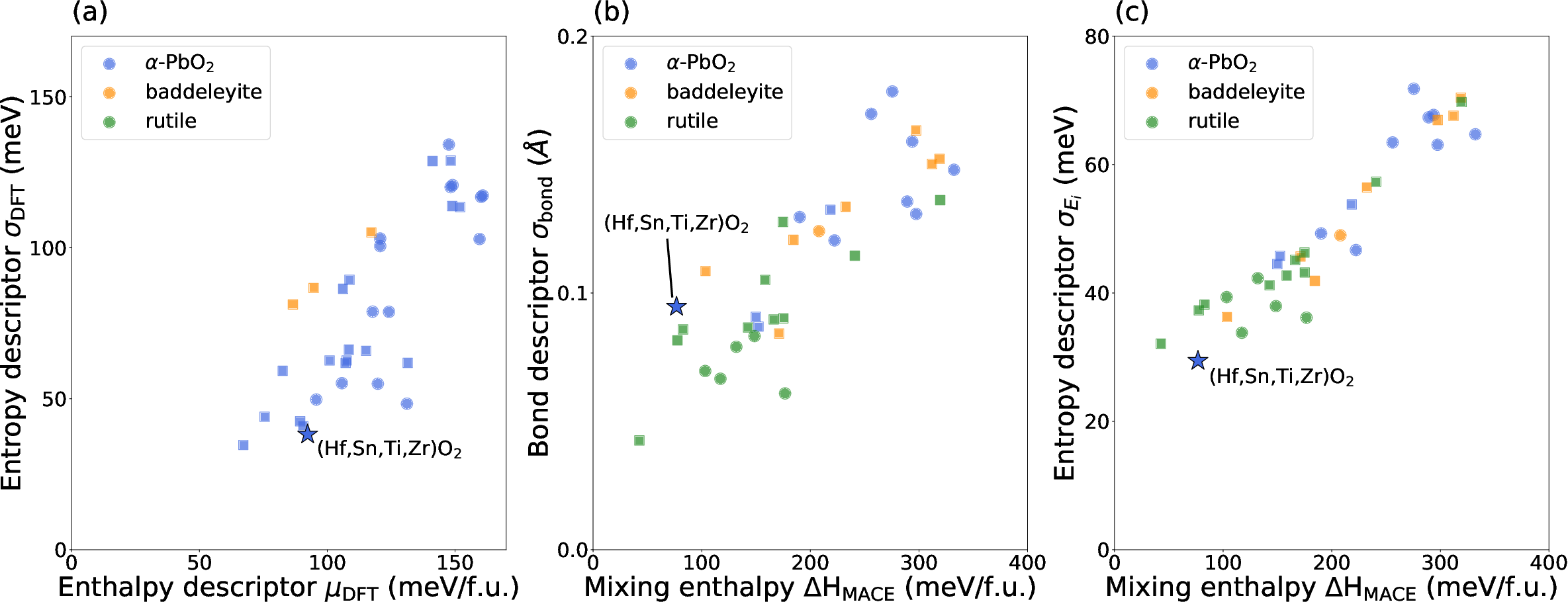
Figure 3: Scatter diagrams of 4-component compounds indicating entropy and enthalpy descriptors calculated via MACE.
Conclusion
In conclusion, this paper illustrates a forward-thinking methodology that advances the field of high entropy oxide discovery. By coupling machine learning techniques with efficient structure screening, the authors present a scalable and adaptable framework capable of identifying promising HEO candidates. This method not only streamlines the discovery process but also enhances the scientific community's ability to harness the complex chemical space of HEOs, fostering innovation and application in various domains.