- The paper presents a comprehensive survey on integrating pre-trained VLMs within VLA frameworks to boost robot manipulation.
- It explains two architectural paradigms—monolithic models for unified processing and hierarchical models that decouple planning from execution.
- The survey highlights advanced integration techniques and diverse datasets that enhance model generalization in dynamic, real-world tasks.
Large VLM-based Vision-Language-Action Models for Robotic Manipulation: A Survey
Introduction
The integration of large Vision-LLMs (VLMs) within the Vision-Language-Action (VLA) framework presents a transformative paradigm for robotic manipulation. Traditional approaches in robotics, often constrained by limited predefined task specifications, struggle to generalize in dynamic or novel scenarios. In contrast, VLA models leveraging pre-trained VLMs on vast image-text datasets offer enhanced capabilities like open-world generalization, hierarchical task planning, knowledge-augmented reasoning, and rich multimodal fusion. These capabilities allow robots to understand high-level instructions, recognize unseen environments, and perform complex tasks.
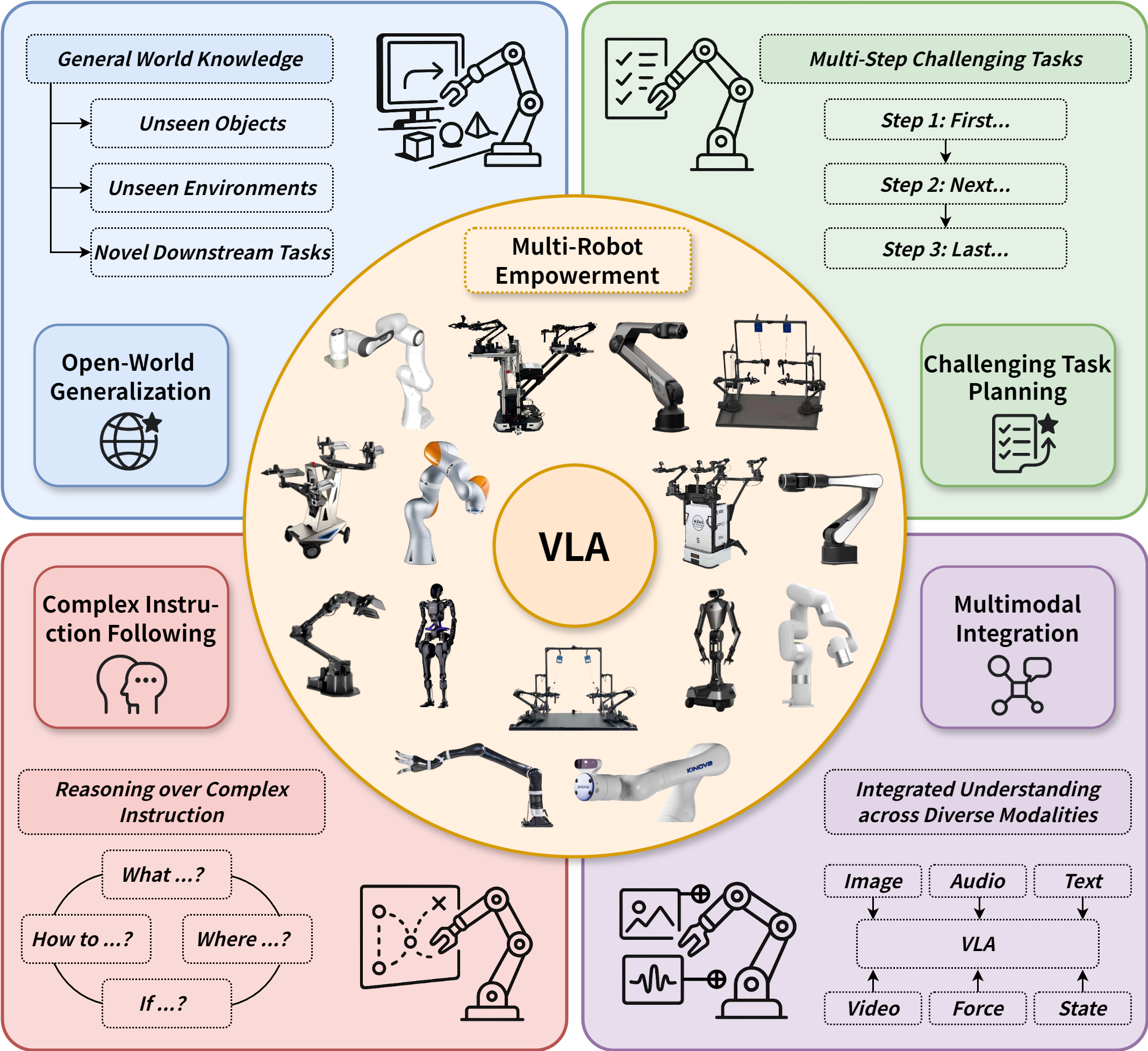
Figure 1: Illustration of core advantages of large VLM-based Vision-Language-Action (VLA) models for robotic manipulation.
Architectural Paradigms
VLA models can be broadly categorized into two principal architectural paradigms: monolithic models and hierarchical models.
Monolithic Models
Monolithic models integrate environmental comprehension and action generation into either single-system or dual-system architectures:
- Single-System Models: These involve a unified architecture that processes visual perception, language comprehension, and robot states, culminating in action generation. RT-2, an example, co-trains on internet-scale vision-language tasks alongside real robot trajectories, adapting its large VLM backbone for robust action generalization.
- Dual-System Models: This architecture splits functionality, typically involving a slower, reflective VLM for high-level planning (System 2) and a fast, specialized module for low-level control (System 1). It allows combining deep multimodal reasoning with efficient task execution.

Figure 2: Comparison of the two principal categories of large VLM-based VLA models.
Hierarchical Models
In hierarchical models, the planning phase is explicitly decoupled from the execution phase. These models include:
- Planner-Only: Models use VLMs to generate actionable intermediate representations such as keypoints or subtask series.
- Planner+Policy: Such frameworks feature both a high-level planner and low-level policy module, enhancing flexibility and task execution fidelity.
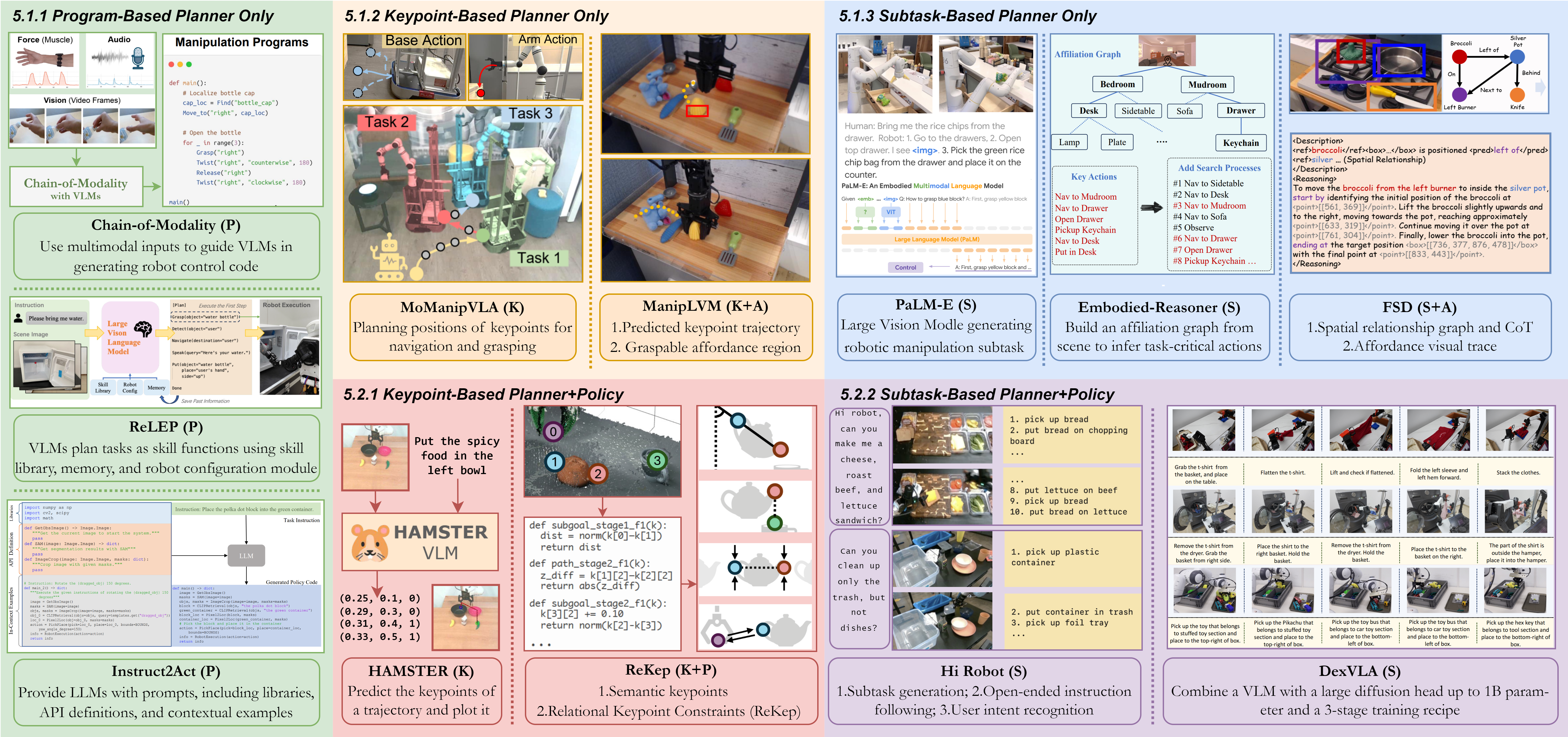
Figure 3: A diagram showing the hierarchical models in this survey.
Advanced Integration Techniques
Beyond core architectures, contemporary research explores techniques like memory mechanisms, 4D perception, effective adaptation, and multi-agent cooperation. Training strategies increasingly incorporate eccentric modalities like tactile data or auditory cues, further enriching the VLA model's contextual grounding and interaction scope.
Datasets and Benchmarks
VLA model evaluation depends critically on diverse datasets and robust benchmarking:
- Real-World Datasets: Essential for training models that must interpret and act in complex, dynamic environments.
- Simulation Benchmarks: Provide controlled environments for assessing model performance and help bridge sim-to-real deployment gaps.
- Human Behavior Datasets: Capture rich semantic and contextual nuances from human interactions, enhancing model grounding and adaptability.
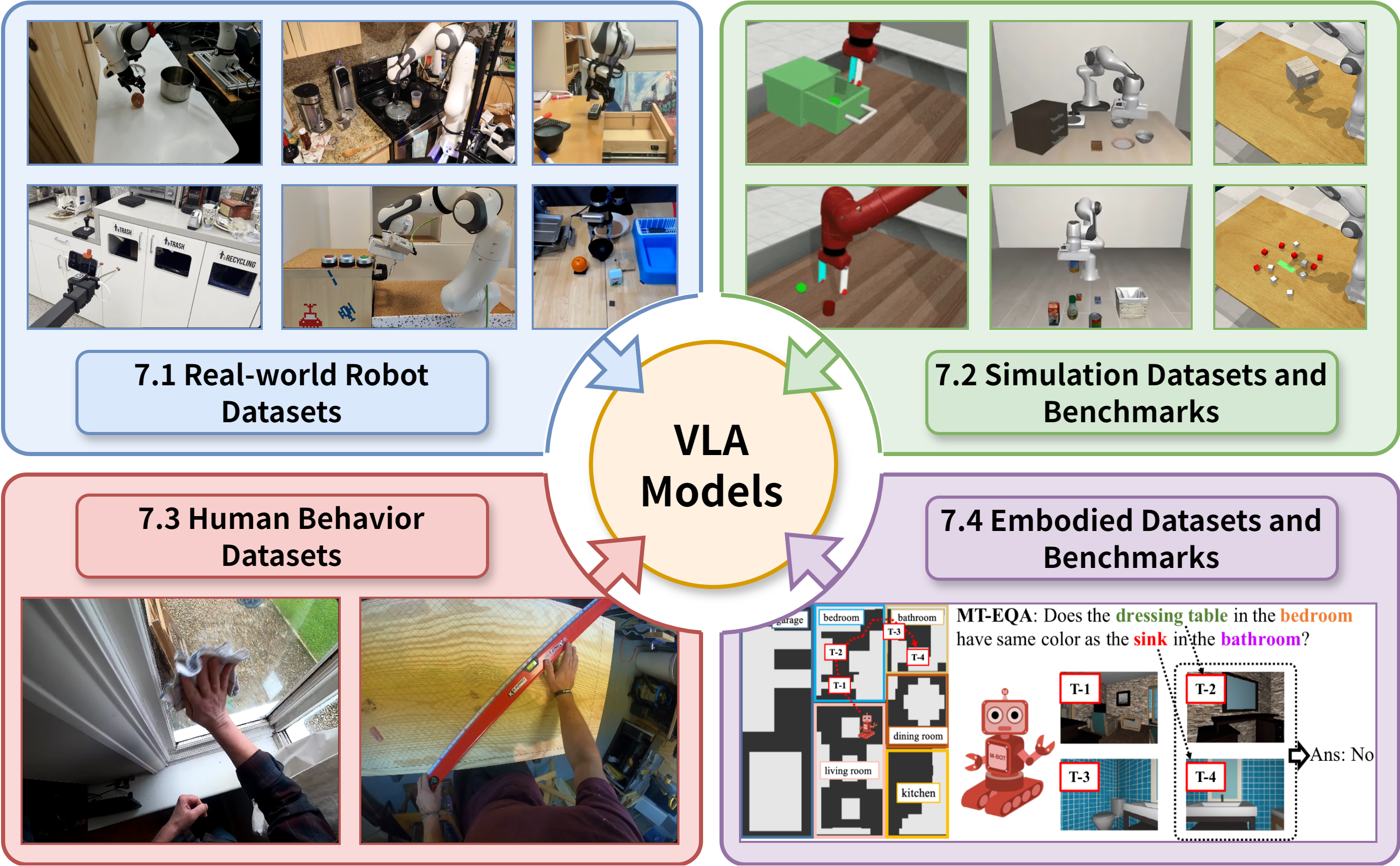
Figure 4: Illustration of four dataset types that underpin large VLM-based VLA models for robotic manipulation.
Conclusion
The survey consolidates advances in VLA models built on large VLMs, offering a structured perspective on their architectures and capabilities. Notable trends point towards more generalizable models capable of adeptly handling open-world challenges while being scalable and robust enough for practical deployment. As the field evolves, future research will likely focus on seamless integration across modalities, enhanced cross-domain generalization, and lifelong learning capabilities to navigate continuously changing real-world environments.

