Raising the Bar: An Asymptotic Comparison of Classical and Quantum Shortest Path Algorithms
Published 16 Aug 2025 in quant-ph and cs.CC | (2508.12074v1)
Abstract: The Single-Source Shortest Path (SSSP) problem is a cornerstone of computer science with vast applications, for which Dijkstra's algorithm has long been the classical baseline. While various quantum algorithms have been proposed, their performance has typically been benchmarked against this decades-old approach. This landscape was recently reshaped by the introduction of a new classical algorithm by Duan et al. with a complexity of $O(m \cdot (\log n){2/3})$. This development necessitates a re-evaluation of the quantum advantage narrative for SSSP. In this paper, we conduct a systematic theoretical comparison of modern quantum and classical SSSP algorithms in light of this new classical frontier. Through an analysis of their theoretical cost functions, we illustrate how their relative scaling compares across scenarios that vary in graph density and path length. Our analysis suggests a nuanced picture: sophisticated quantum algorithms, such as the one by Wesolowski and Piddock, can exhibit more favorable asymptotic scaling, but only in regimes characterized by short solution paths. Conversely, for problems involving long paths, state-of-the-art classical algorithms appear to maintain a scaling advantage. Our work provides an updated perspective for future quantum algorithm development and underscores that the pursuit of quantum advantage is a dynamic race where the classical goalposts are continually shifting.
The paper demonstrates that quantum algorithms outperform classical methods in short path scenarios on both sparse and dense graphs.
The study employs asymptotic analysis to compare cost functions, showcasing regime-specific scaling advantages based on graph structure.
Findings indicate that while quantum methods excel with logarithmically short paths, classical algorithms maintain advantages for longer path lengths.
"Raising the Bar: An Asymptotic Comparison of Classical and Quantum Shortest Path Algorithms" (2508.12074)
Abstract
This paper addresses the asymptotic comparison of classical and quantum algorithms for the Single-Source Shortest Path (SSSP) problem, particularly in light of recent advancements in classical algorithm performance. By examining the cost functions of these algorithms, the study presents nuanced conclusions about the potential for quantum advantage within specific regimes characterized by graph density and path length.
Introduction to SSSP and Classical Algorithmic Benchmarks
The SSSP problem requires computation of the shortest path lengths from a source vertex to all other vertices in a weighted directed graph. Historically, Dijkstra's algorithm has served as the classical benchmark with a time complexity of O(m+nlogn). This baseline was recently challenged by Duan et al., who proposed a new algorithm with a complexity of O(m⋅(logn)2/3), altering the landscape for evaluating quantum algorithms.
Quantum Algorithm Strategies
Modern quantum algorithms for SSSP have evolved through foundational and quantum-native approaches. The Grover-based acceleration attempts to utilize Grover's search to optimize classical procedures by reducing search time, but with inherent limitations due to its complexity of O(n⋅m). The quantum-native approach by Wesolowski and Piddock employs quantum walks and divide-and-conquer strategies, achieving a complexity of O~(l⋅m), where l signifies path length, emphasizing geometry over mere graph size metrics.
Methodology and Asymptotic Analysis
The analytical focus is on asymptotic cost functions reflecting theoretical time complexities of various algorithms, categorized by graph density (sparse or dense) and path length (short or long). Through a comparative analysis, the study identifies scenarios where quantum algorithms potentially demonstrate advantageous scaling behavior compared to their classical counterparts.
Results on Sparse and Dense Graphs
Sparse Graphs
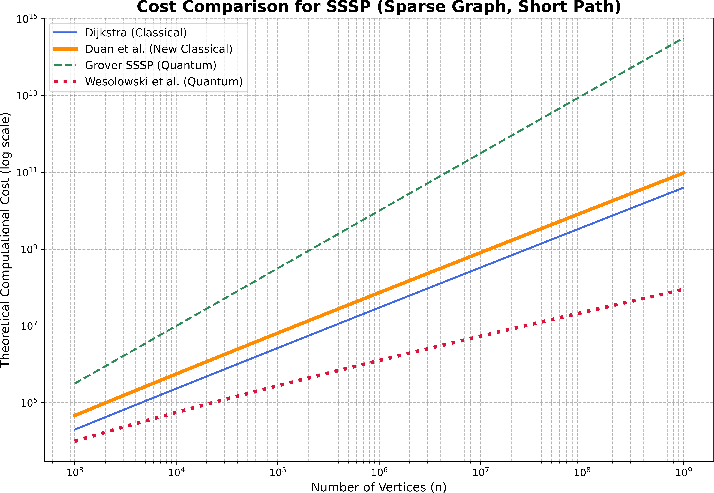
In sparse graphs, characterized by m=10n, the Wesolowski et al. algorithm reveals superior scaling particularly for short path scenarios, due to its sublinear scaling with edge count:
Figure 1: Cost comparison on sparse graphs (m=10n) with short path lengths (l=(log2n)2). The Wesolowski et al. algorithm (red, dotted) demonstrates a clear and growing scaling advantage over all classical and quantum counterparts.
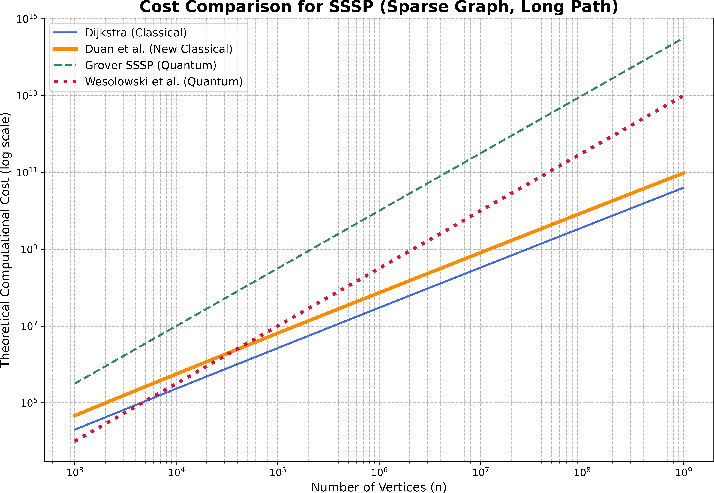
Conversely, in long-path scenarios where l=n/10, classical methods, particularly the new Duan et al. algorithm, retain a scaling advantage due to the quantum algorithm's l dependency:
Figure 2: Cost comparison on sparse graphs (m=10n) with long path lengths (l=n/10). The classical algorithms (blue and orange) show more favorable scaling, as the quantum algorithms' costs are higher due to dependencies on l and n.
Dense Graphs
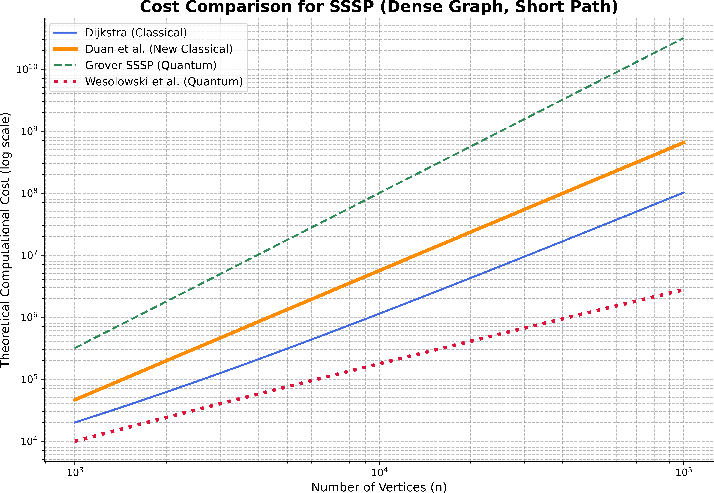
In dense graphs, m=n2/100, the quantum advantage persists for short paths, suggesting resilience to increasing graph edge density:
Figure 3: Cost comparison on dense graphs (m=n2/100) with short path lengths. The asymptotic advantage of the Wesolowski et al. algorithm persists due to its sublinear scaling with m.
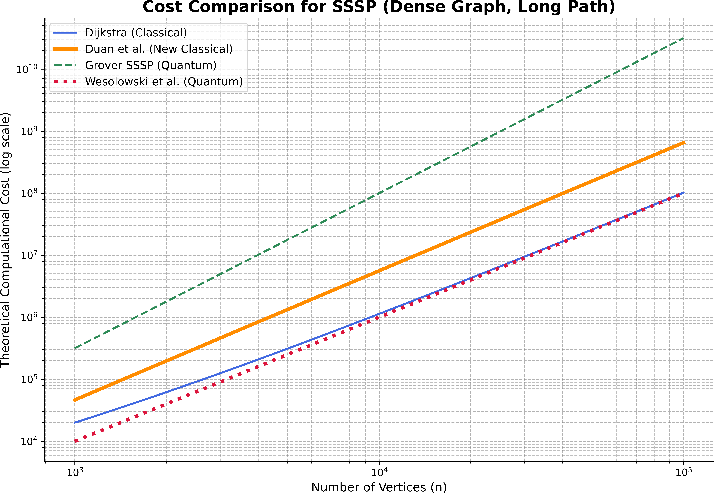
Long-path dense graphs present nearly equivalent scaling for quantum and classical solutions, suggesting possible crossover points where quantum advantages could diminish:
Figure 4: Cost comparison on dense graphs ($m=n2/100) with long path lengths. The scaling behaviors are very close, indicating a potential crossover point where the asymptotic advantage becomes marginal.
Discussion
The study's analysis reveals nuanced conditions under which quantum algorithms demonstrate an asymptotic advantage. Primarily, the result hinges on path length, marking the "Path Length Barrier" as a critical factor. For problems with logarithmically short paths, quantum approaches hold potential, although long-path scenarios favor classical solutions due to scalability limits introduced by path length reliance. The findings stress the necessity for developing quantum algorithms that harmonize with specific structural network properties.
Conclusion
Evaluating quantum algorithms against the new classical frontier established by Duan et al. reveals that quantum advantage for SSSP is context-dependent. The paper elucidates the dynamic nature of algorithmic competition where quantum advantage is contingent upon graph structure and solution path geometry. However, the advancement of classical algorithms continues to raise the bar for quantum solutions, urging a refined approach in quantum algorithm design that can address geometric constraints effectively. Future progress hinges on further advancing quantum strategies with targeted optimizations for path geometry and graph structure.
“Emergent Mind helps me see which AI papers have caught fire online.”
Philip
Creator, AI Explained on YouTube
Sign up for free to explore the frontiers of research
Discover trending papers, chat with arXiv, and track the latest research shaping the future of science and technology.Discover trending papers, chat with arXiv, and more.