- The paper reveals that imposing ultrasoft high-energy behavior and Regge zeros uniquely bootstraps string scattering amplitudes.
- It demonstrates that a linear Regge trajectory and Chew-Frautschi scaling emerge, yielding the Veneziano and Virasoro-Shapiro amplitudes.
- The work establishes a rigorous algebraic structure that excludes single Regge trajectory amplitudes and guides extensions to higher-point functions.
Uniqueness of String Theory from Minimal Scattering Assumptions
Introduction and Motivation
The paper "Strings from Almost Nothing" (2508.09246) establishes that string theory emerges uniquely from a minimal set of physical assumptions about tree-level scattering amplitudes. The authors demonstrate that imposing ultrasoft high-energy behavior and requiring that all tree-level four-point amplitudes exhibit only the zeros mandated by Regge consistency (termed "Regge zeros") is sufficient to bootstrap the Veneziano and Virasoro-Shapiro amplitudes. This approach does not presuppose the spectrum, spin, or explicit form of the amplitude; instead, these properties are derived as necessary consequences of the imposed constraints.
Regge Zeros and Ultrasoftness
The central technical result is the identification of Regge zeros: for any tree-level, crossing-symmetric, Lorentz invariant, unitary amplitude, the residues at the poles must vanish at specific values of the momentum transfer, dictated by the Regge trajectory α(t). The ultrasoftness assumption requires that α(t) is bijective for t<0 and diverges to −∞ as t→−∞, ensuring arbitrarily fast falloff at high momentum transfer. This property is exhibited by string theory but not by its q-deformations or by quantum field theory, which have bounded softness.
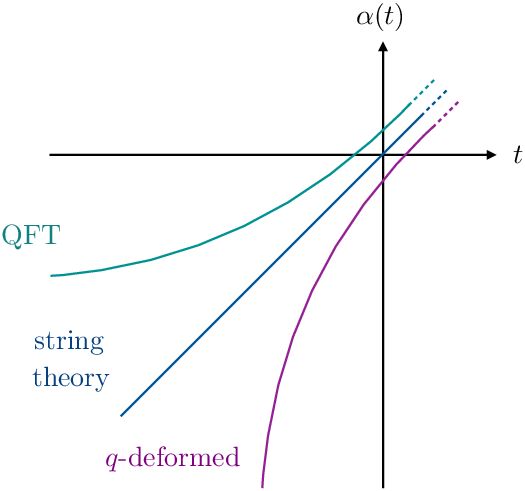
Figure 1: Schematic behavior of Regge trajectories for quantum field theory, string theory, and its q-deformations.
The minimal zeros assumption further restricts the amplitude: all zeros of the residues must be Regge zeros, with no extraneous zeros beyond those required by consistency. This operationally defines the "simplest consistent amplitude."
Bootstrap Construction and Uniqueness
By analyzing the contour integrals of the amplitude and matching the scaling of residues, the authors show that the only solution consistent with ultrasoftness and minimal zeros is a linear Regge trajectory, α(t)∼t, and a spectrum of masses squared linear in spin, μ(n)∼J(n)∼n. This is the Chew-Frautschi scaling, historically associated with string theory.
The explicit bootstrap yields the Veneziano amplitude for planar four-point scattering and the Virasoro-Shapiro amplitude for nonplanar four-point scattering. The argument generalizes to five-point amplitudes, where the Regge zeros uniquely fix the residue structure, and cyclic invariance determines the normalization.
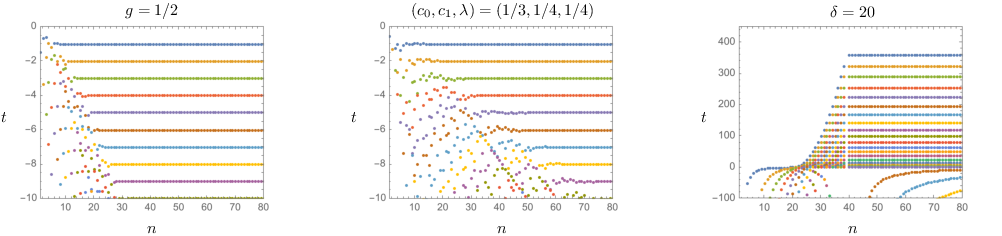
Figure 2: The residues of tree-level four-point amplitudes exhibit Regge zeros at asymptotically large level n; shown are the real components of the zeros in t for several residue constructions.
Level Truncation and Algebraic Structure
A notable consequence is the level truncation property: for certain kinematic configurations, all but a finite number of residues vanish, reducing the infinite dual resonant sum to a finite subset. This renders the amplitude rational in the kinematic variables.
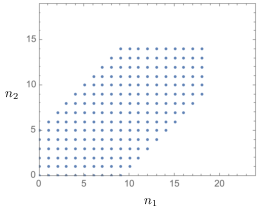
Figure 3: The domain D(10,6,25), where each dot represents a nonzero residue at level (n1,n2) in the kinematic configuration (t23,t34,t51)=−(10,6,25).
The algebraic structure of the residues and their zeros is shown to be sufficient to uniquely fix the amplitude, both for the string and its q-deformations, provided the sum converges.
Contradictory Claims and Exclusions
The paper makes a strong exclusion: amplitudes with a single Regge trajectory and no additional high-energy states are ruled out by the residue scaling, as they cannot satisfy the required scaling of derivatives with respect to t at large n. This contradicts previous conjectures that string uniqueness could be derived from less restrictive assumptions.
Implications and Future Directions
The results have significant implications for the S-matrix bootstrap program. They demonstrate that string theory is not merely one consistent solution among many, but the unique solution under the stated minimal assumptions. This provides a sharp theoretical prediction for the structure of gravitational scattering at or below the Planck scale, independent of experimental input.
The approach also suggests a pathway for generalizing the bootstrap to higher-point amplitudes and to q-deformed spectra, with the algebraic structure of Regge zeros and cyclic invariance providing sufficient constraints for uniqueness.
Conclusion
The paper rigorously establishes that string theory arises uniquely from the minimal requirements of ultrasoft Regge behavior and minimal Regge zeros in tree-level scattering amplitudes. The explicit bootstrap construction yields the Veneziano and Virasoro-Shapiro amplitudes, with the spectrum and spin structure of string theory as necessary outputs. The exclusion of single Regge trajectory amplitudes and the algebraic determination of higher-point amplitudes underscore the power of the S-matrix bootstrap in constraining fundamental theory. Future work may extend these methods to loop-level amplitudes, nonperturbative regimes, and further generalizations of the spectrum.

