- The paper demonstrates transfer learning's viability by transferring learned features between FMCW and IR-UWB radar systems to improve heart rate monitoring.
- It employs a novel 2D+1D ResNet architecture to capture spatial and temporal features, enhancing accuracy with reduced dataset requirements.
- The methodology achieves a 25% MAE improvement for IR-UWB data, reducing errors from 5.4 bpm to 4.1 bpm across varied conditions.
UWB Radar-based Heart Rate Monitoring: A Transfer Learning Approach
Introduction
This paper presents a study on radar technology's potential for continuous and contactless heart rate (HR) monitoring using consumer electronics. The study focuses on leveraging transfer learning between frequency-modulated continuous wave (FMCW) and impulse-radio ultra-wideband (IR-UWB) radar systems. The goal is to enable heart rate monitoring capabilities in devices like smartphones by demonstrating efficient transfer learning methods to overcome the requirement for large datasets for each radar system.
Radar Systems and Dataset Description
FMCW radar systems typically use a continuous chirp waveform operating at 60 GHz, providing a high range resolution with frequent use in consumer devices such as Google's Nest Hub. Conversely, IR-UWB radar systems, which transmit short pulses at 8 GHz, are increasingly integrated into mobile devices but face challenges such as lower range resolution.
The study utilized two datasets:
- FMCW Dataset: Collected using a Google Nest Hub device during overnight sleep sessions. The dataset included 119 valid sessions with continuous ECG ground-truth HR monitoring.
- IR-UWB Dataset: Collected from various sites using an NXP SR160 UWB radar device, including participants with and without cardiovascular conditions.
Methodology
The methodology involves several stages, including data preprocessing, presence detection, feature extraction, model architecture design, and transfer learning.
- Data Preprocessing: Data from radar signals were processed to reduce noise and enhance signal clarity. Techniques like FFT and CFAR were used for dimensional reduction.
- Model Architecture: A novel 2D~+~1D ResNet architecture was deployed to effectively learn spatio-temporal features from the radar data. Highlights include initial 2D convolutional layers to capture spatial relations, followed by 1D layers for temporal correlations.
- Transfer Learning Strategy: The model, initially trained on FMCW radar data, fine-tuned using IR-UWB data to leverage shared features across datasets, thus improving HR estimation accuracy even with smaller datasets.

Figure 1: The high-level architecture of the system, showing the signal processing, presence detection, and feature extraction stages, followed by the ML model.
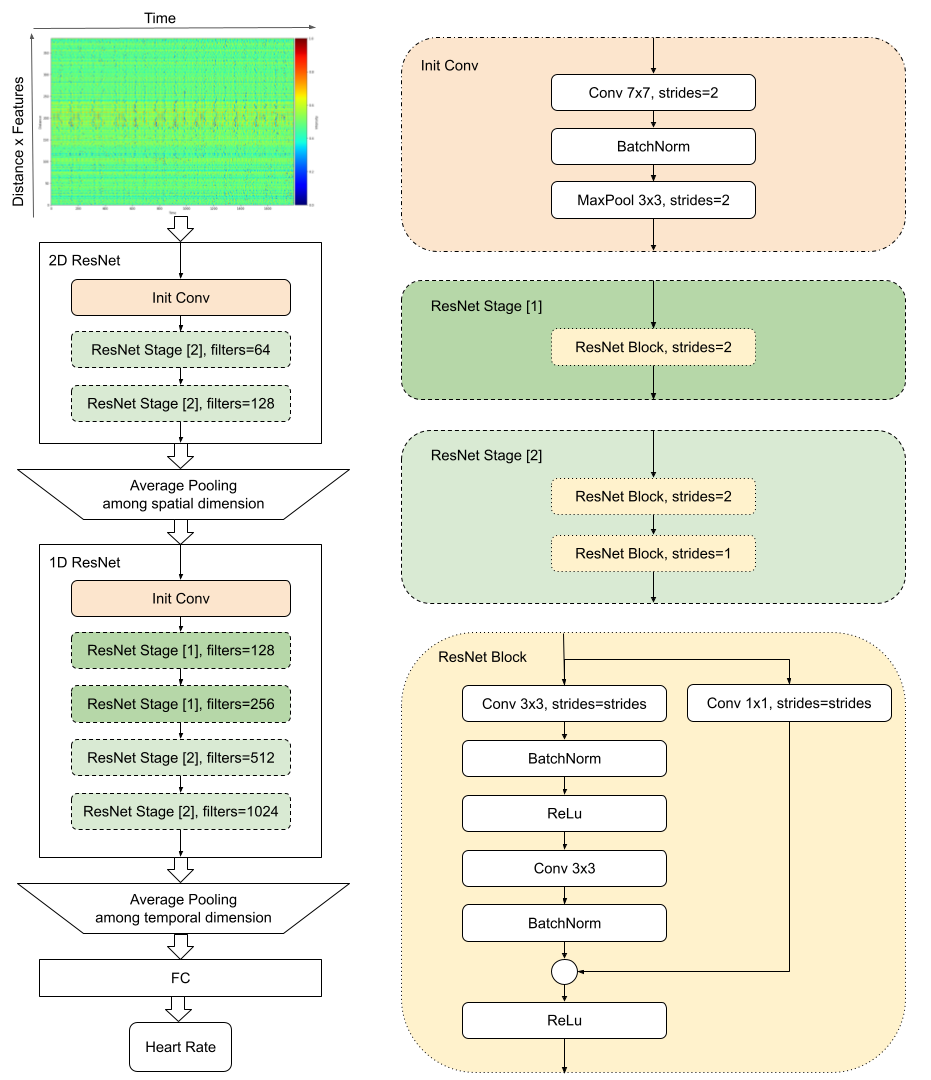
Figure 2: Novel model architecture which combines a 2D and 1D ResNet network.
Results
The proposed method achieved substantial improvements in HR monitoring accuracy:
- FMCW Radar: Achieved an MAE of 0.85 bpm and a MAPE of 1.42%, halving previous SOTA errors with high recall (98.9%).
- Transfer Learning to IR-UWB: Fine-tuning reduced MAE from 5.4 bpm to 4.1 bpm, representing a 25% improvement over baseline models trained from scratch.
The study emphasized model robustness across participant demographics, radar positioning, and heart rate ranges.
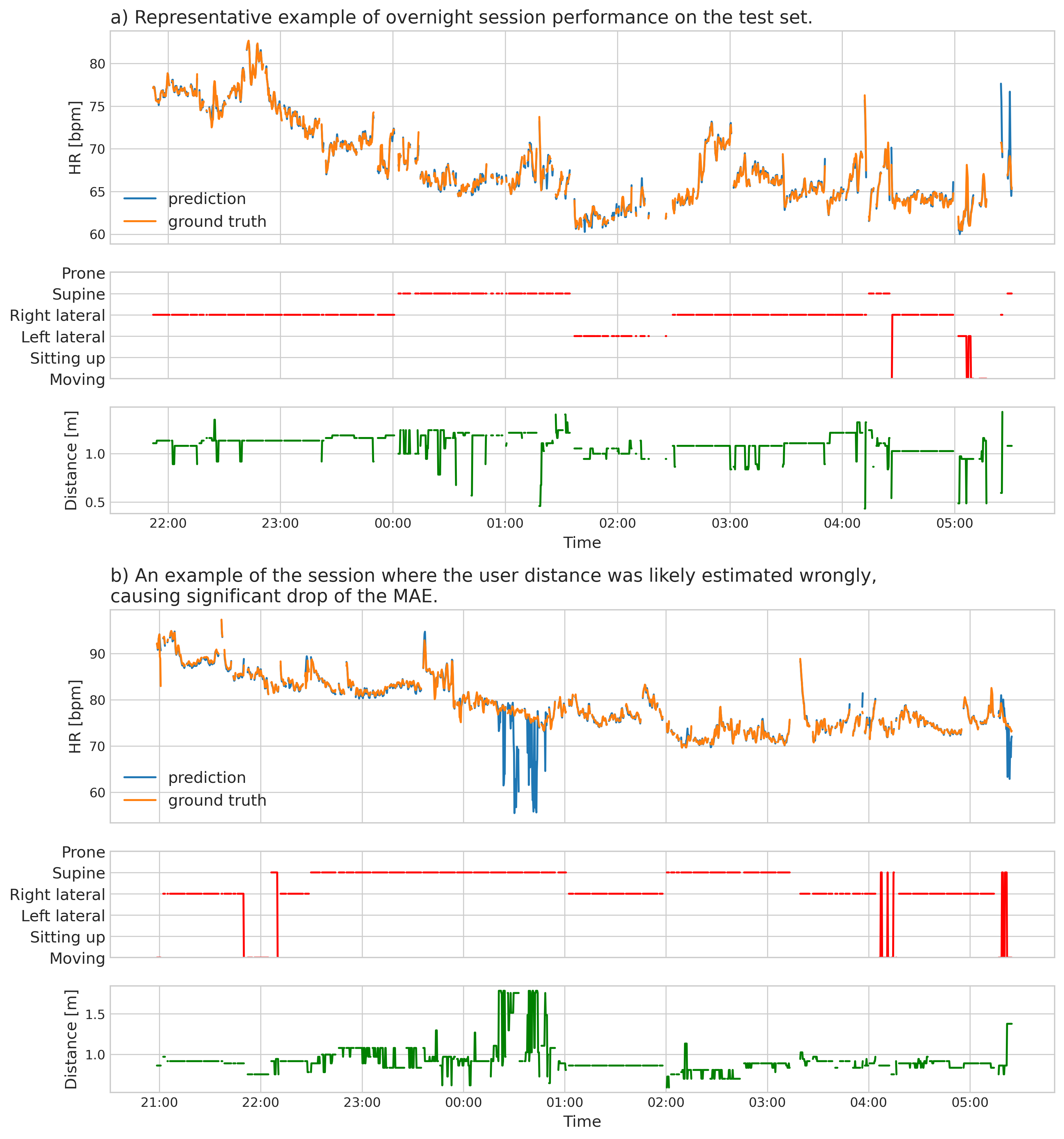
Figure 3: a) Representative example of overnight session performance on the test set. b) An example of a session with significant MAE drop due to misestimation of user distance.
Discussion
The study effectively demonstrates leveraging transfer learning between disparate radar systems to enhance HR monitoring capabilities using smaller datasets. The proposed model's high accuracy and robust performance across varied conditions suggest potential for commercial deployment enabling wide-scale adoption in consumer electronics.
The presented solutions primarily target the challenges of HR monitoring through radar, such as differentiating between respiratory and cardiac motions and the necessity of signal processing innovations tailored to the radar modality.
Conclusion
The paper offers a comprehensive framework utilizing a 2D~+~1D ResNet architecture, enabling the transfer of learned features between FMCW and IR-UWB radar systems for accurate heart rate monitoring. Future research could explore enhancements in radar signal processing and transfer learning techniques across different radar technologies.
These advancements hold promise for contactless health monitoring, significantly benefiting telemedicine and general wellness applications. The outlined methodologies offer a scalable approach for integrating health monitoring seamlessly into ubiquitous consumer devices like smartphones.