Flagged Extensions and Numerical Simulations for Quantum Channel Capacity: Bridging Theory and Computation
Published 3 Jun 2025 in quant-ph and cs.IT | (2506.03429v2)
Abstract: I will investigate the capacities of noisy quantum channels through a combined analytical and numerical approach. First, I introduce novel flagged extension techniques that embed a channel into a higher-dimensional space, enabling single-letter upper bounds on quantum and private capacities. My results refine previous bounds and clarify noise thresholds beyond which quantum transmission vanishes. Second, I present a simulation framework that uses coherent information to estimate channel capacities in practice, focusing on two canonical examples: the amplitude damping channel (which we confirm is degradable and thus single-letter) and the depolarizing channel (whose capacity requires multi-letter superadditivity). By parameterizing input qubit states on the Bloch sphere, I numerically pinpoint the maximum coherent information for each channel and validate the flagged extension bounds. Notably, I capture the abrupt transition to zero capacity at high noise and observe superadditivity for moderate noise levels.
The paper introduces flagged extension methods to establish sharp single-letter upper bounds for quantum and private channel capacities.
Numerical simulations using Sobol/Latin hypercube sampling and trust-region search accurately optimize coherent information over qubit channel inputs.
Findings confirm degradability thresholds in amplitude damping channels and highlight capacity constraints in depolarizing channels through precise benchmarking.
Flagged Extensions and Numerical Simulations for Quantum Channel Capacity
Introduction and Problem Setting
"Flagged Extensions and Numerical Simulations for Quantum Channel Capacity: Bridging Theory and Computation" (2506.03429) addresses core challenges in quantum information theory, specifically the computation and bounding of quantum and private capacities in noisy quantum channels. The work focuses on the practical and theoretical limits of quantum data transmission and privacy under canonical noise models, introducing advanced flagged-extension techniques to derive sharper single-letter upper bounds and leveraging numerical variational optimization on coherent information. The study provides both formal analytical developments and comprehensive simulation results on widely studied channels such as amplitude damping (AD) and depolarizing channels, as well as their flagged extensions.
Analytical Framework: Flagged Extensions and Capacity Bounds
The paper’s primary theoretical contribution is the rigorous derivation and use of flagged extension constructs to upper bound quantum (Q) and private (P) capacities of channels expressed as convex mixtures, N=pU+(1−p)M, where U is unitary and M is an arbitrary CPTP map. By embedding the channel within an augmented Hilbert space marked by a classical "flag" that records the channel branch, the flagged extension becomes
N(ρ)=p∣0⟩⟨0∣⊗U(ρ)+(1−p)∣1⟩⟨1∣⊗M(ρ)
Under the condition that M is degradable, the flagged channel is also degradable, implying that both Q and P for N—and thus upper bounds for Q(N) and P(N)—are given by single-letter coherent and private information maximizations. This methodology leverages the additivity of the coherent information for degradable channels and synopsizes recent developments in flagged extension converses, especially for Pauli-type noise.
This flagged bound sharpens conventional upper bounds which would otherwise require entanglement-breaking or anti-degradability tests that are often loose and provides a tight, efficiently computable bound where analytic forms exist. The tagged extension upper bounds are shown to refine or recover existing literature results, for example, coinciding with precise thresholds for amplitude damping and shrinking the uncertainty region in depolarizing channels.
Numerical Simulation Methodology
To practically complement the theoretical findings, the study establishes a reproducible numerical simulation pipeline to maximize the coherent information over input states for qubit channels, parameterizing pure-state inputs on the Bloch sphere:
∣ψ(θ,ϕ)⟩=cos(θ/2)∣0⟩+eiϕsin(θ/2)∣1⟩
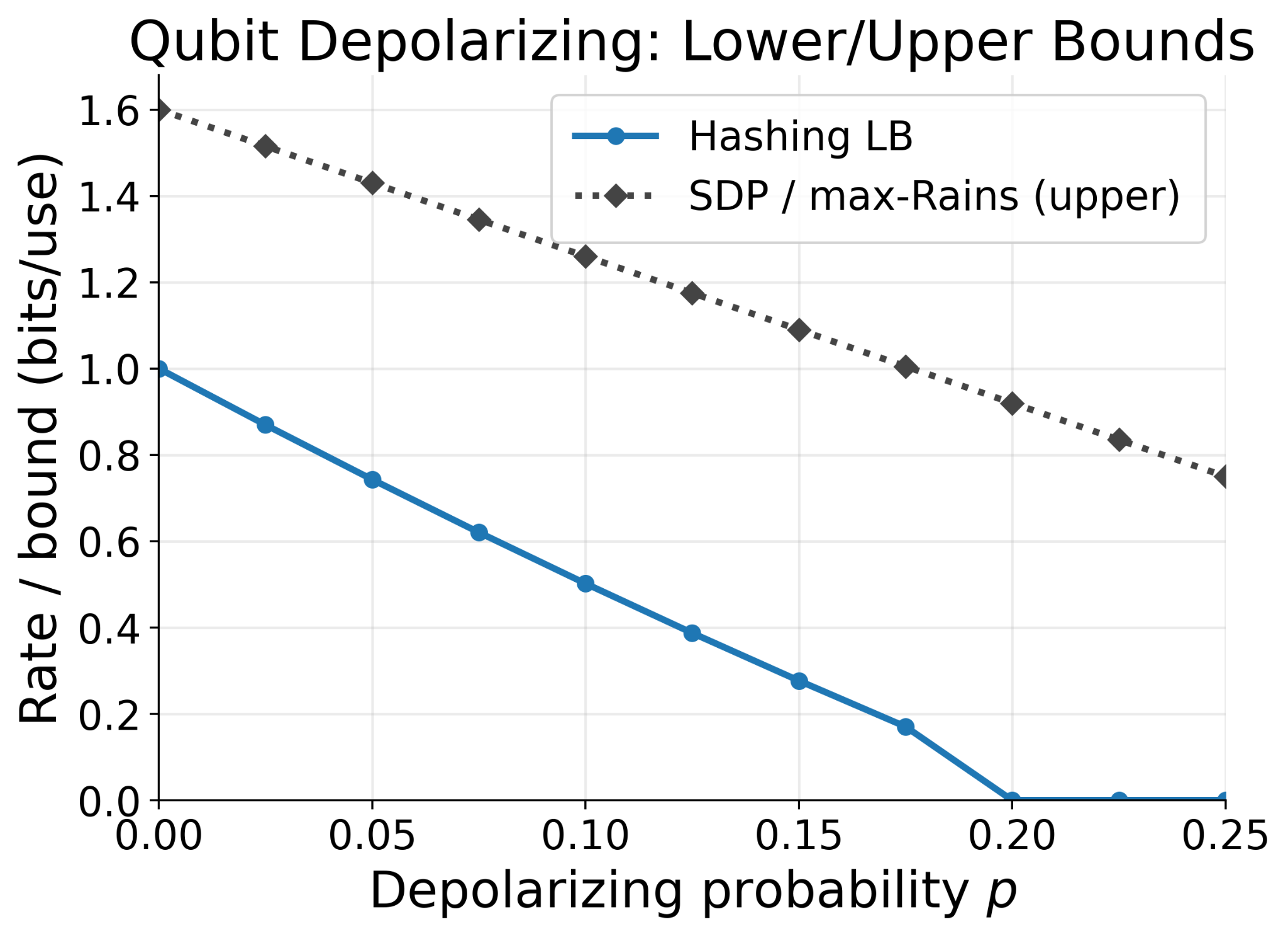
A two-stage search involving Sobol/Latin hypercube sampling followed by local trust-region search (Powell/Nelder–Mead) is implemented to locate the global maxima, with rigorous convergence criteria on the entropy objective function. This allows for high-precision quantification of the channel capacity landscape as a function of the noise parameter over large regions of parameter space. Benchmarks such as the hashing bound and SDP/max-Rains bounds are included for context.
Results for Amplitude Damping and Depolarizing Channels
Amplitude Damping Channel
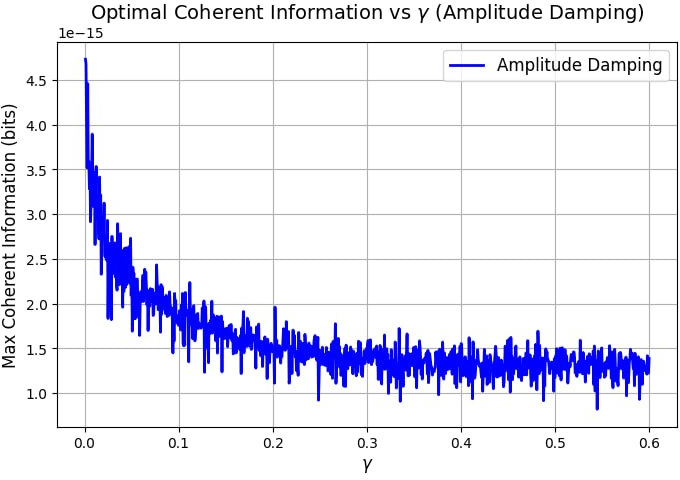
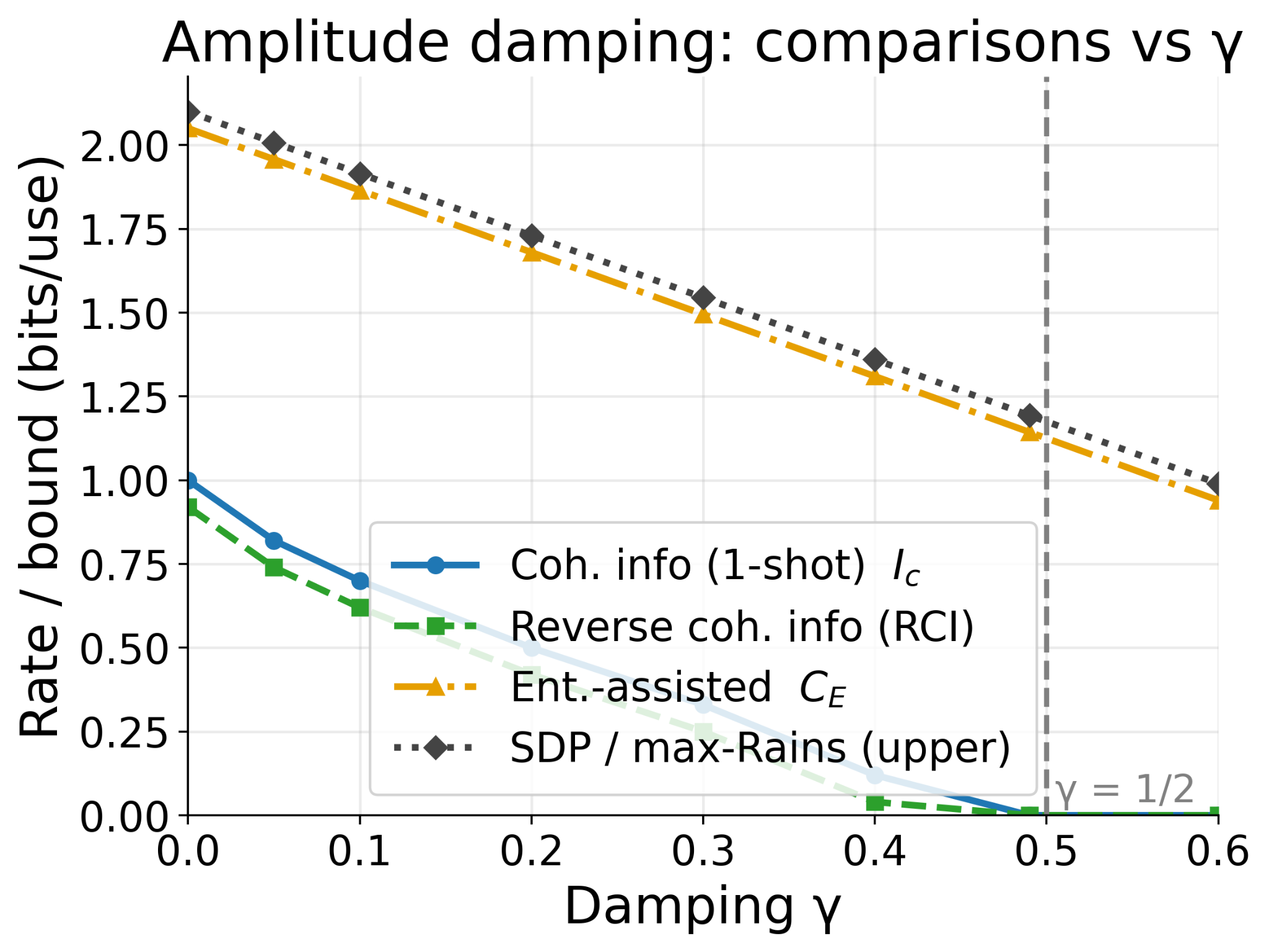
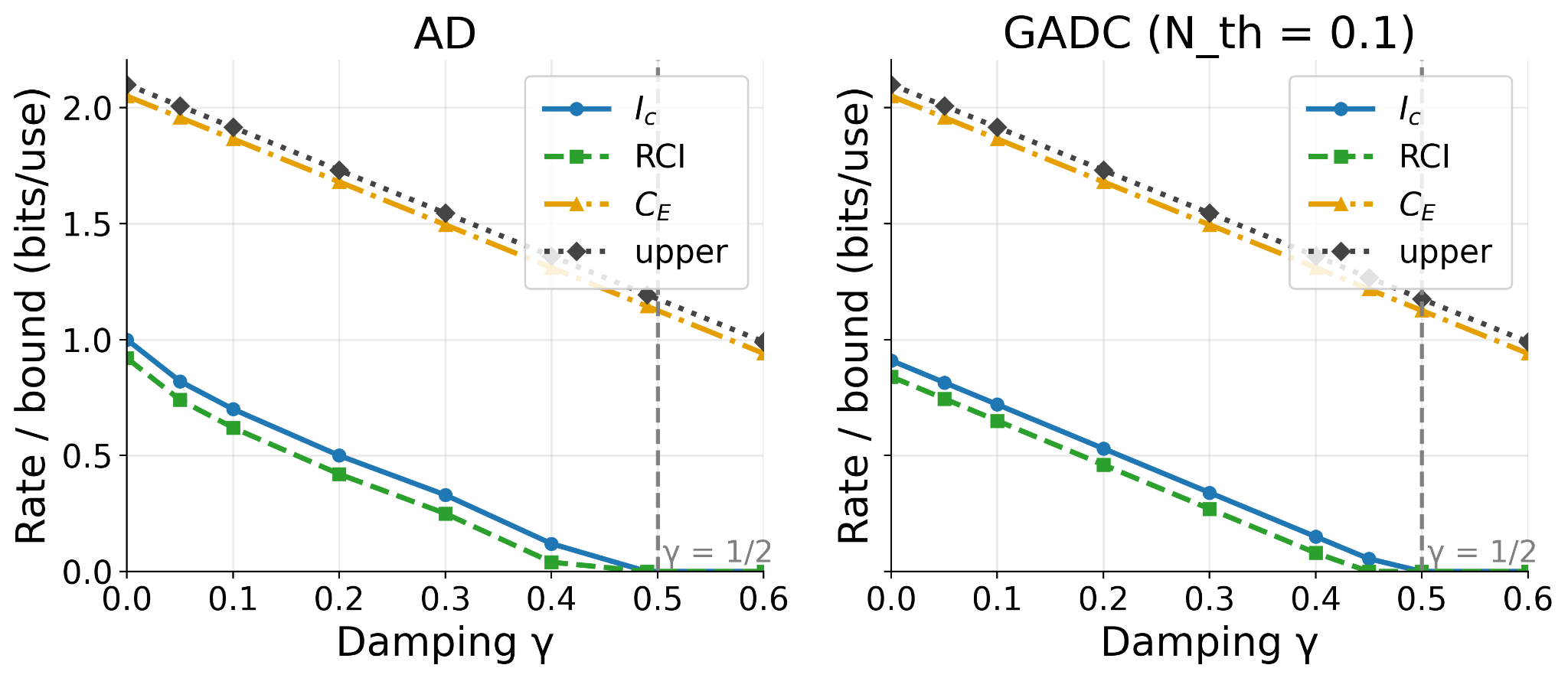
The amplitude damping channel, parameterized by γ∈[0,1], serves as a quintessential testbed due to its known degradability/anti-degradability structure. Simulations reveal that the maximized coherent information monotonically decreases with increasing γ, falling to zero precisely at γ=1/2, thus echoing the analytic degradability threshold. In the degradable regime (γ≤1/2), the channel’s quantum capacity is single-letter and matches its optimized coherent information; for γ>1/2, the channel is anti-degradable, so the capacity drops sharply to zero.
Figure 1: Optimal coherent information versus the amplitude damping parameter γ, showing rapid decay toward zero past the degradability threshold.
Furthermore, comparisons with the reverse coherent information (RCI) and entanglement-assisted capacity (CE) establish the tightness of the coherent information as a lower bound and the utility of SDP-based upper bounds in benchmarking.
Figure 2: Performance of Ic, RCI, CE, and the max-Rains SDP upper bound for amplitude damping; anti-degradable threshold is visible.
Depolarizing and Flagged Depolarizing Channels
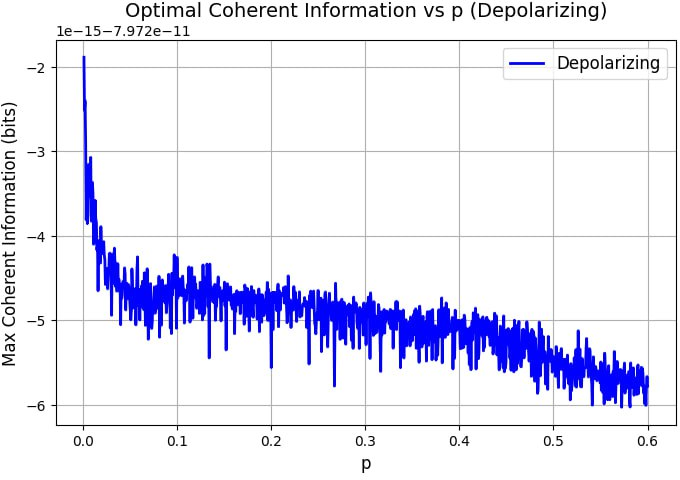
For the depolarizing channel, parameterized by depolarizing probability p, numerical maximization confirms that the single-letter coherent information is negative or zero for any p>0, implying the necessity of regularized (multi-letter or entangled input) formulas to achieve positive rates even for moderate noise. The channel exhibits well-characterized entanglement-breaking and anti-degradability thresholds, but its true quantum capacity in the intermediate regime remains an outstanding open problem; the flagged extension provides new bounds that significantly reduce uncertainty.
Figure 3: Depolarizing channel coherent information as a function of noise probability p, highlighting the quick suppression of quantum communication by moderate noise.
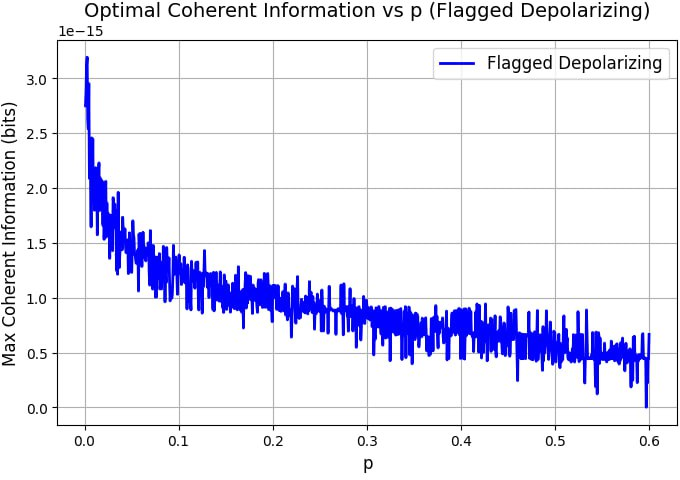
Investigating flagged extensions of the depolarizing channel, the study demonstrates that embedding additional classical information (the flag) can mitigate noise for small p, as reflected by increased coherent information relative to the base channel; however, this advantage is rapidly lost as p increases.
Figure 4: Flagged depolarizing channel capacity enhancement for small p, and collapse of coherent information with growing noise.
Additional Comparative Panels
Panel studies include GADC (generalized amplitude damping) channels, illustrating off-axis input optimization dependence, further validating the simulation architecture over parameter ranges involving thermal excitation.
Figure 5: Panel comparison for amplitude damping and several GADC parameter settings, showing the regime structure and critical parameter transitions.
Figure 6: Hashing lower bound and illustrative SDP/max-Rains upper bound for the depolarizing channel, establishing the bounds landscape.
Implications, Limitations, and Theoretical Impacts
This work delivers formal evidence that flagged extensions are maximally effective when the noise branch is degradable, providing efficiently computable, single-letter upper bounds for Q and P. This explicitly circumscribes the applicability of flagged techniques: general CPTP mixtures without degradable structure do not inherit these simplifications, and the construction is not universally tight. The results clarify parameter thresholds where quantum communication is feasible and specify the shrinking region where capacity is unknown but potentially nonzero.
The numerical methods robustly validate theoretical findings and offer a practical toolkit for capacity estimation in channels that defy analytic expressions. Operationally, the results guide the design of quantum communication protocols, error correction strategies, and quantum cryptography by pinpointing noise thresholds and achievable rates.
Future work along these lines may target improved flagged-extension architectures for non-Pauli (non-Clifford) noise, approximation-theoretic extensions for nearly degradable channels, strong-converse and second-order asymptotic refinements, and scaling the simulation framework to higher-dimensional and multi-user (quantum network) channels.
Conclusion
The integration of flagged extension bounds with high-precision coherent information maximization creates a hybrid theory-computation approach for quantum channel capacity estimation. The findings confirm the power and limitations of flagged extensions and align closely with the analytic structures predicted for single-letterizable, degradable, and anti-degradable channels. The computational results compress open intervals for capacity and provide operational benchmarks, advancing both the theory and practical assessment of quantum channel performance.
References: See (2506.03429) for the full bibliography supporting theoretical claims, algorithms, and benchmarking results.