- The paper introduces dpmm, a robust library that unifies PrivBayes, MST, and AIM to generate synthetic tabular data under strong differential privacy guarantees.
- It employs a select-measure-generate paradigm with PrivTree-based discretization, enhancing model fidelity and performance while addressing floating-point vulnerabilities.
- Empirical results on the Wine dataset demonstrate significant utility improvements and effective privacy auditing compared to existing synthetic data generation tools.
dpmm: A Robust Library for Differentially Private Synthetic Tabular Data Generation
Introduction
This paper presents dpmm, an open-source Python library for synthetic data generation under rigorous Differential Privacy (DP) guarantees (2506.00322). The library unifies and extends the implementation of three leading marginal-based DP models—PrivBayes, MST, and AIM—while systematically addressing well-documented DP vulnerabilities and providing a richer set of functionalities than existing software. The dpmm library, designed for both practitioners and researchers, emphasizes strong empirical utility, robust privacy auditing, and flexibility.
Library Design and Features
dpmm incorporates three families of marginal models: PrivBayes, MST (Maximum Spanning Tree), and AIM (Adaptive and Iterative Mechanism). All three are based on the select-measure-generate paradigm, but differ in marginal selection strategies:
- PrivBayes: Constructs an optimal Bayesian network using the Exponential mechanism for structure learning, then measures marginals via the Gaussian mechanism (unified with Private-PGM for inference).
- MST: Selects all one-way marginals and then the most informative two-way marginals, forming an undirected maximum spanning tree.
- AIM: Iteratively selects higher-order marginals based on their contribution to reducing total error, yielding improved utility on medium-sized tabular datasets.
dpmm distinguishes itself by implementing end-to-end DP, following best practices including:
- Input data domain specification or robust DP-based min/max extraction (for numerical features).
- Discrete data requirement met via uniform or PrivTree-based DP discretization, the latter being default for its empirically superior utility.
- Defense against floating-point vulnerabilities in the Gaussian mechanism, leveraging OpenDP’s sampling techniques.
dpmm supports mixed-type data, conditional synthetic data generation (enabled by Private-PGM), public pretraining (all relevant preprocessing or marginal selection utilizes public data without privacy cost), preservation and configuration of structural zeros, model serialization, and fine control of model size on disk.
Empirical Results
Utility Comparison
The empirical evaluation utilizes the Wine dataset as a benchmark, with consistent hyperparameters (ϵ=1, δ=10−5). Utility is assessed via average similarity across 1-way marginals, 2-way marginals, and the ability to distinguish synthetic from real samples.

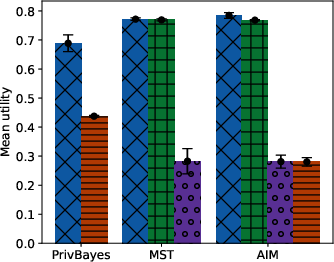
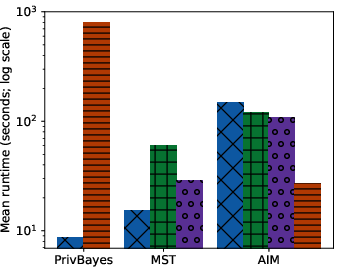
Figure 1: Utility comparison between dpmm and alternative libraries, illustrating improved fidelity to real data in downstream statistical properties.
dpmm achieves higher utility than competing implementations. Specifically, MST and AIM in dpmm yield a 1.5% improvement over private-pgm and a 147% increase over Synthcity/OpenDP baselines. The improvement is attributed primarily to the default use of PrivTree for preprocessing, confirming the necessity of robust discretization for tabular DP synthetic data generation. The MST implementation also demonstrates improved runtime via parallelized marginal calculation; AIM incurs higher cost per its iterative selection process.
Utility-Privacy Tradeoff
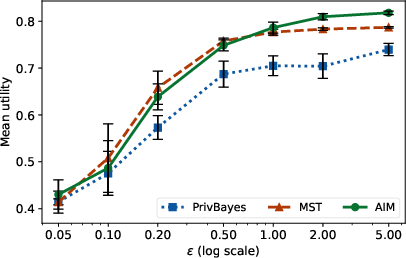

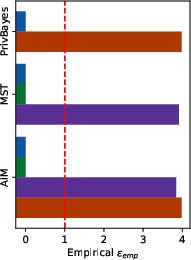
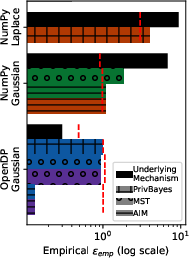
Figure 2: Utility-privacy tradeoff curves for dpmm on Wine, revealing model behavior as a function of ϵ.
As ϵ increases, utility for all models rises. MST and AIM consistently outperform PrivBayes+PGM, and AIM marginally surpasses MST for ϵ>0.5. These results mirror prior benchmarks and highlight the scalability and adaptability of dpmm for varying privacy budgets.
Privacy Auditing and Robustness
dpmm integrates state-of-the-art privacy auditing techniques, including AuditSynth and Delta-Siege, which are used to expose general and floating-point precision vulnerabilities in prior works. AuditSynth implements membership inference attacks in a white-box regime, verifying that dpmm (and private-pgm, when given an explicit data domain) adhere to advertised privacy bounds; in contrast, privacy violations are observed for OpenDP/Synthcity. Delta-Siege reveals that only libraries using OpenDP’s floating-point mechanism (dpmm, OpenDP) avoid measurable leakage through numerical precision flaws. These extensive audits provide strong evidence of the absence of known privacy bugs in dpmm, though not a formal guarantee of completeness.
Practical and Theoretical Implications
dpmm fulfills the requirements mandated by privacy-sensitive domains such as healthcare, government statistics, and finance, which increasingly demand not just theoretical DP, but also auditable and empirically robust toolchains. By consolidating leading marginal model designs and offering a feature-complete interface, dpmm sets a new standard for responsible and practical DP synthetic data generation.
For the research community, dpmm’s modular and auditable architecture provides a high-quality baseline for developing, evaluating, and benchmarking new DP algorithms for tabular data, encouraging reproducibility and fair comparison. On the application side, reliable conditional generation, mixed data support, and preservation of structural zeros enable sophisticated data analysis pipelines suitable for real-world deployment.
Conclusion
dpmm delivers robust, high-utility, and auditable differentially private synthetic data generation, built on the foundational models PrivBayes, MST, and AIM. Its empirical superiority, privacy robustness, and comprehensive feature set mark it as a reference implementation for both methodological research and industrial application in privacy-preserving synthetic tabular data. Continued community-driven development of dpmm is likely to broaden the practical adoption of DP, facilitate improved benchmark practices, and stimulate novel privacy research directions.

