- The paper formulates linear programming frameworks to characterize and optimize the Price of Anarchy in systems with limited inter-agent information.
- It presents robust utility design methods that improve agent coordination and performance even under communication failures.
- Empirical results validate the approach in set covering games and sub-modular objectives, ensuring near-optimal outcomes despite restricted information.
This essay examines the paper "Optimal Utility Design with Arbitrary Information Networks" (2501.17385), which tackles the problem of utility design in multi-agent systems with varying information networks. The primary objective is to optimize the Price of Anarchy (PoA) through strategically designed local utility functions, especially in scenarios where agents possess limited or restricted informational access to others.
Problem Overview
Multi-agent systems are crucial across various domains such as air traffic control, transportation networks, and robotic networks in disaster management. These systems often rely on decentralized control mechanisms due to the infeasibility of centralized information handling. The system designer assigns utility functions based on local information to guide agents toward achieving an optimal system objective.
PoA is the metric used to measure system performance, defined as the ratio between the worst-case Nash equilibrium value and the optimal system objective. The paper introduces a linear programming (LP) approach to characterize and optimize PoA for arbitrary information networks, extending prior work limited to full-information scenarios.
Methodology
The paper presents a framework that generalizes utility design across multi-agent systems with diverse informational constraints. The authors' approach involves:
- Characterization of PoA: An LP is formulated to characterize PoA for given utility designs and information networks, allowing the computation of PoA for any fixed design.
- Optimization of Utility Design: A second LP is devised to optimize utility design, thereby maximizing PoA and establishing the parameters for ideal local utilities.
The structured LPs serve as non-trivial extensions of existing models, effectively handling networks where agents may lack complete observational abilities due to network biases like communication failures.
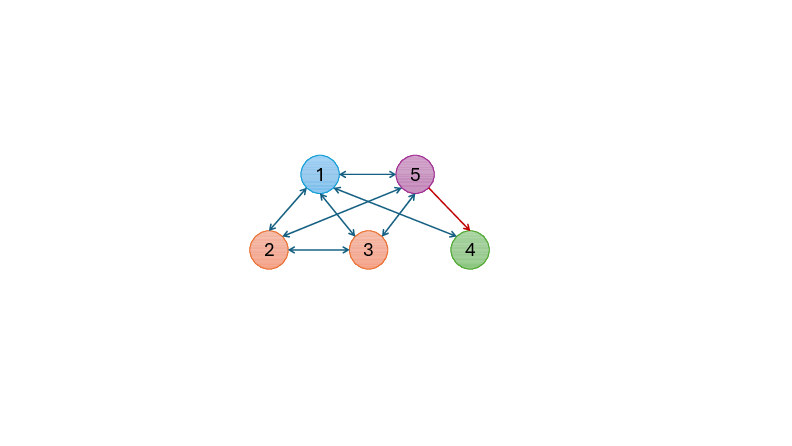
Figure 1: A general network with information available to various agents given by $_1 = _5 = {1,2,3,4,5}.</p></p>
<p>The model examines various agent classes based on their observability and visibility, partitioning them appropriately to assign utility functions which reflect similarities in network characteristics.</p>
<h2 class='paper-heading' id='key-results'>Key Results</h2>
<p>The LP frameworks introduced demonstrate robustness in deriving optimal utility functions, thereby improving PoA even in sub-optimal communication scenarios. Notably:</p>
<ul>
<li><strong>Set Covering Games</strong>: For games where agents have blind spots, the model confirms that the marginal contribution utility design results in optimal PoA.</li>
<li><strong>Sub-Modular Objectives</strong>: Numerical analyses reveal the proposed mechanism's capacity to handle sub-modular objectives, maintaining strong PoA despite partial agent blindness or isolation.
<img src="https://emergentmind-storage-cdn-c7atfsgud9cecchk.z01.azurefd.net/paper-images/2501-17385/Blind_set_cover_MC_PoA_vs_OptimalPoA.png" alt="Figure 2" title="" class="markdown-image" loading="lazy">
<p class="figure-caption">Figure 2: PoA at marginal contribution utility $f^{mc}comparedagainstoptimalPoAforblindagentnetworks.</p><imgsrc="https://emergentmind−storage−cdn−c7atfsgud9cecchk.z01.azurefd.net/paper−images/2501−17385/BlindsubmodularNormalPoAvsOptimalPoA.png"alt="Figure3"title=""class="markdown−image"loading="lazy"></li></ul><p><imgsrc="https://emergentmind−storage−cdn−c7atfsgud9cecchk.z01.azurefd.net/paper−images/2501−17385/IsolatedsubmodularNormalPoAvsOptimalPoA.png"alt="Figure3"title=""class="markdown−image"loading="lazy"><pclass="figure−caption">Figure3:PoAwhenagentskeepusingoptimalutilitymechanismcorrespondingtofullinformationcasef^*evenwhenthereiscommunicationfailure,comparedtotheoptimalPoAforsub−modularsystemobjective.Themechanismf^*$ is near optimal, thus robust against communication failures.
Implications and Future Work
The implications of this framework are manifold, allowing for improved agent coordination without exhaustive informational prerequisites. The approach promises enhanced decision-making in multi-agent systems with varying degrees of information access. Future research could explore qualitative analyses concerning the optimal PoA relative to network connectivity and robustness against uncertain communication reliability.
Conclusion
"Optimal Utility Design with Arbitrary Information Networks" presents a sophisticated methodology for optimizing multi-agent systems through advanced LP models, significantly advancing the understanding of utility design under limited information scenarios. The results demonstrate the model's applicability across broad domains, ensuring agents' performance remains optimized despite network limitations. Further exploration may continue to expand upon the robustness of utility designs with a focus on real-world applications and more complex network dynamics.