Grounding by Trying: LLMs with Reinforcement Learning-Enhanced Retrieval
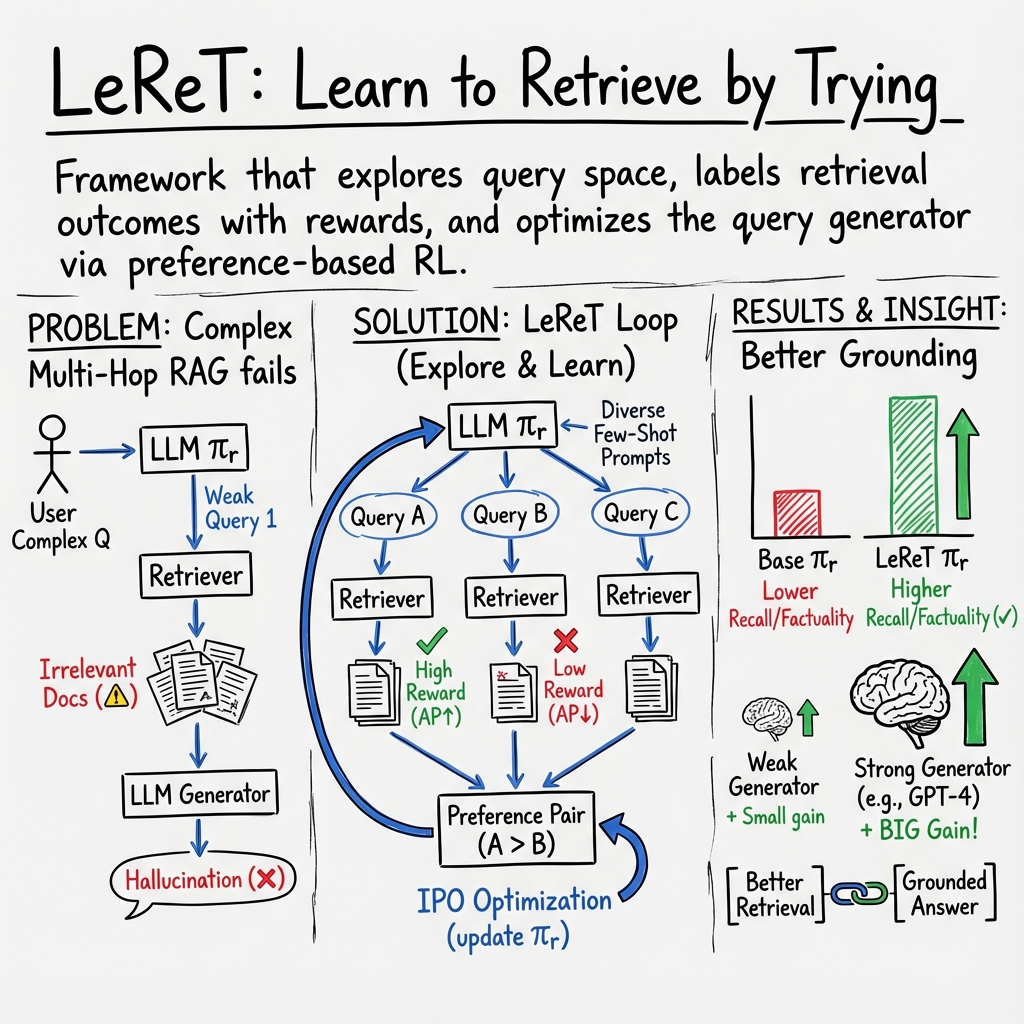
Abstract: The hallucinations of LLMs are increasingly mitigated by allowing LLMs to search for information and to ground their answers in real sources. Unfortunately, LLMs often struggle with posing the right search queries, especially when dealing with complex or otherwise indirect topics. Observing that LLMs can learn to search for relevant facts by $\textit{trying}$ different queries and learning to up-weight queries that successfully produce relevant results, we introduce $\underline{Le}$arning to $\underline{Re}$trieve by $\underline{T}$rying (LeReT), a reinforcement learning framework that explores search queries and uses preference-based optimization to improve their quality. LeReT can improve the absolute retrieval accuracy by up to 29% and the downstream generator evaluations by 17%. The simplicity and flexibility of LeReT allows it to be applied to arbitrary off-the-shelf retrievers and makes it a promising technique for improving general LLM pipelines. Project website: http://sherylhsu.com/LeReT/.
- Self-RAG: Learning to retrieve, generate, and critique through self-reflection. In The Twelfth International Conference on Learning Representations, 2024. URL https://openreview.net/forum?id=hSyW5go0v8.
- A general theoretical paradigm to understand learning from human preferences, 2023. URL https://arxiv.org/abs/2310.12036.
- Rank analysis of incomplete block designs: I. the method of paired comparisons. Biometrika, 39(3/4):324–345, 1952.
- Reading wikipedia to answer open-domain questions. In Proceedings of the 55th Annual Meeting of the Association for Computational Linguistics (Volume 1: Long Papers), pp. 1870–1879, 2017.
- Google. Generative ai is coming to google search. https://blog.google/products/search/generative-ai-google-search-may-2024/, 2024.
- Retrieval augmented language model pre-training. In International conference on machine learning, pp. 3929–3938. PMLR, 2020.
- HoVer: A dataset for many-hop fact extraction and claim verification. In Trevor Cohn, Yulan He, and Yang Liu (eds.), Findings of the Association for Computational Linguistics: EMNLP 2020, pp. 3441–3460, Online, November 2020. Association for Computational Linguistics. doi: 10.18653/v1/2020.findings-emnlp.309. URL https://aclanthology.org/2020.findings-emnlp.309.
- Baleen: Robust multi-hop reasoning at scale via condensed retrieval. Advances in Neural Information Processing Systems, 34:27670–27682, 2021.
- Demonstrate-search-predict: Composing retrieval and language models for knowledge-intensive NLP. arXiv preprint arXiv:2212.14024, 2022.
- Dspy: Compiling declarative language model calls into self-improving pipelines. arXiv preprint arXiv:2310.03714, 2023.
- Internet-augmented dialogue generation. In Smaranda Muresan, Preslav Nakov, and Aline Villavicencio (eds.), Proceedings of the 60th Annual Meeting of the Association for Computational Linguistics (Volume 1: Long Papers), pp. 8460–8478, Dublin, Ireland, May 2022. Association for Computational Linguistics. doi: 10.18653/v1/2022.acl-long.579. URL https://aclanthology.org/2022.acl-long.579.
- Internet-augmented language models through few-shot prompting for open-domain question answering. arXiv preprint arXiv:2203.05115, 2022.
- Latent retrieval for weakly supervised open domain question answering. In Proceedings of the 57th Annual Meeting of the Association for Computational Linguistics, pp. 6086–6096, 2019.
- Retrieval-augmented generation for knowledge-intensive nlp tasks. Advances in Neural Information Processing Systems, 33:9459–9474, 2020.
- OpenAI. Searchgpt is a prototype of new ai search features. https://openai.com/index/searchgpt-prototype/, 2024.
- Optimizing instructions and demonstrations for multi-stage language model programs, 2024. URL https://arxiv.org/abs/2406.11695.
- Training language models to follow instructions with human feedback. Advances in neural information processing systems, 35:27730–27744, 2022.
- PerplexityAI. Perplexity mai. https://www.perplexity.ai/, 2024.
- Measuring and narrowing the compositionality gap in language models, 2023. URL https://arxiv.org/abs/2210.03350.
- Scaling laws for reward model overoptimization in direct alignment algorithms. arXiv preprint arXiv:2406.02900, 2024a.
- Direct preference optimization: Your language model is secretly a reward model. Advances in Neural Information Processing Systems, 36, 2024b.
- Colbertv2: Effective and efficient retrieval via lightweight late interaction, 2022. URL https://arxiv.org/abs/2112.01488.
- Learning by distilling context, 2022. URL https://arxiv.org/abs/2209.15189.
- Trial and error: Exploration-based trajectory optimization for llm agents, 2024. URL https://arxiv.org/abs/2403.02502.
- Fine-tuning and prompt optimization: Two great steps that work better together, 2024. URL https://arxiv.org/abs/2407.10930.
- Learning to summarize with human feedback. Advances in Neural Information Processing Systems, 33:3008–3021, 2020.
- Musique: Multihop questions via single-hop question composition, 2022. URL https://arxiv.org/abs/2108.00573.
- Interleaving retrieval with chain-of-thought reasoning for knowledge-intensive multi-step questions, 2023. URL https://arxiv.org/abs/2212.10509.
- Answering complex open-domain questions with multi-hop dense retrieval. In International Conference on Learning Representations.
- Some things are more cringe than others: Iterative preference optimization with the pairwise cringe loss, 2024. URL https://arxiv.org/abs/2312.16682.
- HotpotQA: A dataset for diverse, explainable multi-hop question answering. In Ellen Riloff, David Chiang, Julia Hockenmaier, and Jun’ichi Tsujii (eds.), Proceedings of the 2018 Conference on Empirical Methods in Natural Language Processing, pp. 2369–2380, Brussels, Belgium, October-November 2018. Association for Computational Linguistics. doi: 10.18653/v1/D18-1259. URL https://aclanthology.org/D18-1259.
- React: Synergizing reasoning and acting in language models, 2023. URL https://arxiv.org/abs/2210.03629.
- Slic-hf: Sequence likelihood calibration with human feedback. arXiv preprint arXiv:2305.10425, 2023.
Paper Prompts
Sign up for free to create and run prompts on this paper using GPT-5.
Top Community Prompts
Collections
Sign up for free to add this paper to one or more collections.