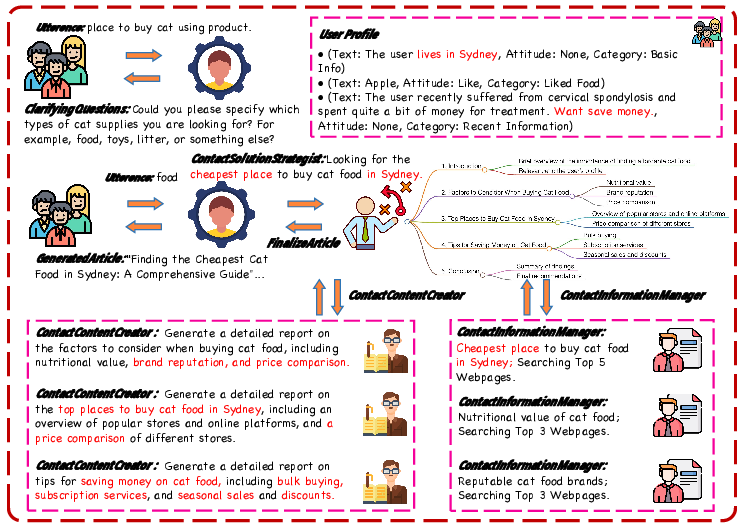
- The paper introduces the ACN framework, using specialized agents to collaboratively enhance personalization and multimodal content integration in AI search.
- The methodology employs chain-of-thought planning and Reflective Forward Optimization to dynamically adjust agent workflows based on user feedback.
- Experimental results demonstrate significant improvements in content richness, personalization, and logical query handling compared to traditional AI search engines.
Overview of "A Learnable Agent Collaboration Network Framework for Personalized Multimodal AI Search Engine" (2409.00636)
The paper presents the Agent Collaboration Network (ACN), a novel AI search engine framework designed to address critical limitations in current AI search engines, namely the lack of multimodal content support, insufficient personalization, difficulty in handling complex logic requirements, and poor adaptability to user feedback. The proposed framework utilizes a collaborative network of specialized agents—such as Account Manager, Solution Strategist, Information Manager, and Content Creator—to deliver high-quality, personalized, and interactive search results.
Framework and Methodology
Agent Collaboration Network Framework
The ACN framework consists of multiple specialized agents, each playing distinct roles:
Each agent communicates via message passing to ensure efficient collaboration. The ACN enhances multimodal understanding and response quality through an agent collaboration architecture, facilitating the execution of complex tasks step-by-step.
Reflective Forward Optimization (RFO)
The paper introduces RFO, a novel optimization strategy that allows the ACN to adaptively fine-tune its agents based on user feedback. This optimization technique uses a depth-first traversal algorithm to inspect and adjust agent workflows, unlike traditional backpropagation methods.
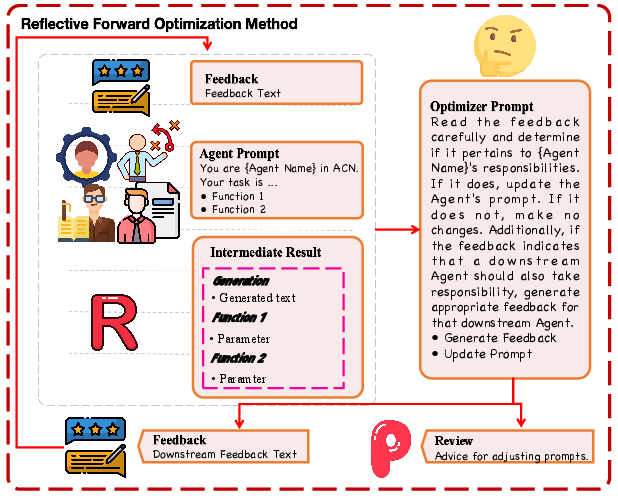
Figure 2: RFO algorithm workflow.
RFO enables real-time updates to agent prompts, leading to significant improvements in response accuracy and personalization. This feature is pivotal in providing timely and relevant content that aligns with user-specific interests and feedback.
Experimental Evaluation
The ACN's performance was evaluated using the synthetic MSMTPInfo dataset, designed to simulate diverse and dynamic user interactions with an AI search engine. The framework was compared to other AI search engines such as TianGong and Perplexity, emphasizing content richness, personalization, and logical consistency.
- Content Richness: The ACN demonstrates enhanced engagement by integrating multimodal content, surpassing traditional text-based responses (Figure 3).
- Personalization and Usefulness: The system effectively tailors responses according to user profiles, proving superior in delivering useful and personalized information (Figure 4).
- Logicality: The COT methods employed by the Solution Strategist agent allow ACN to handle complex queries more logically. ACN's output exhibits improved depth and comprehensiveness compared to other systems (Figure 5).
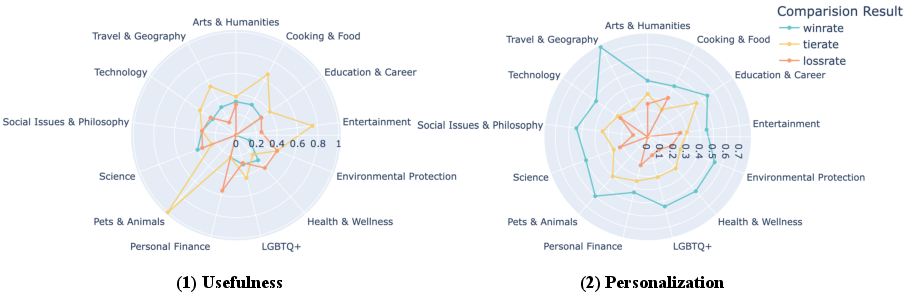
Figure 4: The results of pairwise comparisons between Basic and ACN responses across all categories on the MSMTPInfo dataset.
Implications and Future Directions
ACN presents significant implications for the future of AI search engines by:
- Supporting the rise of AI systems capable of higher interactivity and personalization
- Demonstrating the potential application of agent collaboration in varying domains
- Providing a foundation for real-time adaptability in AI interactions through RFO
Future work will focus on empirical validation of ACN's adaptive learning capabilities and user feedback responsiveness. Efforts will include engaging volunteers for rigorous testing and establishing metrics to evaluate real-time adjustments in dialogue consistency and content personalization.
Conclusion
The "Agent Collaboration Network Framework for Personalized Multimodal AI Search Engine" proposes a robust method for enhancing AI search engines through agent collaboration and real-time optimization. The ACN framework is positioned to advance the capabilities of AI systems in handling dynamic user interactions, delivering personalized, logic-driven, and multimodally-enriched content.