- The paper presents a natural mapping from Max-Cut to MIS using Ising and QUBO formulations, enabling enhanced approximation strategies.
- It evaluates various algorithms including simulated annealing, greedy heuristics, and the Goemans-Williamson method on dense and sparse ER graphs.
- The study discusses implications for coding theory and suggests potential advances with quantum annealing for solving complex graph problems.
From Maximum Cut to Maximum Independent Set
Introduction
The paper, "From Maximum Cut to Maximum Independent Set," explores the intersection of graph theory and physics by examining the natural mapping of the Maximum Cut (Max-Cut) problem onto the Ising model, extending this relation to the Maximum Independent Set (MIS) problem. This exploration paves the way for leveraging solvers designed for Max-Cut and Ising models to tackle MIS, offering enhanced approximation strategies, particularly for Erdős-Rényi (ER) graphs and benchmarks from coding theory.
QUBO, Ising, and Maximum Cut
Max-Cut, a well-known problem in combinatorial optimization, can be framed as a Quadratic Unconstrained Binary Optimization (QUBO) problem or formulated using the Ising model. The QUBO form leverages a quadratic cost function, facilitating a connection to binary optimization problems. The transformation between QUBO and Ising formulations involves expressing binary variables as spin variables, akin to those used in statistical physics, allowing graph cuts to be explored in these frameworks.
Algorithms for Max-Cut: The paper reviews several algorithmic strategies for Max-Cut, from seminal algorithms like Goemans-Williamson (GW), which is acknowledged for its strong theoretical approximation guarantees, to various heuristic approaches. Simulated Annealing (SA) also appears as a prominent heuristic technique, particularly effective with refinements in practical scenarios like the Sherrington-Kirkpatrick (SK) model.
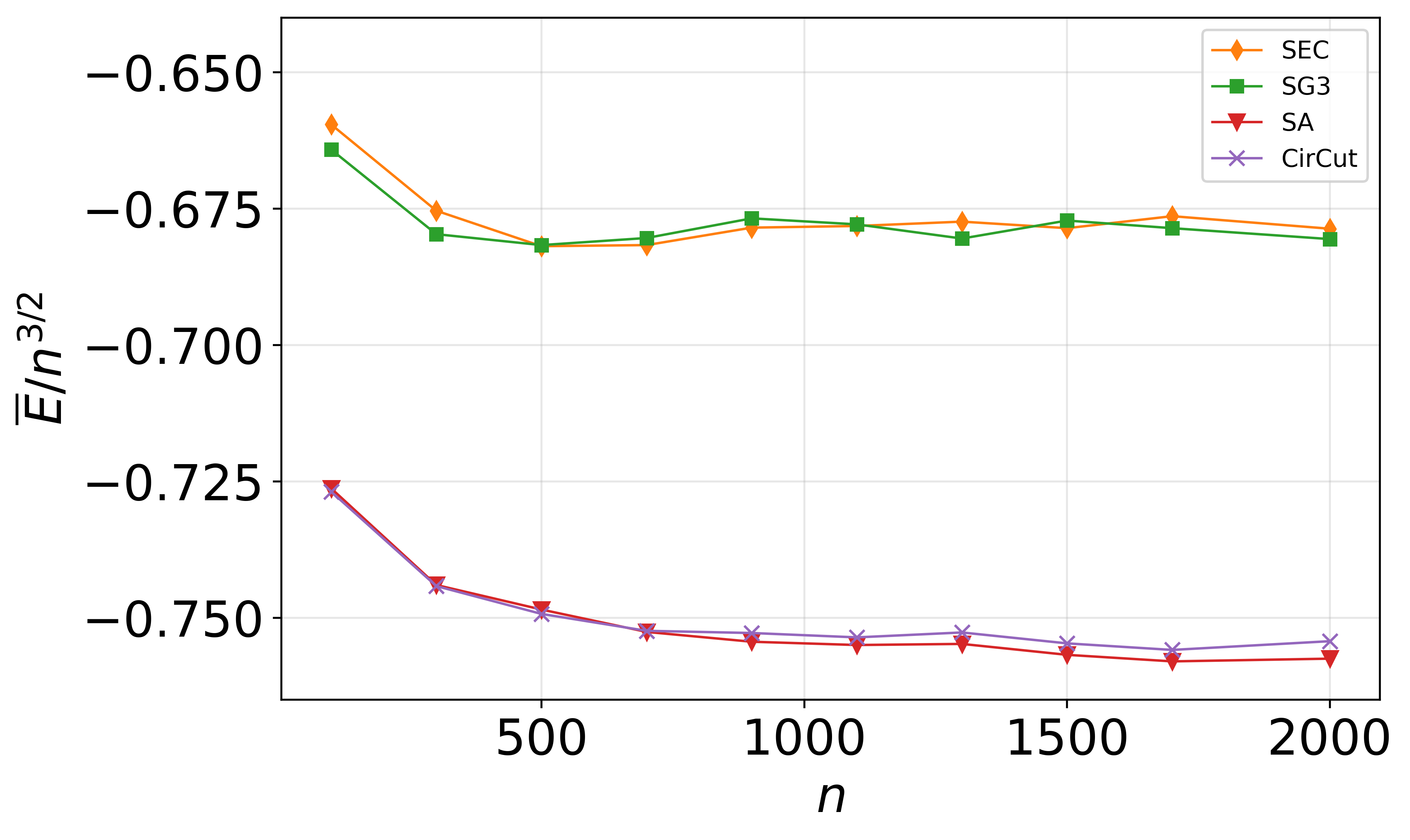
Figure 1: \it Average performance of various algorithms for the groundstate energy of the SK model.
Maximum Independent Set
MIS, a problem analogously related to Maximum Clique, is inherently complex, lacking straightforward linear programming characterization. MIS can be effectively modeled using an Ising Hamiltonian, facilitating its solution via Max-Cut/Ising solvers. The formulation incorporates vertex interactions weighted by penalty terms to handle edge constraints, pivotal when translating the optimization problem into an energy minimization framework.
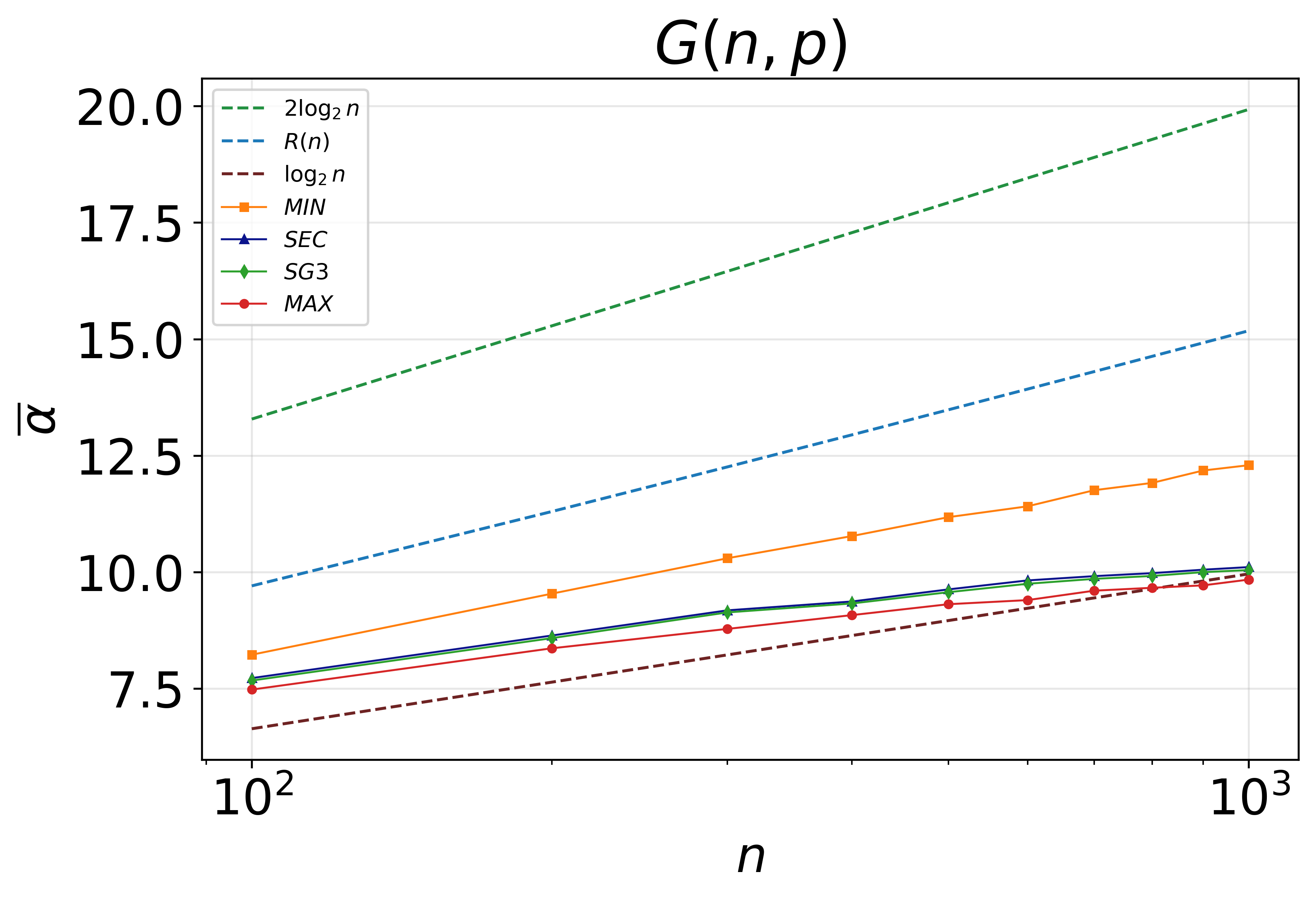
Figure 2: \it Average performance of various greedy heuristics for MIS of the ER graphs G(n,p=0.5).
Greedy Heuristics: Traditional greedy heuristics, like MAX and MIN, evaluate performance primarily on large ER graphs, offering insights into their behavior relative to theoretical predictions for independence numbers. The investigation finds MIN strategies superior for dense graphs, aligning closer to theoretical bounds.
The research extends beyond greedy heuristics, employing SA and CirCut algorithms for improved approximations of MIS in both dense and sparse ER graphs. These algorithms demonstrate capabilities in approaching theoretical predictions for independence numbers within these graph types, a notable advancement over baseline greedy methods.
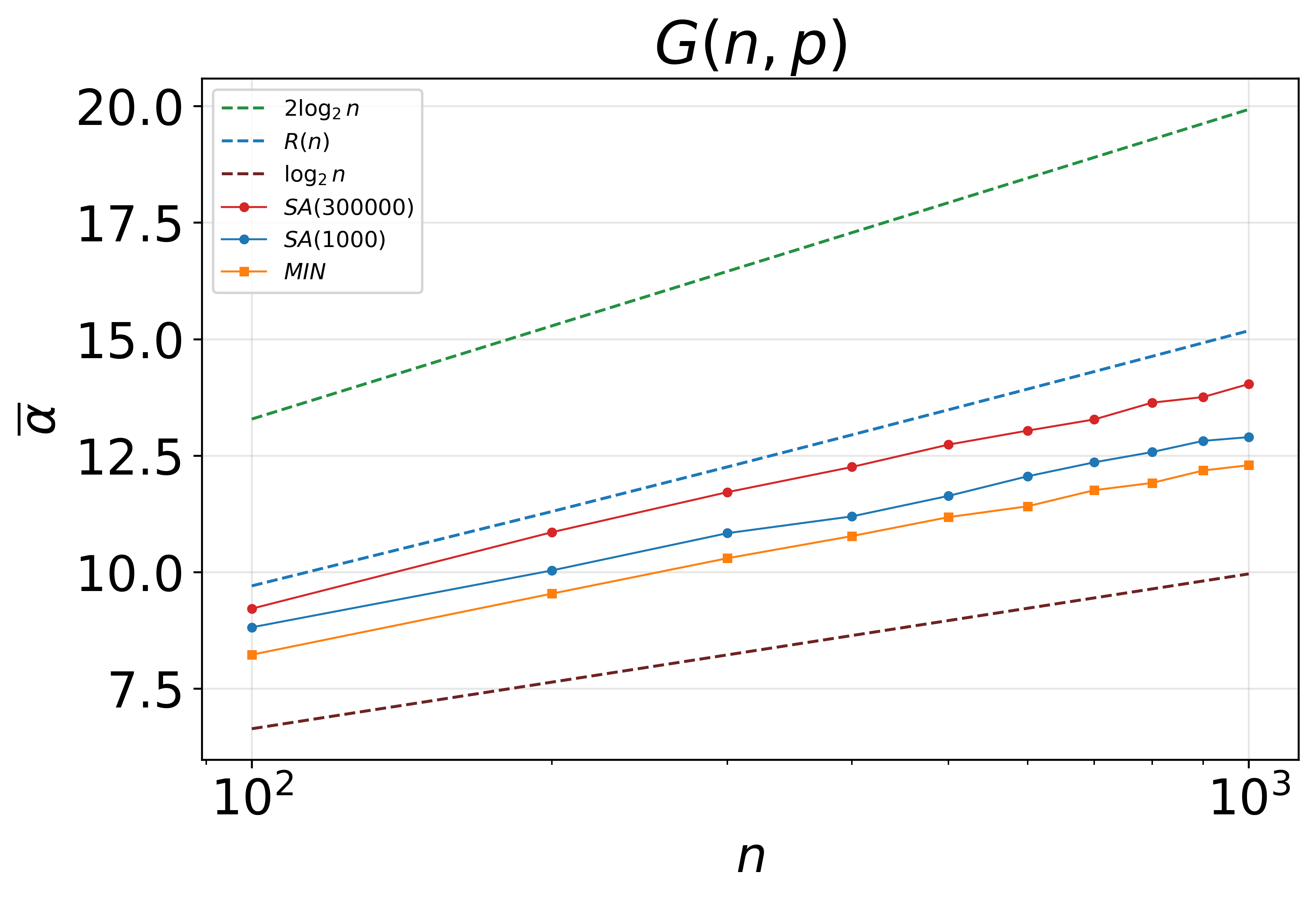
Figure 3: \it Average performance of SA for MIS of the ER graphs G(n,p=0.5), in comparison with that of MIN.
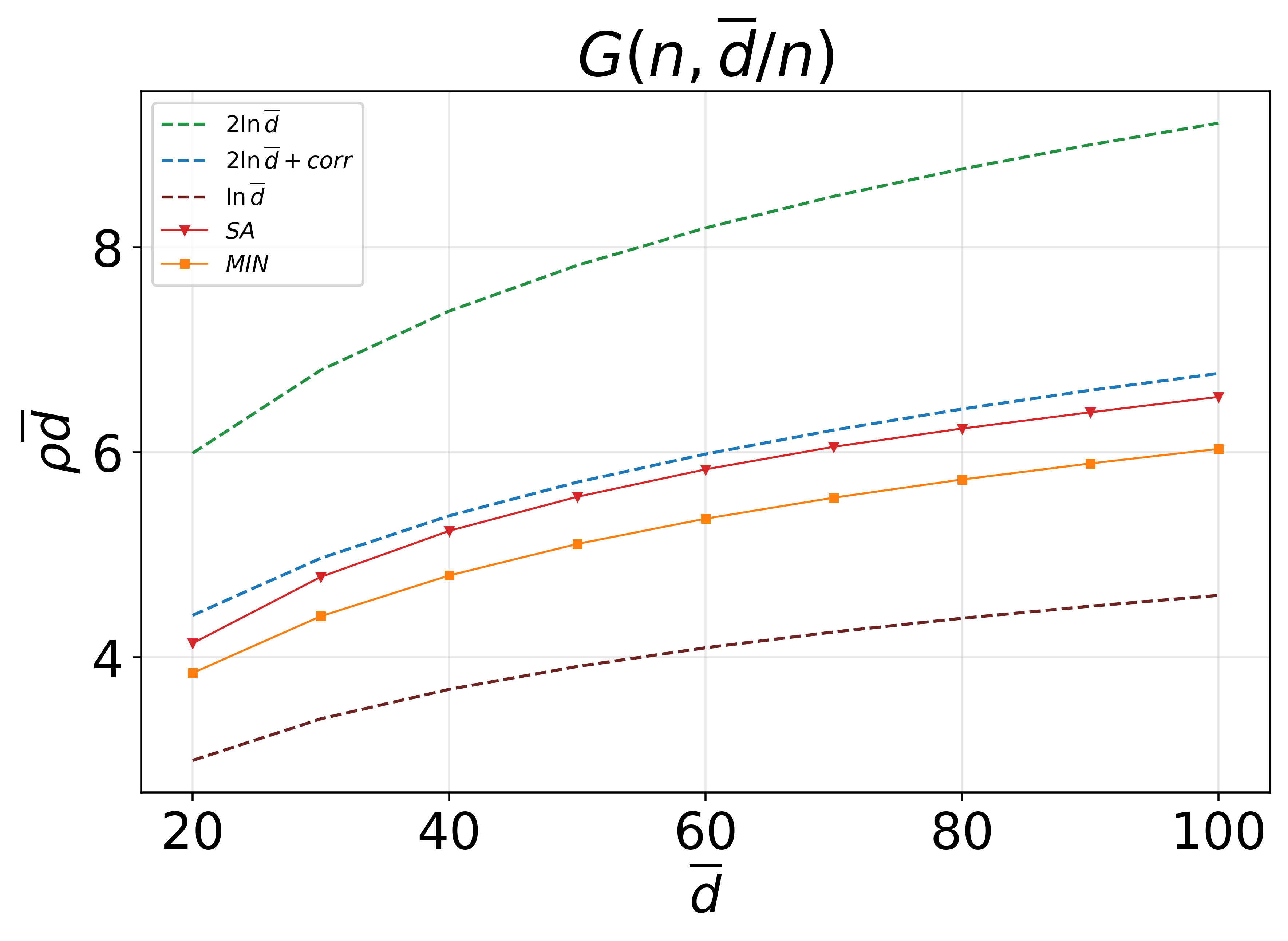
Figure 4: \it Average performance of SA, as a specific Max-Cut/Ising solver, for MIS of the sparse ER graphs G(n,p=\bar d/n).
Implications for Coding Theory and Future Directions
The relation between coding theory and MIS is explored through challenging benchmark graphs derived from coding problems. The study's results indicate that sophisticated Ising-based algorithms like SA reach optimal performance on these benchmarks, often surpassing traditional strategies.
Future Theoretical and Practical Implications: The practical success of Ising-based heuristics suggests quantum algorithms might be the next frontier, potentially enhancing MIS solutions via quantum annealing or circuit-based approaches. The transition to quantum algorithms could further refine solutions to long-standing coding benchmarks, prompting a deeper integration of graph-theoretic and quantum computational paradigms.
Conclusion
This paper bridges classical combinatorial problems with advanced physical models, utilizing state-of-the-art Max-Cut/Ising solvers for MIS. The results not only enhance our theoretical understanding but also suggest promising avenues for future exploration, particularly in leveraging quantum computational techniques to solve complex graph-theoretic problems.