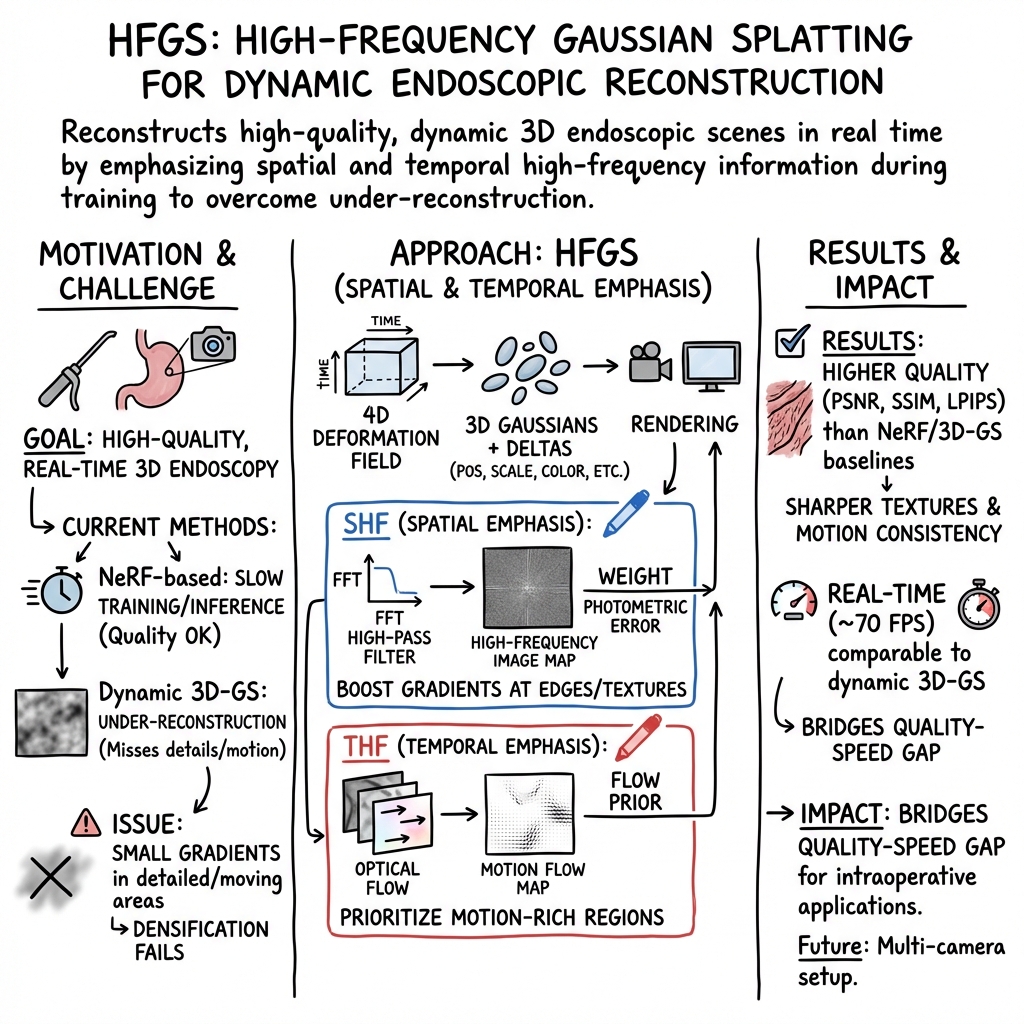
- The paper introduces a novel 4D Gaussian splatting method that integrates spatial and temporal frequency analysis to enhance endoscopic scene reconstruction.
- It employs two modules, SHF and THF, to boost static detail and dynamic motion rendering using FFT-based spatial emphasis and optical flow for temporal focus.
- Experimental evaluations on ENDONERF and SCARED datasets show superior PSNR, SSIM, and LPIPS, achieving real-time performance over NeRF-based methods.
HFGS: 4D Gaussian Splatting with Emphasis on Spatial and Temporal High-Frequency Components for Endoscopic Scene Reconstruction
Introduction
The paper "HFGS: 4D Gaussian Splatting with Emphasis on Spatial and Temporal High-Frequency Components for Endoscopic Scene Reconstruction" (2405.17872) discusses a novel approach for enhancing the reconstruction of dynamic endoscopic scenes, crucial for robot-assisted minimally invasive surgeries. Existing methods, including NeRF-based techniques, face limitations in rendering speed and computational demand. This paper proposes a solution using 3D Gaussian Splatting (3D-GS) to deliver rapid and high-quality endoscopic scene reconstruction.
Methodology
HFGS integrates spatial and temporal frequency analysis into the 3D-GS framework to address under-reconstruction issues commonly seen in static and dynamic scenes. The approach introduces two new modules: Spatial High-Frequency Emphasis Reconstruction (SHF) and Temporal High-Frequency Emphasis Reconstruction (THF). SHF focuses on accentuating high-frequency spatial components, thereby refining the detail in rendered static scenes. THF enhances the dynamic scene rendering by incorporating a flow-based temporal emphasis, targeting motion-intensive areas to improve reconstruction accuracy.
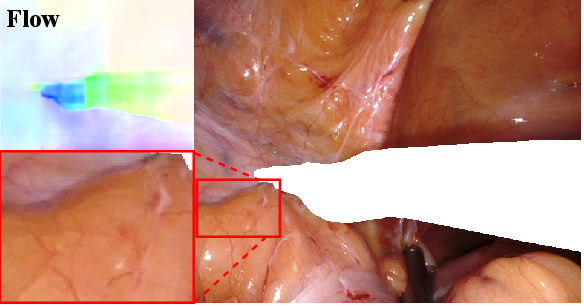
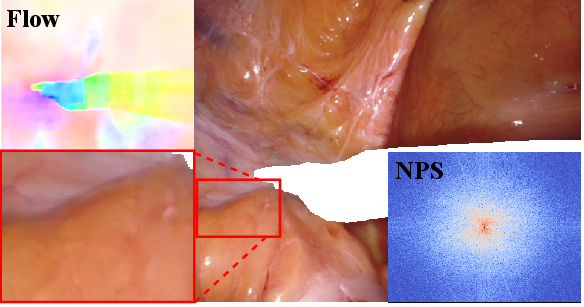
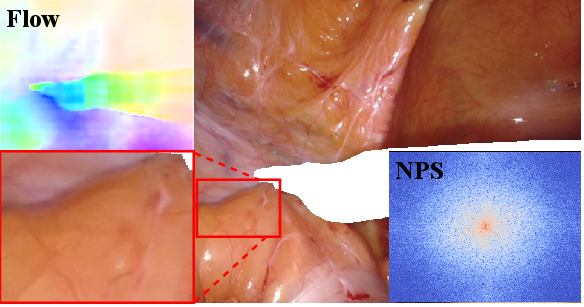
Figure 1: For the sample image from ENDONERF showcasing the efficacy of HFGS in detail preservation through frequency analysis.
Key Components
Spatial High-Frequency Emphasis Reconstruction (SHF)
SHF applies regularization in the spatial frequency domain, leveraging Fast Fourier Transform (FFT) to differentiate between high and low-frequency components. This approach accentuates essential structural details that are often underrepresented in Gaussian densification processes, thus improving the fidelity of static scene reconstructions.
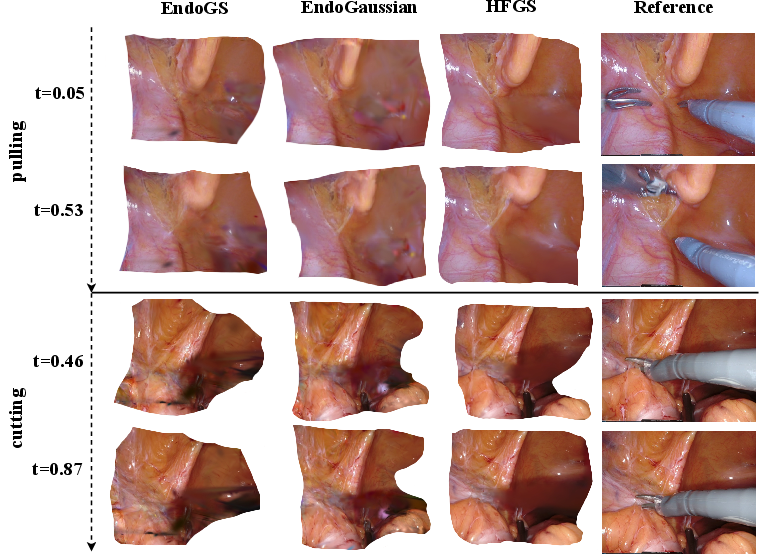
Figure 2: Illustration of reconstruction results on challenging endoscopic scenes, highlighting superior detail via SHF.
Temporal High-Frequency Emphasis Reconstruction (THF)
THF employs optical flow prediction to identify and emphasize dynamic regions of interest. By integrating flow priors into the optimization process, THF enhances the model's sensitivity to temporal changes, crucial for rendering moving tissues accurately.
Optimization Framework
The formulation incorporates losses that account for tool occlusions, depth estimation discrepancies, and frequency components. The optimization process is finely tuned through a multi-stage training regimen, initially focusing on static fields before adapting to dynamic deformations.
Experimental Evaluation
HFGS was extensively validated on ENDONERF and SCARED datasets, where it demonstrated superior performance across PSNR, SSIM, and LPIPS metrics compared to existing methods. Notably, HFGS achieved real-time rendering speeds, a significant advancement over NeRF-based techniques.
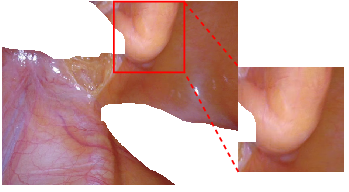
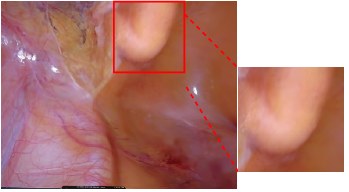
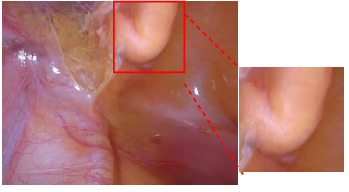
Figure 3: Ablation on SHF shows the impact of spatial emphasis on reconstruction precision.
Implications and Future Work
This research significantly contributes to the field of real-time surgical visualization, offering improvements over previous NeRF implementations in both speed and quality. The ability to render detailed dynamic scenes in real-time has profound implications for minimally invasive surgery navigation and precision.
Future work could explore the integration of multi-camera setups to further enhance 3D accuracy and extend the applicability of HFGS in complex surgical environments. The paper sets a new benchmark for endoscopic reconstruction, paving the way for more adaptable and efficient intraoperative imaging solutions.
Conclusion
HFGS represents a meaningful progression in the domain of endoscopic 3D reconstruction, combining the rapidity of 3D Gaussian Splatting with a nuanced understanding of high-frequency spatial and temporal components. This advancement offers substantial improvements in rendering quality and operational speed, underscoring its potential utility in advanced surgical applications.