- The paper introduces a novel orthogonalization framework that extends bias mitigation from linear to non-linear models.
- The approach uses projection-based corrections to nullify sensitive features even after non-linear activations like ReLUs.
- Experimental results on face recognition and chest X-ray embeddings demonstrate its effectiveness in reducing bias while preserving accuracy.
Generalizing Orthogonalization for Models with Non-Linearities
Introduction
The paper "Generalizing Orthogonalization for Models with Non-Linearities" (2405.02475) addresses the limitations of existing orthogonalization methods in machine learning, especially those constrained to linear models. The research proposes a novel approach that extends orthogonalization techniques to accommodate non-linearities prevalent in advanced neural network architectures, such as ReLUs and tensor-valued predictions. This advancement is pivotal for mitigating biases and ensuring fairness in model predictions across various applications.
Background and Motivation
The increasing complexity of black-box algorithms in AI, particularly neural networks, poses several challenges, including the inadvertent encoding of biases. Traditional methods have focused on orthogonalizing models with respect to sensitive information to mitigate biases. However, these methods primarily assume linear relationships, which are inadequate for handling non-linear transformations common in deep learning models. The paper highlights the necessity of extending orthogonalization to non-linear contexts, ensuring that model predictions remain unaffected by sensitive features while maintaining their predictive power.
Methodology
The proposed method introduces a generalized orthogonalization framework applicable to non-linear models, such as those using ReLU activations. This involves correcting both the model needing adjustment and the orthogonalization function itself. The approach is designed to integrate seamlessly within neural network architectures, ensuring flexibility and effectiveness in preserving data privacy and model fairness.
Theoretical Framework
The orthogonalization process is conceptualized as a projection-based correction. By employing projection matrices, the method effectively removes the influence of protected features from the model's predictions, even after non-linear transformations. This is depicted in the following illustrative optimization process:
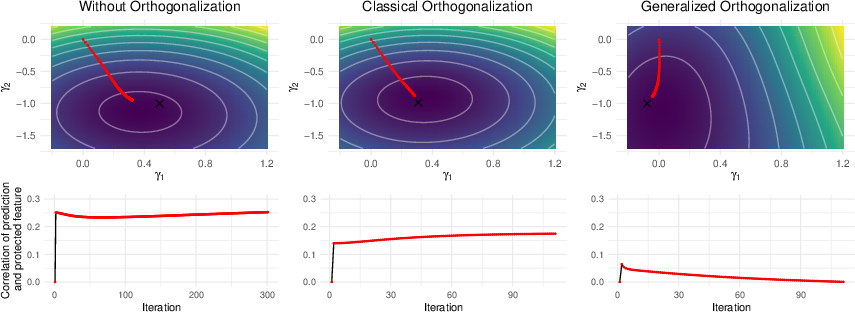
Figure 1: Exemplary optimization process for logistic regression with features, weights, and protected features, demonstrating the path of generalized orthogonalization.
Ensuring Orthogonality
A key development in the paper is the derivation of conditions under which the orthogonalization succeeds in models with non-linear transformations. The authors provide rigorous proofs to demonstrate that their method maintains orthogonality by ensuring that the influence of protected features is nullified post-activation in non-linear settings.
Experimental Validation
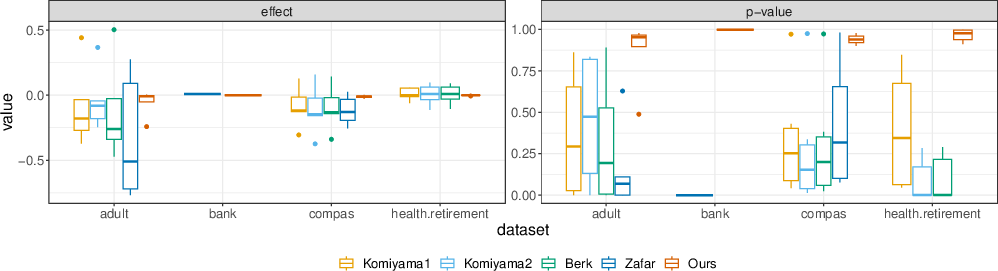
The efficacy of the proposed orthogonalization technique is validated through extensive empirical evaluations. The experiments cover a broad range of applications, including safeguarding sensitive information in Generalized Linear Models (GLMs), normalizing convolutional networks, and correcting pre-existing embeddings.
Key Results
Implications and Future Directions
The research presents significant implications for AI model deployment, emphasizing ethical considerations and the necessity of bias mitigation in sensitive applications like healthcare and automated decision-making. Future research directions include extending the framework to scenarios with multiple interacting non-linearities and exploring its integration with other debiasing techniques.
Conclusion
By generalizing orthogonalization to non-linear models, this paper pioneers a robust strategy to combat the effects of implicit biases in machine learning predictions. The proposed methodology not only enhances the fairness of AI systems but also underscores the importance of methodological rigor in addressing ethical challenges in contemporary AI research.
In conclusion, the paper provides a comprehensive solution to orthogonalization for models with non-linearities, paving the way for more equitable and unbiased AI systems. The method's adaptability and efficiency make it a vital tool for researchers and practitioners striving to uphold fairness in machine learning.