- The paper demonstrates that any coloring of ℝ³ yields either a monochromatic or rainbow acute triangle, extending previous results to lower-dimensional spaces.
- It establishes that for every m there exists an n such that any coloring of ℝⁿ produces either a monochromatic or rainbow m-dimensional unit hypercube, with extensions to maximum norm spaces.
- The paper introduces canonical versions of classical Ramsey theorems, paving the way for future research in geometric and combinatorial coloring problems.
Canonical Theorems in Geometric Ramsey Theory
Introduction to Geometric Ramsey Theory
The paper "Canonical theorems in geometric Ramsey theory" (2404.11454) explores problems related to finding monochromatic or rainbow configurations in Euclidean space when points are colored using a fixed or arbitrary number of colors. Canonical Ramsey theory aims to identify a minimal set of 'unavoidable' colorings for any finite configuration, including both monochromatic and rainbow colorings. The canonical version considers configurations that persist irrespective of the color count.
Key Results
The paper presents two principal results:
- Acute Triangles in Euclidean Space: The authors prove that for any acute triangle T and any coloring of R3, there must exist either a monochromatic or rainbow copy of T. This expands upon existing results by confirming that R3 suffices for such results, improving upon previous work limited to higher-dimensional spaces.
- Unit Hypercubes and Maximum Norms: The paper establishes that for every m, there exists a sufficiently large n such that any coloring of Rn yields either a monochromatic or a rainbow m-dimensional unit hypercube. The authors further extend this finding by proving a more robust statement for maximum norm spaces, showing for every finite set M, there exists an n such that in any coloring of ∞n, there is either a monochromatic or a rainbow isometric copy of M.
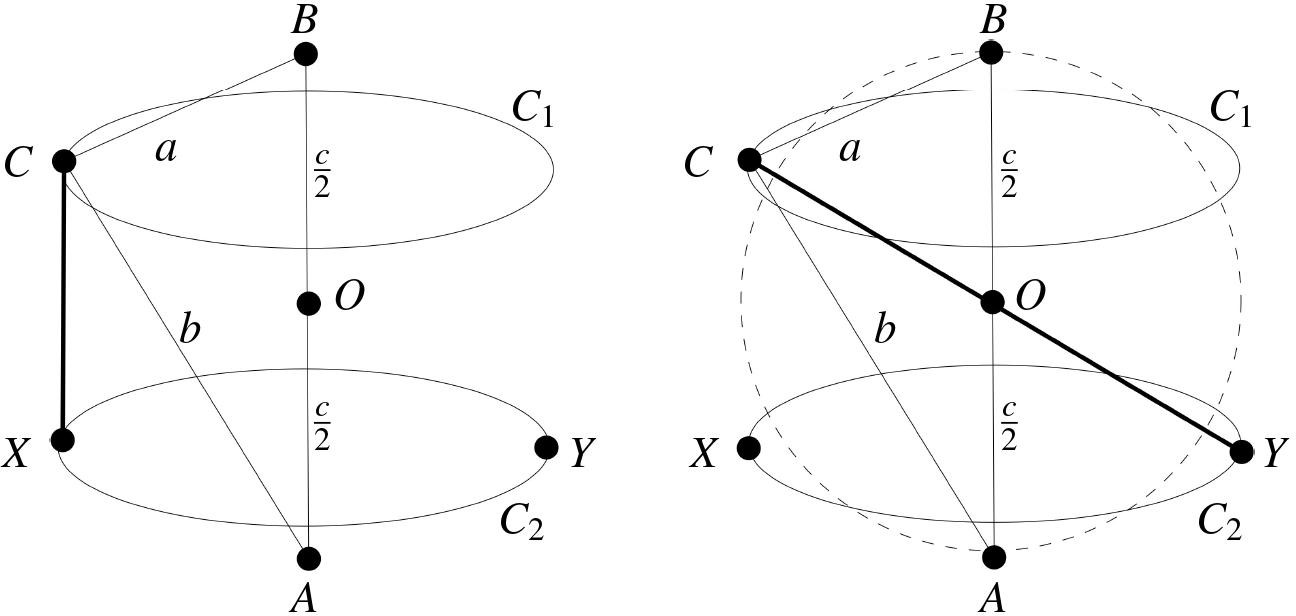
Figure 1: Segment AB is longer than CX and shorter than CY.
Canonical Variants and Theorems
The research explores several canonical variants of existing geometric Ramsey theorems. For example, a canonical version of the van der Waerden theorem is discussed, demonstrating that for any k, there exists n such that every coloring of [n] includes either a monochromatic or rainbow k-term arithmetic progression. This framework extends to other well-known theorems like the Hales-Jewett theorem, showcasing the wide applicability of canonical results.
Advanced Geometric Problems
The geometric problems studied draw upon foundational works, such as those by Erdős and others, and tackle open questions like the Hadwiger-Nelson problem. Despite decades of research, certain definitive answers remain elusive, signaling ongoing challenges in the field.

Figure 2: For A={0,16,20,26}, intermediate points enable mapping of geometric configurations.
Implications and Future Directions
The findings propose significant implications for understanding geometric configurations resistant to color count variations. The introduction of canonical perspectives across varied configurations suggests potential pathways for new research inquiries. There's speculation that all Ramsey sets might satisfy type 2 conditions, yet this remains a hypothesis requiring further exploration.
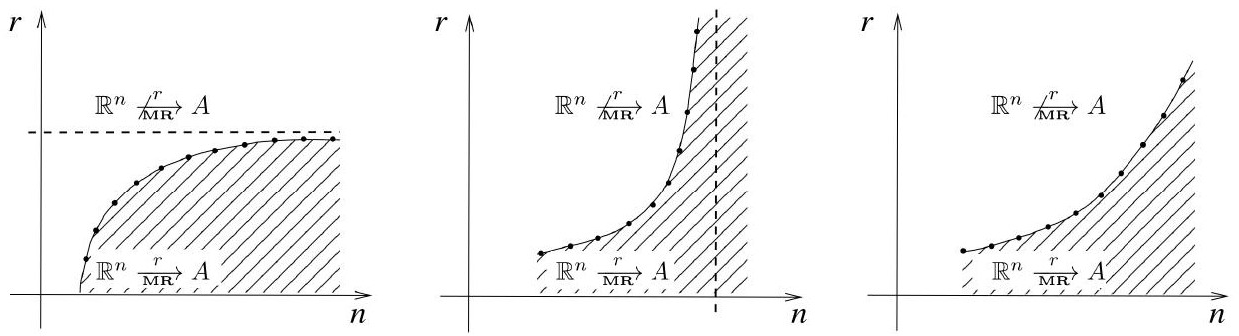
Figure 3: All three possible types of finite sets.
Conclusion
The paper establishes foundational results in the domain of geometric Ramsey theory by confirming canonical theorems applicable within Euclidean spaces. The research opens avenues for further exploration into canonical properties of geometric configurations, suggesting that future work will refine these theorems and potentially uncover new directions in both Euclidean and non-Euclidean geometries. The introduction of the canonical notion provides a robust framework for understanding colorings in geometric and combinatorial contexts.

