- The paper proves that proper PAC learning of free-fermionic states is NP-hard by reducing the learning problem to a nonlinear matrix completion task constrained by Wick’s theorem.
- It shows that NP-completeness persists using limited two-body and four-body correlation data, even under constant additive noise conditions.
- The result distinguishes free-fermionic states from efficiently learnable classes like stabilizer states, impacting quantum device certification and state verification.
NP-Hardness of Proper PAC Learning for Free-Fermionic States
Introduction
This paper, "PAC-learning of free-fermionic states is NP-hard" (2404.03585), presents a comprehensive analysis of the computational complexity of properly PAC-learning free-fermionic (Gaussian) quantum states. Free-fermionic states—encompassing matchgate circuits and efficiently classically simulable fermionic Gaussian states—play a central role across condensed matter, quantum chemistry, and computational quantum information. While the learnability of quantum states under the PAC (Probably Approximately Correct) framework has been previously explored for other tractable classes such as stabilizer and matrix product states, the status for fermionic Gaussian states was fundamentally unsettled. The authors fill this gap by proving that, despite their classical tractability for simulation, the proper PAC-learning task for free-fermionic states is NP-hard.
Problem Formulation and Main Results
The core computational task is as follows: Given a training set comprised of (potentially noisy) estimates of a small subset of Majorana or Pauli correlation functions, determine whether there exists a free-fermionic quantum state consistent with these data within a prescribed tolerance. This is the natural proper PAC-learning analog for free-fermionic states, in which the hypothesis must lie within the class itself.
The central result is that this problem is NP-complete—even when the data set consists only of two-body (i.e., entries of the correlation matrix) and a small number of higher-body (in fact, up to four-body) Majorana expectation values, and even allowing for constant additive noise. Consequently, they prove that no polynomial-time algorithm can perform proper PAC-learning for free-fermionic states unless P=NP. This stands in stark contrast to stabilizer states, for which proper PAC learning is in P with respect to Pauli measurements.
Following their argument, the authors also establish that the related "Gaussian Consistency" problem—deciding whether a set of correlation data is compatible with any Gaussian state—is also NP-complete under the same conditions.
Given a set of partial information (some two-body correlation matrix elements and a few higher-order four-body correlations), the issue of determining whether any free-fermionic state could agree with the data is visualized below.
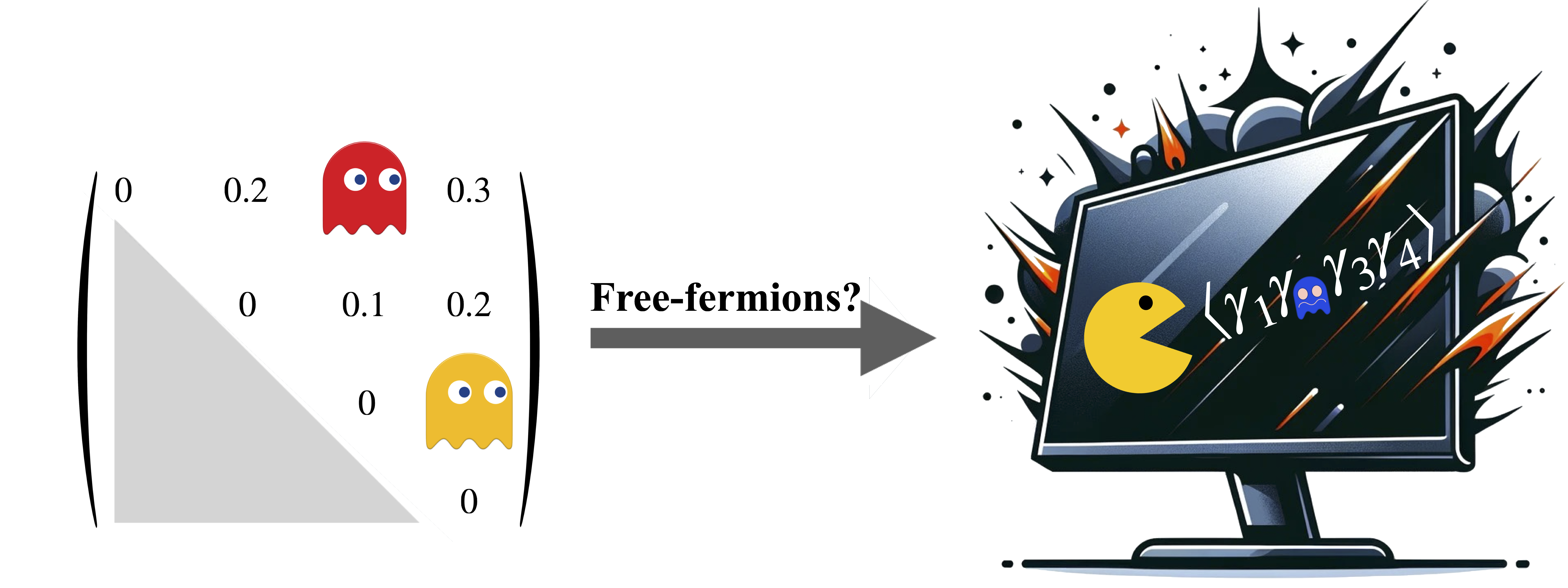
Figure 1: Given partial information about the $2$-body correlation matrix and a few $4$-body correlation functions ⟨γiγjγkγl⟩, determining whether there exists a free fermionic state consistent with the provided data is NP-complete.
Proof Architecture and Technical Insights
The authors' proof proceeds by formalizing the “proper PAC-learning” and “Gaussian Consistency” decision problems. The learning task is recast as a nonlinear matrix completion problem: Can one fill in the unspecified elements of a skew-symmetric correlation matrix (with some of its entries fixed by data), such that all higher-order correlation constraints (imposed by Wick’s theorem) are satisfied, and the complete matrix represents a physical Gaussian state? Crucially, two-point functions set the linear structure (the correlation matrix), but only the inclusion of higher-point (specifically, four-body or greater) correlations enforces the nonlinear Pfaffian constraints that make the problem computationally intractable.
The reduction strategy is as follows:
- Construct an explicit polynomial-time reduction from 3-SAT to the Gaussian Consistency problem, encoding the 3-SAT variables and clauses into the structure of the correlation matrix and the observed correlation functions.
- Show that, if the system of nonlinear constraints imposed by the training set can be satisfied, this is equivalent to finding a satisfying assignment to the 3-SAT instance.
The proof holds even in the presence of constant experimental noise (robustness to errors in the expectation values), reflecting realistic experimental protocols.
A salient aspect of their construction is that, if only two-body functions are involved, the feasibility reduces to a semidefinite program and remains tractable. The intractability emerges entirely from the nonlinear structure of Wick’s theorem when higher-order correlations are present.
Relationship to Prior Work and Complexity-Theoretic Context
This work refines the learnability landscape of quantum state classes under PAC learning. While Aaronson’s original results for learnability of general quantum states [Aaronson, 2007] achieve sample efficiency, the time efficiency question depends crucially on the structure of the state class and the measurement model.
- Stabilizer states: Proper PAC learning (with respect to Pauli or Majorana measurements) is in P, as shown in [rocchetto2018stabiliser].
- Matrix Product States (MPS): Similar tractability holds with low-rank constraints [yoganathan2019condition].
- Free-fermionic states: Despite their classical simulability (efficiently computable marginals, sampling, etc. [Terhal_2002, Jozsa_2008]), proper PAC-learning is shown here to be NP-hard.
These results emphasize that sample efficiency does not imply time efficiency, nor is classical simulability sufficient for efficient proper PAC learning. The authors also show that free-fermionic states violate the so-called “invertibility condition” from prior learnability results [yoganathan2019condition].
The hardness established here is distinct from the QMA-completeness of the N-representability problem [Liu_2007], which restricts to general mixed states. Instead, it arises purely from nonlinear constraints in the free-fermionic manifold.
Implications and Theoretical Consequences
For Quantum Learning Theory
- First negative result for classically simulable quantum states: This is the first known class of states (where marginals and sampling are efficient) for which proper PAC learning is proved NP-hard.
- Robustness to experimental noise and physicality: Intractability persists even with noisy data, making the result highly relevant for benchmarking and verification protocols on near-term quantum devices.
- No improper PAC learning separation is established: The result pertains to “proper” PAC learning—that is, when the hypothesis is restricted to the class. It leaves open whether efficient “improper” PAC learning is possible (e.g., learning with an alternative ansatz).
For Quantum Device Certification
- Hardness of certification/validation: Since verifying whether experimentally obtained data can be explained by a free-fermionic ansatz is NP-hard, scalable certification of physical quantum devices will require protocols that avoid the full proper PAC-learning bottleneck, or restrict to more tractable measurement classes.
- Contrast with property testing and tomography: Several property testing frameworks for pure fermionic Gaussian states are known to be efficient in both sample and computational complexity [Bittel2024testing]. The present task remains hard even in restricted cases, demonstrating a necessary granularity in formulating learning versus testing problems.
Future Directions
The results establish several new directions for theoretical and experimental quantum machine learning:
- Improper PAC learning: Whether improper PAC learning (permitting the hypothesis to lie outside the fermionic Gaussian class) can be achieved efficiently is left as an open problem.
- Other observable classes: It remains to be seen if there exist alternative, physically motivated measurement settings for which proper PAC learning for free-fermionic states may be tractable.
- Intermediate state/class regimes: The learnability of “close-to-stabilizer” states, such as t-doped stabilizer states [leone2023learning], or small stabilizer extent/rank states, is another unexplored territory.
Conclusion
This work provides a definitive complexity-theoretic barrier to proper PAC learning of free-fermionic quantum states, adding substantive nuance to the interplay between simulability, learnability, and certification in quantum many-body science. Proper PAC-learning of free-fermionic states—unlike that of stabilizer or MPS states—is computationally intractable, even with limited, experimentally motivated measurements and moderate noise. The result compels a more detailed taxonomy of learnability for quantum state classes, circumscribes the power of classical post-processing in quantum device characterization, and highlights the subtlety of efficient learning in quantum systems.
References:
- "PAC-learning of free-fermionic states is NP-hard" (2404.03585)
- Aaronson, S. "The learnability of quantum states" [Aaronson_2007]
- Rocchetto, A. "Stabiliser states are efficiently PAC-learnable" [rocchetto2018stabiliser]
- Yoganathan, M. "A condition under which classical simulability implies efficient state learnability" [yoganathan2019condition]
- Terhal, B. M. & DiVincenzo, D. P. "Classical simulation of noninteracting-fermion quantum circuits" [Terhal_2002]
- Jozsa, R. & Miyake, A. "Matchgates and classical simulation of quantum circuits" [Jozsa_2008]
- Liu, Y.-K., Christandl, M., & Verstraete, F. "Quantum Computational Complexity of the N-Representability Problem: QMA Complete" [Liu_2007]
- Bittel, L. et al., "Optimal trace-distance bounds for free-fermionic states: Testing and improved tomography" [Bittel2024testing]
- Leone, L. and Oliviero, S. F. E., "Learning t-doped stabilizer states" [leone2023learning]

