Two-step aging dynamics in enzymatic milk gels
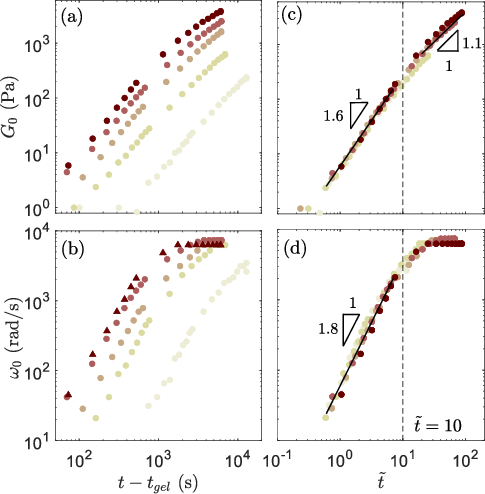
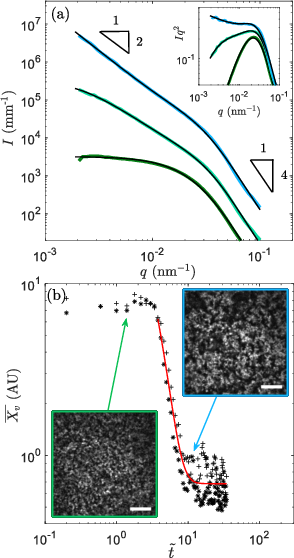
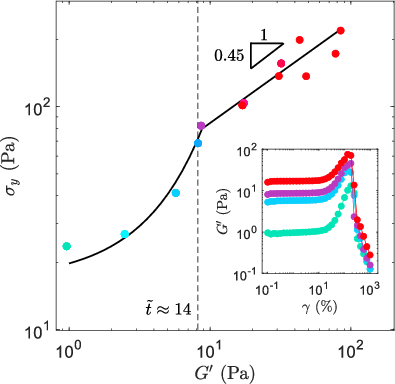
Abstract: Colloidal gels undergo a phenomenon known as physical aging, i.e., a continuous change of their physical properties with time after the gel point. To date, most of the research effort on aging in gels has been focused on suspensions of hard colloidal particles. In this letter, we tackle the case of soft colloidal "micelles" comprised of proteins, where gelation is induced by the addition of an enzyme. Using time-resolved mechanical spectroscopy, we monitor the viscoelastic properties of a suspension of colloidal micelles through the sol-gel transition and its subsequent aging. We show that the microscopic scenario underpinning the macroscopic aging dynamics comprises two sequential steps. First, the gel microstructure undergoes rapid coarsening, as observed by optical microscopy, followed by arrest. Second, aging occurs solely through a contact-driven mechanism, as evidenced by the square-root dependence of the yield stress with the elastic modulus measured at different ages of the gel. These results provide a comprehensive understanding of aging in enzymatic milk gels, which is crucial not only for a broad range of dairy products, but also for soft colloids in general.
- Y. Cao and R. Mezzenga, Nat. Food 1, 106 (2020).
- V. Trappe and D. A. Weitz, Phys. Rev. Lett. 85, 449 (2000).
- E. Zaccarelli, J. Phys. Condens. Matter 19 (2007).
- L.-V. Bouthier and T. Gibaud, J. Rheol. (N. Y. N. Y). 67, 621 (2023).
- J. H. Cho and I. Bischofberger, Phys. Rev. E 103, 32609 (2021).
- G. Ovarlez and P. Coussot, Phys. Rev. E 76, 011406 (2007).
- Y. M. Joshi, Annu. Rev. Chem. Biomol. Eng. 5, 181 (2014).
- C. Holt, Eur. Biophys. J. 50, 847 (2021).
- D. S. Horne and J. A. Lucey, in Cheese Chem. Phys. Microbiol. Fourth Ed., Vol. 1 (Academic Press, 2017) pp. 115–143.
- H. H. Winter and F. Chambon, J. Rheol. (N. Y. N. Y). 30, 367 (1986).
- D. Adolf and J. E. Martin, Macromolecules 23, 3700 (1990).
- C. de Kruif, J. Dairy Sci. 81, 3019 (1998).
- H. H. Winter and M. Mours, “Rheology of polymers near liquid-solid transitions,” in Neutron Spin Echo Spectroscopy Viscoelasticity Rheology (Springer Berlin Heidelberg, Berlin, Heidelberg, 1997) pp. 165–234.
- T. H. Larsen and E. M. Furst, Phys. Rev. Lett. 100, 146001 (2008).
- V. Adibnia and R. J. Hill, J. Rheol. (N. Y. N. Y). 60, 541 (2016).
- R. C. Koeller, Journal of Applied Mechanics 51, 299 (1984).
- A. Jaishankar and G. H. McKinley, Proc. R. Soc. A Math. Phys. Eng. Sci. 469 (2013).
- J. Teixeira, J. Appl. Crystallogr. 21, 781 (1988).
- W. Thielicke and R. Sonntag, J. Open Res. Softw. 9, 1 (2021).
- M. Muthukumar, Macromolecules 22, 4656 (1989).
- D. Vlassopoulos and M. Cloitre, Curr. Opin. Colloid Interface Sci. 19, 561 (2014).
- P. Walstra, J. Dairy Res. 46, 317 (1979).
- S. R. Aragón and R. Pecora, J. Chem. Phys. 64, 2395 (1976).
Paper Prompts
Sign up for free to create and run prompts on this paper using GPT-5.
Top Community Prompts
Collections
Sign up for free to add this paper to one or more collections.